
Could GLP-1 compounding surge in Australia the way it did in the United States? It already did. Between 2022 and 2024, both countries saw it grow at commercial scale at the same time, and both have since shut it down.
That makes the “could it happen here” question less useful than it sounds. The more instructive story is what followed, because it is a clear recent case of revenue resting on a rule the business did not write and could not control.
That pattern is not limited to healthcare. Once you see how two regulators removed the same foundation by two different routes, you can put a consistent set of dependency questions to any company in any sector, using this case as your worked example.
What compounding is for, and how it became something else
Compounding exists for patients that approved medicines cannot serve. You might need an unusual strength, a form you can swallow, or a version free of an ingredient you react to. Pharmacists are permitted by regulators to make these medicines for one patient at a time, without going through the complete approval pathway, so that no one is left without treatment.
The allowance was deliberately small. It was never meant to supply a mass market.
Then demand for GLP-1 receptor agonists outran the supply of approved products. From 2022 to 2024, compounders in both Australia and the US produced their own versions at scale, and direct-to-consumer telehealth businesses built their distribution around those products. In Australia, the Therapeutic Goods Administration (TGA) made clear that its objection was not to pharmacist compounding itself. It objected to supply on a commercial-like scale outside the individual-patient model.
If you want background on reformulation, bioequivalence, the Special Access Scheme or Authorised Prescribers, StockWire X’s 18 September explainer covers those pathways.
When an exemption looks like a business model
While an exemption holds, the numbers can look excellent. Supply is accessible, demand is strong and regulatory cost is low, so the business grows, raises capital and builds customer relationships.
Nothing in the revenue line tells you the foundation is conditional. A business built on an exemption inherits its terms: who may supply, on what conditions and for how long. You have to look past the revenue to see them.
When big ASX news breaks, our subscribers know first
Different rules, different routes, identical result for two regulators
Australia and the US closed the same door with entirely different keys. Follow the dates and the logic becomes plain.
Australia: the exemption was narrowed
In January 2024, the TGA met state and territory Chief Health Officers, Chief Pharmacists and Ahpra, the national health practitioner regulator. The TGA reported unanimous agreement that existing arrangements should be strengthened.
On 29 February 2024, the TGA opened a consultation proposing to remove GLP-1 receptor agonists from the pharmacist extemporaneous compounding exemption. Its stated reasons were that these are sterile, high-risk products, that ingredients could be unknown or unsuitable, that supply went beyond the individual-patient model, and that the products had received no TGA assessment of safety, quality or efficacy.
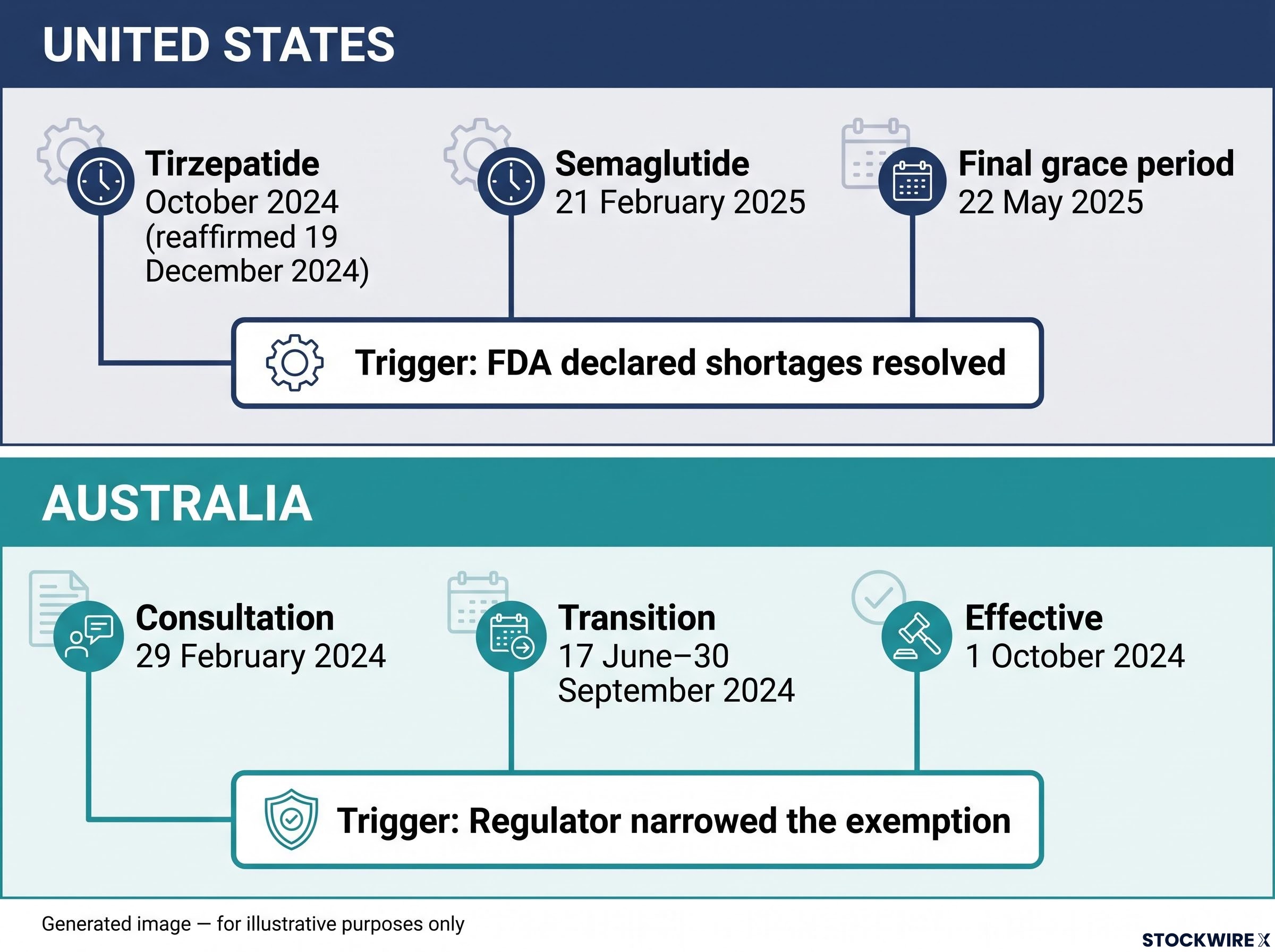
A transition period ran from 17 June to 30 September 2024. From 1 October 2024, compounding these medicines was not permitted in any dosage form, and civil and criminal penalties may apply under the Therapeutic Goods Act for unlawful manufacture or supply. Affected businesses had a fixed date to stop.
United States: the shortage ended
The US route ran through a different rule. Compounders there may prepare copies of drugs on the Food and Drug Administration (FDA) shortage list, so the allowance lasted only as long as the shortage did.
The FDA removed tirzepatide from shortage in October 2024, reaffirming that decision in a formal declaratory order on 19 December 2024. Semaglutide’s shortage was resolved on 21 February 2025. State-licensed pharmacies had until 22 April 2025 and outsourcing facilities until 22 May 2025 to wind down. Industry court challenges did not obtain the preliminary injunctions they sought.
On 30 April 2026, the FDA went further and proposed excluding semaglutide, tirzepatide and liraglutide from the bulk substances list for 503B outsourcing facilities, which are larger compounders registered with the FDA. The proposal was published on 1 May 2026 (91 Fed. Reg. 23431), and the comment period, extended to 30 July 2026, has closed. It remains a proposal, not a final rule. The FDA’s compounding page, updated 2 October 2026, showed no final determination. It also does not, by itself, end patient-specific compounding under section 503A.
| Country | Mechanism | Trigger for ending | Key dates |
|---|---|---|---|
| Australia | Standing pharmacist compounding exemption | Regulator narrowed the exemption | Consultation 29 February 2024; transition 17 June-30 September 2024; effective 1 October 2024 |
| United States | Temporary shortage-based allowance | FDA declared shortages resolved | Tirzepatide October 2024 (reaffirmed 19 December 2024); semaglutide 21 February 2025; final grace period 22 May 2025 |
Built to persist, or built to expire
One country removed a standing exemption. The other watched a temporary condition lapse.
The common thread: The mechanisms were completely different, but in both countries the businesses relying on them had no say in when the revenue foundation disappeared.
The US detail is the more revealing one. The shortage provision was temporary by design, because shortages end. Some regulatory foundations are built to persist and others to expire, and the rule itself usually tells you which you are looking at.
So the date a revenue stream ends may be set by a regulator, a supply condition or a court. It is never set by the company.
Rules can also erode an asset over time rather than ending revenue on a single date; you can see regulatory risk to a moat in cases where mandatory deletion sweeps and consent rulings steadily shrink the data a business depends on.
The TGA’s attention has not stopped at GLP-1s either. Its 9 April 2026 safety alert and its “Peptide product information for health practitioners” guidance, updated 5 October 2026, state that unapproved peptide products have not been assessed for safety, quality or effectiveness, and that the onus sits with the practitioner. That is a regulator watching the next category closely.
Five questions to ask of any company that depends on a rule
Shortage exemptions are one kind of foundation among many. Transitional arrangements, grandfathering provisions, temporary tariff relief, grant programmes and licensing concessions can each hold up a revenue line. Think of a manufacturer whose margin depends on temporary tariff relief, or a developer funded partly by a grant that must be renewed.
The same logic applies well beyond healthcare: regulatory risk investing shows up whenever pricing power is written into rules rather than earned, and a single regulator can remove that advantage without any earnings miss to warn you.
Before you rely on any growth story, put these five questions to it:
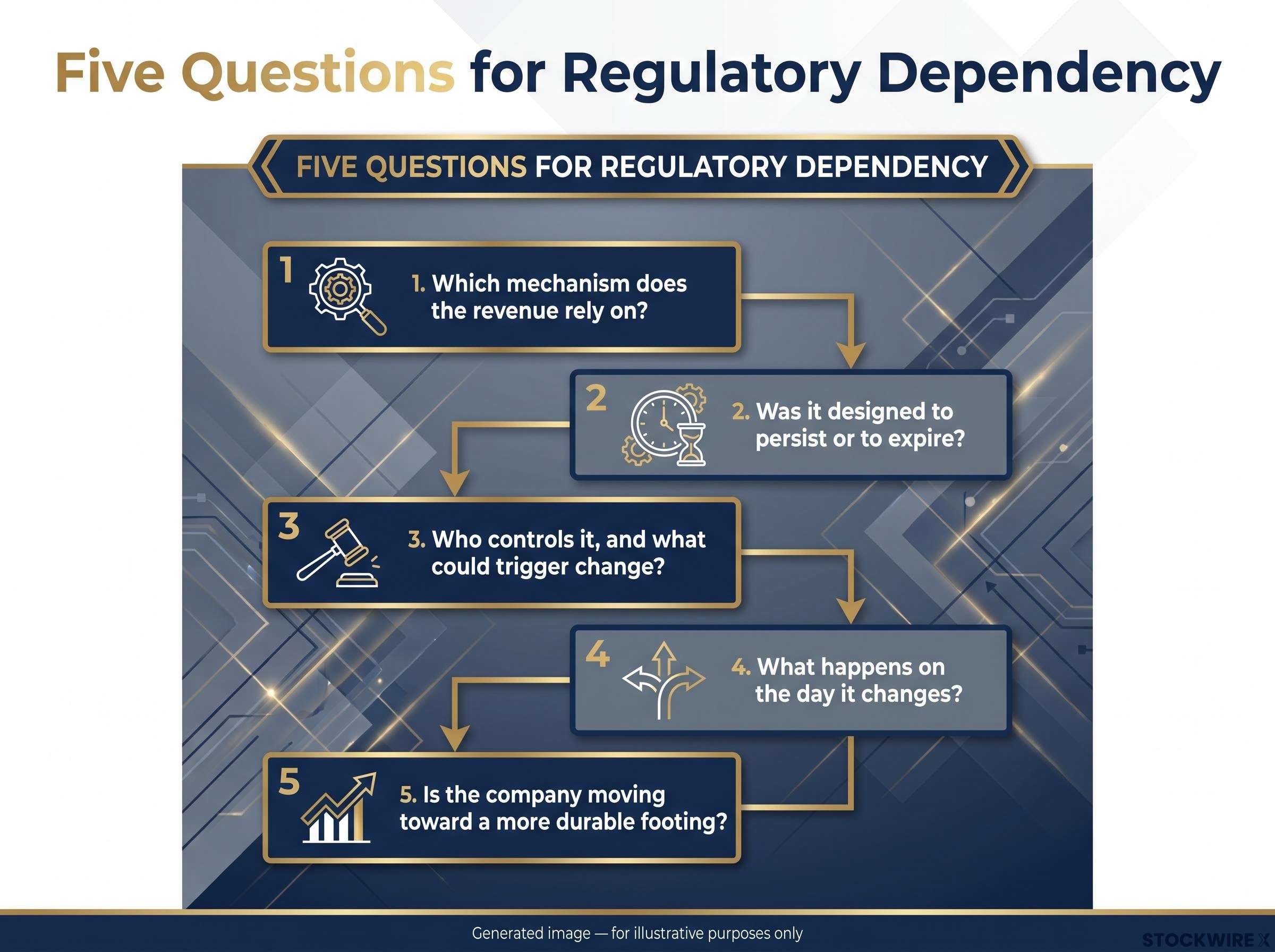
- Which mechanism does the revenue rely on? Check whether the company discloses it in announcements or whether you have to infer it.
- Was it designed to persist or to expire? The wording of the rule usually answers this.
- Who controls it, and what could trigger change? That could be a regulator, minister, court, supply condition or political decision.
- What happens on the day it changes? Look for a transition path to something more durable, or recognise that revenue may simply stop.
- Is the company moving toward a more durable footing? A mechanism treated as a stage with a stated destination differs from one treated as the business itself.
| Mechanism | Typical design intent | What to check |
|---|---|---|
| Shortage exemptions | Designed to expire | How shortage status is decided and how long wind-down lasts |
| Transitional arrangements | Designed to expire | The end date and what replaces the arrangement |
| Grandfathering | Usually persists for an installed base, under conditions | Which products, licences or customers are protected, and on what terms |
| Tariff relief, grants, licence concessions | Generally expire unless renewed | Renewal timing, eligibility rules and political exposure |
Most mechanisms sit somewhere between the extremes. The quality of a revenue line depends not only on its size but on what it is standing on, and these questions let you test that.
One ASX company applying the fifth question to itself
EVE Health Group (ASX: EVE) offers a live example. The company has stated in its ASX announcements that it provides its products as unapproved medicines under TGA-authorised frameworks instead of relying on the compounding exemption, and that full registration is something it plans to seek.
Different access mechanisms carry different properties. A company with a stated route to registration is putting the fifth question to itself, and you can check that destination in its announcements. StockWire X’s 18 September piece explains those pathways.
No access pathway is immune from regulatory change.
Limits of the lesson: what this story does not show
It would be easy to take this too far. Keep these points in view:
- Compounding remains lawful and clinically important for individual patients whose needs approved products cannot meet.
- Regulators gave stated reasons, including patient safety and resolving supply shortfalls. Others disagreed: the Outsourcing Facilities Association argued the FDA disregarded evidence of continuing access problems, the Alliance for Pharmacy Compounding said the 2026 proposal largely reflected existing legal status while preserving 503A compounding, and the Consumers Health Forum in Australia argued patients with genuine need should keep access.
- Some businesses transition successfully. Compounding pharmacies, digital prescribing providers, pharmaceutical developers and contract manufacturers can move onto approved or durable pathways.
- Dependency is a spectrum. Every pharmaceutical business relies on regulators to some degree.
What matters is degree, mechanism and fallback. The right response is a sharper question, not blanket suspicion.
The APC statement on the proposal stresses that it applies to 503B outsourcing facilities and that the association will submit comments, which is why you should treat it as a proposed change, not a final rule.
What a rule you did not write can cost, and how to see it coming
“Could it happen here” sounds like a request for a forecast. The answer sits in the recent past, and it is more useful than any prediction: it demonstrates how rapidly a regulatory foundation can disappear, how little notice the revenue line offers, and how two regulators can arrive at the same outcome by quite different paths.
Having followed both stories, you can ask a sharper question of any company whose growth depends on a rule it did not write, whatever its sector.
For readers wanting a sector far from healthcare, our deep-dive into AI regulatory risk shows how valuations can reprice before earnings change.
This article is for informational purposes only and should not be considered financial advice. Investors should conduct their own research and consult with financial professionals before making investment decisions. Regulatory proposals referred to are subject to change.
StockWire X has a commercial relationship with EVE Health Group Limited (ASX: EVE).
—