
Most investors assume a currency weakens because its economy does. The Swedish krona is challenging that assumption. Nordea has abandoned its long-held bullish view on the krona and moved to neutral, raising its three-month EUR/SEK forecast to 11.15, almost exactly where the European Central Bank (ECB) reference rate sat on 16 October 2026 at 11.1450.
The krona’s problem is not Sweden’s economy.
A bank that spent months expecting the currency to appreciate has now conceded the move did not arrive. The forces behind that failure (interest rate gaps, oil prices and nervous global money) also reach anyone holding euro, Nordic or carry-trade exposure.
Three questions shape the Swedish krona outlook from here: why the call failed, what it means for the krona to act as a funding currency, and which conditions would have to change before it recovers.
Why did Nordea’s krona call fail?
What Nordea expected
Nordea’s earlier position rested on Sweden itself. Its strategists expected the krona (SEK) to strengthen gradually as domestic conditions improved. As recently as 21 September 2026, Nordea Markets’ strategy still described a neutral EUR/SEK in the short term with gradual SEK appreciation over the medium term, although it warned that near-term weakness could continue.
What changed
Within four weeks, the medium-term optimism was gone. According to Placera, which reported the shift on 16 October 2026, Nordea raised its three-month EUR/SEK forecast to 11.15 and expects that level to persist through the end of 2028. The primary Nordea client note is not fully accessible publicly, and a relay by FXStreet gave no forecast horizon, so the figures here rest on Placera’s account.
The ECB reference rates for 16 October put EUR/SEK at 11.1450, which sits almost exactly on Nordea’s new three-month forecast of 11.15 and shows how quickly the market had already moved.
Nordea’s verdict: the krona strengthening it had anticipated “has not materialised.”
Nordea pointed to five pressures:
- Risk-averse flows linked to the Middle East
- Strong performance in US technology shares
- A Riksbank trailing the ECB on policy
- The “Scandie trade” favouring the Norwegian krone (NOK)
- SEK being used as a funding currency
These are not five separate stories. Risk aversion feeds the funding role, the rate gap feeds the Scandie trade, and US tech strength pulls capital away from smaller markets.
Only one of the five, the Riksbank’s policy stance, sits inside Sweden. The rest are global.
That is the lesson for you. If a major Nordic bank can hold a bullish view for months on solid domestic reasoning and still be wrong, a “cheap on fundamentals” argument alone is not a reliable guide to where the krona goes next.
When big ASX news breaks, our subscribers know first
What does it mean for the krona to be a funding currency?
How the carry trade works
A funding currency is one that investors borrow because it is cheap to borrow, then sell to finance purchases elsewhere. A carry trade is the strategy that uses it: borrowing in a low-interest currency to invest in a higher-yielding one and pocketing the difference.
The sequence runs in four steps:
- Borrow SEK at the Riksbank’s low rate of 1.75%.
- Sell the SEK.
- Buy higher-yielding currencies or assets, including NOK.
- Earn the interest gap, as long as exchange-rate losses do not wipe it out.
Every step two is a sale of krona. When enough investors repeat it, the selling becomes a steady weight on the currency.
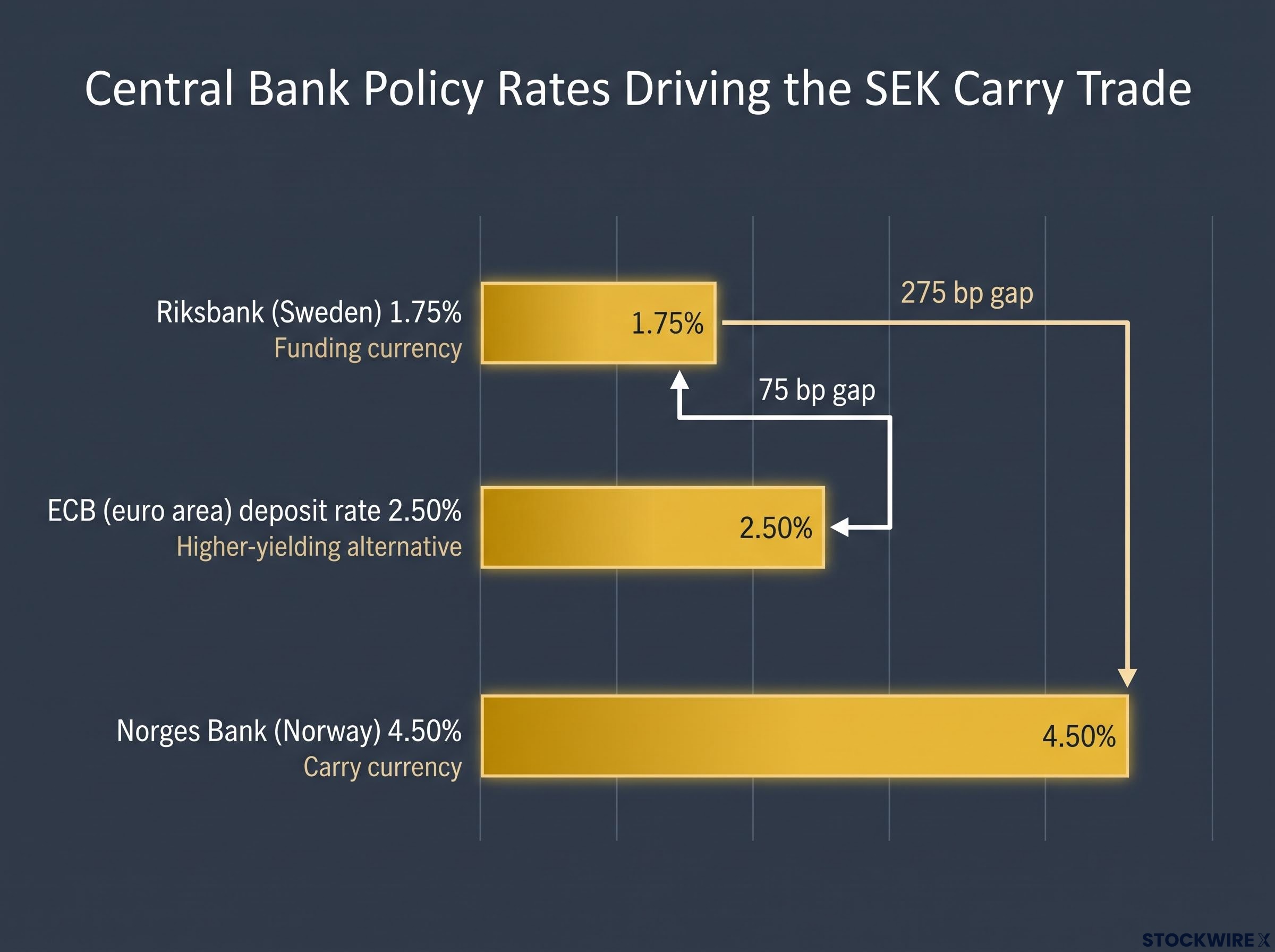
The current rate settings make the trade attractive. The ECB raised its deposit rate (the rate it pays banks on overnight deposits) by 25 basis points to 2.50% on 10 September 2026, while the Riksbank held at its September meeting.
| Central bank | Policy rate | Gap versus Riksbank | Role in trade |
|---|---|---|---|
| Riksbank (Sweden) | 1.75% | None | Funding currency |
| ECB (euro area, deposit rate) | 2.50% | 75 bp | Higher-yielding alternative |
| Norges Bank (Norway) | 4.50% | 275 bp | Carry currency |
The 75 bp gap with the ECB has been described as unprecedented. The 275 bp gap with Norway places SEK and NOK on opposite sides of the same trade.
Norges Bank’s surprise hike to 4.50% in September widened the gap to Sweden and repriced the expected path toward a plateau through late 2027, which strengthens the carry case for NOK.
Why risk-off makes it worse
SEK is small, liquid and cyclical, which makes it easy to sell when markets turn nervous. In geopolitical stress, investors cut leveraged positions, trim smaller European currencies and buy dollars. Each of those actions pushes EUR/SEK higher.
The yen and Swiss franc show the other side. Both have served as funding currencies, and both have surged sharply when carry trades were unwound in market stress. SEB has warned that SEK could revert to that funding role if the Riksbank lags other central banks.
The takeaway: a funding currency moves on financing decisions and global risk appetite. Swedish data alone will not tell you where the krona goes.
Why has the Norwegian krone won the Scandie trade, and who still disagrees?
Norway’s built-in advantage
The two Scandinavian currencies sit on opposite ends of the oil price. On 16 October 2026, the ECB reference rates put EUR/SEK at 11.1450 and EUR/NOK at 10.6240, with Brent crude at about US$105.285 per barrel, according to Trading Economics.
- Norway (net exporter): higher oil lifts petroleum revenue and improves its terms of trade, meaning its export prices rise relative to its import prices.
- Sweden (net importer): higher oil inflates the import bill and worsens the inflation outlook.
Add Norway’s 4.50% policy rate and the Scandie trade writes itself: buy NOK for carry and oil exposure, sell SEK for its weaker yield. SEB has argued that central-bank divergence is now replacing oil sensitivity as the dominant driver between the two. BNP Paribas, in June 2026, pointed to NOK’s high-yield status and favourable terms of trade while oil stays elevated.
Where the banks disagree
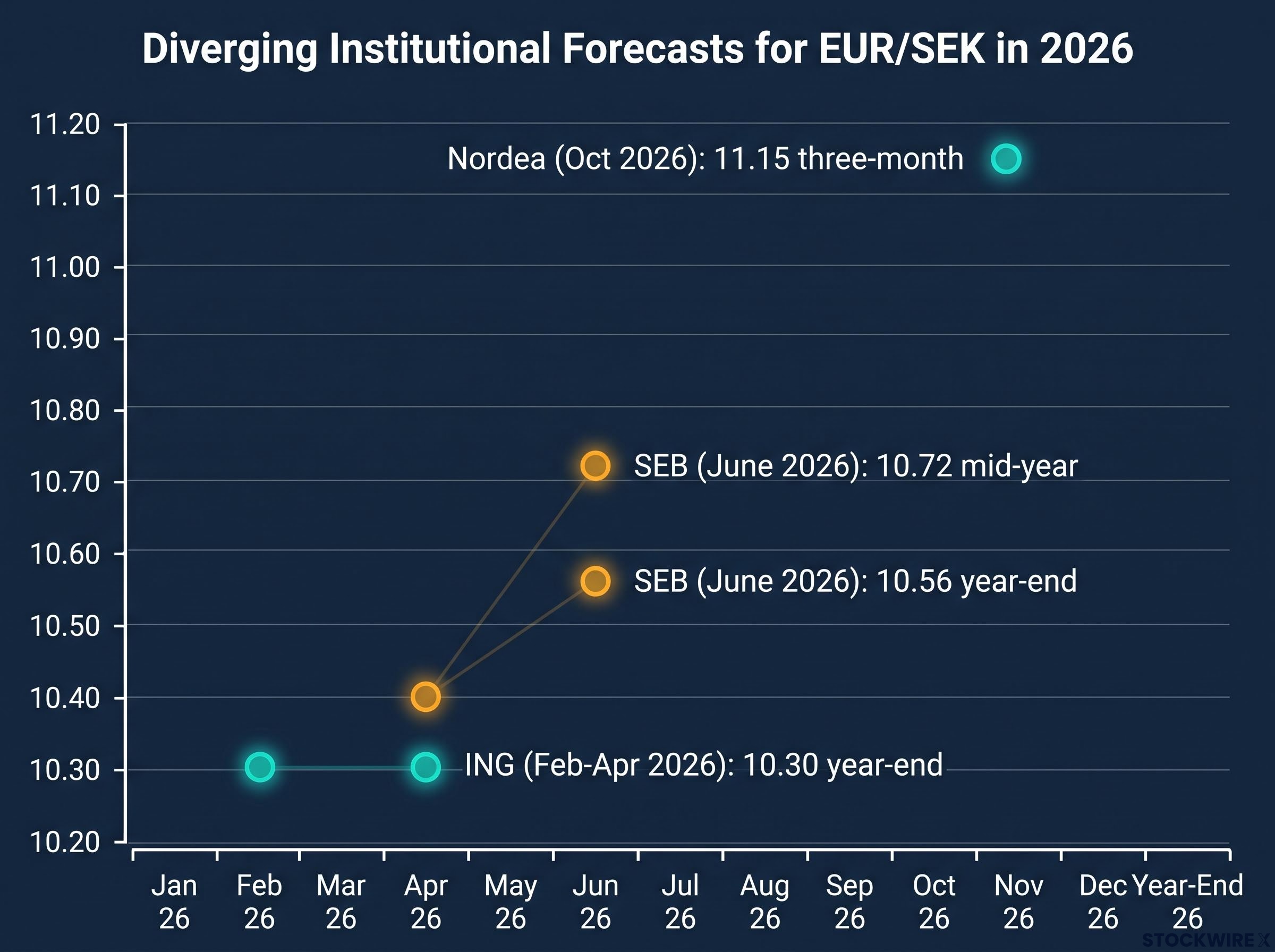
The banks themselves are split into two camps. Convergence bulls expect Swedish growth, fiscal strength and eventual Riksbank hikes to lift SEK. Carry-and-risk analysts argue the rate gap and energy prices will keep it under pressure.
| Institution | Timing | EUR/SEK view | Core reasoning |
|---|---|---|---|
| ING | Feb-Apr 2026 | 10.30 year-end | Stronger growth, attractive fiscal profile, no further Riksbank cuts |
| SEB | June 2026 | 10.72 mid-year, 10.56 year-end | Fiscal policy and capital moving from the US to Europe |
| SEB (later research) | June 2026 | More cautious | Rate divergence could restore funding-currency status |
| Danske Bank | Sept 2026 | Weakness acknowledged | Weak SEK, high oil and rate spread pushing EUR/SEK higher |
| Nordea | Oct 2026 | 11.15 three-month | Risk-off flows, US tech, policy divergence, Scandie trade |
The spread from 10.30 to 11.15 is information in itself. It tells you how uncertain the outlook remains, and that no single bank’s number should be treated as settled.
What would revive the Swedish krona, and how likely is it?
Nordea’s three conditions
Nordea has set out what it would take for SEK to strengthen again: lower oil prices, easing inflation pressure and lower global short-term interest rates. None of the three is under Sweden’s direct control.
What else could shift the picture
The wider research extends the list. Ordered from Nordea’s conditions outward, the revival watchlist reads:
- Lower oil prices
- Easing inflation pressure
- Lower global short-term rates
- Calmer geopolitics
- A narrowing ECB-Riksbank spread
- Stronger Swedish growth and fiscal outperformance
The Riksbank itself has left the door open on the fifth point.
Riksbank guidance (24 September 2026): rates could begin rising during 2026, with faster tightening if the inflation upturn proves more persistent.
That matters because positioning can turn quickly. If the market is heavily short SEK and the Riksbank turns hawkish, short covering could drive a rapid rebound. A reversal in oil would erode Norway’s terms-of-trade edge, and a recovery in risk appetite could revive demand for cyclical European currencies.
The evidence points to weakness that is mostly cyclical: Middle East risk, oil, US equity outperformance and carry flows can all fade. The stubborn element is the policy-rate disadvantage, which persists only as long as the Riksbank stays behind.
The stubborn part of the krona’s weakness may owe something to a structural decline in Sweden’s neutral rate, which would mean the Riksbank’s 1.75% is already close to where policy settles and the gap with the ECB closes slowly.
The funding-currency precedents carry a warning in both directions. A currency can look cheap and keep weakening, then appreciate sharply once the gap narrows. For you, the variables to track are oil, geopolitics and the Riksbank-ECB gap, not Swedish headline data.
Past performance does not guarantee future results. Forecasts are subject to market conditions and various risk factors, and forward-looking views may change as conditions develop.
What the neutral call changes, and what it leaves open
Nordea’s shift to neutral reflects uncertainty, not a bearish conviction. The krona is being driven by rates, oil and risk appetite rather than by Swedish fundamentals, and the banks remain divided on how long that lasts.
Three variables give you the clearest read:
- Oil: a sustained fall would weaken Norway’s advantage and ease Swedish inflation.
- The ECB-Riksbank gap: narrowing would erode SEK’s appeal as a funding currency.
- Risk sentiment: calmer markets could trigger short covering and a fast rebound.
The nearest test is the Riksbank’s next decision and the guidance that accompanies it. A clear move toward tightening would challenge the funding-currency story directly.
This article is for informational purposes only and should not be considered financial advice. Investors should conduct their own research and consult with financial professionals before making investment decisions.