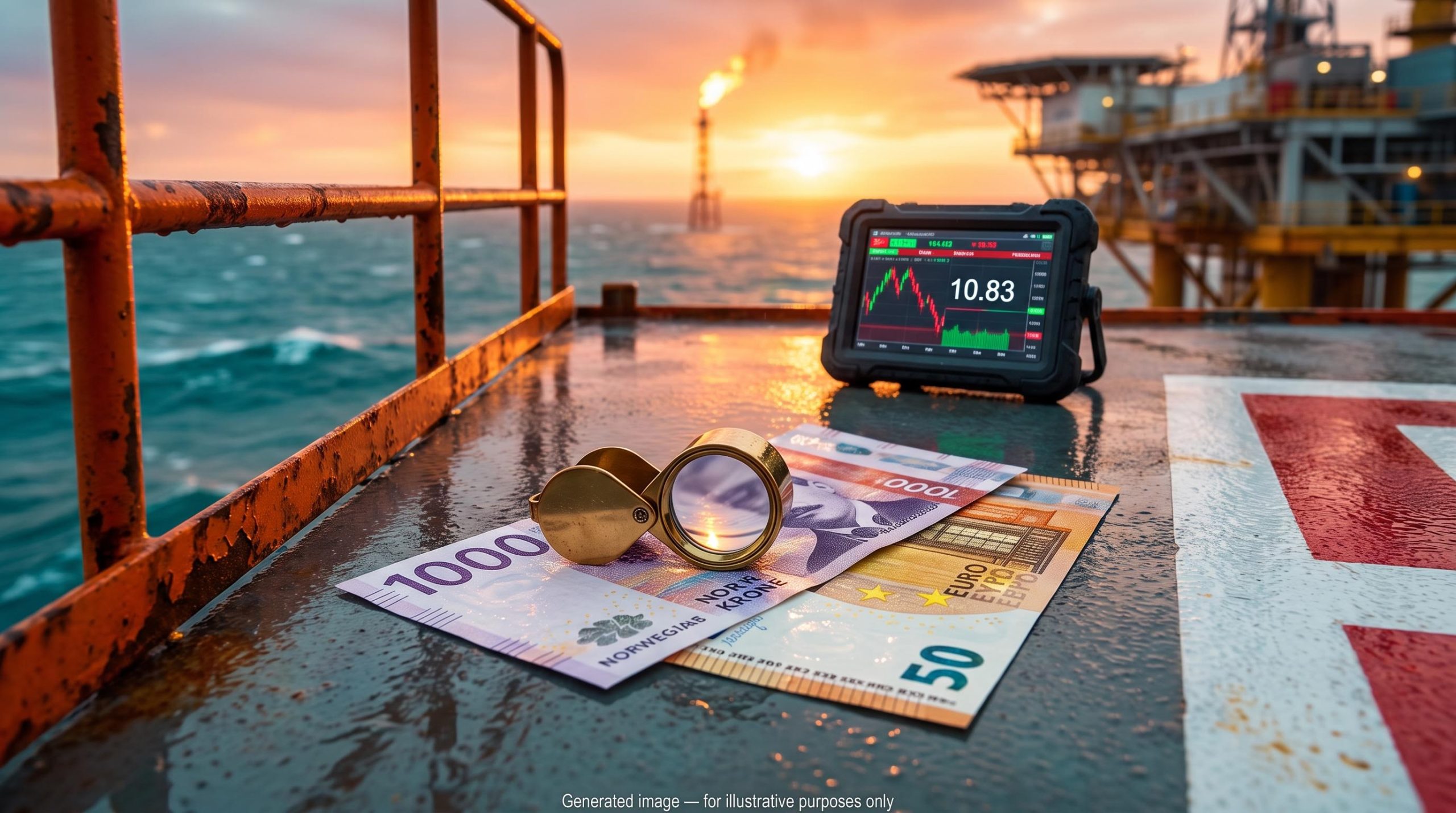
The krone is trading near 10.83 per euro, and the headline call from Nordea says it should reach 10.50 within three months. That is a strong signal for any EUR/NOK forecast, but it may be the wrong number to anchor on. Nordea’s own latest published path is noticeably more cautious than the target circulating in market coverage.
The pair sits where three forces meet. Norges Bank’s policy rate of 4.50% stands about 200 basis points above the European Central Bank (ECB) deposit rate of 2.50% (a basis point is one-hundredth of a percentage point). Brent crude is near $107 a barrel, and French fiscal stress keeps unsettling European risk appetite.
Most forecasters agree on where the krone is heading. They disagree on how fast it gets there.
The sections below show which of these drivers deserve the most weight, and how far you can trust the aggressive targets compared with the most recent published numbers.
What is Nordea actually forecasting for the krone, and how firm is the call?
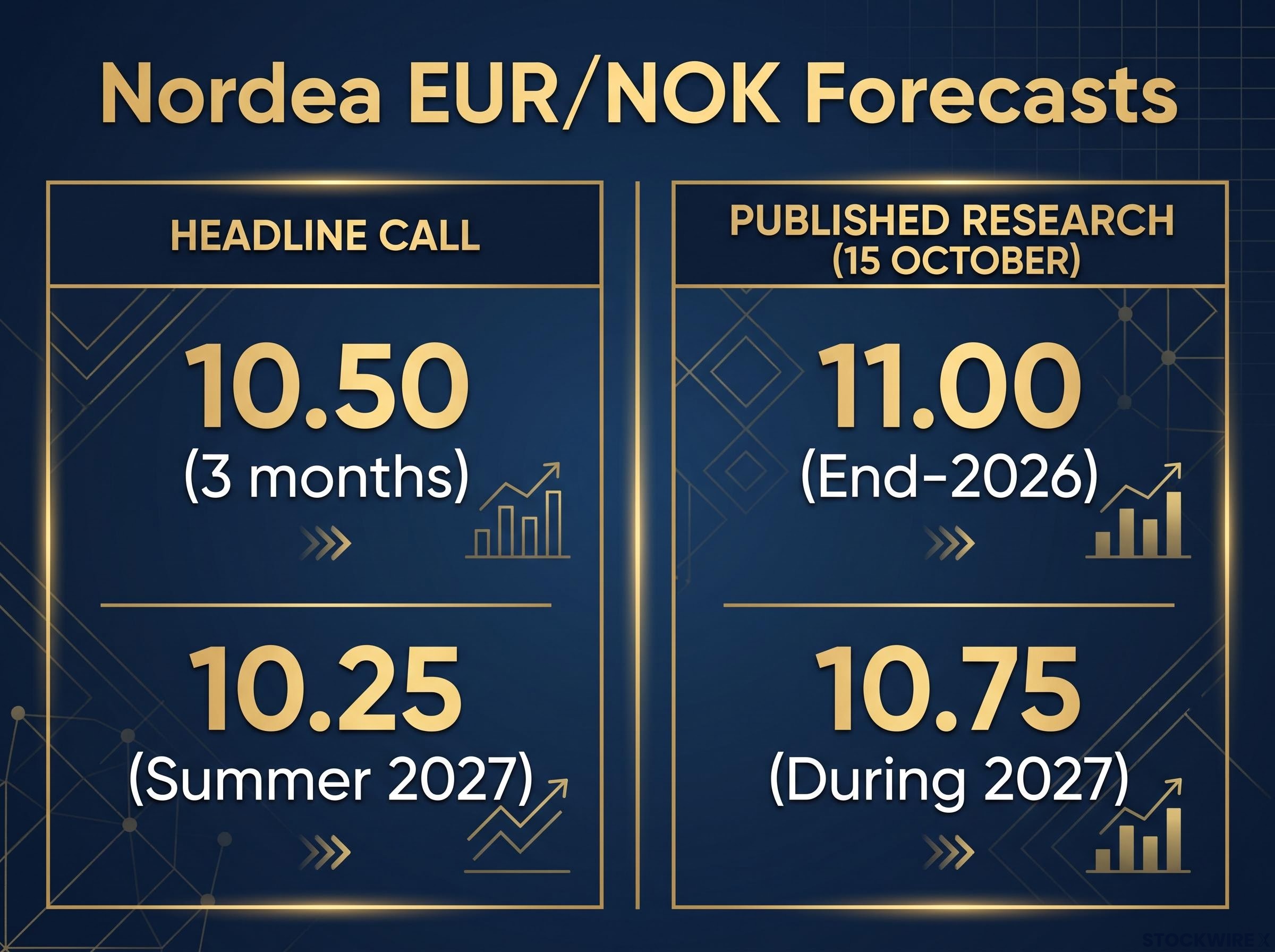
The headline version is bold. Market coverage reported Nordea strategists expect EUR/NOK at 10.50 within three months and 10.25 by summer 2027, against an ECB reference rate of 10.8315 on 15 October 2026. A falling EUR/NOK means each euro buys fewer kroner, so the krone is strengthening.
The case rests on Norway’s strong public finances, its interest-rate advantage over the euro area, and oil prices that Nordea expects to stay firmer for longer than markets currently price in.
Then the published research arrives. Nordea’s latest forecast, dated 15 October, points to EUR/NOK around 11.00 at end-2026 before easing toward 10.75 during 2027. That implies the krone weakens slightly before it recovers.
| Forecast version | Horizon | EUR/NOK level |
|---|---|---|
| Headline source claim | 3 months / summer 2027 | 10.50 / 10.25 |
| Nordea, 14 August | 6 months | Broadly stable, gradual NOK gains in 2027 |
| Nordea, 2 September | Successive forecast periods | 11.00, 10.75, 10.75 |
| Nordea, 15 October | End-2026 / 2027 | About 11.00 / about 10.75 |
The sources conflict, and the research does not resolve the gap. Each published Nordea view since August has pointed to patience rather than a sharp move, with longer-term support credited to a weaker US dollar, better external conditions and structural krone flows.
Conflict note: The two versions differ on pace and magnitude, not direction. Both expect the krone to strengthen over time.
The gap between 10.50 and roughly 11.00 tells you the headline figure works best as a best-case marker. Anchor on the direction and treat the speed as genuinely uncertain.
When big ASX news breaks, our subscribers know first
How do rate gaps and oil prices move a currency pair?
Two engines drive most of the krone’s story. To read the outlook well, you need to know how each one works and when it stalls.
The rate differential channel
Carry is the return an investor earns by holding a higher-yielding currency funded by a lower-yielding one. With Norges Bank at 4.50% and the ECB deposit rate at 2.50%, holding kroner pays more than holding euros.
What matters, though, is the expected path of rates rather than today’s level. Norges Bank has signalled rates will stay high for longer, with another hike not its central scenario but not ruled out. The ECB raised by 25 basis points on 10 September, an October pause was expected, and a December hike remains possible.
A EUR/NOK forecast is only half the picture, since what drives the euro (ECB guidance, HICP inflation and trade balances) moves the other side of the pair just as much as anything happening in Oslo.
One detail is unresolved. The original source dates the Norges Bank move to September, while later research places it on 15 October 2026; the 4.50% level is consistent across both.
A rate gap can fail to lift a currency when:
- Markets expect the gap to narrow, for example through ECB catch-up hikes
- High rates reflect domestic weakness or stress rather than strength
- Risk aversion overwhelms the extra yield on offer
If you hold euro-based exposure to the krone, the spread is a tailwind only while markets believe it will last. ECB and Norges Bank guidance will tell you more than the headline gap.
The oil and tax channel
Norway is a major net energy exporter, so higher prices lift export revenue, corporate cash flow and tax receipts. Petroleum companies also need kroner to pay Norwegian taxes, which creates direct demand for the currency.
According to the International Energy Agency (IEA), Brent futures have climbed about 13% since early September. The precedent is encouraging: in 2022, with Brent above $110, EUR/NOK fell from about 10.7 to 9.7.
Why does Norway’s position outside the euro matter, and what do official flows add?
The structural story is reassuring. Because Norway stands outside the monetary union, investors need not worry about the eurozone’s bond markets fragmenting, and Norwegian debt is not measured against Bunds. The state also has no pressing financing requirement to protect.
Official flows add a second layer. When the government needs kroner to cover its non-oil deficit, Norges Bank buys the currency. Norges Bank itself reports the krone appreciated alongside higher oil and gas prices.
Here the mechanics turn less obvious. Stronger petroleum-tax receipts mean the state needs fewer transfers from the sovereign wealth fund, which can reduce official krone buying.
The flow swing: Nordea reported Norges Bank purchases of about NOK 600m per day in one 2026 analysis, warning they could fall to roughly NOK 150-200m per day on stronger petroleum-tax receipts.
The balance looks like this:
- Supports: strong public finances, no euro fragmentation exposure, petroleum-tax demand for NOK, official purchases
- Offsets: fewer purchases as tax receipts rise, and the wealth fund’s foreign investment creating demand for other currencies
The same oil rally that helps the krone can quietly trim one of its supports. Commerzbank’s Antje Praefcke calls the outlook mildly positive, with oil and gas still the primary driver. The safe position is real, but it does not shield the krone from everything.
What could stall the krone, from French risk-off to an oil reversal?
The near-term threat comes from Paris, not Oslo. Its impact depends on how investors behave when fear rises.
The near-term French shock
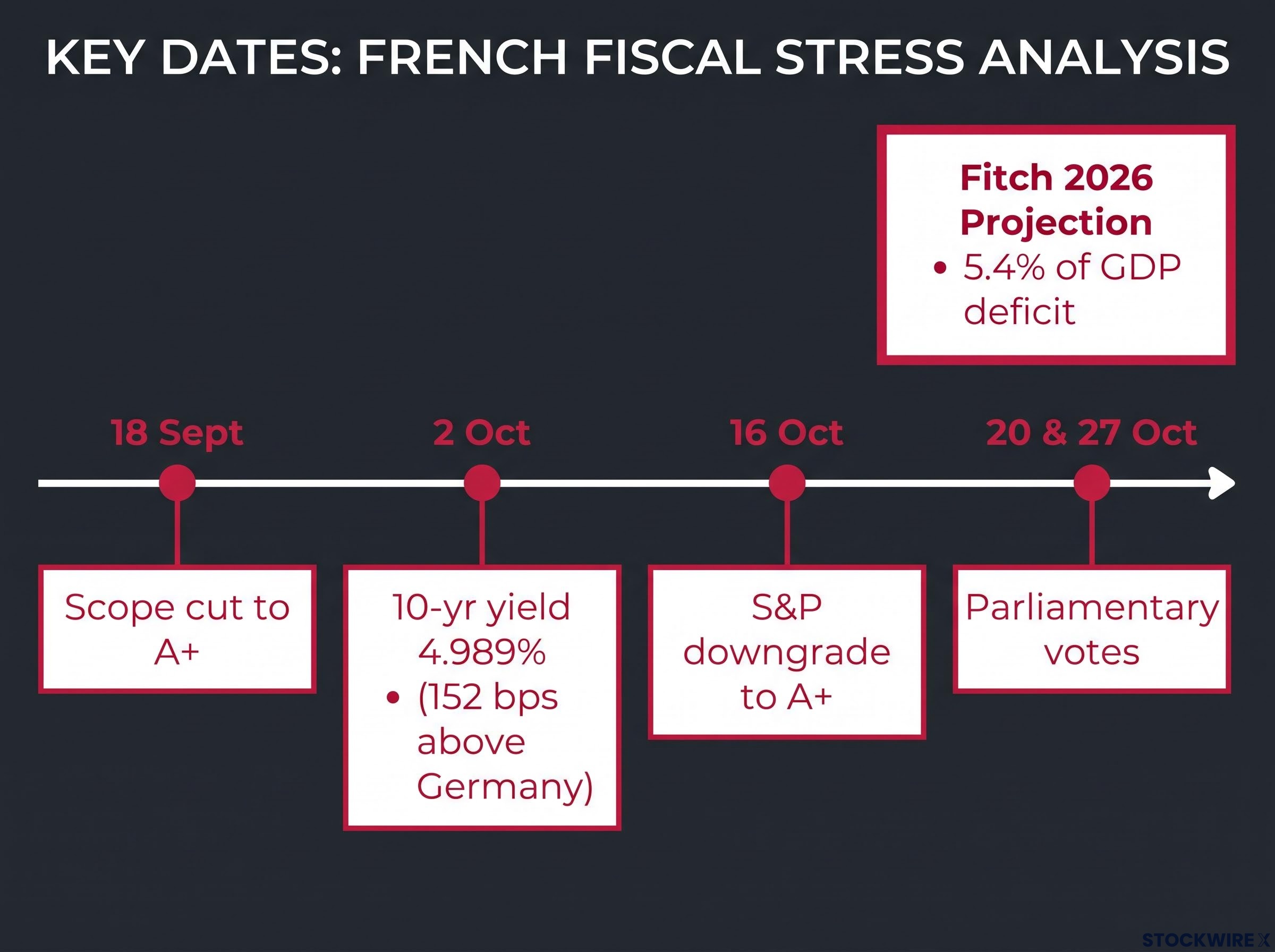
Scope cut France to A+ on 18 September. On 2 October the French 10-year yield hit about 4.989%, roughly 152 basis points above Germany’s, the widest gap since the 2011 euro-area debt crisis. Fitch projects a 2026 deficit of 5.4% of GDP, and S&P is reported to have downgraded France to A+ on 16 October.
Parliamentary votes on 20 and 27 October are the next flashpoints. In risk-off episodes, investors favour dollars, euros, Swiss francs and bonds, and they sell small, cyclical currencies like the krone regardless of Norway’s fundamentals.
You should treat French headlines as a timing risk for krone entries rather than a verdict on Norway.
The risks that change the thesis
Oil is the bigger question. The US Energy Information Administration (EIA) expects Brent to average $87 in Q2 2027 and $74 in Q4 2027, while Norges Bank expects weaker global petroleum investment to damp exports. Danske Bank and SEB are more cautious than Nordea, citing higher global real rates, oil normalisation and possible Norges Bank cuts.
The oil tailwind looks less secure once you recognise Brent’s strength as a conflict-contingent rally, where a diplomatic breakthrough could unwind much of the price support the krone has enjoyed.
Statistics Norway research also found a risk premium in NOK-euro pricing, which helps explain years of krone weakness that simple rate and oil models missed. The 2020 shock, when EUR/NOK jumped from about 9.85 to 12.2, shows how fast that premium can bite.
| Risk | Trigger | Effect on NOK | Horizon |
|---|---|---|---|
| French risk-off | Votes on 20 and 27 October, downgrades | Short bouts of weakness | Near term |
| Oil reversal | Brent toward EIA’s $87 then $74 | Removes a main tailwind | 2027 |
| ECB catch-up | Possible December hike | Narrows the rate advantage | Near to medium term |
| Norges Bank easing | Faster disinflation or weaker activity | Reduces carry appeal | Medium term |
| Risk premium | Persistent investor caution on NOK | Weakens rate and oil signals | Ongoing |
French stress may shake the timing. Oil and policy shifts are what could break the thesis.
Past performance does not guarantee future results. Forecasts cited here are subject to market conditions and change as new data arrives.
What the krone call changes, and what it does not
The direction holds up. Rates, oil, public finances and official flows all lean toward a stronger krone over time. The pace does not: Nordea’s latest published path of about 11.00 then 10.75 offers no support for 10.50 within three months.
Three variables will decide which version proves closer:
- The ECB’s December decision, and whether it narrows the rate gap
- Brent’s path compared with the EIA’s projected decline
- The outcome of France’s October votes and the market reaction that follows
Keep the direction in view and treat the headline targets as the optimistic edge of the range. Your timing will depend on those three signals more than on any single number.
This article is for informational purposes only and should not be considered financial advice. Investors should conduct their own research and consult with financial professionals before making investment decisions.