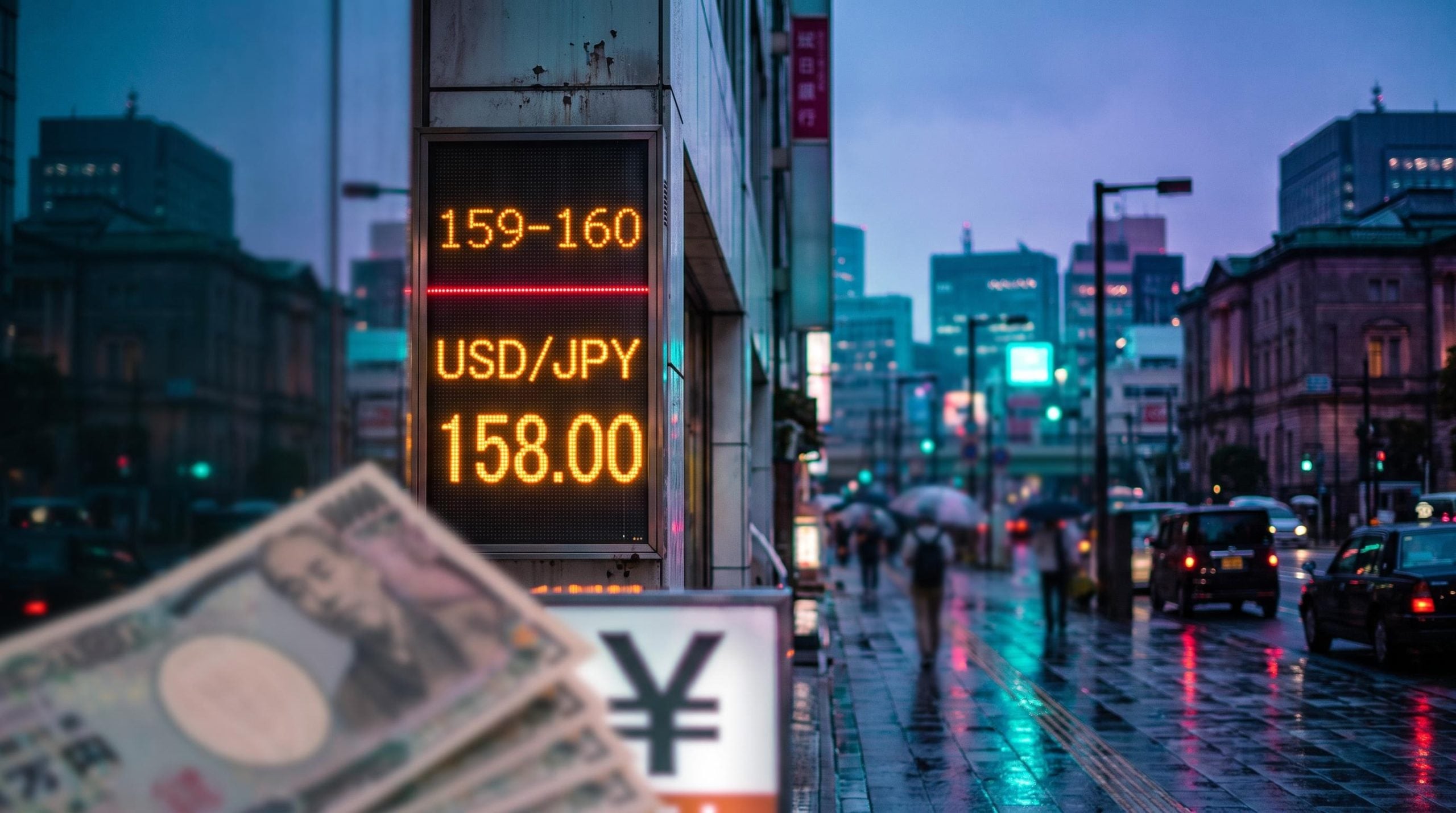
The Bank of Japan has already raised its policy rate to 1.25%, yet the yen weakened after that hike. Then a single speech, with no change in policy at all, pushed USD/JPY back below 158.00. If the yen simply followed the policy rate, neither move would make sense, and any USD/JPY forecast built on that assumption would mislead you.
The latest move came on 15 October 2026. Markets turned risk-averse, and Bank of Japan (BoJ) board member Junko Koeda told local leaders in Kumamoto that the central bank should not become overly cautious about raising rates. The yen gained against the dollar during the overnight session.
MUFG expects the BoJ to hold in October and hike again by December. Meanwhile, the 159-160 area has become a sensitive zone where traders watch for Japanese intervention.
Here is a working framework for judging when hawkish central bank talk is likely to move USD/JPY, and which variables decide where the pair heads next.
Why did USD/JPY slip below 158.00 on one speech?
The headline version is simple: a BoJ official sounded hawkish and the yen rallied. “Hawkish” means favouring higher interest rates to contain inflation. The session itself was more crowded than that.
Koeda made three linked arguments. Upside risks to prices are sizable, financial conditions remain accommodative, and the BoJ should therefore avoid excessive caution about further hikes, according to Reuters reporting of her remarks.
Koeda’s core message (paraphrased from reporting) With price risks tilted higher and financial conditions still loose, the BoJ should keep adjusting rates in a timely way rather than hold back out of caution.
She did not set out a pace for future hikes. That leaves the speech hawkish in tone but stops short of a commitment.
The full text of Koeda’s Kumamoto speech shows she tied her case for further hikes to sizable upside price risks and accommodative financial conditions, while stopping short of setting any pace for future moves.
The pair reportedly fell from the 158.95-159.00 area to roughly 157.6-157.9. These intraday figures come from FX market coverage and have not been independently confirmed. Coverage attributed the decline to five overlapping drivers:
- Lower US Treasury yields, which narrowed the yield advantage of holding dollars over yen
- Dollar profit-taking after the rise toward 159
- Risk aversion following weaker US equities
- Renewed concern about Japanese intervention near 159-160
- A gradually more hawkish BoJ outlook, reinforced by Koeda
Lee Hardman of MUFG observed that the yen’s performance was more varied against currencies other than the dollar. That detail matters: if the yen were broadly in demand, it would have gained everywhere. Part of this move looks like dollar softness as well as yen strength.
What this tells you is that the market was already leaning toward the yen, and the speech worked as a catalyst rather than a cause. Treat any single headline with caution before reading it as a turning point.
When big ASX news breaks, our subscribers know first
What does a neutral rate “well above 1%” mean for a 1.25% policy rate?
After several hikes, a 1.25% policy rate can sound tight. Koeda’s argument challenges that assumption directly.
Why the neutral rate is a range, not a number
The neutral rate is the interest rate that neither stimulates nor restrains the economy. It cannot be observed directly, so economists estimate it from assumptions about growth and inflation. Change those assumptions and the estimate moves.
Koeda said Japan’s neutral rate is “considerably above 1%”, adding that one estimate based on potential growth could put it above 2%. BoJ staff estimates reportedly place the nominal range at roughly 1.1%-2.5%, though that figure is not independently confirmed and the BoJ itself cautions against treating it as definitive.
If neutral sits anywhere in the upper part of that range, a 1.25% policy rate is still accommodative. “Well above 1%” is not proof that rates must reach 2%, however. It is an argument for flexibility.
What the MUFG path assumes
The last hike reportedly came in September 2026, lifting the rate from 1.00% to 1.25% on a 7-2 vote. Those details are not independently confirmed. MUFG’s path builds gradually from that base.
| Meeting or period | Expected move | Implied policy rate | Source or confidence note |
|---|---|---|---|
| October 2026 | Hold | 1.25% | MUFG, per original reporting |
| December 2026 | 25bp hike | 1.50% | MUFG; described as most likely timing |
| Q1-Q2 2027 | Further 25bp hikes | About 2.00% | MUFG path; not independently confirmed |
The board is not unified, and the institution appears to favour conditional, roughly quarterly moves over back-to-back hikes. Treat any “terminal rate” forecast as a scenario, and judge each BoJ speech by what it does to the odds of the next hike.
Board composition adds a further layer of uncertainty, since the two most hawkish members are due to leave by mid-2027 and the nominees chosen to replace them could reshape the majority behind any terminal rate.
How does central bank rhetoric actually move USD/JPY?
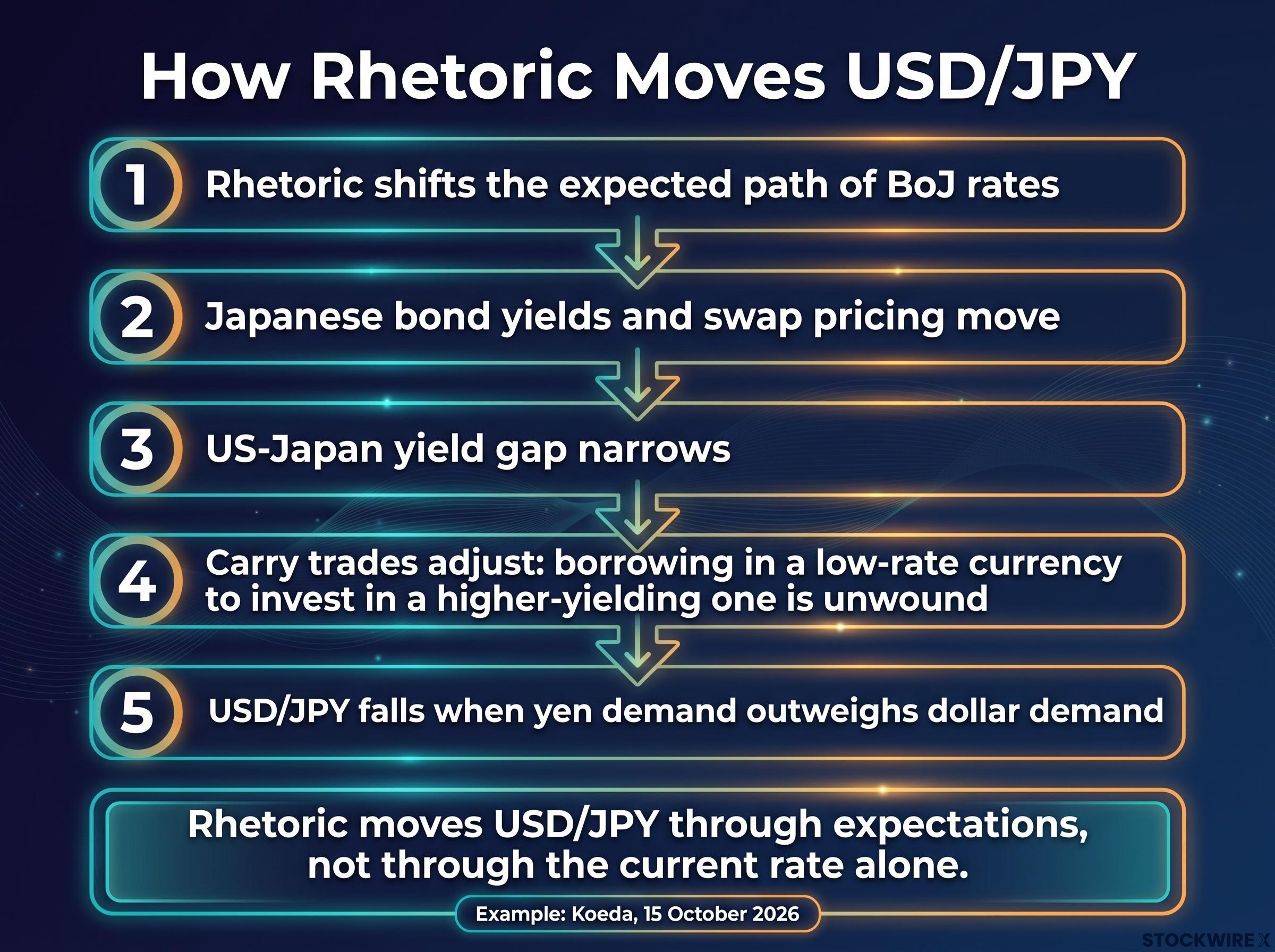
On screen, the signal looked simple: yen up, policy unchanged. Behind it sits a chain of mechanics:
- Rhetoric shifts the expected path of BoJ rates.
- Expected rates move Japanese bond yields and swap pricing (market contracts that lock in future interest rates).
- The US-Japan yield gap narrows, reducing the reward for holding dollar assets funded in yen.
- Carry trades adjust. A carry trade means borrowing in a low-rate currency to invest in a higher-yielding one, so unwinding it means selling dollars and buying yen.
- USD/JPY falls when yen demand outweighs dollar demand.
The September hike shows the chain in reverse. The yen reportedly weakened after the decision because the move was priced in, the vote revealed dissent, and guidance was limited.
A priced-in hike leaves the forward guidance as the real market event, and hawkish phrasing can extend yen gains while cautious wording risks a sell-the-news reversal even after the move is delivered.
| Episode | What happened | Currency reaction | Lesson |
|---|---|---|---|
| September 2026 pre-meeting | Hike probability reportedly rose to about 75% | Yen strengthened | Rising odds move the yen before any decision |
| September 2026 hike | Reported 7-2 vote, little guidance | Yen weakened, USD/JPY rose | A priced-in hike can disappoint |
| Koeda, 15 October 2026 | Warned against excess caution | Yen supported, capped by high US yields | Talk works if it shifts the next hike’s odds |
September figures are reported and not independently confirmed. Risk aversion adds another layer: because the yen funds so many carry trades, stress often triggers repayment of yen borrowing, which lifts the currency. A severe global shock, though, can send money into the dollar first as the most liquid safe haven.
The main lesson Rhetoric moves USD/JPY through expectations, not through the current rate alone.
For you, that means the yen reacts to the gap between what the BoJ does and what markets expected. A speech can outweigh a hike if it changes the odds of the next one.
What could push the USD/JPY forecast off course?
Why forecasts disagree so widely
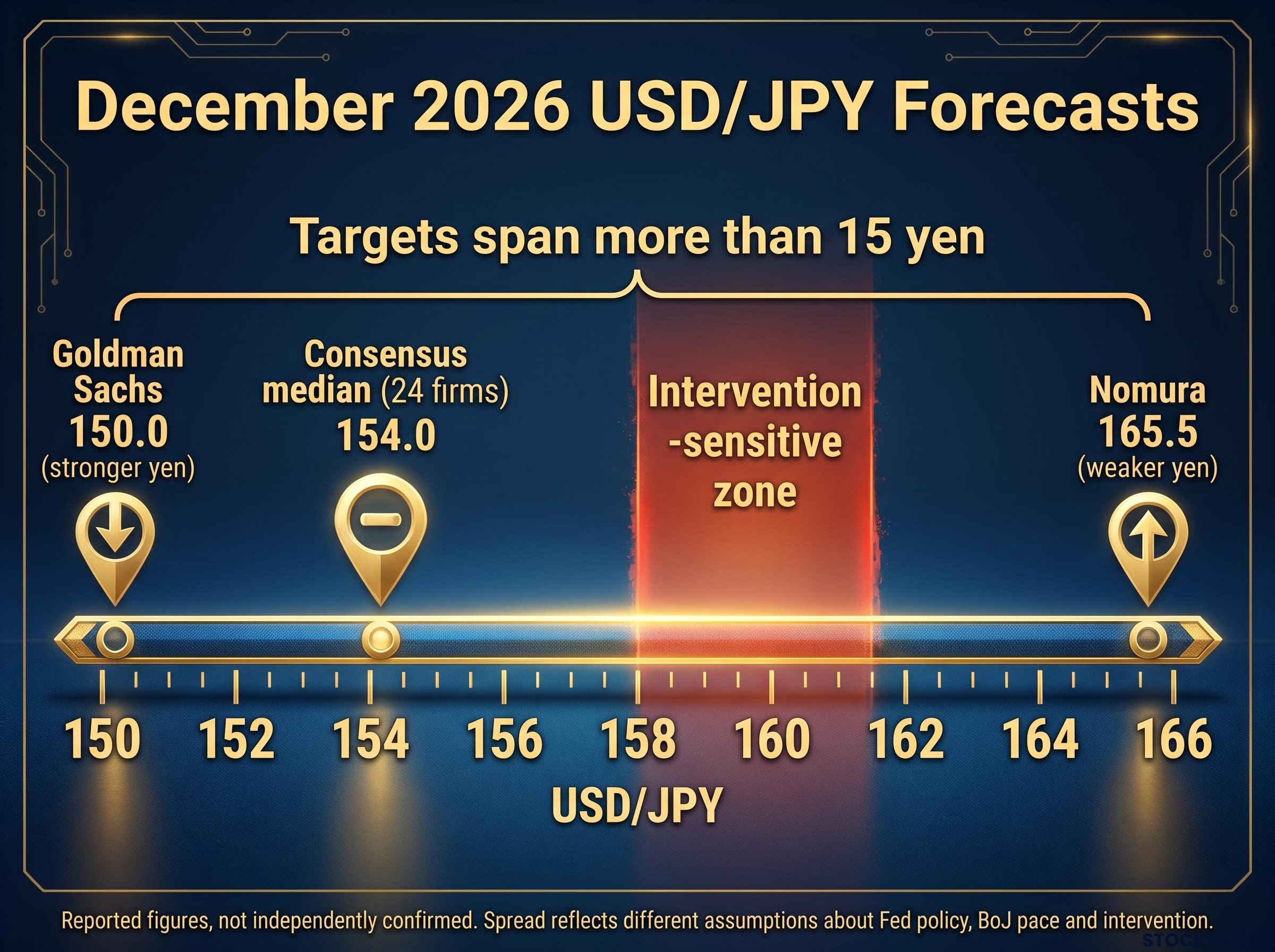
Published December 2026 targets span more than 15 yen. All figures below are reported and not independently confirmed.
| Source | December 2026 view or range | Implication for the yen |
|---|---|---|
| Goldman Sachs | 150.0 | Stronger yen |
| Consensus median (24 firms) | 154.0 | Moderately stronger yen |
| Nomura | 165.5 | Weaker yen |
| UOB / BBH (near-term ranges) | 157.00-158.70 (1-3 weeks) / 155.00-160.00 | Range-bound for now |
The spread reflects different assumptions about Fed policy, BoJ pace and intervention. MUFG’s source material offered no USD/JPY point target at all, only a BoJ rate path, so you should not treat its December view as a currency call.
The four risks to watch
- Fed hawkishness or high US yields: would widen the yield gap and could lift USD/JPY even if the BoJ hikes.
- Intervention near 159-160: caps dollar upside. Japan reportedly intervened on 29 April 2024 after the pair hit 160.245, and spent about ¥5.53 trillion in July 2024 as it fell from roughly 161.76 to 157.30 (not independently confirmed).
- Political and fiscal pressure: could slow normalisation, or raise Japanese yields without helping the yen.
- A delayed December hike: pre-meeting reports suggested officials were reluctant to hike consecutively (not independently confirmed). Delay would likely weaken the yen.
Treat 159-160 as a ceiling enforced by intervention risk, and treat BoJ delay or Fed hawkishness as the scenarios that would break the yen-positive case.
Investors exploring why velocity matters more than price level will find our full explainer on USD/JPY intervention triggers, which shows how a fast move to 160 differs from a slow drift.
Past performance does not guarantee future results. Financial projections are subject to market conditions and various risk factors.
Reading the next BoJ signals without overreacting
The yen follows the expected rate path, not the rate already in place. Koeda’s remarks raised the odds of a December hike without guaranteeing it, while US yields and intervention risk set the boundaries of any move.
Your watch list is short:
- The BoJ meeting reportedly scheduled for 29-30 October (date not independently confirmed)
- The 17-18 December meeting
- US Treasury yields
- Any official Japanese commentary as the pair approaches 159-160
The official BoJ 2026 meeting schedule confirms the October 29-30 and December 17-18 sessions, the two decision points that will test whether Koeda’s argument translates into a majority view on the board.
If December odds firm and US yields ease, the yen-positive case strengthens. If the BoJ hesitates while US yields hold high, it weakens. The direction is conditional, and your positioning should be too.
This article is for informational purposes only and should not be considered financial advice. Investors should conduct their own research and consult with financial professionals before making investment decisions.