Strategy used its STRC preferred stock to help buy nearly 100,000 BTC in the first half of the year. By K33 Research‘s count, it ended up with just 4,947 BTC more than it would have held by sticking with ordinary common stock.
That gap is the problem. A preferred-stock funding engine that raised billions added only a small net amount of Bitcoin once its recurring costs were counted.
Vetle Lunde, Head of Research at K33, published the critique on 13 October 2026, and press coverage followed today. The timing matters because preferred-stock financing is spreading across corporate Bitcoin treasuries, and smaller issuers are copying the template.
Headline raises are easy to celebrate. The harder question is what a financing tool costs every year after the money arrives. You will leave with a working framework for judging whether a preferred-stock structure earns that cost.
How does STRC work, and why did Strategy build its funding around it?
On screen, STRC looks simple: a 12.00% annualised dividend on a security trading at about $100. Strategy’s 30 September 2026 8-K set the rate at $0.50 per share per semi-monthly period on a $100 stated amount. The original report had STRC closing at $99.90, and STRC Tracker showed about $99.64 on 13 October 2026.
Behind that quote sits a carefully engineered instrument. Its formal name is Variable Rate Series A Perpetual Stretch Preferred Stock, and its defining features are:
- Seniority: it ranks ahead of common shares for dividends and liquidation claims
- Perpetual: it has no maturity date
- Monthly reset: Strategy adjusts the dividend rate each month
- Par target: the reset aims to keep the price near $100 (par is the stated face value)
- Non-guaranteed dividend: Strategy states the cash dividend is not guaranteed
STRC is also not backed by specific Bitcoin. Holders have a preferred claim on Strategy’s remaining assets, so they carry corporate-credit risk on top of Bitcoin exposure.
Strategy management’s framing Strategy presents STRC as “digital credit,” a security designed to trade near $100 with an adjustable rate.
Market commentary from May 2026 put STRC at roughly $8.54 billion notional. That figure has not been independently confirmed and may have shifted with later repurchases and issuance.
The issuance loop near par
The design is clever because price controls the tap. When STRC trades at or above par, Strategy can sell new shares through its at-the-market (ATM) programme, which lets a company sell stock gradually into the open market, and use the cash to buy Bitcoin.
Below par, issuance stops. Strategy has said it will not issue STRC below $100, and it has used cash to buy shares back instead.
In May 2026, K33 spotted a mid-month rhythm: demand built ahead of the ex-dividend date, letting Strategy issue near or above par. What this tells you is that the whole engine depends on a price level Strategy can influence but does not fully control.
For investors weighing the income side of the trade, our dedicated guide to STRC yield and concentration risk explains how the 12% coupon compares with CCC-rated credit, including the return-of-capital tax treatment.
When big ASX news breaks, our subscribers know first
What does K33’s counterfactual say about 843,303 BTC versus 848,250 BTC?
Lunde’s method starts by asking what Strategy would have done without STRC. In K33’s scenario, the company never used STRC to fund H1 purchases. The money that went into building a USD reserve, repurchasing STRC and paying dividends would instead have gone straight into Bitcoin.
Run those numbers forward and the counterfactual company holds about 843,303 BTC as of 12 October. The real Strategy holds 848,250 BTC, roughly 4% of Bitcoin’s 21-million supply. (Sources conflict on holdings; a May SEC filing showed 843,738 BTC, so the more recent October figure is used here.)
| Scenario | BTC held (12 Oct 2026) | Funding route |
|---|---|---|
| Actual | 848,250 | STRC issuance plus reserve build, repurchases and dividends |
| K33 counterfactual | ~843,303 | No STRC for H1 purchases; reserve, repurchase and dividend cash redirected to BTC |
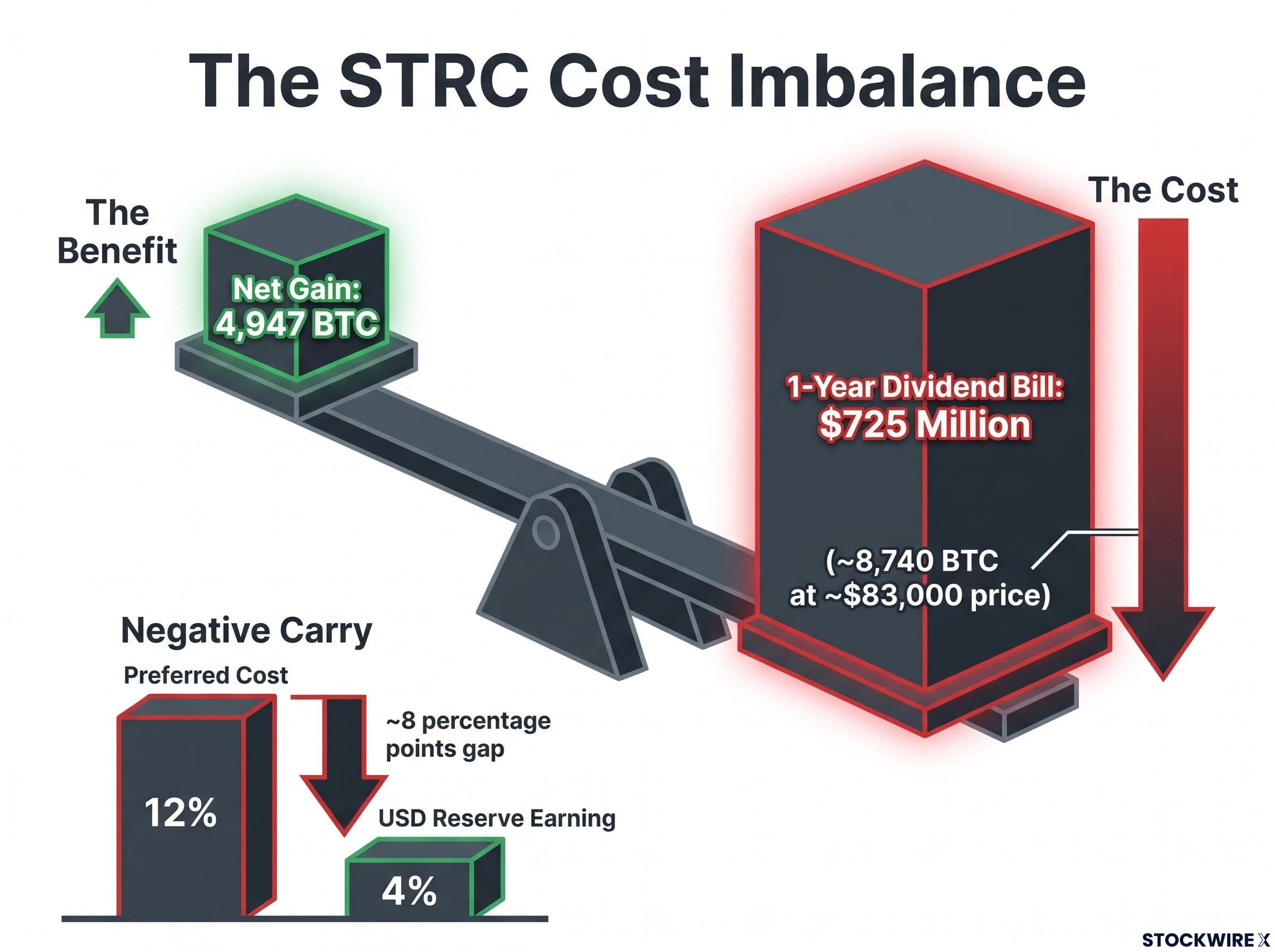
| Difference | 4,947 | Net advantage of the STRC approach |
The net gain Nearly 100,000 BTC bought with STRC’s help shrinks to a 4,947 BTC advantage once the alternative is modelled.
Gross and net tell different stories because the gross figure ignores what STRC consumed. Every dollar parked in reserves, spent on buybacks or paid as dividends was a dollar not buying Bitcoin.
K33 concluded that STRC did add Bitcoin but raised financing costs and complicated a capital structure that had been simple. The lesson for you is portable: capital raised is the wrong scoreboard, and what counts is what remains after the recurring bills are paid.
Where do the costs sit: $725 million in dividends and a reserve earning 4%?
That 4,947 BTC gain looks thinner still against the annual bill. The cost case builds in layers:
- Dividend bill: K33 puts STRC’s dividends at about $725 million a year, roughly 8,740 BTC at a Bitcoin price near $83,000. One year of dividends exceeds the entire net gain.
- Reserve carry: K33 assumed the USD reserve earns 4% while supporting preferred stock costing 12%, a negative carry (holding an asset that earns less than it costs to fund) of about 8 percentage points.
- Discount-to-par effect: a $12 dividend on a share trading at $90 is a 13.33% yield, so any slip below par lifts the effective cost.
- Perpetual duration: with no maturity, the obligation can run indefinitely.
The reserve is large. Strategy reported $4.88 billion as of 4 October 2026, with separate cash of $833.4 million. A June 2026 disclosure put annual preferred dividends plus debt interest near $1.76 billion, and at Q2 results the then-smaller reserve was said to cover more than 2.1 years of obligations; neither figure has been independently confirmed.
Size aside, USD reserve restrictions matter: the cash is earmarked for preferred dividends, interest and repurchases, so it cushions obligations rather than funding fresh Bitcoin purchases directly.
Estimates of the dividend burden also vary. JPMorgan, via CryptoSlate, implied about $982 million a year at 11.5% on roughly $8.54 billion, also unverified.
Even the tax appeal has limits. Strategy expects distributions to be treated as return of capital, which defers tax and reduces an investor’s cost basis rather than making income permanently tax-free.
The case for STRC
Supporters see a cheaper picture:
- It avoids immediate common dilution when mNAV is low
- It raises roughly $100 for a $12 annual cash cost near par
- It opens a separate funding channel with a distinct investor base
- It appeals to income investors seeking yield and price stability
mNAV is the ratio of Strategy’s market value to the value of its Bitcoin. When it is low, selling common stock buys less Bitcoin per share issued.
The case against
Critics see the costs piling up:
- Dividends are a recurring senior claim, owed whether Bitcoin rises or falls
- The reserve earns far less than the preferred it supports
- Incremental Bitcoin was small relative to the bill
- Common ATM issuance can be cheaper when mNAV is favourable
The reserve does lower the chance of forced Bitcoin sales. For you, the takeaway is that safety has a price: the structure only breaks even if Bitcoin’s long-term return outruns its financing cost.
How should you evaluate preferred-stock financing in any Bitcoin treasury?
Preferred stock sits between debt and common equity. It pays a fixed or variable dividend and ranks ahead of common shareholders, but behind lenders. When the next treasury company launches one, run it through five checks:
- Price versus par: issuance works at or above par; a discount raises the effective yield and shuts the tap
- Coupon versus cash return: compare the dividend rate with what the company earns on held reserves
- mNAV: if it is favourable, common ATM issuance is probably cheaper
- Net BTC versus recurring cost: ask for a counterfactual, not a gross purchase figure
- Stress behaviour: test what happens if Bitcoin falls sharply
That last check matters most. Critics describe a feedback loop: lower Bitcoin weakens MSTR and STRC prices, lifts effective yields and makes issuance costlier. Strategy is not contractually required to sell Bitcoin if STRC slips below par; its options are raising the rate, issuing common, drawing the reserve or repurchasing preferred, though commentators warn prolonged stress could still pressure asset sales.
The stress test matters because Bitcoin has behaved as a high-beta risk asset in correlated sell-offs, falling alongside gold and Treasuries when forced deleveraging and rising real yields hit at once.
| Financing route | Cash cost | Dilution profile | Key risk |
|---|---|---|---|
| Perpetual preferred (STRC) | 12% variable | No immediate common dilution | Permanent senior dividend claim |
| Perpetual preferred (Strive SATA) | About 13% reported (unverified) | No immediate common dilution | Higher cost for a smaller issuer |
| Convertible notes | Lower cash coupons | Contingent future dilution | Conversion dilutes holders later |
| Common ATM (MARA, Metaplanet lean on equity) | None | Immediate dilution | Expensive when mNAV is low |
K33’s conclusion Plain ATM issuance of common stock is the most efficient way to buy Bitcoin, subject to mNAV and dilution.
No current assessments from S&P, Morningstar, Bernstein or TD Cowen were found, so K33’s note stands largely uncontested by major research houses for now. The real dispute is not whether STRC can raise money. It is whether the extra Bitcoin compensates for a high, senior, perpetual claim, and the five variables above decide that.
Past performance does not guarantee future results, and these assessments are speculative and subject to change with market conditions.
Weighing the extra Bitcoin against the permanent bill
STRC did what it was built to do: it raised capital and added Bitcoin. K33’s point is that the net gain, 4,947 BTC, was modest against a dividend bill that recurs every year with no end date.
Whether that trade pays off rests on a short list: STRC’s price relative to par, the dividend rate, Strategy’s mNAV, Bitcoin’s long-term return, and the gap between reserve yield and coupon.
Two signals are worth tracking from here. Watch whether STRC holds near $100, and whether Strategy’s reserve earns more than K33’s assumed 4%. When the next treasury company pitches its own preferred, apply the same five checks before you judge the headline raise.
This article is for informational purposes only and should not be considered financial advice. Investors should conduct their own research and consult with financial professionals before making investment decisions.