
A restaurant chain spending $10 billion on 10 million GPUs just to decide what goes on its menu sounds absurd. Yet that hypothetical sits at the centre of one of the boldest arguments for why AI valuations are not a bubble, and why the usual bubble-or-not question may be the wrong one.
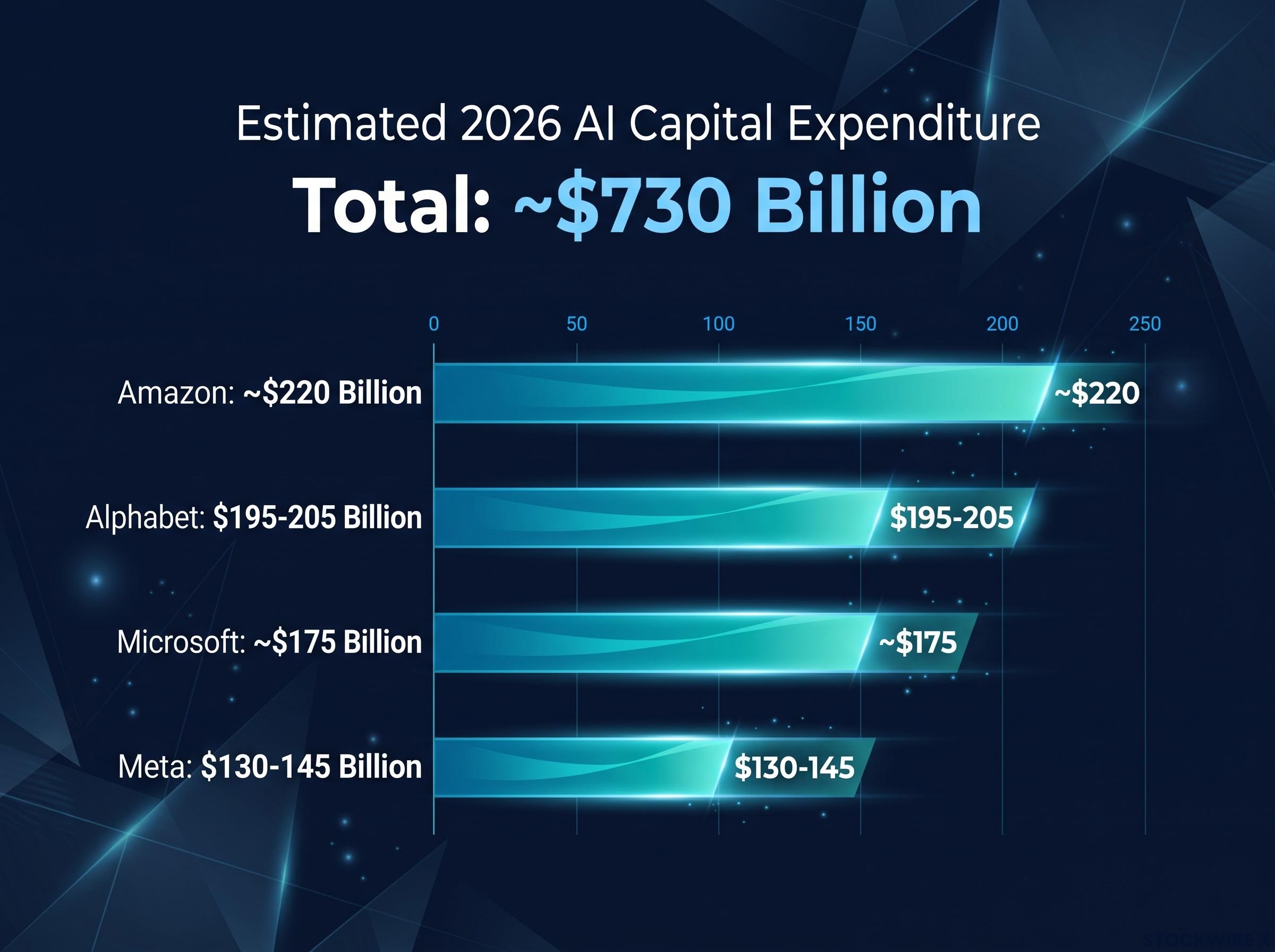
The stakes are large. OpenAI closed a round at an $852 billion valuation in March 2026 and is now reported to be in talks near $1.4 trillion. Meanwhile, the four largest cloud spenders are on track for roughly $730 billion of capital spending this year.
All of it rests on one question: does demand for computing power have a ceiling? Narrative, not only earnings, is moving prices on the answer.
This piece separates the demand evidence from the storytelling. It sets Martin Shkreli‘s bullish, accelerationist stance against the safety camp and the institutions warning of a bubble, so you can see which story your own AI exposure is betting on.
Why do bulls argue AI demand has no ceiling?
The bull case begins with the internet. Nobody in 1998 could list the applications that broadband would eventually carry, and bulls argue AI compute is following the same path.
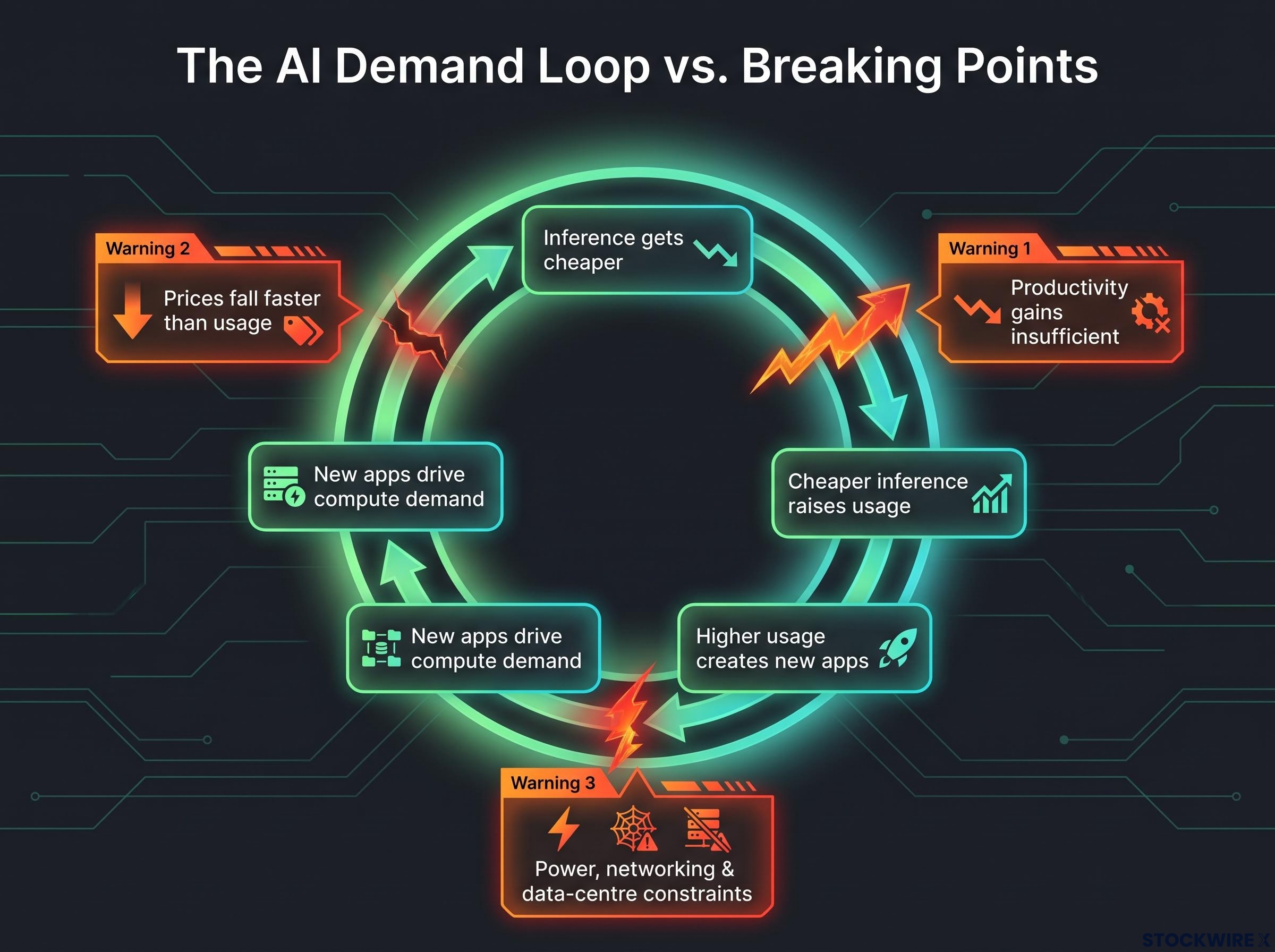
The mechanism is a self-reinforcing loop:
- Inference, the cost of running a trained model to answer a query, gets cheaper.
- Cheaper inference raises usage.
- Higher usage creates new applications.
- New applications drive more demand for compute, and the cycle repeats.
Shkreli pushes this logic to its edge. He argues demand is essentially unbounded and reaches well beyond knowledge workers.
The McDonald’s stress test Shkreli imagines McDonald’s spending $10 billion on 10 million GPUs to choose new menu items. He argues this would be positive net present value (meaning the expected future returns exceed the cost today) if intelligence keeps scaling.
There is observable evidence behind the enthusiasm. Nvidia reported data-centre revenue of $89.0 billion for the quarter ended 26 July 2026, up 117% year on year. BlackRock‘s iShares team argues demand exceeds supply, and TCW reported that leading cloud providers were still describing shortages.
Nvidia CEO Jensen Huang added that about $400 billion of venture capital flowed into AI-native companies over six months. Coverage places the remark at the Goldman Sachs Communacopia + Technology Conference on 10 September 2026, with a similar statement reported on CNBC; Shkreli’s own commentary gave no venue.
That figure cuts both ways. Capital is being redirected to buy compute, which supports demand today, but it also tells you part of that demand is funded by investor optimism rather than end customers.
Shkreli discloses that he went long after a selloff he considered ridiculous and now manages only his own money. Treat that as his position, not as evidence.
Where the loop could snap
The bubble camp identifies three conditions that would break the cycle:
- Enterprises find AI deployments do not deliver enough productivity gains.
- Model prices fall faster than usage rises.
- Power, networking and data-centre constraints make new capacity uneconomic.
Grid power constraints are the most physical of the three breaking conditions, since AI accelerator racks draw three to five times more power than traditional cloud racks and data-centre electricity use may top 1,000 TWh this year.
The bull thesis is conditional, not absolute. Shortages and Nvidia’s revenue are observable; unbounded enterprise use is a projection.
When big ASX news breaks, our subscribers know first
What do the bubble warnings and the numbers actually say?
Two terms carry this debate. Capex, short for capital expenditure, is money a company spends on long-lived assets such as data centres and chips. Circular financing occurs when companies in the same ecosystem fund one another, so money spent as “revenue” partly originates from the sellers themselves; think of a shop lending customers the cash to buy its own goods.
The spending is enormous. Estimated 2026 capex for the four hyperscalers totals about $730 billion: Amazon near $220 billion, Alphabet $195-205 billion, Microsoft near $175 billion and Meta $130-145 billion, after Meta spent about $31.1 billion in Q2. One report puts the total near $674 billion, a gap explained by differing definitions rather than contradictory data.
Some banks think even these totals are conservative, since Barclays and Goldman Sachs both model hyperscaler capex forecasts well above Wall Street consensus for 2027 and 2028, with spending absorbing most operating cash flow.
TCW holds the middle view: AI is a real general-purpose technology, but investors may be pricing future revenue too early. Unlike dot-com firms, today’s leaders generate substantial cash flow.
The institutions are less relaxed. The Bank of England‘s July 2026 Financial Stability Report flagged concentration, momentum-driven positions and leverage, while the IMF warned about herding and rapid equipment obsolescence.
| Risk | Source | Mechanism | Bullish counterpoint |
|---|---|---|---|
| Concentration | Bank of England | Correlated positions enlarge any valuation reassessment | Leaders have real cash flow and customers |
| Power constraints | Bank of England | Capacity may not be energised or monetised in time | Shortages show demand exceeds supply |
| Overcapacity | IMF | Obsolete hardware hurts earnings and collateral | High utilisation reported |
| Circular financing | Market critics | Capital recycles, inflating apparent demand | Cloud providers still cite end-customer demand |
| Leverage | Bank of England, IMF | Debt raises refinancing and credit risk | Spending largely funded by cash flow at leaders |
| Herding | IMF | AI-driven trading detaches prices from fundamentals | Demand may outlast capacity long enough for revenue to catch up |
Read together, the warnings concern the plumbing rather than the technology. A reset would most likely start with an earnings disappointment amplified by crowded positions, so watch the concentration in your own holdings more closely than headlines about model breakthroughs.
Reading OpenAI’s three sets of numbers
OpenAI’s figures look contradictory until you label them:
- Completed: a $122 billion round at an $852 billion post-money valuation in March 2026.
- Current: about $50 billion in annualised revenue as of September 2026.
- Proposed: reportedly seeking at least $30 billion at roughly $1.4 trillion, with a target of $70 billion or more in annualised revenue by year end.
Shkreli discloses OpenAI exposure and expects Meta to do well on distribution and its Muse product, saying AI is still “day one”. That is opinion, not data.
How do safety fears and accelerationism move AI valuations?
The gap between capex and proven revenue leaves room for stories, and two competing ones are shaping prices.
- AI safety and effective altruism: treats advanced AI as a potential catastrophic risk and favours oversight, safeguards and model restrictions. In valuation terms, it raises compliance costs, delays deployment and lifts the odds of licensing or liability rules.
- Effective accelerationism: prioritises rapid development, arguing that capability brings productivity and medical gains and that heavy regulation entrenches incumbents. In valuation terms, it expands the estimated size and speed of the addressable market.
Both camps price the same technology. Safety raises the discount rate, the return investors demand to compensate for risk, while accelerationism inflates the estimated market. A higher discount rate shrinks today’s value of future profits; a larger market inflates them.
Dario Amodei’s forecast In a May 2025 interview, the Anthropic CEO said AI could eliminate about half of entry-level white-collar jobs and push unemployment to 10-20% within one to five years. He also argued AI could compress 50-100 years of biological progress into five to ten years. Critics cited by CNN counter that high-quality training data is limited, reliable complex work remains beyond current systems, and adoption friction slows job loss.
Shkreli’s position, and where it is contested
Shkreli says he helped popularise effective accelerationism as a counter to effective altruism. He calls Amodei a fear-monger, argues AI is just software that can be switched off, and praises Meta and Huang for dismissing the fear narrative.
Those are arguments, not findings. The “switch it off” claim does not address the misuse or concentration risks the safety camp raises, while the critics of Amodei’s forecast lend Shkreli partial support on timing. No recent Shkreli valuation commentary beyond his original remarks could be verified.
Frontier-lab valuations are highly sensitive to regulation, accidents and backlash. Treat a sudden shift in the safety debate as a pricing event, not a philosophical one.
Does AI drug discovery justify the optimism?
Drug discovery offers a rare checkable test of whether AI promises become outcomes. Shkreli says AI adds little and expects no AI-relevant drug within 10 years.
The clinical record partly challenges him:
- Rentosertib (Insilico Medicine, idiopathic pulmonary fibrosis) has both an AI-discovered target, TNIK, and an AI-designed molecule. In a 71-patient Phase IIa, the 60 mg daily group showed improved lung function versus placebo, published in Nature Medicine.
- Its Phase III dosed a first patient on 9 September 2026, planning 320 participants at 47 centres in China.
- Insilico’s second IPF candidate entered Phase I today, 12 October 2026, with 80 healthy volunteers.
- Recursion‘s REC-4881 is in a Phase 1b/2 trial.
The speed gains are real but narrow:
- Compressed: target discovery to clinical candidate in roughly 18-30 months, per Insilico, with other reports citing about 13 months against roughly 4.5 years traditionally.
- Not compressed: a 2025 Nature Medicine analysis found AI-discovered drugs fail Phase II at similar rates to conventional drugs.
Labels matter too. “AI-designed” is not “AI-originated”; Takeda‘s zasocitinib was computationally assisted, not a fully AI-discovered novel-target programme.
No AI-discovered drug had full FDA approval in the sources reviewed. Shkreli’s approval timeline stands uncontradicted, while his claim that AI adds little looks weaker.
Read drug-discovery claims as pipeline-size stories, not approval guarantees. The same discipline applies to AI valuations broadly.
For readers weighing the sector beyond Insilico, our full explainer on AI scientific discovery investment covers the IP inventorship risk that may narrow the moats of AI-native biotechs.
What to weigh before trusting any AI valuation story
Demand is real but conditional. The risks cluster in concentration, leverage and power, not in the technology itself. Narratives work as discount-rate inputs, and drug discovery shows progress without proof of payoff.
Three variables will tell you which story is winning:
- Evidence that enterprises are gaining measurable productivity from AI.
- Whether model prices fall faster than usage grows.
- Regulatory or safety events that shift the risk premium.
Overconfidence in either the bull or fear narrative is a risk in its own right. The useful question is not whether AI is a bubble, but which assumptions your holdings require to hold true.
Past performance does not guarantee future results. Financial projections and forward-looking statements are speculative and subject to market conditions and various risk factors.
This article is for informational purposes only and should not be considered financial advice. Investors should conduct their own research and consult with financial professionals before making investment decisions.