
The WTI crude oil price keeps finding its way back to roughly $90 a barrel. In Monday’s Asian session on 12 October 2026, the US benchmark slipped to around $90.00-$90.85 after two sessions of gains. That came despite weekend drone and missile strikes on Riyadh’s main airport, a drone-hit tanker just outside the Strait of Hormuz and a hurricane threatening Gulf of Mexico supply.
Traders are weighing several shocks at once. These include Houthi strikes in Saudi Arabia, the Sohar tanker attack, an emergency US reserve exchange and an unconfirmed claim of a Russia-Ukraine energy ceasefire.
None has yet pushed prices decisively out of their range.
Here is what is holding the price near $90, and which of these headlines actually deserve your attention.
Why $90 is holding: the risk premium that attacks have and have not created
What the attacks did and did not disrupt
The weekend’s headlines were grim. These are the two incidents traders are weighing:
- King Khalid International Airport, Riyadh (Saturday and Sunday): The Houthis claimed both strikes. The Saturday attack reportedly killed 12 people and injured 309, according to Iran International citing Saudi Arabia’s civil aviation authority. A Sunday strike reportedly killed one Pakistani national and injured 11.
- Sohar anchorage, Oman (weekend): UK Maritime Trade Operations (UKMTO) reclassified the incident as an attack after confirming a drone struck a tanker. Indian Shipping Minister Sarbananda Sonowal said the vessel, reportedly the MT Petro Dolphin, carried 11 Indian seafarers. Nine were rescued and two remain missing.
Neither set of casualty or vessel details has been independently confirmed. UN Secretary-General António Guterres condemned the airport attack. President Donald Trump is reportedly weighing whether to join Saudi Arabia in retaliating against the Iran-backed Houthis.
Yet none of the available coverage shows a large, sustained loss of physical oil supply. Persian Gulf crude exports appear to be rising, not falling.
The table below shows the recent price points. They come from Reuters-attributed coverage that could not be independently confirmed.
| Date | WTI level | Daily change | Driver |
|---|---|---|---|
| 6 October 2026 | $89.44 | Described as stable | Supply risk balanced against rising exports |
| 8 October 2026 | $89.94 | Up $1.66 (1.88%) | Middle East worries and hurricane risk, part of a roughly 4% rally |
| 10 October 2026 | $90.97 | Down $0.52 (0.6%) | Storm risk largely priced in, slight weekly decline |
Headline premium versus systemic threat
The muted reaction makes sense once you compare it with the past. The 2019 Abqaiq-type attacks hit Saudi processing sites directly. Prices spiked sharply, then retraced as repairs and spare capacity came online.
Airports and single tankers are a different category. Traders appear to separate these headlines from threats to Strait of Hormuz flows or major fields, which would be far more likely to force a lasting repricing.
The flat reaction to Iran and Gulf shocks reflects a market weighing unresolved Hormuz risks and real hurricane-related supply losses against OPEC+ idle capacity that could return to cap any spike.
For you, the takeaway is that the market is treating these events as contained. A move beyond this range would likely need evidence of lost barrels or a threat to Hormuz traffic, not simply more attack headlines.
Reserve moves, a ceasefire claim and a hurricane: the policy and weather signals behind the range
What the SPR exchange does, and what it does not
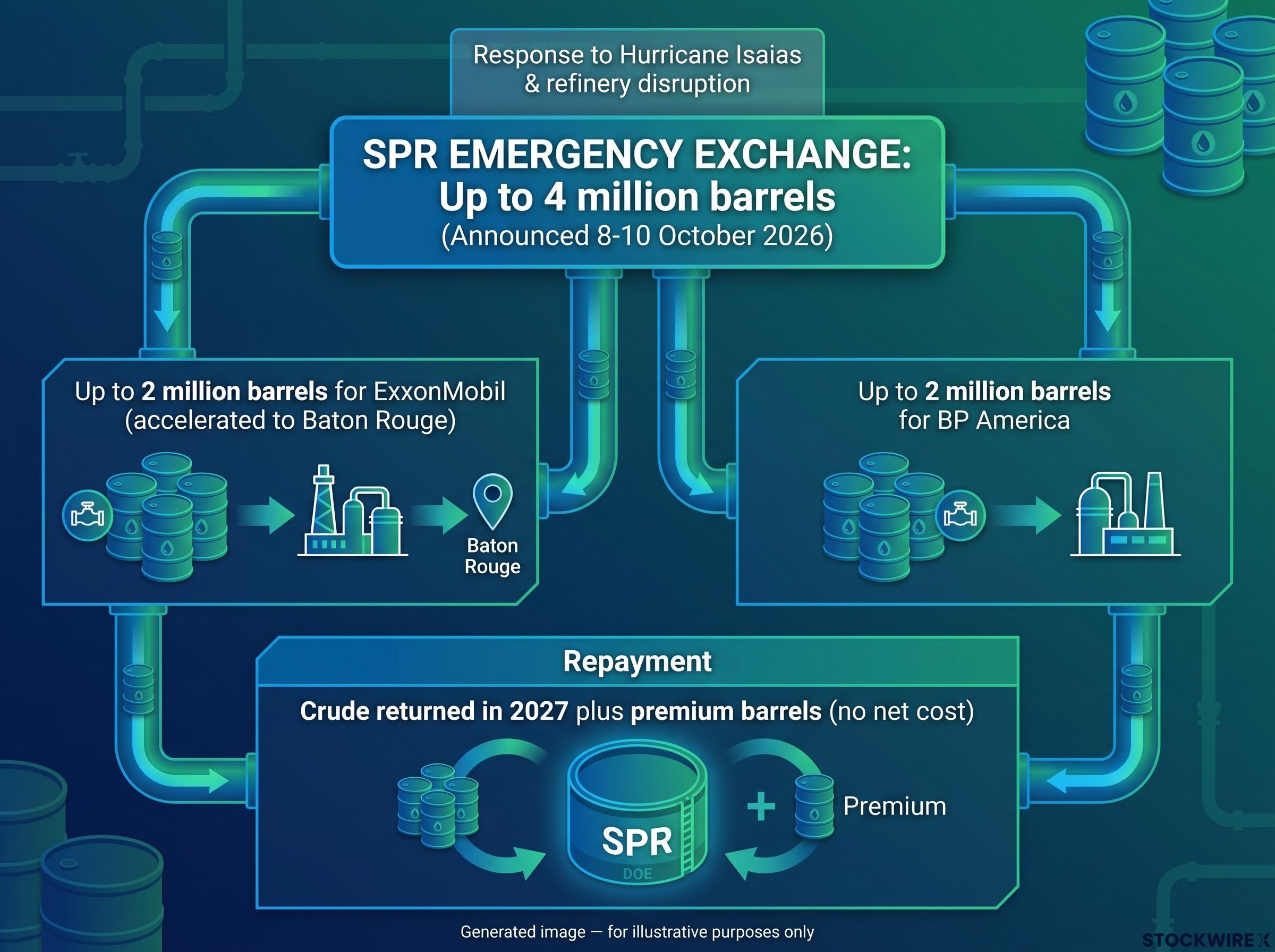
The firmest policy signal of the week came from Washington. The US Department of Energy (DOE) approved an emergency exchange from the Strategic Petroleum Reserve (SPR), the government’s emergency crude stockpile. The exchange responds to Hurricane Isaias and refinery disruption along the Gulf Coast.
- Volume: up to 4 million barrels
- Recipients: up to 2 million barrels each for ExxonMobil and BP America, with ExxonMobil’s share accelerating previously awarded deliveries to Baton Rouge
- Repayment: crude returned in 2027, plus additional premium barrels, at no net cost to taxpayers
- Timing: announced around 8-10 October 2026
This is an exchange, not a sale. It has a capped volume and mandatory repayment with interest in kind. That makes it a tool to keep refineries running, not a sign that Washington wants to push the price down.
The US exchange sits alongside the broader G7 oil reserve release of up to 100 million barrels announced on 2 October, which analysts see as buying time on diesel rather than resolving supply tightness.
The storm itself also seems to have faded as a price driver. WTI was on track for a slight weekly decline by 10 October, which suggests the hurricane risk was already largely priced in.
A ceasefire claim without confirmation
The second signal is far shakier.
Two positions, no confirmation Trump said Russia and Ukraine had accepted an energy ceasefire but gave no details. Ukrainian President Volodymyr Zelenskyy said he knew of no such agreement and that Kyiv would accept one if Moscow agreed.
Zelenskyy said he had discussed an energy ceasefire with leaders from Canada, Finland and NATO. No response from Moscow could be found. Until Moscow responds, the claim should not be treated as a bearish catalyst.
Why trend-followers are being whipsawed around $90, and what else decides the next move
How a round number creates a feedback loop
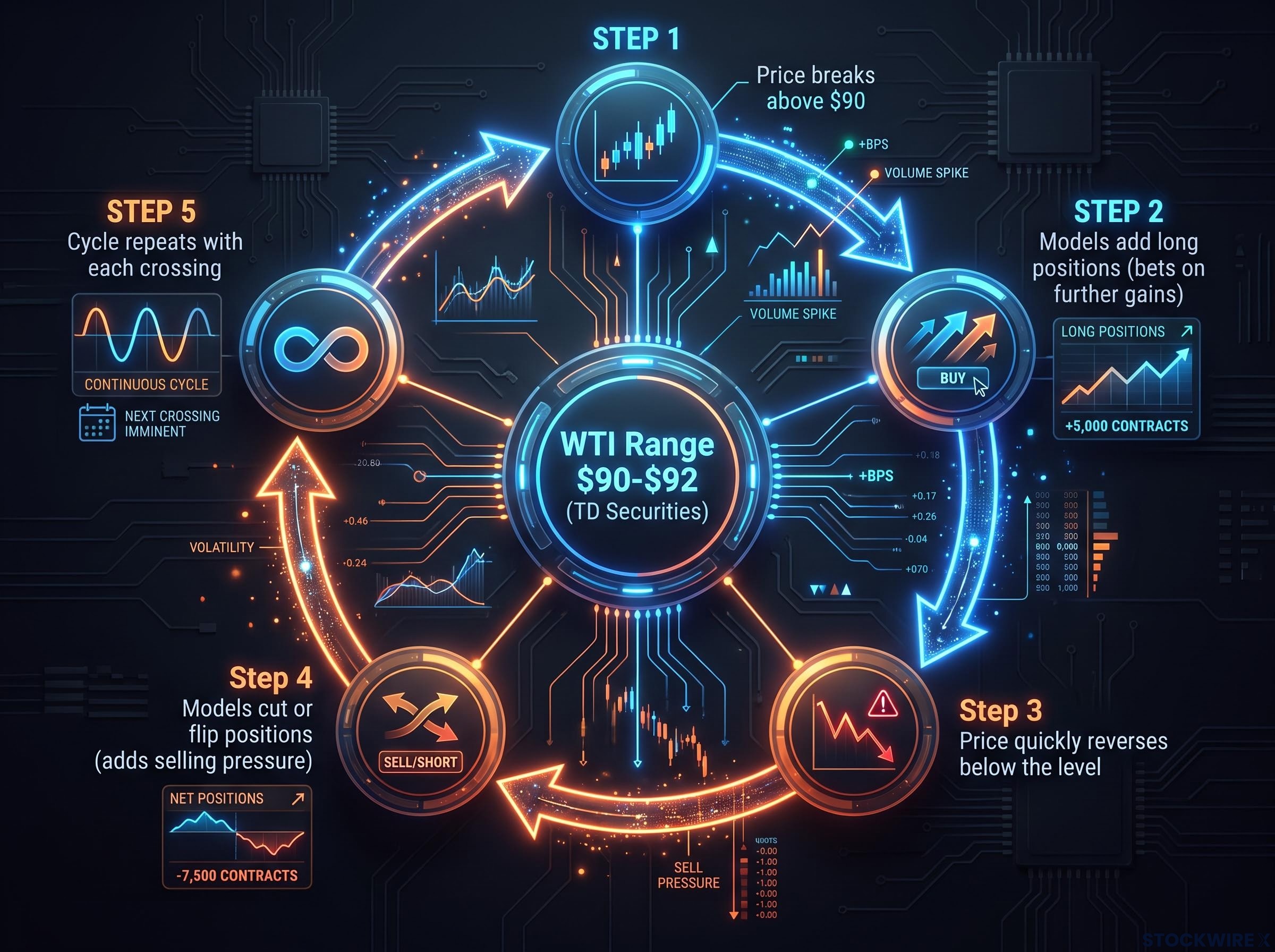
Commodity trading advisers (CTAs) are funds that buy and sell automatically based on price trends. According to TD Securities, these trend-following funds are being whipsawed as WTI oscillates around $90, a key CTA level, with recent trading in the $90-$92 range.
The loop works like this:
- Price breaks above $90.
- The models add long positions, which are bets on further gains.
- Price quickly reverses below the level.
- The models are forced to cut or flip those positions, which adds selling pressure.
- The cycle repeats with each crossing.
Discretionary traders watch the same round number, and option strikes cluster there too. As a result, signals change faster than fundamentals. Some of the swings you see may reflect positioning rather than new information.
The drivers that decide whether $90 breaks
WTI is a light, sweet US crude delivered through the Cushing hub. It is one of three major benchmarks, alongside Brent and Dubai. Whether its price breaks out of this range depends on a few familiar factors.
| Driver | Bullish signal | Bearish signal | When it is published or decided |
|---|---|---|---|
| US inventories | Falling stocks | Rising stocks | American Petroleum Institute (API) on Tuesday, Energy Information Administration (EIA) on Wednesday |
| OPEC+ quotas | Quota cuts | Production increases, ample spare capacity | OPEC meetings twice a year |
| US dollar | Weaker dollar | Stronger dollar, higher real yields | Continuous |
| Global demand | Firmer activity data | Soft demand indicators | Ongoing data releases |
The EIA is generally seen as the more reliable of the two inventory reports. Its figures land within 1% of the API’s about 75% of the time. OPEC has 12 members, while OPEC+ adds ten more producers, including Russia.
A single day’s move through $90 tells you less than a sustained close beyond the $90-$92 zone that is backed by inventory and dollar data.
Traders reading EIA data and price charts together tend to focus on the surprise versus forecast rather than the headline figure, which is why a single inventory print can move WTI even when the underlying trend is unchanged.
What would change the picture from here
The market is pricing a contained risk premium, a limited reserve response and an unverified ceasefire claim, with systematic trading amplifying every swing around $90. There are three triggers to watch: any Trump decision on retaliating against the Houthis, evidence of threats to Hormuz flows or large production sites, and API and EIA inventory prints alongside moves in the dollar.
Key price and casualty details remain unverified, so check live quotes before drawing conclusions. The next decisive signal is more likely to come from lost barrels than from louder headlines. These statements are speculative and subject to change based on market developments. Past performance does not guarantee future results.
This article is for informational purposes only and should not be considered financial advice. Investors should conduct their own research and consult with financial professionals before making investment decisions.