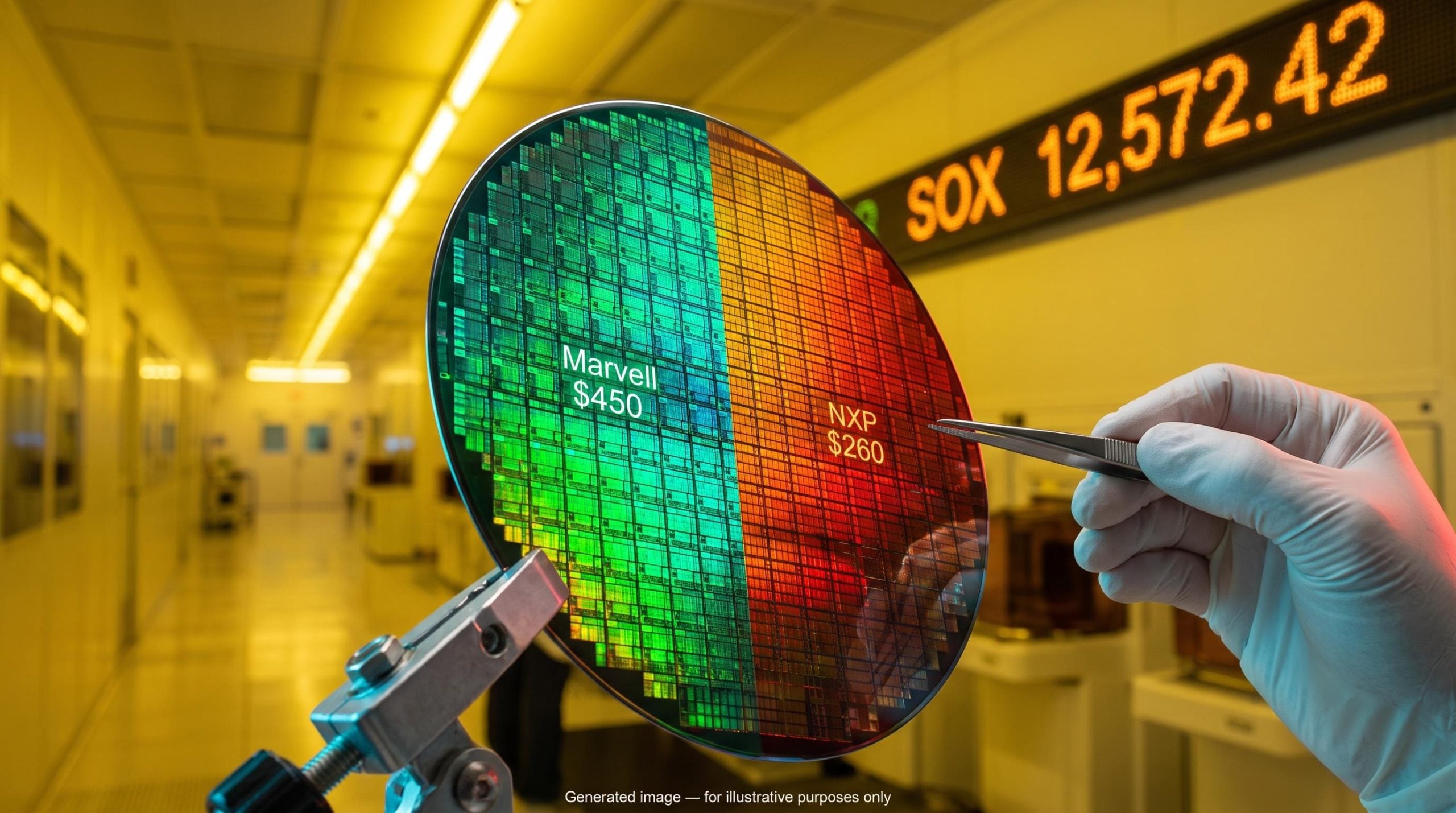
The Philadelphia Semiconductor Index (SOX) has climbed roughly 24% from its summer correction, closing at 12,572.42 on 9 October 2026. That rebound tempts you to treat semiconductor stocks as a single trade. The analyst notes published this week argue against doing that.
In the same week, Citi cut its NXP Semiconductors price target from $370 to $260, while firm after firm raised its targets on Marvell Technology. Both companies make chips, yet the Street reached opposite verdicts on them within days.
Third-quarter earnings season opens with ASML on 14 October and TSMC on 15 October. Analysts now say that estimate revisions, rather than headline demand, decide which names lead and which lag. If you buy the sector as one block, you take on the laggards along with the leaders.
This covers how analysts are separating data centre beneficiaries from cyclical laggards, and the signals worth checking before the reports arrive.
Why is Citi getting more selective on semiconductor stocks after a 24% rebound?
The five Buy-rated picks
The rebound came close to Citi’s earlier call, and the bank still has favourites going into earnings. Analyst Atif Malik names five Buy-rated picks:
- AMD: compute exposure to data centre and AI demand.
- Texas Instruments: analog supplier expected to see some of the largest sales revisions.
- Lam Research: semiconductor equipment, one of the strongest areas for revision momentum.
- Teradyne: equipment name in the expected revision upgrade group.
- Synopsys: chip design software (known as EDA, or electronic design automation) tied to AI-driven design activity.
Read the list closely and it is narrower than it first appears. It leans towards data centres, AI and companies with improving estimate-revision profiles. An estimate revision is a change analysts make to their forecasts for a company’s sales or earnings.
Citi says the industry remains in “Phase 2” of its framework. In that phase, data centre demand stays strong and auto and industrial markets recover, while PC and smartphone demand stays weak. Revision momentum slowed in Q2, and Citi expects it to moderate further in Q3.
Where revisions are expected to land
Citi expects the largest sales revisions in three groups.
| Category | Names | Why revisions matter |
|---|---|---|
| Compute | Marvell, Astera Labs, AMD, Intel, Nvidia | Direct links to data centres, which make up about 40% of the chip market |
| Analog | Texas Instruments, Analog Devices | Guidance above normal seasonal levels could lift forecasts |
| Equipment | Lam Research, Teradyne | Momentum ranks among the strongest in the sector |
Momentum is strongest in networking, equipment and analog, followed by compute and memory. Auto and industrial account for roughly 20% of demand. Q4 is usually a soft quarter for analog, but Malik expects most analog firms to guide above seasonal norms.
The market has already wobbled. The SOX fell about 3.8% between 7 October (13,066.15) and 9 October. When revisions slow after a large rally, the easy gains are likely behind the sector. Choosing the right stocks now matters more than simply owning the sector.
The Citi and Marvell notes fit a wider pattern of the market tiering the chip supply chain by proximity to AI demand, a split that was already visible in Asian trading in July when memory names fell while AI server suppliers gained.
When big ASX news breaks, our subscribers know first
What does the NXP downgrade reveal about data centre exposure?
The numbers behind the cut
Citi moved NXP to Neutral from Buy. The bank also lowered the valuation multiple it applies. The P/E ratio (price-to-earnings, meaning share price divided by earnings per share) fell from 17x to 14x expected 2028 earnings, in line with NXP’s five-year average.
| Metric | Prior | New | Change |
|---|---|---|---|
| Price target | $370 | $260 | -$110 |
| P/E on 2028 EPS | 17x | 14x | -3 turns |
| 2027 EPS | $16.61 | $16.30 | -$0.31 |
| 2028 EPS | $21.00 | $18.64 | -$2.36 |
None of these numbers points to a collapse at the company. The cuts bring Citi into line with Street consensus and reflect weaker auto and industrial assumptions. Citi expects NXP’s revisions to trail its peers’ heading into 2027.
The cause shows up in NXP’s sales mix. Data centres contribute only 3-4% of sales, the lowest share among its peers. About 56% of revenue comes from automotive, where demand is subdued.
Why analog is splitting in two
That mix matters because of where Citi places the cycle.
Citi’s cycle read The analog upturn is “more than halfway through”, and the remaining upside depends more and more on data centre buildouts.
Much of the cyclical correction has already played out. The analog names with remaining upside are those supplying power management, high-speed connectivity and analog front-end chips for data centres. Pure auto and industrial names are tied to slower cycles.
The same note moved Universal Display to Sell with a $71 target because of weaker smartphone demand next year. It also cut Nova to Neutral at $415, citing a balanced risk-reward. Citi calls these three its lowest-ranked names, although secondary coverage does not clearly match each one to a segment. No named analysts have publicly disputed the NXP call.
The details come from secondary coverage, including Investing.com on 9 October. If you hold analog names, a cyclical recovery alone is no longer enough. The real question is how much of each company’s growth depends on data centre spending.
How do analysts weigh data centre exposure, analog recovery and estimate revisions?
Citi’s picks and the NXP case come down to three questions you can put to any chip holding:
- How much revenue comes from data centres? Data centres make up about 40% of the chip market, compared with roughly 20% for auto and industrial. Greater exposure links a company to the faster-growing driver.
- Where does the segment sit in its cycle? A recovery that is “more than halfway through” leaves less room for broad gains.
- Are analysts raising or trimming forecasts? The direction of revisions shows whether expectations are improving or fading.
| Lens | What to look for | Example from this article |
|---|---|---|
| Data centre exposure | Share of sales tied to AI and cloud | NXP at 3-4%; Citi favours compute and networking names |
| Cycle position | How much of the recovery is already done | Analog upturn “more than halfway through” |
| Revision direction | Rising or falling forecasts | NXP 2028 EPS cut to $18.64; Marvell estimates raised |
The third lens usually carries the most weight. A share price moves when expectations change, not simply when a company grows. Fast growth that everyone already expects is built into the price, while an upward revision is news the market has not yet priced.
Even record profits have not guaranteed gains this year: TSMC and ASML both fell after strong July reports, because results that confirm what is already priced in rarely move a share price.
No historical cycle comparisons were sourced, so treat this as a current framework rather than a proven pattern. Even so, running each holding through these three questions before earnings shows you whether you own a likely revision winner or a revision risk.
Why did Marvell’s analyst day trigger a wave of target increases?
What management promised
Marvell went the other way. At its 6 October investor day, management set out large new targets:
- Fiscal 2028 revenue of about $20B, up from $18B
- A fiscal 2031 framework of $70-$90B, with the $80B midpoint roughly 10x fiscal 2026 revenue of about $8.2B
- Fiscal 2029 custom-chip revenue above $12B, up from above $10B
- Earnings above $30 per share by 2030, with gross margins of 56-59% and an addressable market near $400B
- A fiscal 2031 interconnect target of $37.5B
The mix has also changed. Custom accelerators make up about 19% of the 2030 target, compared with more than 40% of expectations last year. Marvell’s fiscal years do not match calendar years, and these figures come via secondary coverage.
Marvell’s own investor day materials set out the fiscal 2031 framework and custom-chip targets behind the Street’s upgrades, and investors weighing the stock can test each assumption against management’s stated guidance rather than relying on analyst summaries.
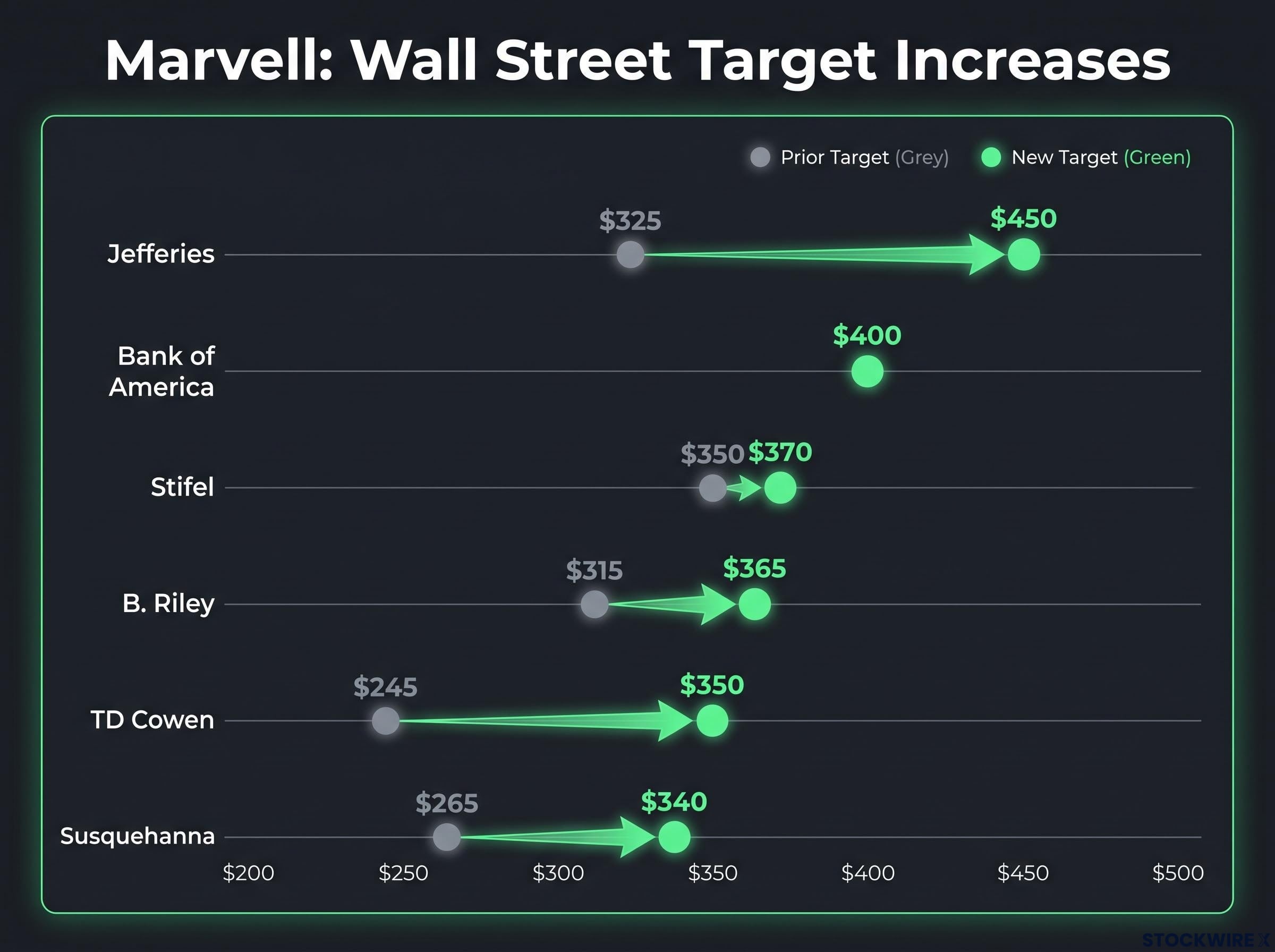
How the Street reacted
| Firm | Action | New target | Prior target |
|---|---|---|---|
| TD Cowen | Upgrade to Buy | $350 | $245 |
| Jefferies | Raised | $450 | $325 |
| Stifel | Raised | $370 | $350 |
| B. Riley | Raised | $365 | $315 |
| Susquehanna | Raised, Positive | $340 | $265 |
| Bank of America | Buy | $400 | Not disclosed |
Each firm reached its number by a different route. Jefferies called the $30 EPS target conservative and sees potential for $35-40. Stifel noted the plan is built bottom-up and does not rely on one huge contract, with fiscal 2031 EPS scenarios ranging from $24.30 to $40.59.
B. Riley cited more than 100 active projects, with 2030 targets 73% above consensus for sales and 67% above for earnings. Susquehanna expects operating costs to grow at half the pace of revenue. Bank of America raised its 2029 revenue estimate to $34.84B from $28.50B and its 2029 EPS estimate to $13.92 from $11.02.
TD Cowen’s Sean O’Loughlin admitted his firm’s downgrade a year ago was wrong on connectivity, then added a caution.
TD Cowen’s caution The market may not fully credit Marvell’s targets, given the risks that could emerge in 2028 or sooner.
Targets set this far above consensus show you what the market has to believe for those prices to hold. Before buying, decide which of those assumptions you are willing to accept.
What to check before Q3 earnings land, and what remains unresolved
The Citi picks, the NXP downgrade and the Marvell upgrades all point to the same filter: data centre leverage combined with resilient revisions. Use the calendar as a set of checkpoints:
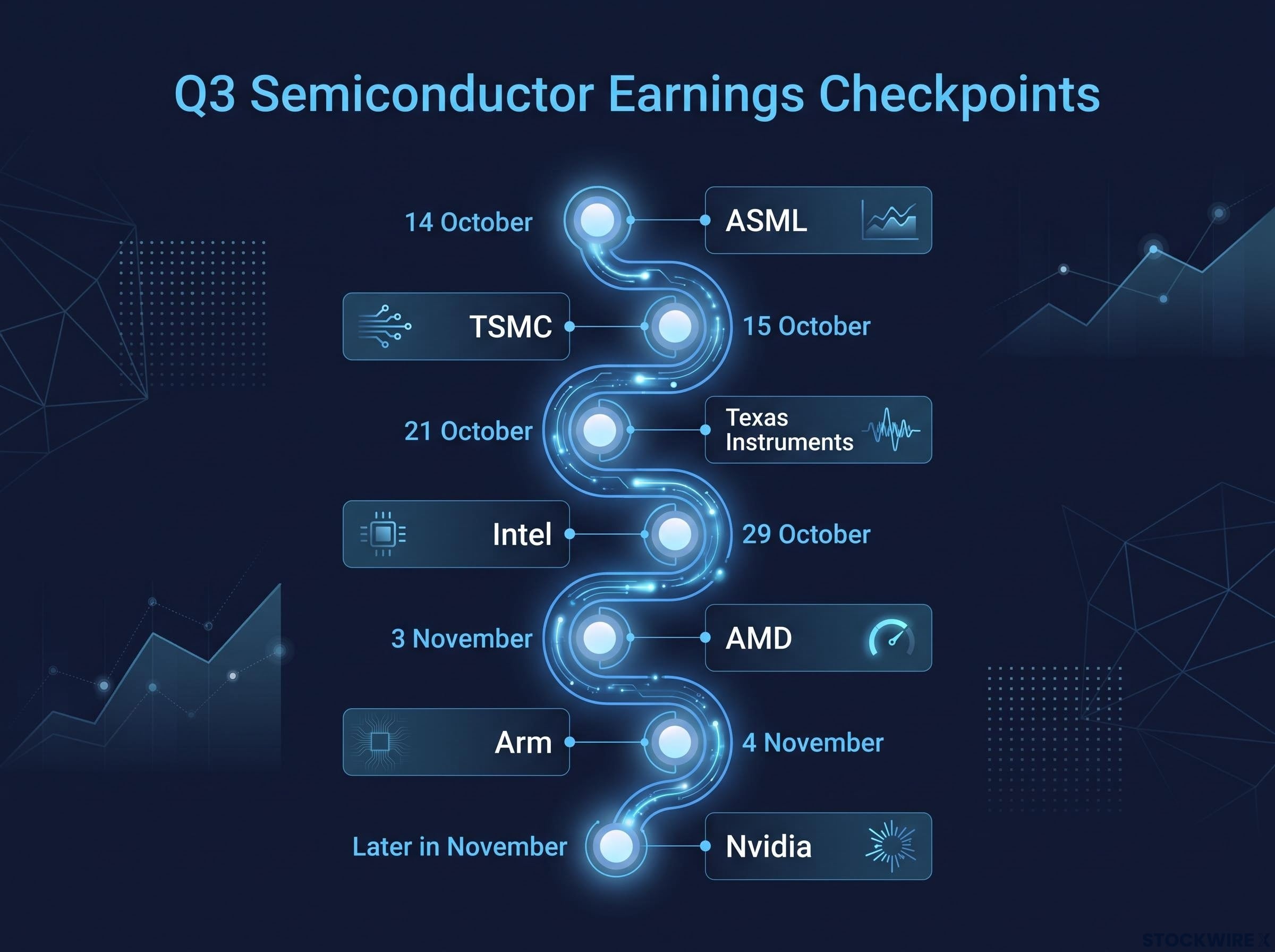
- ASML (14 October): equipment demand signals for Citi’s semi-cap picks.
- TSMC (15 October): the scale of AI-related demand across the supply chain.
- Texas Instruments (21 October): whether Q4 guidance beats seasonal norms, as Malik expects.
- Intel (29 October): compute revisions in a segment Citi flagged.
- AMD (3 November): confirmation for a Buy-rated data centre name.
- Arm (4 November): the broader compute demand read.
- Nvidia (later in November, date unconfirmed): the largest single test of AI demand.
Each report will either confirm or challenge your current view of the revision picture. Some gaps remain. No historical precedents were sourced, no named bear case on the rebound emerged, and much of the detail relies on secondary coverage.
Reading the chip trade into earnings season: selectivity over sector exposure
The rebound is real, but this week’s notes reward selectivity over broad exposure. Citi’s shortlist, its NXP downgrade and the reception of Marvell’s targets all apply the same test: how much a company earns from data centres, and which way its forecasts are moving.
Investors who prefer not to pick between Marvell and NXP can use semiconductor ETF structures, though weighting differs sharply, with some funds placing nearly a third of assets in just two names.
As the October reports arrive, put three questions to each holding. How much of its revenue comes from data centres? How far through its recovery is its segment? Are analysts raising or cutting its numbers? Holdings that pass all three are aligned with the trend. Holdings that fail them may lag even if the sector rises.
This is analysis rather than personalised advice. Past performance does not guarantee future results, and forecasts and price targets are subject to market conditions and other risks.
This article is for informational purposes only and should not be considered financial advice. Investors should conduct their own research and consult with financial professionals before making investment decisions.