
Two calls landed in the same week, and they point in opposite directions. BMO Capital Markets kept Alphabet as a Top Pick after the launch of its Gemini Agent. Truist Securities started coverage of IBM at Hold with a $240 price target, months after a Q2 software miss sent the shares down more than 20%.
Both companies sell artificial intelligence (AI) to large businesses. One is being rewarded for momentum, and the other is being asked to prove itself. The question is whether enterprise AI is sorting companies into winners and prove-it stories, and what separates the two groups.
Alphabet’s AI agents now compete directly with Meta’s Muse and OpenAI’s Dots. Gemini Agent runs on Gemini 4 Argo, Alphabet’s newest model. If you are weighing AI exposure, you need to know which advantages are structural and which are still unproven. This analysis reflects information available as of October 2026.
Here is a clear lens for comparing the two stocks: what the evidence supports for Alphabet, what would need to happen for IBM, and which risks deserve the most weight in your thinking.
Why does BMO still call Alphabet a Top Pick after Gemini Agent?
Gemini Agent is a unified enterprise AI agent: software that runs in the cloud, can be reached from any device and is built to coordinate multi-step work across a company’s tools. It sits on top of Gemini 4 Argo, the advanced model Alphabet released shortly before. Together, the two launches eased a worry that had followed the stock for some time, which was that Alphabet was falling behind in AI.
BMO did not change its view. It kept its Outperform rating and Top Pick status after the debut. The primary BMO note was not publicly accessible, so the details here come through secondary coverage, and no price target linked to this specific note was found.
BMO’s framing, as relayed in secondary coverage BMO describes Alphabet as a clear leader across the AI stack, with ownership from infrastructure through to applications.
That framing explains why the rating held. BMO treats the agent as the newest expression of strengths Alphabet already had, rather than as a fresh bet. The argument builds in layers:
- Infrastructure: the data centres and chips that run AI workloads
- Models: Gemini 4 Argo and the wider Gemini family
- Applications: Gemini Agent and Alphabet’s own product suite
- Integration partners: early links into Microsoft Office, Salesforce and ServiceNow
The last point carries real weight. Instead of selling standalone APIs (application programming interfaces, which let developers plug a model into their own software), Alphabet is placing the agent inside tools that employees already open every morning. Coverage presents BMO as more enthusiastic than other, more cautious sell-side views.
Agents that coordinate work across company tools still depend on incumbent systems of record for authoritative data, which helps explain why integration with Salesforce and ServiceNow matters so much to Alphabet’s distribution strategy.
What the full-stack claim means in practice
When one company controls every layer, it can improve each one with the others in mind. As AI workloads grow, small gains in chip efficiency, model design and software integration stack on top of each other.
Not everyone accepts that this is where the value ends up. Some argue that specialists focused on a single layer can capture as much profit. The Top Pick call tells you BMO believes Alphabet’s edge comes from owning the whole stack. Your question is whether competitors that rely on one layer, or on someone else’s infrastructure, can match that cost and distribution position.
When big ASX news breaks, our subscribers know first
What do falling token costs and enterprise usage say about adoption?
Behind that full-stack argument sits a simple unit of measurement. A token is a small piece of text, often part of a word, that an AI model reads or writes. AI providers charge businesses per token, so the cost of each token determines how expensive it is to run AI across a company.
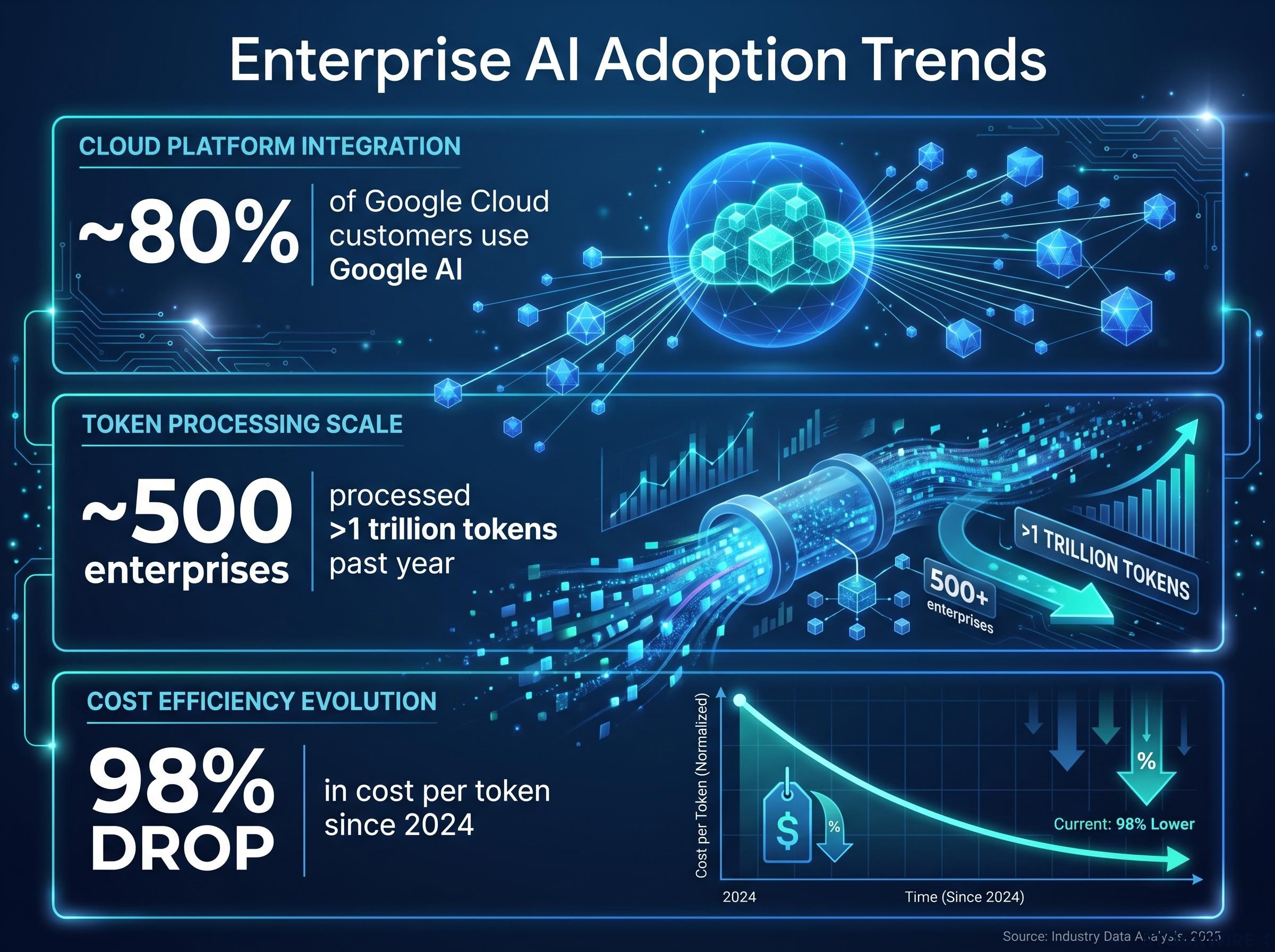
Cheaper tokens let businesses use AI more freely. BMO’s adoption figures, cited from its research, suggest that is already happening:
- About 80% of Google Cloud customers use Google AI products
- About 500 enterprise customers each processed more than 1 trillion tokens in the past year
- Cost per token has fallen 98% since 2024
That last number deserves a moment. A task that cost a business $100 in tokens in 2024 would cost about $2 today. BMO says enterprise AI volumes remain at an early stage, which suggests this usage is a starting point rather than a peak.
Cheaper tokens do not automatically mean smaller bills, because agentic workloads can consume far more tokens per task than simple chat, which is why falling unit prices and rising enterprise spend can coexist.
| Metric | Figure | What it signals |
|---|---|---|
| Google Cloud customers using Google AI | ~80% | AI is already spreading through the existing customer base |
| Enterprises above 1 trillion tokens | ~500 | Heavy usage among large businesses, not just trials |
| Change in cost per token since 2024 | -98% | Experimentation is cheap, so providers must compete on volume |
| Expected price floor | ~2030 | The point where falling prices may stop |
Several forces have pushed prices down: better use of hardware, more efficient ways of running models (known as inference optimisation), and competition from both rival closed models and increasingly capable open-source alternatives.
Where the price floor could land
Prices cannot fall indefinitely. The cost of compute, energy and infrastructure sets a practical floor. BMO points to expert calls indicating that prices could stop falling around 2030, and that providers of closed-source models may then attempt to lift them.
That could split the market in two: cheap commodity models for high-volume tasks, and premium models for mission-critical work. Providers see margins per token shrink, while customers gain cheap access but grow more dependent on the provider’s future pricing. For you, the signal to watch is whether usage growth and agent upsell outpace price compression.
Why is IBM in a prove-it phase, and is the Q2 miss timing or structure?
IBM shows what happens when that enterprise AI demand arrives on a different schedule. After its Q2 results on 22 July 2026, the shares fell more than 20%.
What the quarter showed
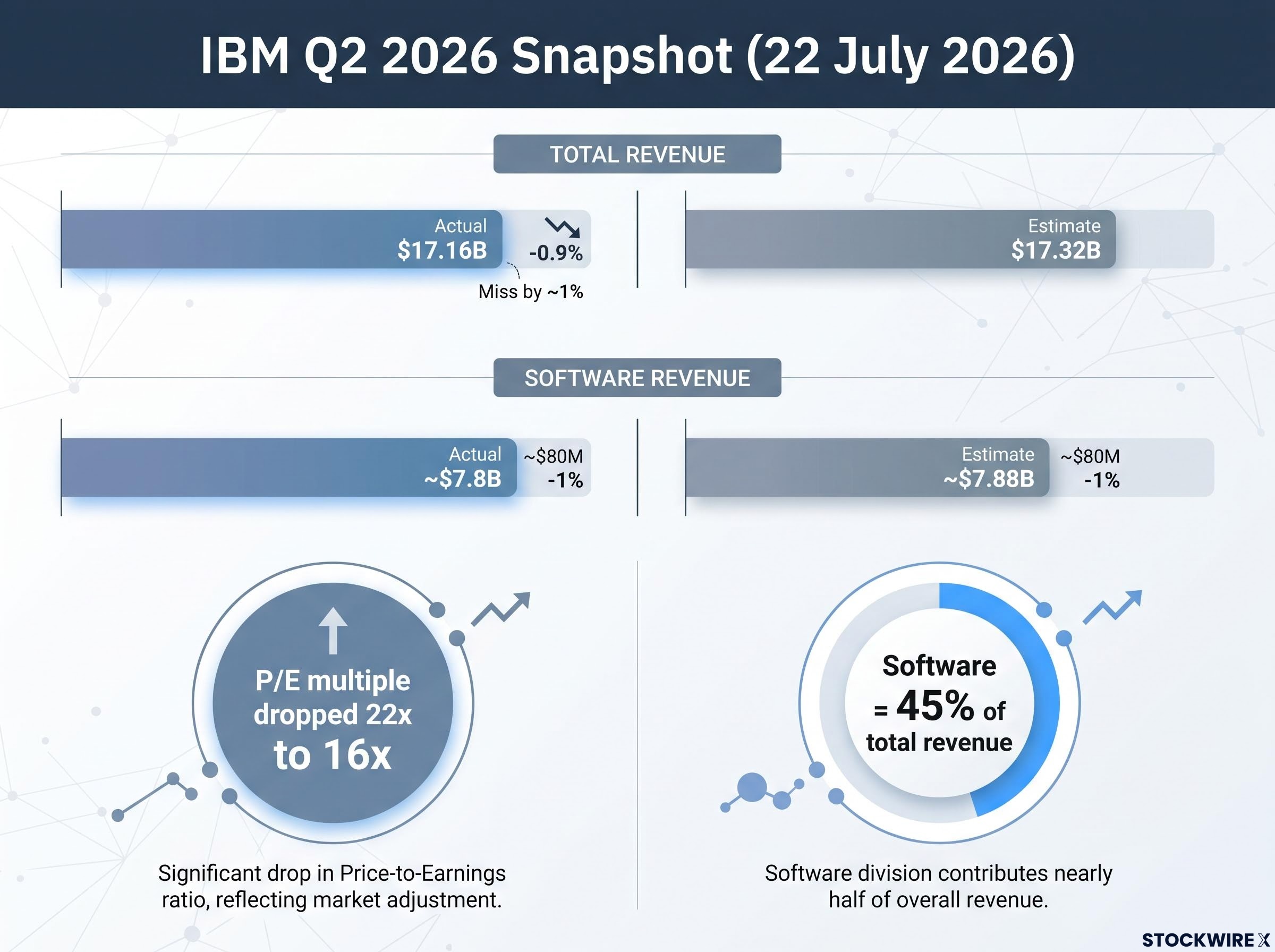
Software revenue came in at about $7.8 billion (Reuters and CNBC reported $7.76 billion, a rounding difference), below the Street estimate of about $7.88 billion. Total revenue reached $17.16 billion, a 0.9% miss against a $17.32 billion consensus according to Zacks, though other sources put the shortfall higher.
| Metric | Result | Comparison |
|---|---|---|
| Software revenue | ~$7.8B, up 5% | Street estimate ~$7.88B |
| Transaction processing | Down 8% | Offset gains in data and hybrid cloud |
| Total revenue | $17.16B, up 1.1% | Consensus $17.32B (Zacks) |
| Software shortfall | $400M-$500M | Versus internal expectations |
| Full-year growth guidance (constant currency) | 4-5% | Previously “5%-plus” |
The forward price-to-earnings (P/E) ratio, which compares the share price with expected profits, fell to 16x from 22x and now sits near 17x. Software still makes up 45% of revenue and 61% of segment pre-tax income, with about 80% recurring and annual recurring revenue (ARR) of $24.6 billion, up 8%.
Timing or structure?
Truist, with analysts led by Arvind Ramnani, sees the miss as execution and timing. Customers redirected spending towards servers, storage and memory in order to lock in hard-to-source AI hardware, and many big mainframe-linked contracts were pushed back instead of being cancelled. Two readings compete:
- Timing view: demand exists, but procurement cycles pushed deals into later quarters
- Structural view: dependence on mainframe-linked transaction processing and large deals points to a less resilient growth engine
Truist named three catalysts that would justify a more positive stance:
- Deferred contracts closing without heavy discounts
- Sustained improvement in transaction processing growth
- Stronger organic software growth
The verdict rests on whether those deferred deals close at full price. Treat the next few quarters of transaction processing and software growth as the evidence that could move IBM beyond Hold.
What could undermine each thesis?
Both cases look tidy on paper. Stress-testing them shows each carries real risk, just of a different kind.
| Risk area | Alphabet | IBM |
|---|---|---|
| Regulation | Scrutiny of search, ads and mobile; lock-in and data-use questions from a unified agent | Not a primary concern in the research |
| Spending and demand | Heavy capex while token prices compress | Budgets diverted to AI hardware; mainframe cyclicality |
| Execution | Adoption hurdles: data governance, reliability, proof of return | Forecasting credibility after the guidance cut |
| Competition and valuation | Meta’s Muse, OpenAI’s Dots, Microsoft’s Office and Azure | Multiple compressed from 22x to ~17x |
Alphabet’s capital expenditure (capex), the money spent on data centres and chips, could weigh on free cash flow if token prices fall faster than volumes and premium features grow. IBM faces the opposite problem: whether demand is simply late or partly lost.
Live antitrust proceedings covering search distribution and the ad tech stack could produce remedies ranging from behavioural limits to divestitures, which makes regulation a valuation variable and not just a headline risk for Alphabet.
Truist on IBM’s Q2 The firm describes the miss as “an execution and timing issue rather than a structural problem.”
No other brokers’ contemporaneous rating changes on either stock were found, so these two calls stand largely alone. Alphabet’s risks centre on spending and regulators; IBM’s centre on demand timing. Size each position against the kind of uncertainty you can tolerate. Both companies do share a cushion: recurring revenue and hybrid-cloud positions, with Red Hat, HashiCorp and Confluent supporting IBM’s side.
Weighing a proven stack against a pending recovery
BMO’s case rests on advantages already visible in adoption and cost data. Truist’s case rests on events that have not yet happened. That difference shapes what you should track.
For Alphabet, watch whether usage growth keeps pace with token price compression, along with any regulatory developments. For IBM, watch deferred deal closures and transaction processing trends over the coming quarters.
The expected token price floor around 2030 is where today’s cost advantage may face its real test. Weigh both stories against your own time horizon and risk tolerance.
This article is for informational purposes only and should not be considered financial advice. Investors should conduct their own research and consult with financial professionals before making investment decisions. Past performance does not guarantee future results. Analyst views and projections are speculative and subject to change based on market developments and company performance.
—