
The average 30-year mortgage rate in the US hit 7.40% this week, according to Freddie Mac. Most mortgage stocks are trading near their 52-week lows, yet national home prices are still rising. If housing has rarely been this expensive to finance, why are the lenders struggling while house prices are not?
That question hangs over the Mortgage Bankers Association (MBA) annual meeting in Chicago. Around 10,000 people are expected to attend, and according to Rich Verbinsky of the Ohio MBA, many of them are quietly hoping to sell their firms. Mortgage industry consolidation is no longer a forecast. It is the corridor conversation.
Higher rates are hitting lender volumes and margins rather than headline prices. Read the data below and you will see where the pain in housing finance sits, why prices have not cracked, and which signals would change that picture.
Why are lenders shrinking while home prices hold?
Start with the lenders. Freddie Mac’s 30-year rate reached 7.40% on 8 October 2026, up from 7.28% a week earlier and 6.30% a year ago. The 15-year rate sits at 6.73%. At HousingWire’s Mortgage Banking Summit, about 70% of executives said they expect rates of 7.5% or higher into 2027.
The Freddie Mac PMMS weekly survey, which tracks both the 30-year and 15-year fixed rates, shows borrowing costs climbing, and that trajectory is what lenders are now pricing into their volume and margin assumptions for 2027.
Capital markets have noticed. Most mortgage stocks, including loanDepot, are near 52-week lows. Analyst Chris Whalen could recall only one financing deal in six months: Carrington‘s purchase of servicing software firm Valon.
Now look at prices. The S&P Cotality Case-Shiller national index rose about 1.9% year over year through July 2026, and the Federal Housing Finance Agency (FHFA) index rose 2.6%.
| Metric | Latest reading | Source | What it signals |
|---|---|---|---|
| 30-year fixed rate | 7.40% (8 October 2026) | Freddie Mac PMMS | Financing costs are rising, not easing |
| 2026 total originations | About $2.123T | MBA September 2026 forecast | Modest volume and no refinance boom |
| Case-Shiller national YoY | About +1.9% (July 2026) | S&P Cotality | Prices still rising slowly |
| FHFA HPI YoY | +2.6% (July 2026) | FHFA | Confirms price resilience |
The MBA’s forecast splits that $2.123 trillion into roughly $1.423 trillion of purchase loans and about $700 billion of refinancing. That is gradual growth, not the surge an industry staffed for the pandemic boom needs.
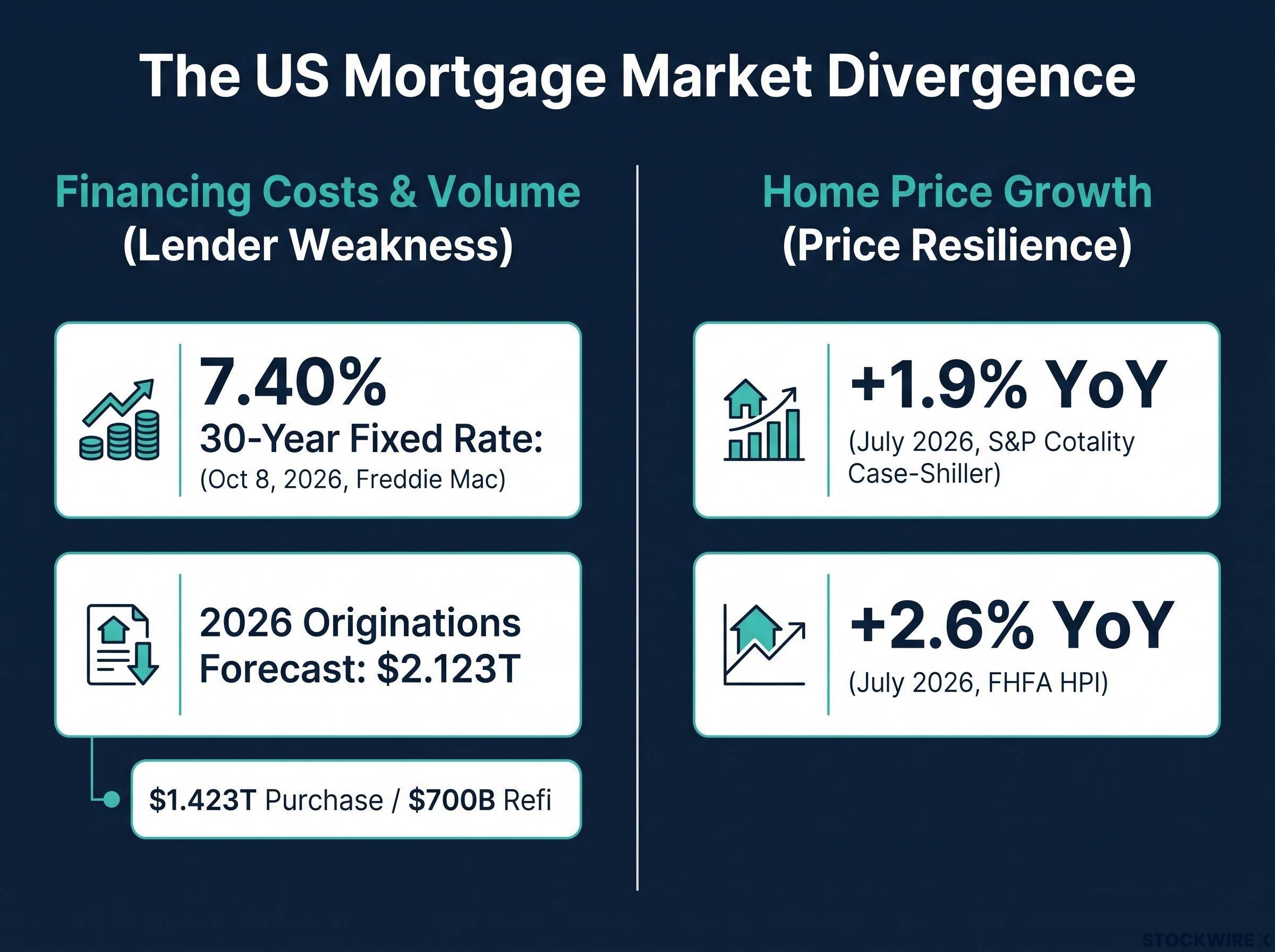
The two halves of the market are reacting to the same rate shock. It simply lands on the number of transactions rather than on the price of each home.
Profitability has improved, but from a low base:
Marina Walsh, MBA vice president of industry analysis: “production profitability in the second quarter of 2025 was the highest since 2021, a welcome development after ten quarters of net production losses.”
If you are weighing exposure to housing, this tells you that “housing is weak” and “lenders are weak” are different claims. The data clearly supports only the second.
When big ASX news breaks, our subscribers know first
What is driving mortgage industry consolidation, and how does it work?
The visible symptom is firms looking for buyers. Whalen says his mortgage mailing list of about 25,000 subscribers shows considerable attrition, and Stan Middleman of Freedom Mortgage predicted a reset some time ago.
To see why, consider how a lender earns money. Origination fees are charged when a loan is written. Servicing rights are the right to collect payments on a loan for an ongoing fee. Secondary-market execution means selling loans to investors at a profit. When rates rise and volumes fall, all three weaken together.
The pressures stack in a predictable order:
- Rates: Prices near 7.4% cap refinancing and squeeze purchase affordability.
- Capacity: Industry headcount rose almost 50% during COVID, according to Whalen, and much of it is now surplus.
- Fixed costs: Compliance, technology and servicing costs do not shrink with volume.
- Expectations: Executives see 7.5%+ into 2027, so no rescue is in sight.
- Funding: Warehouse lines and investor appetite tighten when spreads widen.
Walsh says lenders are exploring technology and process improvements to cut costs, and some are considering mergers or acquisitions to gain scale. Others are pivoting into rental loans assessed on debt service coverage ratio (DSCR), non-resident loans and non-qualified mortgage (non-QM) products, which fall outside standard lending rules. These carry higher credit and liquidity risk.
When a lender pivots to niche products rather than cutting costs, it tells you the firm is chasing yield to survive. That matters whether you are a borrower, a counterparty or a shareholder. No specific 2025-2026 merger, layoff or closure tallies were available, so the evidence points to direction and incentives rather than deal counts.
Lessons from 2008 and 2022
- 2008-2012: Large banks absorbed distressed lenders, with Bank of America buying Countrywide. Tighter regulation and capital rules pushed smaller firms to sell or merge.
- 2022-2023: As rates jumped from near 3% to above 6-7%, several nonbank lenders closed or sold platforms, and others sold servicing portfolios at distressed prices to servicing-focused buyers.
The buyers change from cycle to cycle. The pattern of scale absorbing weakness does not.
Why home prices are holding up despite 7%+ rates
Instinct says high rates must sink prices. The supply data disagrees. Several forces keep prices firm:
- Rate lock-in: Millions of owners hold sub-4% mortgages from 2020-2021 and are not listing.
- Underbuilding: Construction after 2008 left a structural shortage, especially of entry-level homes.
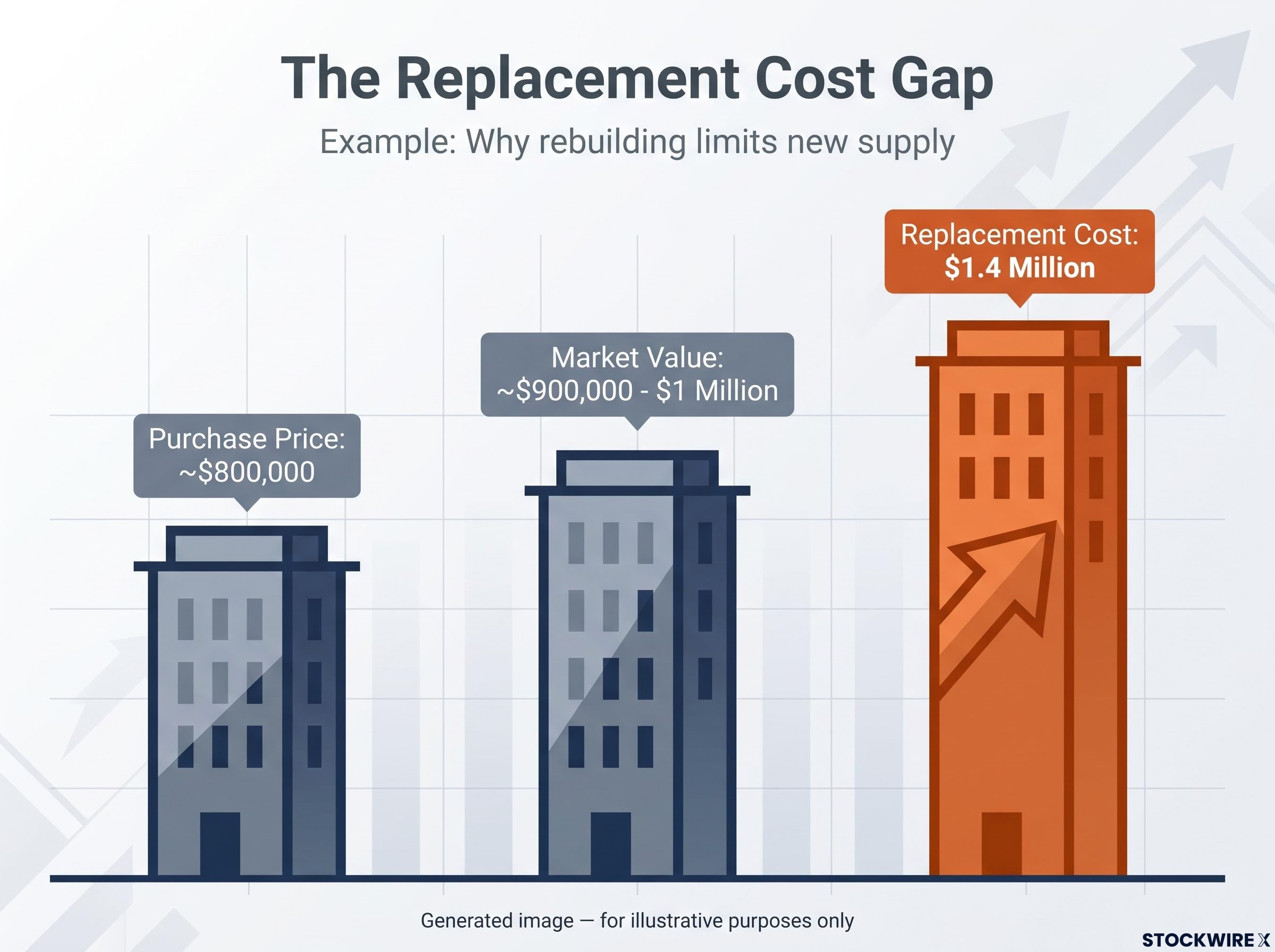
- Replacement cost: Building new has become far costlier than buying existing.
- Inflation: Rising prices generally lift nominal home values.
- Rents: Rising rents support what buyers will pay.
The rate lock-in effect keeps millions of owners with sub-4% loans off the market, trapping existing-home supply and removing the forced selling that would normally pull prices down when financing costs climb this far.
Whalen’s own home illustrates the replacement-cost gap:
The replacement gap: Bought for about $800,000, the home now carries an insurer’s replacement cost of $1.4 million, against a market value of roughly $900,000-$1 million.
When rebuilding costs this much more than buying, speculative construction becomes risky and supply stays thin. Past Fed policy helped too: years of suppressed rates and mortgage bond purchases lifted prices about 50% over a few years.
Monthly gains remain steady, with Case-Shiller near 0.3% and FHFA up 0.3% in July. Builders appear to rely on rate buydowns and closing-cost credits rather than headline price cuts, although sources conflict, with some reports saying large public builders have scaled incentives back.
Real estate is local. Whalen expects a sellers’ market, especially in the Northeast. Central Florida saw price drops earlier this year and has since rebounded, and San Francisco has recovered on AI wealth.
Where the counter-case is strongest
If rates hold near 7.5% and the economy softens, regional corrections are possible in pandemic-boom metros. New-build and multifamily oversupply in the Sunbelt and mountain West could pressure rents and investor-owned home prices. Forced sales from job loss, divorce or investor unwinds are the trigger to watch.
Scarcity, not affordability, is setting the price. For a buyer or owner, waiting for a national price collapse is a bet on forced selling, not on rates alone, and local inventory data matters more than the national index.
What does the end of Fed mortgage bond support mean for lenders and borrowers?
The quietest risk is mechanical. The Federal Reserve continues to let its agency mortgage-backed securities (MBS), which are bonds made from pooled home loans, run off its balance sheet. No large new purchases or sales beyond standard runoff have been announced. Specific portfolio size and runoff pace figures were not available.
As the Fed steps back, private investors must carry more duration and prepayment risk. That chain can move quickly:
- Fed portfolio runs off.
- Spreads between mortgage rates and Treasuries widen.
- Lenders mark down loan pipelines and servicing assets.
- Origination margins get squeezed.
- Pressure to sell or merge rises.
Whalen does not expect the Fed under Kevin Warsh to resume mortgage bond purchases, though he sees Treasury purchases as possible. That is one analyst’s view, not stated policy, and no direct Warsh statements on MBS were found.
Credit adds a second layer. Whalen expects commercial real estate defaults to rise this year and next, which could strain regional banks and nonbank lenders and shrink the warehouse capacity lenders rely on. Consumers are stretched too: analyst Adam Josephson’s earnings notes since the end of Q2 repeatedly cite lower volumes and bargain-hunting shoppers, a theme Whalen expects to persist into Q3.
If spreads widen, the 7.4% rate you see can rise without any Fed move. Three signals deserve your attention:
- Mortgage spreads to Treasuries
- Warehouse funding availability
- MBA weekly application data
Mortgage pricing is anchored to the 10-year Treasury yield plus a spread, which is why the 7.4% rate you see can rise or fall without any Fed move and why spreads deserve a place on your watchlist.
What the squeeze changes, and what it does not
The rate shock is landing on lender capacity and volumes, while scarcity keeps prices firm. Consolidation is the visible result. That thesis weakens if rates fall meaningfully, if forced selling rises, or if commercial property stress spreads into funding markets.
After the MBA meeting, borrowers should track spreads and local inventory, investors should watch deal announcements and funding conditions, and industry workers should read rising defaults as an early warning. The next phase of this cycle may be decided less by the Fed’s headline rate than by who still has the scale to fund loans when spreads move.
This article is for informational purposes only and should not be considered financial advice. Investors should conduct their own research and consult with financial professionals before making investment decisions. Past performance does not guarantee future results. Forecasts and forward-looking statements are speculative and subject to change based on market developments.