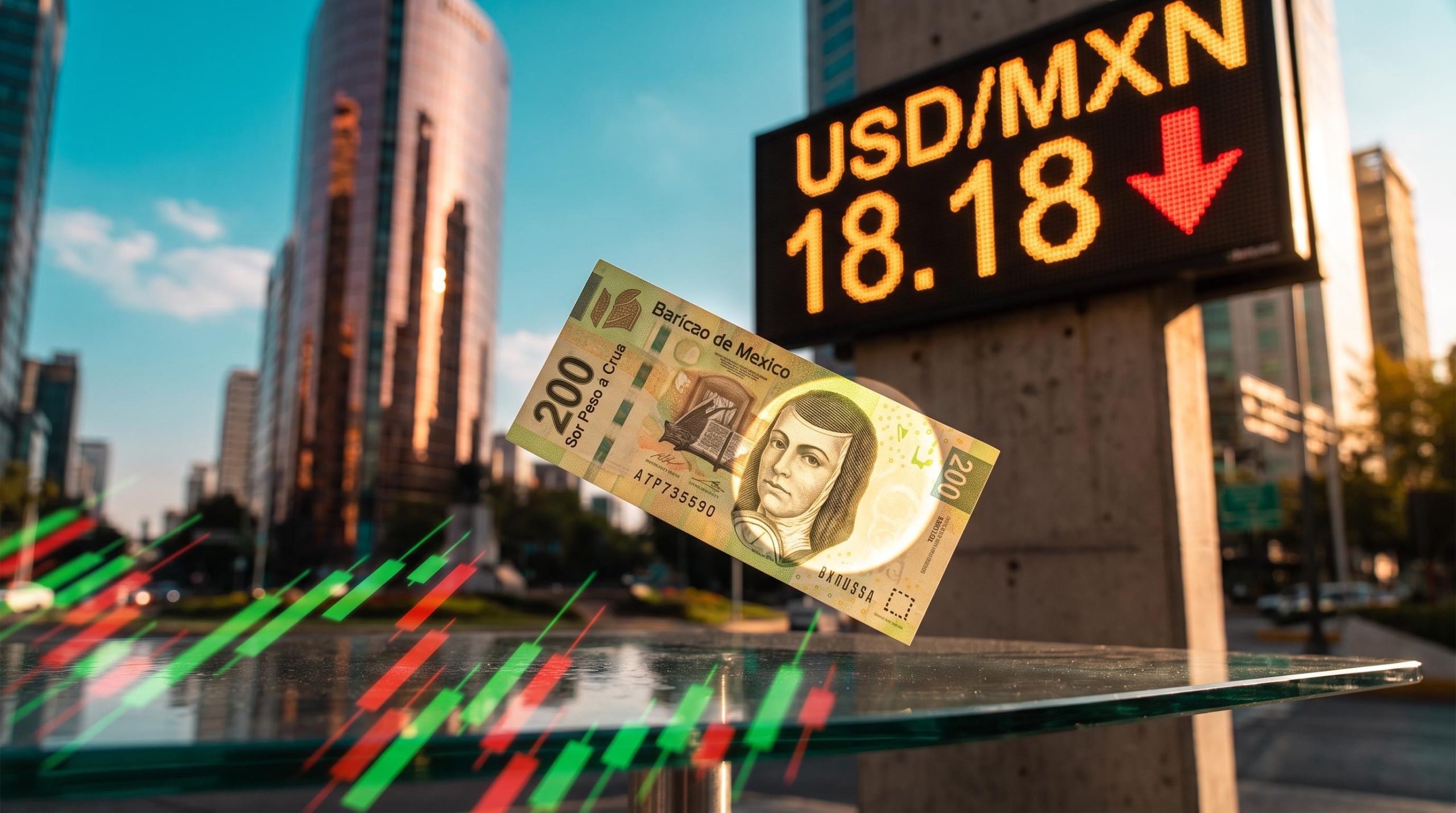
The Mexican peso fell about 0.91% against the US dollar on Thursday, pushing USD/MXN to roughly 18.18. Over the same session the US Dollar Index barely moved, slipping 0.07% to 102.17. The dollar trailed most G7 currencies but still beat the peso, which points to a peso problem rather than a dollar rally, and that shapes any USD/MXN forecast from here.
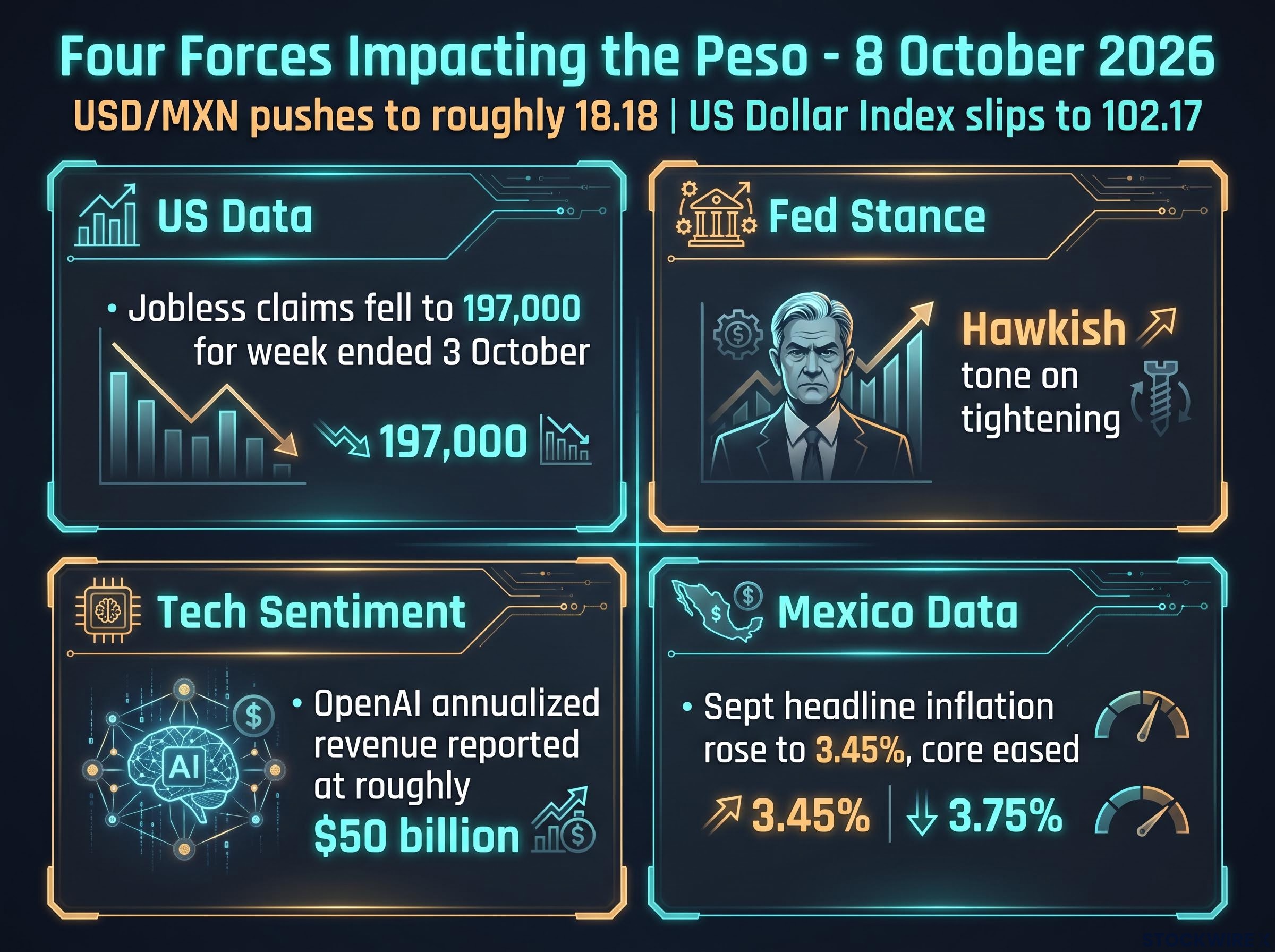
Four forces hit the currency on 8 October 2026. Federal Reserve officials sounded hawkish. US jobless claims came in firm. A report on OpenAI’s revenue unsettled tech stocks. Mexico’s latest inflation data muddied the case for lower rates.
Some of these forces fade within days. Others can set the peso’s direction for months.
Here is how to tell which is which, and a working framework for judging where the pair may head next.
Why did the peso fall when the dollar barely moved?
A flat dollar and a weaker peso can look contradictory. They stop looking that way once you list what hit the market on Thursday:
- Firm US jobless claims: these supported the case for keeping US rates high.
- Hawkish Fed commentary: this reinforced the view that the Fed is not finished tightening.
- The Financial Times report on OpenAI: this knocked tech shares and triggered a risk-off turn, meaning investors moved away from riskier assets.
- Fading Iran optimism: early relief gave way as equities slid.
The peso is a liquid, high-beta emerging market (EM) currency. High-beta means it moves more sharply than the broader market when sentiment shifts. That combination made it the easiest asset to sell when risk appetite cooled.
US rate transmission to emerging markets works through term premia, capital outflows and reserve buffers, which is why a hawkish Fed can weigh on the peso even when the dollar index itself barely moves.
US data and Fed tone
Initial jobless claims fell to 197,000 for the week ended 3 October, below the 200,000 consensus. The four-week average eased to 198,000. A labour market that stays this tight gives the Fed little reason to soften.
St. Louis Fed President Alberto Musalem added to that message. He said inflation remains above 2% and that more tightening is required. The Federal Open Market Committee (FOMC), the Fed’s rate-setting body, had already raised rates by 25 basis points to 3.75-4.00% in September, and the minutes showed every member supported the move.
The risk-off trigger
The session opened on a brighter note. A Truth Social post from President Trump citing productive talks with Iran supported global stocks early in the day.
That support did not last. The Financial Times, citing internal documents, reported that OpenAI’s annualised revenue was about $50 billion as of September.
The OpenAI revenue gap Reported annualised revenue of roughly $50 billion sits around $20 billion below the $70 billion figure previously circulated to investors and media.
The report fed doubts about whether the AI-driven equity rally can hold, even with OpenAI projecting around $350 billion in revenue by 2030. The research did not capture index-level equity moves, so the story is best read as a sentiment trigger, not a Mexico-specific event.
The point for you is this: traders used the peso to release global risk-off pressure. A peso drop on a day like Thursday is not automatically a verdict on Mexico’s economy, and risk-driven moves tend to fade faster than moves driven by fundamentals.
When big ASX news breaks, our subscribers know first
Can Banxico cut while inflation risks tilt upward?
The risk-off story explains Thursday’s speed. Mexico’s own data explains why buyers did not rush back in.
Mexico’s statistics agency, INEGI, reported that full-month September headline inflation rose to 3.45% from 3.26%, just under the 3.47% forecast. Core inflation, which strips out volatile items such as food and energy, eased to 3.75% from 3.88%, slightly below the expected 3.8%. An earlier, separate release covering the first half of September showed headline at 3.42% and core at 3.79%.
| Indicator | Latest | Prior | Expected | Read |
|---|---|---|---|---|
| Headline CPI (Sept, full month) | 3.45% | 3.26% | 3.47% | Rising, but below forecast |
| Core CPI (Sept, full month) | 3.75% | 3.88% | 3.8% | Easing, below forecast |
| Banxico policy rate | 6.50% | 6.50% | Not available | Held at 24 September decision |
| Fed funds target range | 3.75-4.00% | 3.50-3.75% | Not available | Hiked 25bp in September |
The picture is mixed. Headline inflation is climbing while core is cooling.
The Bank of Mexico, known as Banxico, held its rate at 6.50% on 24 September. Minutes released on Thursday showed a majority of members willing to consider cuts at future meetings if conditions allow. The same minutes flagged that the projected inflation path is tilted to the upside.
Banxico’s forward guidance shift matters here, because moving to a data-dependent stance leaves the rate path open in both directions and makes each inflation print a potential repricing event for the peso.
That leaves two broad paths:
- Cut path: core keeps easing, headline stays inside the target band, and Banxico trims rates.
- Hike trigger: inflation breaches 4%, the top of Banxico’s 2%-4% tolerance band around its 3% target, and policymakers reverse course. Whether they would actually hike remains an open question.
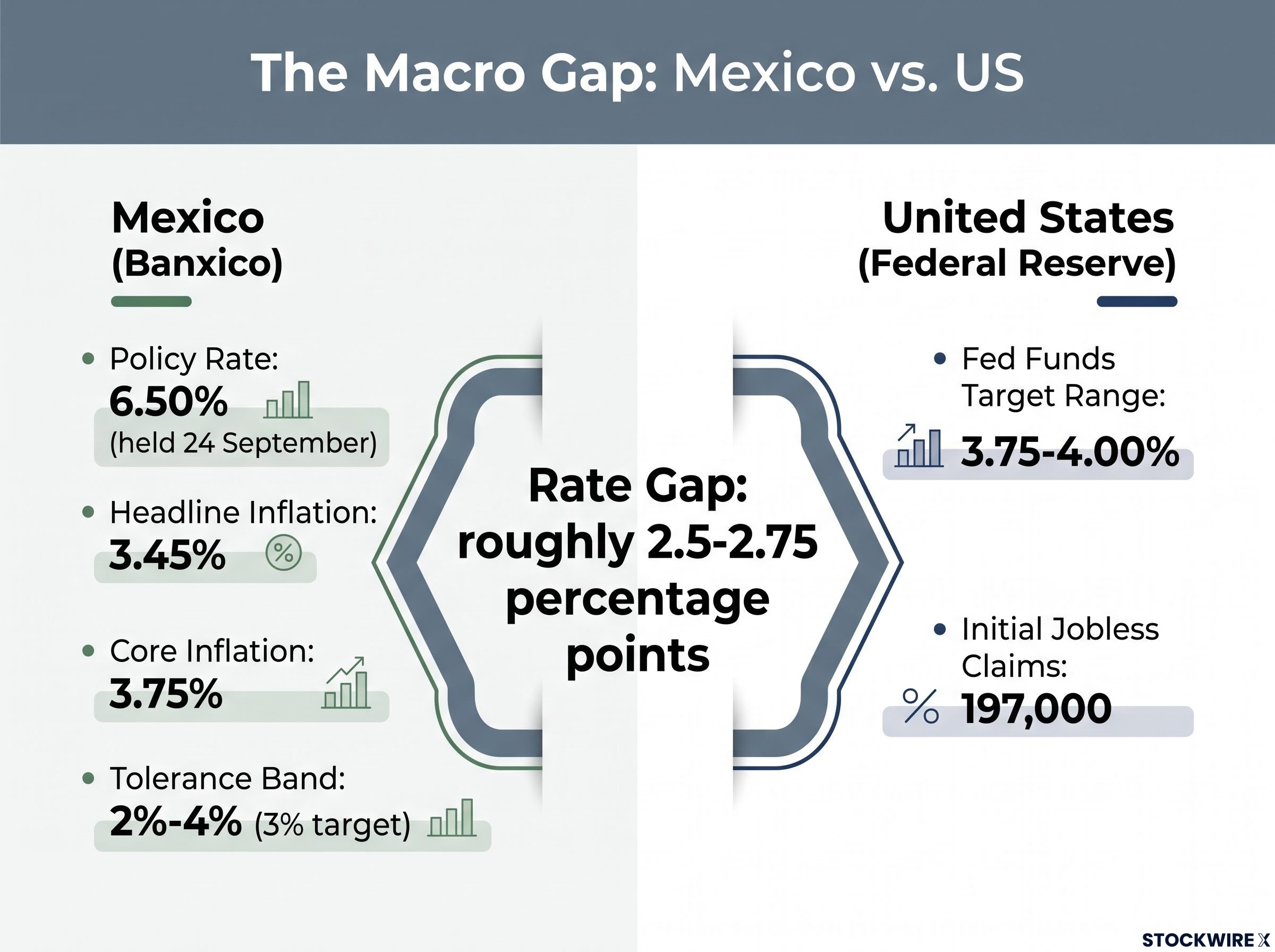
The gap between Banxico’s 6.50% and the Fed’s 3.75-4.00% works out to roughly 2.5-2.75 percentage points. That gap is the cushion that keeps carry trades attractive. Watch whether a Banxico cut or a further Fed hike starts to narrow it, because that matters more for the medium-term peso than any single day’s headlines.
What does the technical picture say about USD/MXN?
The macro picture leaves policy finely balanced. The chart is less ambiguous, at least on the surface.
An AI-assisted daily chart read from FXStreet puts the pair at 18.1986, extending a recovery above clustered simple moving averages (SMAs) near 17.29. An SMA is the average closing price over a set number of days. Horizontal support sits around 16.89. Holding above both zones would point to dip buying and a bullish near-term bias for the dollar.
Momentum tells a more cautious story. The 14-period relative strength index (RSI), a gauge that measures how fast and how far a price has moved on a scale of 0 to 100, reads 72.18. Readings above 70 are generally treated as overbought.
The RSI caveat RSI can stay overbought for long stretches during strong trends, and it does not predict when or how far a reversal will come. In high-beta EM currencies like the peso, strong macro drivers can keep it elevated longer than in calmer G10 pairs.
| Scenario | Trigger | Level to watch | Risk |
|---|---|---|---|
| Bull case (USD up) | Strong US data, higher-for-longer Fed | Holding above 18.1986 | Overbought RSI limits upside |
| Pullback case | Momentum cools, risk-off eases | SMA cluster near 17.29 | Fresh tech or Fed shock |
| Peso rebound case | Carry reasserts, Banxico keeps its real yield edge | Support near 16.89 | Dovish Banxico surprise |
Positioning adds another layer. If speculators have crowded into long-dollar, short-peso trades, a positive Mexican surprise could force a short squeeze, where traders rush to buy back the peso to close losing bets.
An RSI of 72.18 tells you the move is stretched, not that it is about to reverse. A consolidation or mild pullback is easier to defend than a confident call for a sharp peso recovery.
For readers wanting to build their own scenario maps, our dedicated guide to forex technical analysis shows how to combine SMAs, trend lines and RSI on any currency pair.
What actually moves the Mexican peso?
What you saw on Thursday, a currency falling harder than its fundamentals seemed to justify, makes sense once you see how the peso is used.
The peso is the most traded currency in Latin America. Global funds trade it heavily in spot, forwards and options markets. That liquidity makes it a convenient way to express a view on emerging market risk as a whole, so it can overshoot in both directions.
Carry and the rate gap
A carry trade means borrowing in a low-interest currency and investing in a higher-yielding one to capture the difference. Mexico has historically kept rates above US rates, which makes the peso a popular carry target.
When risk appetite collapses, those positions unwind quickly. Investors sell pesos and buy dollars, and USD/MXN jumps. During the COVID-19 shock of 2020, the pair surged as carry unwound, then recovered as sentiment stabilised and Banxico anchored inflation expectations.
Banxico’s credibility on its 3% target, plus or minus one point, matters here. In past pivots, moves seen as too dovish produced sharper peso selloffs than cautious, data-driven ones.
Structural drivers
- Nearshoring: Mexico’s role in US supply chains supports long-term demand for the peso.
- Remittances: large, steady inflows provide a slow-moving buffer, though they do not stop daily swings.
- Oil: Pemex revenues have linked the peso to crude, but the correlation is not constant.
- US tariffs: anticipated tariffs tend to trigger risk-off moves in the peso and wider EM currencies.
USMCA review risk adds a policy layer to the structural drivers, since stalled trade talks could delay nearshoring investment and turn each annual review into a discrete peso event.
Knowing which driver dominates on a given day tells you how to read a peso drop. A sentiment spike may offer an opportunity. A policy or trade shock is more of a warning.
Reading the peso through the next data cycle
Thursday’s slide looks like a risk-driven spike sitting on top of a still-wide rate cushion. The overbought RSI favours consolidation over a clean reversal, and Banxico’s split signals keep the medium-term path open.
Your watchlist from here:
- University of Michigan Consumer Sentiment
- Further Fed commentary on tightening
- Banxico’s next communication
- Whether Mexican inflation approaches 4%
- AI and tech sentiment
The available research did not include named strategist forecasts or index-level equity data, so treat this as a framework rather than a price call. If risk appetite steadies and the rate gap holds, the case for the peso strengthens. If either cracks, the dollar keeps its edge.
This article is for informational purposes only and should not be considered financial advice. Investors should conduct their own research and consult with financial professionals before making investment decisions. Past performance does not guarantee future results. Financial projections are subject to market conditions and various risk factors.