
The finish line for US monetary policy looks closer than it is. Core PCE inflation is running at roughly a 2% annualised pace over the past three months, yet the Federal Reserve raised rates by a unanimous 12-0 vote in mid-September. Chair Warsh has never said how fast inflation must slow before officials consider it fast enough.
That gap is the puzzle. A 2% short-run pace sits right on target, while the 3.0% year-over-year core reading sits well above it.
Citi economist Andrew Hollenhorst has filled the silence with his own yardstick, effectively a Fed core PCE benchmark the central bank itself has never published. Meanwhile, fed funds futures price in fewer than two rate cuts over the next 12 months.
How this gets resolved feeds directly into rate expectations, mortgage and borrowing costs, and how you position a portfolio. Here is a working framework for reading the next inflation prints and Fed signals without mistaking an analyst’s estimate for a central bank promise.
What does Citi’s 2% annualised pace actually claim?
The number on screen is simple. Core PCE, the Fed’s preferred inflation gauge excluding food and energy, rose 0.2% month-on-month in August, according to the Bureau of Economic Analysis (BEA) release on 30 September 2026.
Downward revisions to June and July pulled the three-month annualised pace to about 2%. “Annualised” means taking a short-period change and projecting what it would equal if sustained for a full year.
| Measure | Latest reading | Period | Source note |
|---|---|---|---|
| Core PCE m/m | 0.2% | August 2026 | BEA; July revised to 0.1% |
| Core PCE y/y | 3.0% | August 2026 | BEA |
| Three-month annualised core PCE | About 2% | June-August 2026 | After revisions to June and July |
| Headline PCE y/y | 3.4% | August 2026 | BEA-based summaries; Warsh cited about 3.6% on 16 September, before the release |
Yahoo Finance said the 2% pace cooled the case for another hike. CNBC called the core reading “much lighter than expected” while noting it still sits above target.
Hollenhorst’s claim builds on that reading:
Citi’s view A steady monthly core PCE pace running near 2% annualised would probably meet the Fed’s test of inflation easing quickly enough, potentially opening the door to a more dovish stance.
He goes further. Hollenhorst does not see the US economy as overheated, never saw a strong case for the hike, and expects underlying inflation to stay subdued over the next four months, with year-over-year readings still falling despite seasonally strong January and February prints.
Why the Fed has not named a number
Neither the FOMC statement, the minutes released on 7 October 2026, nor Warsh’s press conference defined a numeric threshold. That leaves markets without an official benchmark, which is exactly why analyst yardsticks carry so much weight.
The absence of a stated threshold feeds the credibility gap investors already see in long-term yields, where a hawkish statement and a cautious press conference sent conflicting signals about the Fed’s reaction function.
What this tells you: a 2% pace is a plausible bar for a dovish turn, not a promise. Treat it as a scenario marker rather than a trigger.
When big ASX news breaks, our subscribers know first
Core PCE versus core CPI: which inflation gauge is the Fed reading?
If the benchmark is unofficial, the next question is which inflation figure it should even be applied to. The answer is less obvious than the headlines suggest.
Core PCE tracks prices for what households consume, measured by the BEA. Core CPI, compiled by the Bureau of Labor Statistics (BLS), tracks a basket of consumer prices. Both strip out food and energy, but they weight items differently, and the Fed frames its 2% target in PCE terms.
August showed how far apart they can sit. Core CPI rose about 0.269% month-on-month (rounding to 0.3%), and core services accelerated to 0.3%. The drivers behind that picture:
- Base effects: core CPI fell to 2.4% year-over-year, per the EY review of BLS data, a post-pandemic low helped by high readings from a year earlier dropping out of the calculation.
- Core services: monthly services inflation picked up even as the annual rate eased.
- Cellphone services: the largest surge on record added about 0.08 percentage points to headline CPI and 0.1 points to core.
The figures also conflict across sources. Citi-based material puts core CPI near 3.2% year-over-year, and Warsh described core PCE and CPI as running in the “low-3% area”.
Energy and cellphones: noise or signal?
Energy costs have climbed since spring, but Citi does not expect a material lift to core inflation. The increases have not been broadly passed through to goods, and slowing real incomes limit how much higher pricing consumers will accept.
The cellphone jump looks more like noise. Citi flags that it could reverse in September, which may produce a softer core print than expected.
The record wireless price jump distorted August readings in both CPI and core measures, and the gasoline-driven headline figure further obscured how soft underlying core inflation actually was.
The lesson for you: a single “inflation number” can mislead. Before drawing a policy conclusion, check which gauge, which time window and which source.
Why hike when the economy is not overheating?
That measurement fog makes the September decision look stranger still. On 16 September 2026, the FOMC voted 12-0 to lift the target range by 25 basis points to 3.75%-4.00%, even though Hollenhorst reads the minutes as showing some officials agreed the economy was not overheating.
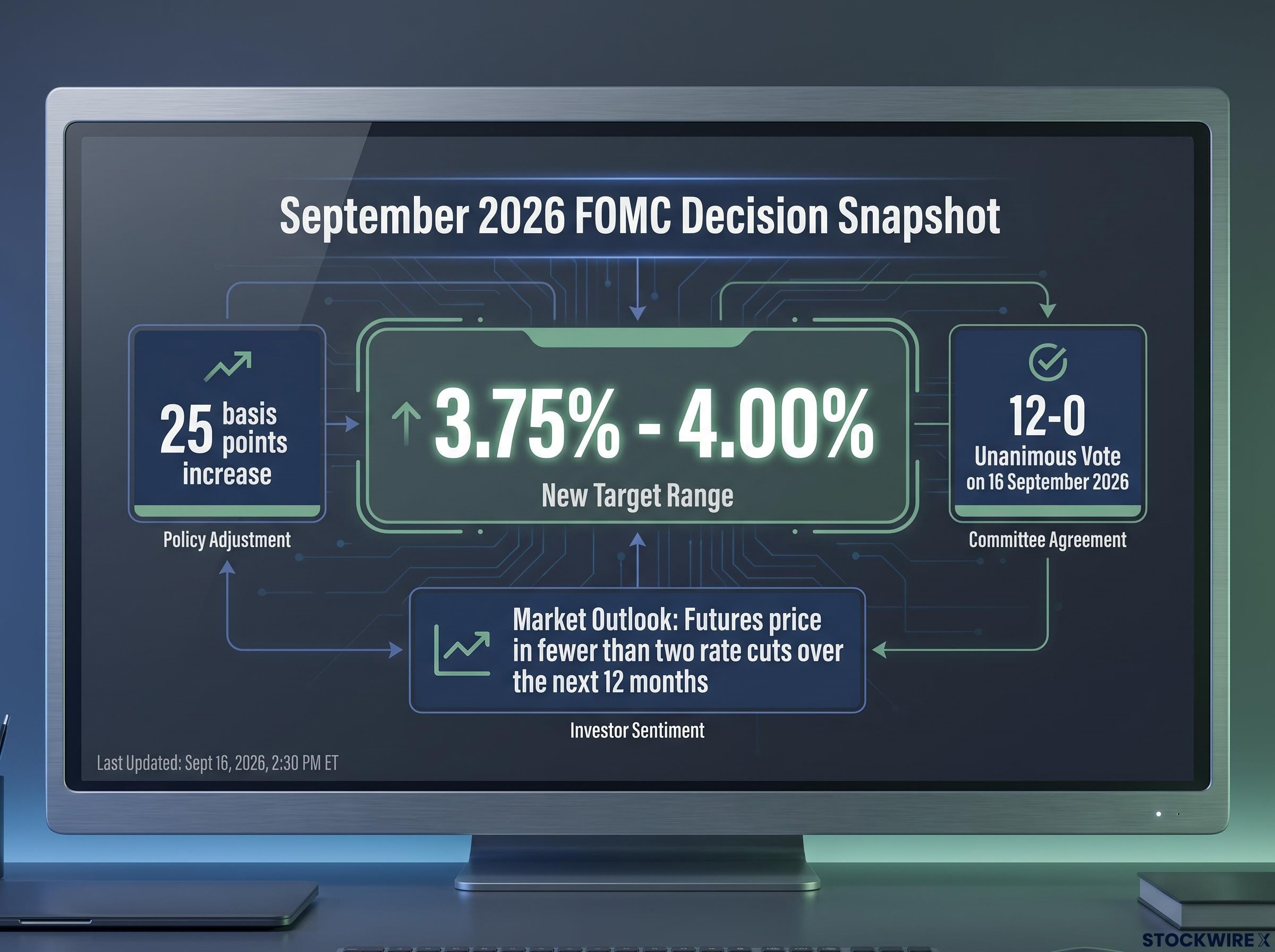
Warsh’s case rested on level, not momentum. Inflation was still well above 2%, at about 3.6% for total PCE and low-3% core by his account, and officials framed the move as insurance against upside risks.
| Argument | Supports hike | Supports caution | Evidence |
|---|---|---|---|
| Inflation expectations | Yes | No | Expectations could re-firm if the Fed appears tolerant of mid-3% inflation |
| Tariff and energy shocks | Yes | No | Could feed into core prices |
| Labour market | Yes | No | Strength could sustain above-target services inflation |
| Short-run disinflation | No | Yes | Falling core CPI; 2% three-month core PCE pace |
| Goods prices and growth risk | No | Yes | Goods disinflation; risk of unnecessary damage if cooling persists |
History offers no clean verdict on such moves:
- 1994: the Greenspan Fed tightened rapidly to pre-empt inflation that had not yet surged.
- 2015-2018: gradual hikes continued with inflation often near 2%, to build policy room.
- 2023: the Fed held restrictive policy despite signs of slowing growth, wary of persistent inflation.
In each case, the judgment came later and depended on what inflation actually did.
That is the key read for you. A risk-management hike weighs what could go wrong, not only what has happened, so one soft print is unlikely to reverse the stance quickly. Futures pricing fewer than two cuts over 12 months suggests markets agree, which points to borrowing costs staying elevated for longer.
Where could a 2% benchmark mislead you?
Even the clean 2% pace deserves scrutiny. Five caveats each weaken the story:
- Base effects: core CPI’s drop to 2.4% partly reflects high readings rolling off, which can overstate true cooling.
- Methodology: the BEA revised how it measures prices for legal services, software and computer accessories, and portfolio management, with a sizable effect on August, as CNBC and TechTimes flagged.
- Short-run versus 12-month gap: a 2% three-month pace coexists with 3.0% annual core PCE.
- Volatility and seasonality: the cellphone surge may reverse, and January and February tend to run hot, although Citi still expects annual rates to fall.
- Persistence: the Fed will likely want sustained evidence, not one quarter’s pace.
Key caution Part of the recent improvement in core PCE is statistical, driven by BEA measurement changes rather than shifts in underlying price behaviour.
A practical way to read the coming releases:
- Check the three-month annualised core PCE pace for consistency near 2%.
- Confirm the 12-month core rate is falling, not just the short-run measure.
- Strip out distorted components such as cellphone services.
- Listen for any Fed definition of “fast enough”.
Look for several consecutive soft months and a declining annual core rate before concluding the Fed has what it needs to ease.
The Fed also watches trimmed mean and median gauges, which were trending near 2% earlier this year and show whether disinflation is broad or concentrated in a few components.
What the 2% pace changes, and what it does not
A steady 2% annualised core PCE pace is a credible marker for easing. It remains Citi’s inference, though, not Fed policy, and the 12-month core rate is still above target.
Markets reflect that restraint. Futures price in fewer than two cuts over the next year, so nobody is betting on a swift unwinding of September’s hike.
Futures pricing fewer than two cuts also invites a comparison between the dot plot and futures pricing, since the two signals have diverged and each carries different information for borrowers and portfolio positioning.
Your decision points sit in a short list of variables: the next few core PCE and CPI prints, any Fed definition of “sufficiently fast”, and whether cellphone and seasonal distortions flatter or inflate the data.
Past performance does not guarantee future results. Financial projections are subject to market conditions and various risk factors. These statements are speculative and subject to change based on market developments.
This article is for informational purposes only and should not be considered financial advice. Investors should conduct their own research and consult with financial professionals before making investment decisions.