Most traders treat an official “no devaluation” pledge as the end of the conversation. The People’s Bank of China (PBoC) said on 8 October 2026 that China has “neither the need nor the intention” to weaken the Yuan. Yet the same institution changed its fixing mechanism in August 2015 in a way markets read as a devaluation, which is why PBoC Yuan policy is better judged by what the bank does than by what it says.
The statement lands at a moment when the bank’s own data appears to back it. The 1-year Loan Prime Rate is unchanged at 3.00%. China posted a record second-quarter current-account surplus, and the Yuan has gained nearly 9% against the US dollar since late 2024.
If you hold Yuan exposure, trade emerging-market currencies or own exporters sensitive to China’s exchange rate, reading this signal correctly carries real money consequences.
Here is a working model of how the PBoC is built, which tools it uses to steer the currency, and which of its behaviours deserve more of your attention than its words.
What did the PBoC actually say, and does the data back it up?
On paper, the message is clean and confident. The PBoC said China “has never engaged in competitive currency devaluation” and that it has no reason to start.
The core line China has “neither the need nor the intention” to depreciate the Yuan to gain a competitive advantage in international trade. (PBoC, 8 October 2026, via Reuters)
The bank added that it sets no fixed exchange-rate target, does not intervene against long-term trends, and lets market forces play a decisive role within a two-way managed float. A managed float is a system where the currency moves with supply and demand, but the central bank guides how far and how fast it moves.
The PBoC also argued that the link between exchange rates and the current account is not simple or linear, and that a country’s competitiveness depends on more than its currency value. That point matters, because it pushes back on the idea that a cheaper Yuan automatically wins China more exports.
Now test the claim against the numbers, reported by Reuters and relayed by FXStreet and others.
| Metric | Value | Date | Source note |
|---|---|---|---|
| Onshore USD/CNY spot | ~6.703 | 8 October 2026 | Market reports |
| Offshore USD/CNH | ~6.704 | 8 October 2026 | FXStreet |
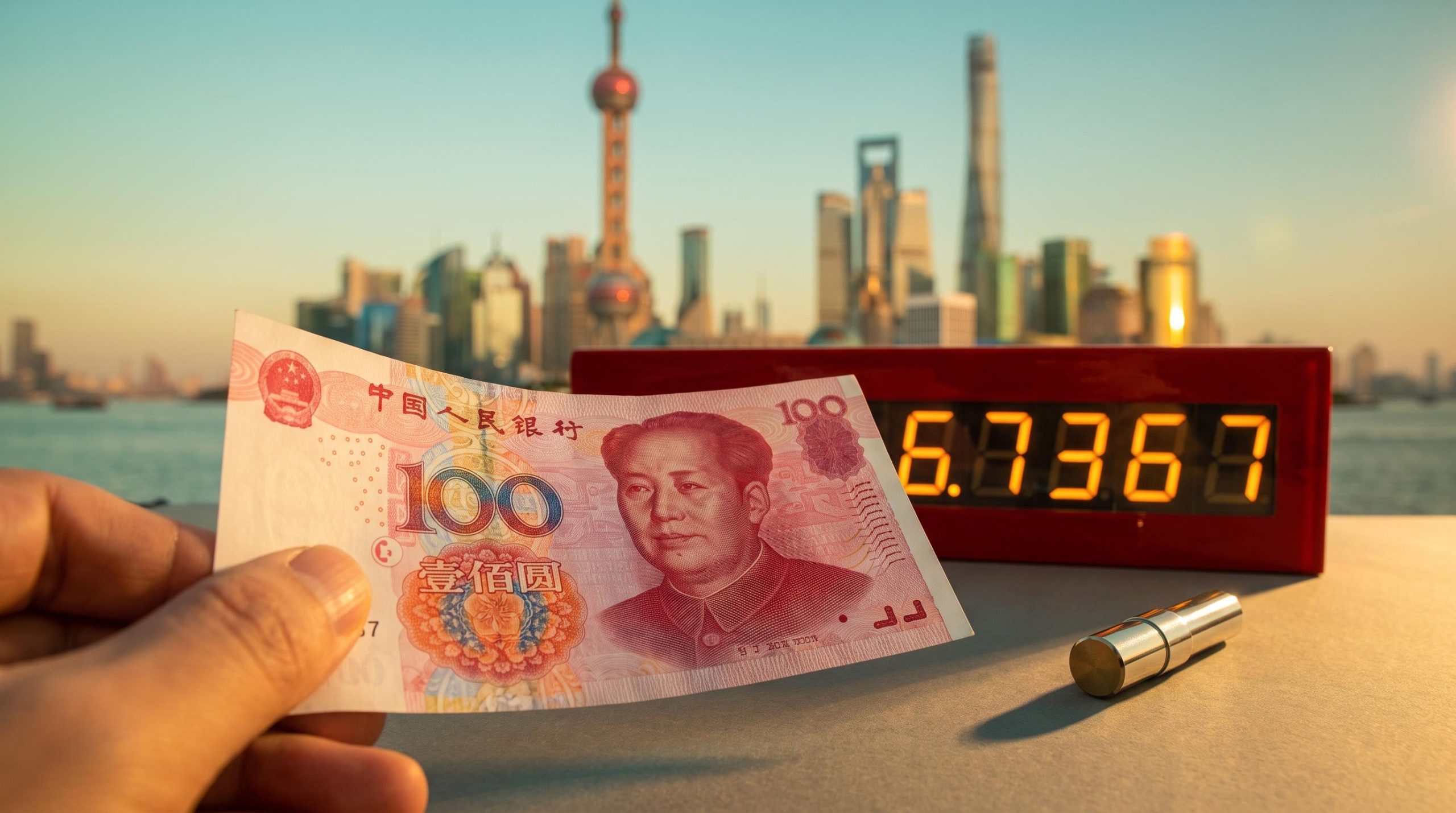
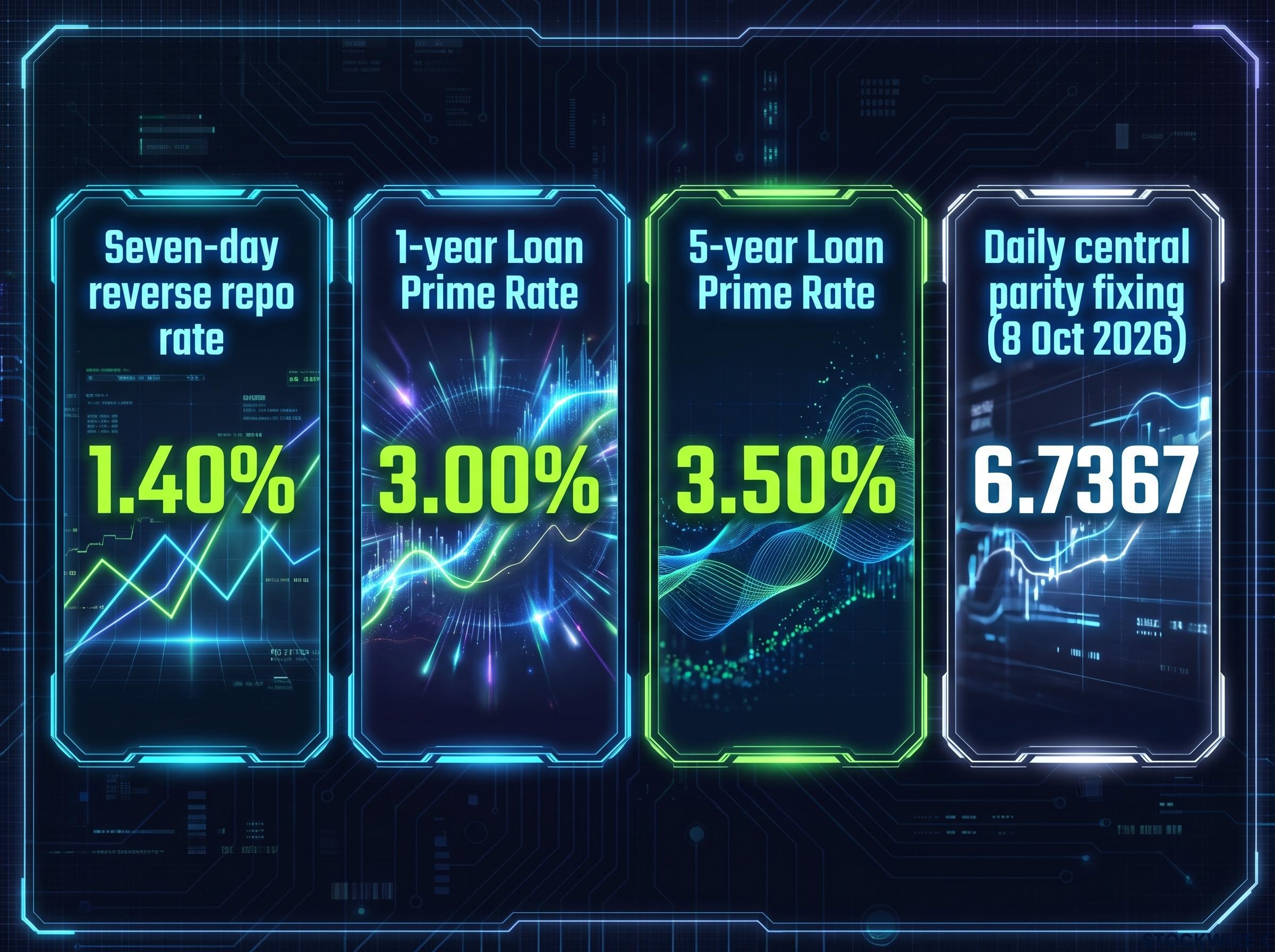
| Daily central parity fixing | 6.7367 | 8 October 2026 | PBoC fixing |
| July trade surplus | US$112.5B | July 2026 | Customs, via Trading Economics |
| August trade surplus | ~US$119.1B (CNY 809.3B) | August 2026 | Customs, via Trading Economics |
| Q2 current-account surplus (final) | US$193.7B | Q2 2026 | SAFE |
The Q2 surplus was the largest second-quarter figure on record, up from US$128.7 billion a year earlier. It was built on a goods surplus of US$278.8 billion, partly offset by a US$55.4 billion services deficit.
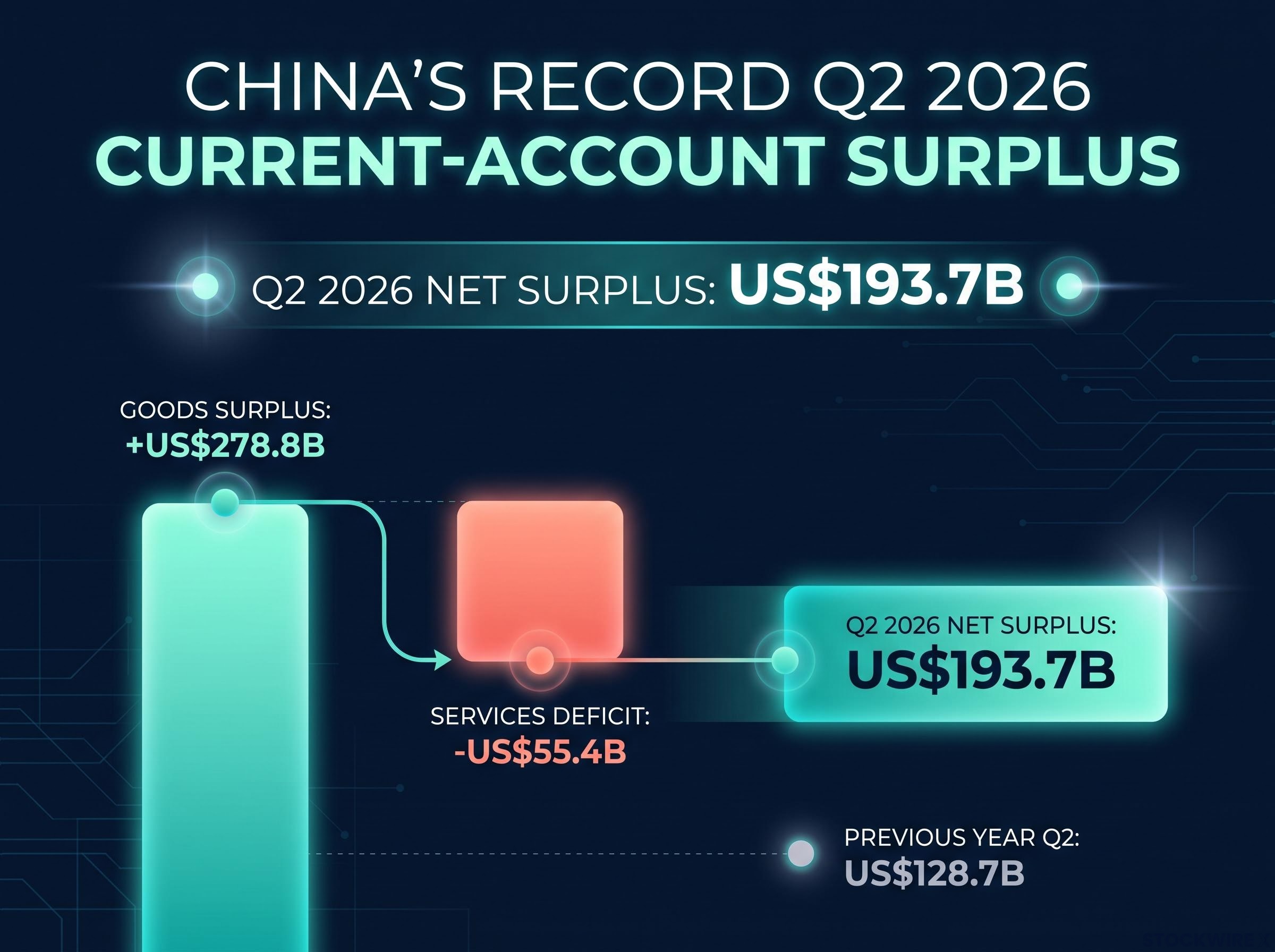
That is the key to reading the pledge. Surpluses of this size bring a steady flow of foreign currency into China, which is already pushing the Yuan higher, so promising not to weaken it costs the PBoC very little today. The pledge only faces a real test if those surpluses narrow.
Falling bond yields alongside a firmer currency are historically rare, and they suggest the PBoC currently faces no sharp trade-off between domestic stimulus and holding the Yuan steady.
What the 2027 IMF reporting step does and does not tell you
Beijing also said it will begin reporting additional foreign-exchange data to the International Monetary Fund (IMF) from 2027, framed as a transparency measure on exchange-rate policy.
The catch is that official releases have not named the dataset or standard involved. Until they do, you cannot tell whether it will shed light on the operations traders most want to see, such as state-bank currency activity.
When big ASX news breaks, our subscribers know first
How is the PBoC built, and why does that shape every Yuan signal?
If you are used to the US Federal Reserve or the European Central Bank, you probably assume a central bank’s word is an independent promise. With the PBoC, that assumption breaks down quickly.
Three structural facts explain why:
- Ownership: The PBoC is state-owned and sits under the State Council, China’s cabinet, so it is not autonomous.
- Leadership: Power is split. The Chinese Communist Party (CCP) Committee Secretary at the bank, nominated by the State Council Chairman, has more influence over its direction than the governor. Pan Gongsheng currently holds both roles.
- Mandate: The bank’s aims include price stability (which covers exchange-rate stability), economic growth and financial reform, such as developing China’s financial markets.
That mandate is broad by design. When growth, stability and reform pull in different directions, currency policy can be bent to serve whichever priority the leadership ranks highest.
Because Party governance sits above the bank’s professional toolkit, you should read every PBoC statement as a political directive as well as a monetary signal, something no Fed or ECB communication carries in the same way.
| Feature | Typical Western central bank | PBoC |
|---|---|---|
| Independence | Operationally independent of government | State-owned, under the State Council |
| Top authority | Governor or chair | Party Committee Secretary (currently also the governor) |
| Exchange rate | Usually free-floating | Managed float with a daily fixing |
The rest of the financial system offers little counterweight. According to The Straits Times, China has just 19 private banks, fully privately capitalised domestic lenders were only allowed from 2014, and the largest are WeBank and MYbank, backed by Tencent and Ant Group.
For you, this changes what a PBoC pledge actually is. It is a policy commitment backed by Party priorities, which means it can hold very firmly while those priorities stay put, and shift quickly if they change.
Which tools move the Yuan, and how do they fit with a “no devaluation” pledge?
Knowing who runs the PBoC tells you why its words carry conditions. Knowing its tools tells you where to look for those conditions changing.
The anchor is the seven-day reverse repo rate, the rate at which the PBoC lends short-term cash to banks against collateral. Governor Pan confirmed it became the primary policy anchor in July 2024. It sits at 1.40%, cut from 1.50% in May 2025, and analysts polled by Reuters expect no cut for the rest of 2026.
Banks then set the Loan Prime Rate (LPR) as a markup over that rate. The LPR is the benchmark for loans, mortgages and savings, with the 1-year at 3.00% and the 5-year at 3.50%. Because interest-rate gaps between countries steer where global money flows, these rates feed directly into Yuan demand.
| Tool | What it does | Yuan relevance |
|---|---|---|
| Seven-day reverse repo | Sets short-term funding cost for banks | Cuts can weaken the Yuan via lower yields |
| Loan Prime Rate | Benchmark for loans and mortgages | Shapes rate gaps and cross-border flows |
| Daily central parity fixing | Sets the midpoint for onshore trading | Directly anchors the daily band |
| Counter-cyclical factor | Adjustment inside the fixing formula | Lets the PBoC lean against market pressure |
| State-bank FX operations | Buying or selling currency in the market | Smooths volatility or defends levels |
| RRR and Medium-term Lending Facility | Control bank reserves and longer-term liquidity | Easing adds liquidity, which can soften the Yuan |
The reserve requirement ratio (RRR) is the share of deposits banks must hold in reserve. The current level for large banks has not been specified in recent releases, and no recent change has been announced.
The daily fix is where management becomes visible. In broad terms, it works like this:
- Market makers submit quotes that feed into the fixing calculation.
- The PBoC factors in external conditions, such as moves in the dollar index.
- The counter-cyclical factor can strengthen the fix when depreciation pressure is heavy.
- The published fix anchors the band in which onshore Yuan trades that day.
- State banks smooth volatility within that band as needed.
On 8 October 2026, the fix of 6.7367 sat on the weaker side of spot near 6.703. The gap between the two is one of the clearest variables you can track: a fix that suddenly diverges further from where the market trades is often the first hint of a policy shift.
The fix gap on 8 October, with the fix roughly 113 pips weaker than the Reuters estimate while spot traded stronger, suggests Beijing is moderating yuan strength rather than defending against weakness.
Why low, steady rates limit pressure on the Yuan
The Asian Banker reports the LPR was held for a 15th consecutive month at the 20 August 2026 fixing, even after net new RMB bank lending fell by a record RMB 340 billion in July. Holding rates through that weakness shows the PBoC is choosing not to ease in ways that could drag the Yuan down.
There is a trade-off. Low yields also limit the foreign inflows that might otherwise support the currency. For you, frozen rates are a sign the bank is currently leaning against Yuan weakness, and a surprise cut would be an early warning for the pledge.
Why should traders weigh PBoC behaviour above PBoC words?
History is the reason. In August 2015, the PBoC changed its fixing mechanism and allowed a sharp one-day weakening, presented as a step towards a more market-based rate. Markets read it as a devaluation to help exporters, and the result was global risk aversion and capital outflows.
In 2019, the Yuan broke through 7.0 per US dollar amid US-China trade tensions. The PBoC called the move market-driven, while many observers saw deliberate tolerance of a weaker currency to offset tariffs.
Neither episode involved a formal announcement of devaluation. Both came through technical channels.
That history fuels the debate around today’s statement. Supporters point to the surpluses, frozen rates and the IMF reporting commitment. Critics see rhetoric designed to pre-empt manipulation accusations, echoing past US claims that China kept the Yuan undervalued, while leaving the bank’s operational room intact.
The research points to four risks worth keeping in view:
- Policy can change quickly if growth slows further or external conditions worsen.
- Limited transparency on state-bank FX operations and counter-cyclical adjustments means large, surprising moves in the fix are possible.
- If surpluses narrow or capital outflows accelerate, the trade-off between supporting growth and holding the currency steady becomes sharper.
- Geopolitical tensions and domestic political priorities can override economic logic.
A practical set of signals to watch:
- The daily fix relative to market-implied levels
- Any change to the fixing methodology or the counter-cyclical factor
- Signs of heavier state-bank buying or selling
- Divergence between fundamentals (trade data, current account, domestic rates) and PBoC actions
The bottom line Technical changes to the fixing mechanism have delivered de facto devaluations before, despite official denials.
The pledge lowers the odds of a deliberate devaluation in the near term, but it does not remove tail risk. Your position sizing should reflect how little of the PBoC’s operations you can actually see, not the reassurance in the headline.
Investors weighing geopolitical tail risk can read our detailed coverage of USD/CNH scenarios after the trade truce, which maps three distinct paths for the renminbi.
What the pledge settles, and what it leaves open
The pledge is credible right now because the conditions make it easy to keep. Record surpluses and frozen rates are doing the work. What it cannot settle is how the PBoC behaves if those conditions fade, and its structure and track record both say behaviour will reveal that before rhetoric does.
Your near-term checklist is short. Watch the next LPR fixing for any break in the hold, the daily fix against spot for widening gaps, the next SAFE and customs releases for signs the surplus is narrowing, and any detail on what the 2027 IMF reporting will actually cover.
If all four stay steady, the pledge holds. If one moves, give the move more weight than the words.
Past performance does not guarantee future results. Financial projections are subject to market conditions and various risk factors. Forward-looking statements are speculative and subject to change based on market developments and policy decisions.
This article is for informational purposes only and should not be considered financial advice. Investors should conduct their own research and consult with financial professionals before making investment decisions.