A 10-year Treasury yield near 5.3% and a 30-year at 5.6-5.7%, the highest in roughly two decades, reads like a fiscal alarm. The bond market may be sending a different message. Rising Treasury yields can also mean the US economy is running hotter than investors expected.
The quarter ending September 2026 produced one of the largest quarterly yield increases this century. The move is global: Japan’s 10-year has pushed above 3% and France’s sits near 5%.
Whether this is a growth story or a debt story decides how much duration risk you should carry. Duration risk is the sensitivity of a bond’s price to changes in interest rates.
Here is a test for telling an economy-driven yield rise from a debt-driven one, plus Ed Yardeni’s staged approach to buying longer-dated Treasuries.
What are bond vigilantes, and why should yields track nominal GDP?
After a decade of near-zero rates, a 10-year at 5.27-5.31% (as of 6 October 2026) looks extreme. Measured against the size of the economy, it looks far more ordinary.
The growth reading gains support from history, since pre-QE yield levels in the early-to-mid 2000s sat close to today’s, suggesting the post-2008 era of suppressed rates was the anomaly.
Bond vigilantes are investors who sell government bonds to push back against loose fiscal or monetary policy, driving yields higher until policymakers respond. Yardeni Research founder Ed Yardeni says he coined the term in 1983. It became famous in the early 1990s, when the Clinton administration was warned that bond markets would punish deficit spending.
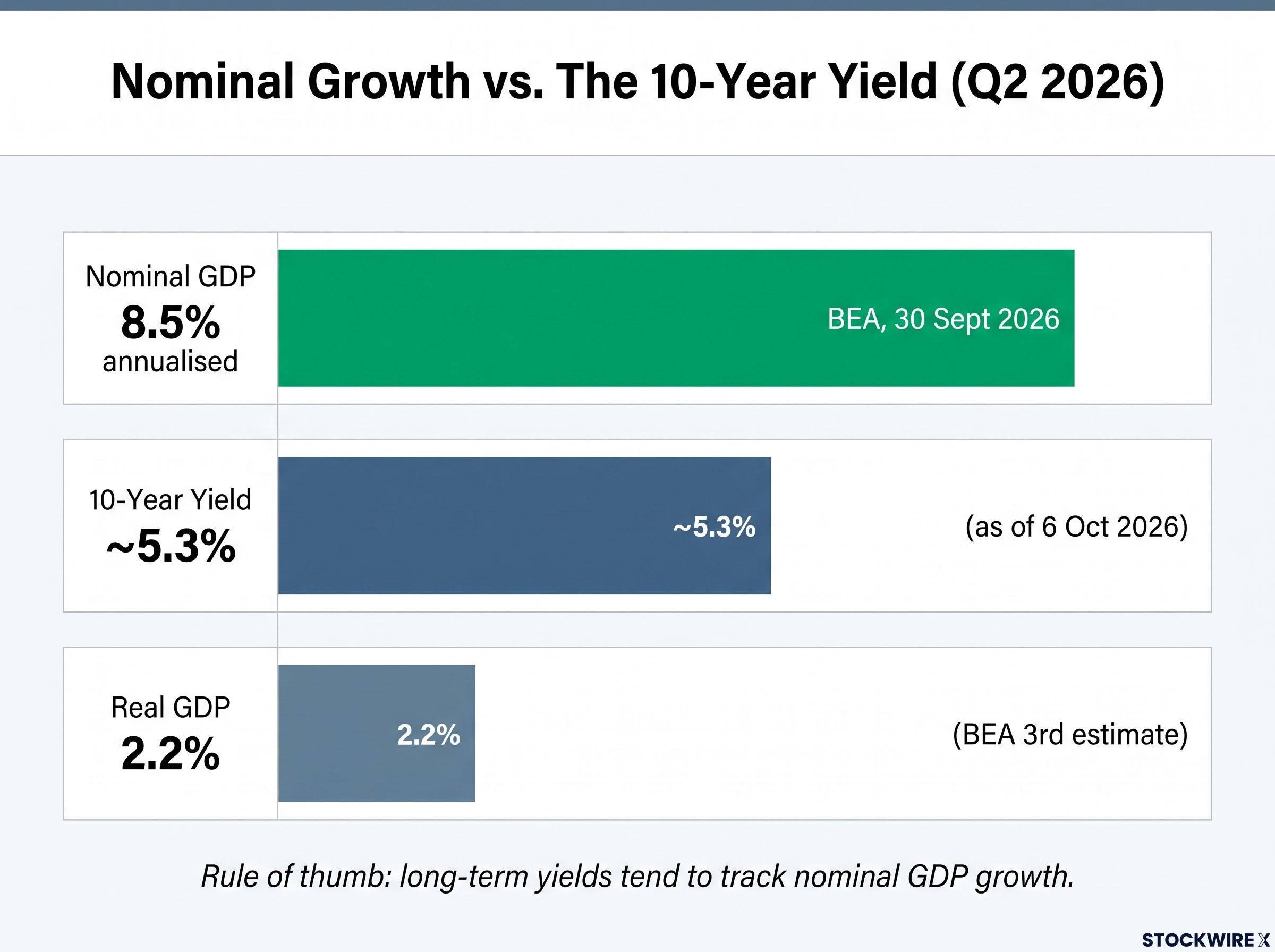
The rule of thumb is that long-term yields tend to track nominal GDP growth. Nominal GDP is economic output measured in current dollars, so it includes inflation.
How the 1970s broke the rule
In the 1970s, yields stayed below nominal growth because investors underestimated inflation. Henry Kaufman and Albert Wojnilower were among the few economists who saw it coming. Paul Volcker‘s sharp tightening at the Federal Reserve ended that inflation wave.
Why the vigilantes returned
Since the early 1980s, Yardeni says, yields have generally traded above nominal GDP growth. Discipline did not mean crisis: in the 1990s, fiscal policy tightened and the US reached a surplus by decade’s end, with no default.
Nominal growth versus the 10-year Q2 2026 nominal GDP: 8.5% annualised (BEA, 30 September 2026). 10-year yield: about 5.3%.
Real GDP grew 2.2% in Q2 2026, according to the Bureau of Economic Analysis (BEA) third estimate. Yardeni describes nominal growth as running above 6%. If yields are anchored to nominal growth of that size, a 5.3% 10-year looks like a normal market pricing a normal economy. Read the level before reading panic into the direction, and check it yourself against each GDP release.
When big ASX news breaks, our subscribers know first
Is this a strong economy or a debt problem? The three camps
That benchmark favours the growth reading, but it does not settle the debate. Three serious camps are competing to explain the same chart.
Yardeni’s case
Yardeni argues the neutral rate has risen. The neutral rate is the interest rate that neither speeds up nor slows down the economy. His evidence is the Fed’s own language: earlier this year it called policy restrictive, while the Fed chair now says a small amount of accommodation is being withdrawn. Policy that was “restrictive” at similar levels and is now “accommodative” implies the neutral rate has moved, although the research found no Fed statement putting a number on it.
He also points to retiring baby boomers, who hold roughly $100 trillion in net worth and earn more interest income as rates rise. AI capital spending by the hyperscalers is less sensitive to borrowing costs. In his view, the abnormal period was between the global financial crisis and the pandemic, not now.
The sceptics
The fiscal camp points to heavy deficits and supply. The Treasury raised over $2 trillion in marketable securities in the past 12 months, which pushes up the term premium. The term premium is the extra yield investors demand for locking money up over a long period. A Dalio-style debt-cycle camp goes further and sees rising interest costs as an early warning of inflationary finance or currency pressure.
| Camp | Core claim | Main driver | Implication for yields | Key weakness |
|---|---|---|---|---|
| Growth and neutral rate (Yardeni) | Rates are returning to normal | Retiree spending, AI capex | Fair level, may still drift higher | AI capex may be concentrated and cyclical; ageing could lower trend growth |
| Fiscal and term premium | Yields exceed fundamentals | Deficits, supply, fiscal dominance | Higher risk premium persists | Hard to separate from growth effects |
| Debt cycle (Dalio-style) | Late-stage debt cycle | Rising interest costs | Potential spike | No US default or funding failure so far |
Yardeni concedes a Dalio-style crisis is possible. Equities also send mixed signals: the market-cap-weighted S&P 500 sits near record highs, while the equal-weighted index is down about 6% from its August peak.
The camps disagree on cause but share one conclusion: the repricing may not be finished. Which camp is right determines whether you are being paid fairly for duration or absorbing unpriced risk. Hold your view as a probability, not a certainty.
Why France looks like Greece, Japan like a carry-trade story, and the US like neither
The same uncertainty becomes clearer when you look abroad. Yields are rising across major markets, but Yardeni reads three different stories.
| Market | 10-year yield | Main driver | Yardeni’s read | Crisis type |
|---|---|---|---|---|
| United States | 5.27-5.31% | Growth, higher neutral rate | Economic strength | None so far |
| Japan | 3.09-3.11% | Inflation after deflation, BoJ hikes | Cheap financing ending | Possible carry-trade unwind |
| France | 4.8-5.0% | Fiscal and political stress | Resembles Greece 2010 | Debt crisis |
Japan’s 10-year first crossed 3% in early September 2026, the first time since 1996, as inflation took hold after decades of deflation. Yardeni argues Bank of Japan (BoJ) hikes may be ending the cheap yen financing that investors used to buy bonds elsewhere. That would explain why yields are rising in step around the world.
Synchronised moves in global bond yields, driven by deficits, heavy long-dated issuance and sticky inflation, help explain why the dollar can strengthen even as fiscal stress spreads across major economies.
France’s 10-year sits near 5%, its highest since 2002; sources range from about 4.8% to 5.0%. Some accounts call it France’s worst quarter since 1987. Yardeni says French fiscal policy and politics are out of control, much like Greece in 2010. German 10-year yields have also hit multi-year highs.
Lessons from Greece 2010 and the UK in 2022
Greece’s 10-year reached about 40%, yet the crisis stayed local. In the UK in 2022, an unfunded mini-budget collided with leveraged liability-driven investment (LDI) pension strategies, forcing the Bank of England to step in. The US has had neither a comparable single fiscal shock nor that concentration of leverage.
Crises tend to cluster where monetary sovereignty or institutional credibility is weak. With deep markets and reserve-currency status, the US sits closer to the 1990s than to Athens or London.
A spike in French or Japanese yields does not by itself tell you the US is in trouble. A Japan-driven carry-trade unwind could still lift US yields mechanically, which is a different problem from a credit scare.
What can Bessent actually do if yields keep climbing?
If the US story is strength, policy support is a backstop rather than a rescue. Treasury Secretary Scott Bessent has three levers:
- Buybacks: expanded in September 2026 to operations of up to $6 billion, doubling prior ceilings for longer maturities
- Japan coordination: backing higher BoJ rates and yen intervention so Japan need not sell Treasuries
- T-bill financing: funding larger long-bond purchases by issuing short-term bills
The buybacks are designed to improve liquidity and calm markets, not to set prices. Yardeni says a genuine crisis could force a much larger Operation Twist-style programme, swapping short-term debt for long-term debt.
Buyback scale Now: about $6 billion per operation. Possible crisis response: $15-20 billion per operation, financed in the T-bill market (Yardeni).
The Japan lever cuts both ways. A stronger yen without Treasury sales also unwinds the carry trade, which may push global yields higher, including in the US. Yardeni says Bessent’s “house” remark was made in a Japan context and was poorly framed.
His broader judgement is that Bessent is constrained and his tools have been ineffective since August. If the response already looks stretched while yields rise on strength, treat any jump toward $15-20 billion operations as a stress signal, not a floor under prices.
How to position for duration: Yardeni’s dollar-cost averaging approach
With limited policy support and an unfinished repricing, Yardeni’s answer is to buy gradually. He recommends dollar-cost averaging (investing fixed amounts at regular intervals) into longer-dated Treasuries, because yields could rise further if the vigilantes are taking revenge after years of suppressed bond markets.
The case for buying in stages
For investors holding 5-10 years, a 5.3% 10-year and a 5.6-5.7% 30-year offer decent coupons and the return of principal at maturity. Yardeni expects productivity gains to lower inflation over the next 5-10 years, which would make today’s yields look attractive. Pensions and endowments may also find mid-5% yields adequate compensation for gradual accumulation.
A sample staged entry might look like this:
- Set a total duration allocation sized against your risk budget.
- Split it into equal tranches.
- Buy one tranche at a fixed interval regardless of the yield.
- Favour intermediate maturities over 30-year bonds if drawdowns would trouble you.
- Review the plan after each GDP release and Treasury buyback announcement.
What could go wrong
- Mark-to-market losses: if the neutral rate and term premium are still repricing, bond prices can fall further
- Fiscal and inflation risk: persistent deficits could keep inflation high, eroding real returns
- Reinvestment risk: if yields later fall, maturing bonds roll into lower rates
- Multi-year drawdowns: staged buying reduces timing risk but does not remove it
Yardeni’s approach treats the yield as attractive and the entry point as uncertain. Size the position for a worse mark before a better one. This is one analyst’s view, not personal advice.
Duration risk explains why default-free Treasuries can still lose money: a long-duration fund fell more than 30% in 2022, which is why matching duration to your holding period matters before any staged buying begins.
Past performance does not guarantee future results. Financial projections are subject to market conditions and various risk factors.
What the yield rise settles, and what it leaves open
The evidence leans toward a growth and higher-neutral-rate reading. Nominal output is outpacing the 10-year, and the Fed’s own language has shifted. A debt-crisis outcome remains a tail risk the market has not ruled out, and every camp agrees the repricing may still have further to go.
Three variables will tell you which way the balance tips:
- Nominal GDP prints relative to the 10-year yield
- Whether Treasury buybacks scale beyond $6 billion per operation
- The pace of BoJ rate rises and any carry-trade unwind
If nominal growth holds above yields and buybacks stay routine, staged duration buying fits the evidence. If either breaks, the sceptics gain ground, and your position size should reflect that.
This article is for informational purposes only and should not be considered financial advice. Investors should conduct their own research and consult with financial professionals before making investment decisions.