Adobe beat on revenue and earnings, edged its full-year guidance higher and crossed one billion monthly active users. The stock fell anyway. The Adobe Q3 FY2026 results raise one question: what is the market seeing that the engagement numbers are not?
The quarter ended 28 August 2026 and was reported on 10 September 2026. It tested whether surging user growth is finally converting into faster revenue growth. Phillip Securities called the results in line, kept a Neutral rating and set a US$261 target.
The backdrop adds uncertainty. Chief Executive Shantanu Narayen hands the role to Anil Chakravarthy on 1 December 2026, in the middle of an AI repositioning.
Here is a working framework for weighing user growth against near-term revenue acceleration. It also shows why a neutral stance on the stock is defensible right now.
What did Adobe actually deliver in the quarter?
On the surface, the quarter was clean. Revenue reached US$6.76 billion, up 13% year on year (12% in constant currency, which strips out exchange-rate movements). GAAP diluted earnings per share came in at $4.62, and non-GAAP EPS, which excludes items such as stock-based compensation, reached $6.13.
Total ending annual recurring revenue (ARR) hit $27.50 billion, up 11.2%. Phillip noted that revenue and adjusted profit had already reached 74% and 78% of its full-year forecasts, with the Creative Cloud Pro deal doing most of the work.
Then the small print arrived.
| Metric | Q3 FY2026 / FY2026 guidance | Change |
|---|---|---|
| Revenue | $6.76B | +13% YoY |
| Non-GAAP EPS | $6.13 | Beat |
| Total ending ARR | $27.50B | +11.2% YoY |
| FY2026 revenue guidance | $26.576B-$26.626B | About +0.2% |
| FY2026 non-GAAP EPS guidance | $24.45-$24.50 | About +0.3% |
Phillip’s own calculations put the revenue guidance lift at roughly 0.2% and the EPS lift at about 0.3%. That is a rounding-error raise. Net new ARR also fell year on year, and some reports put remaining performance obligation (RPO) growth, a measure of contracted future revenue, at about 8%.
Unchanged ARR guidance According to Phillip Securities, FY2026 ending ARR growth guidance stayed at 10.2%, down from 11.5% in FY2025.
A beat paired with a near-flat guidance lift tells you the quarter confirmed Adobe’s existing trajectory rather than changing it. That is why “in line” is the right label, and why the raise did not spark a rally.
Adobe’s muted reaction to a clean beat reflects the broader legacy software repricing, in which investors rotated away from headcount-dependent licensing models and now demand proof before restoring premium multiples.
When big ASX news breaks, our subscribers know first
Why is engagement surging while ARR growth stays near 11%?
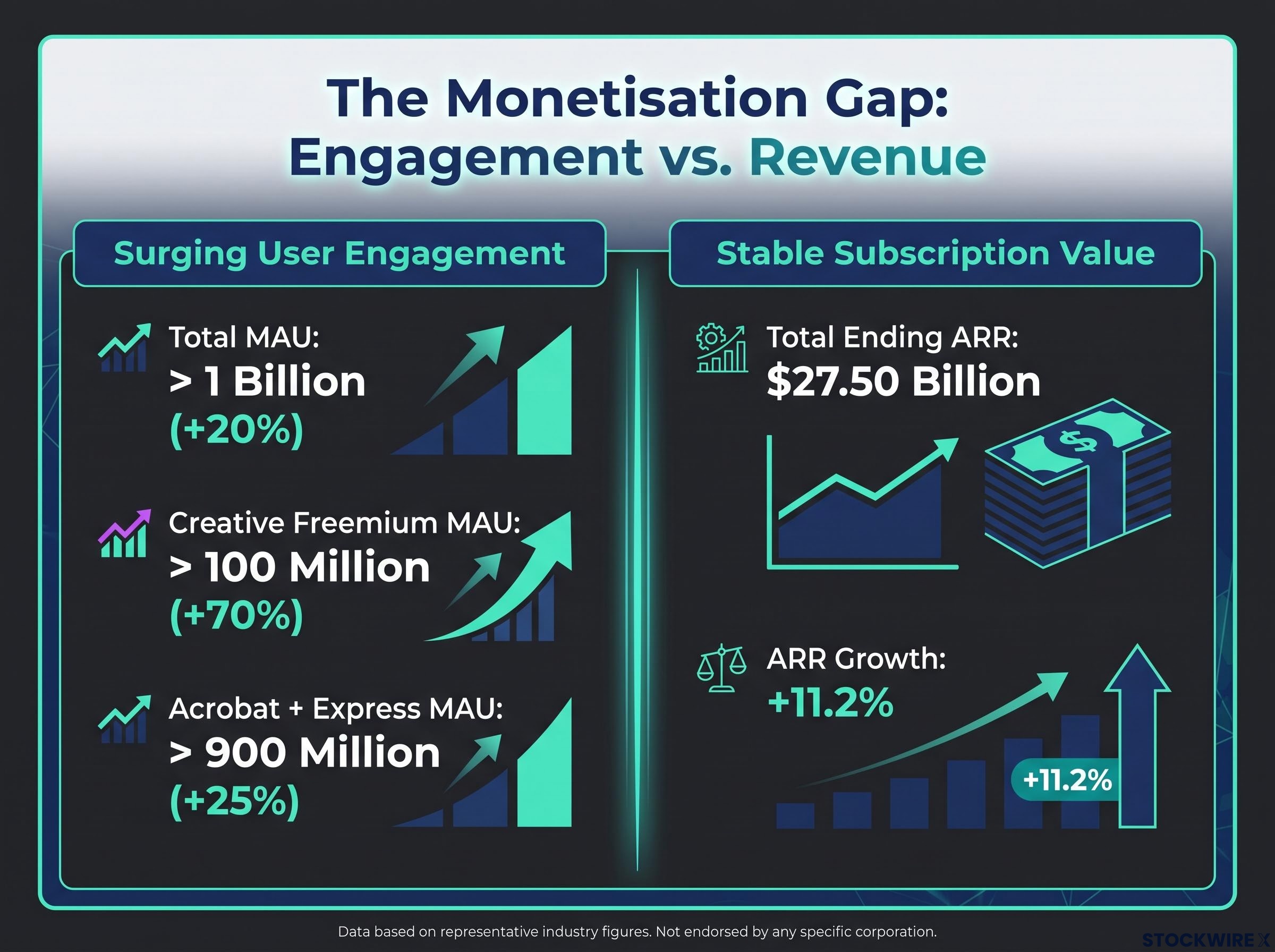
Put the two sets of numbers side by side and the gap is hard to miss. Monthly active users (MAU), the count of people using a product at least once a month, passed one billion, up more than 20%. Creative freemium MAU, meaning users on free versions that offer paid upgrades, topped 100 million, up over 70% on uptake of Firefly, Express, Premiere, Photoshop and Lightroom.
Acrobat and Express combined passed 900 million MAU, up over 25%, and Acrobat AI Assistant users doubled quarter on quarter. Acrobat now summarises documents, builds interactive reports and slides, and extracts knowledge across large document sets.
Yet ARR, the yearly value of subscription contracts, grew only 11.2%. Document revenue rose 16% to US$1.91 billion, while Creative & Marketing Professionals revenue rose 13% to US$4.65 billion.
Three mechanics explain most of the delay:
- Embedded AI: many AI features sit inside existing subscriptions, lifting usage without creating separate ARR.
- A long freemium funnel: free tiers drive experimentation, but only heavier users and enterprises move to paid plans such as Creative Cloud Pro.
- Bundled credits: AI credits are usage allowances that pay for generating images or other outputs. Because many are included in subscriptions, extra usage often shows up as retention rather than new revenue.
The paid AI lines are moving fast from a small base. Firefly ending ARR rose 40% quarter on quarter, and AI-first ARR passed US$650 million, up more than 150%.
Traction versus scale AI-first ARR is roughly 2.4% of Adobe’s $27.5 billion total ARR base.
Adobe’s AI-first ARR of over US$650 million is meaningful, but analysts increasingly ask for quantified additive AI revenue, meaning proof that AI lifts total company growth above what the base business would deliver alone.
The bullish reading
Adobe is sitting on under-monetised demand. Premium tiers, tighter pricing and enterprise AI deployments could convert that usage into dollars over time.
The bearish reading
If guidance does not move despite huge usage gains, AI may be protecting the franchise rather than adding new revenue. Much of that promise may already be in the share price.
For you as an investor, usage growth is a leading indicator only if free and bundled users eventually pay. Until pricing and tier uptake prove that, treat engagement as a signal, not as revenue.
Why does Phillip Securities stay neutral at US$261?
That monetisation gap is exactly what Phillip’s valuation prices in. The broker lifted its target from US$203 to US$261, implying 14.3x FY2026 price-to-earnings (P/E), the share price divided by expected earnings per share. Adobe’s two-year average sits at 16x.
Phillip credits the stock’s recovery to three factors:
- Evidence that AI complements, rather than undermines, Adobe’s business
- Strong AI engagement across products
- Growing confidence in freemium monetisation
It still sees no inflection point. Phillip reads the unchanged ARR guidance as management choosing user base expansion over near-term revenue acceleration.
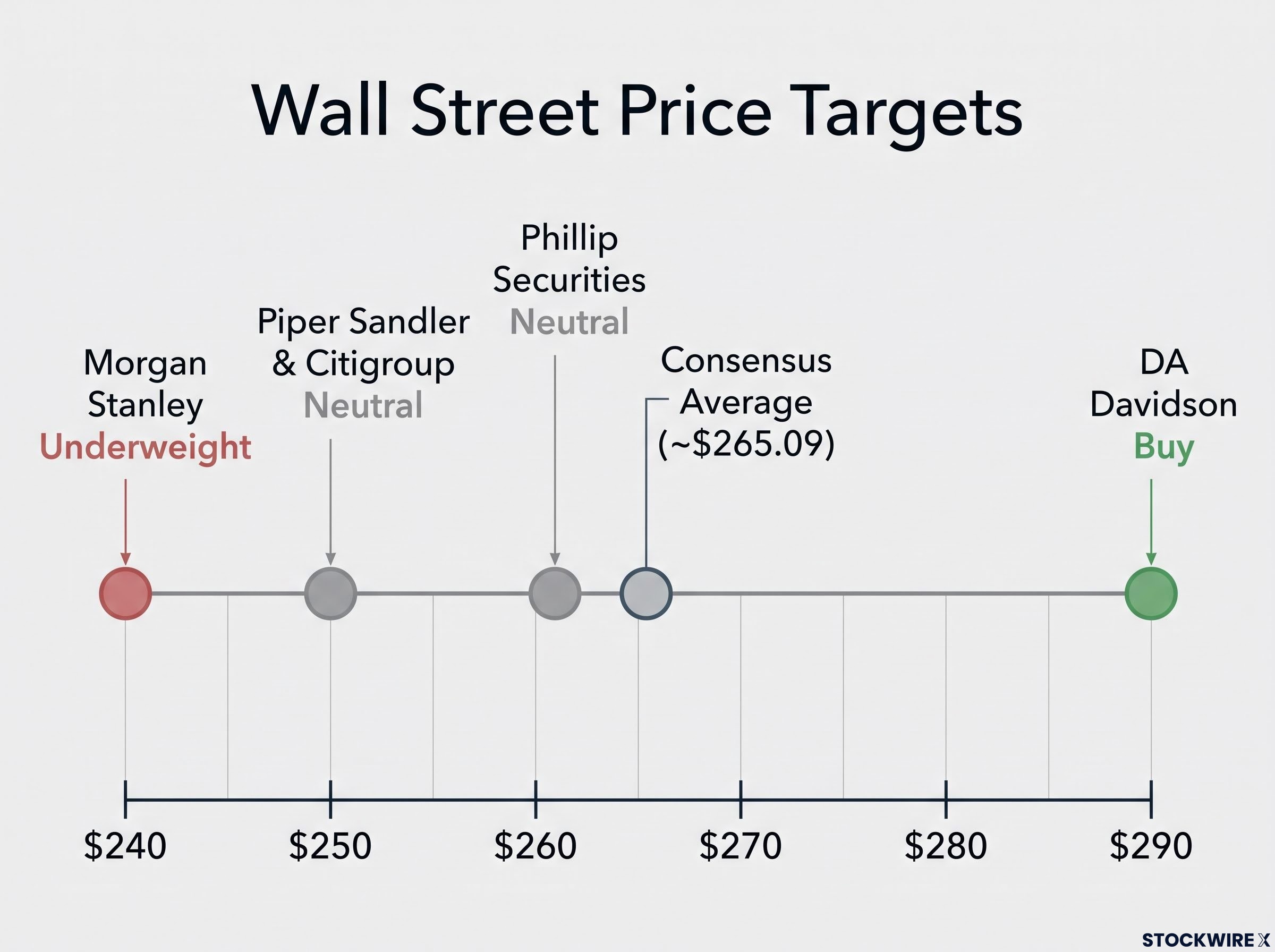
The wider street splits the same way. Consensus is Hold, with an average target of about US$265.09 and a range of roughly US$240-US$290.
| Analyst | Rating | Target |
|---|---|---|
| Morgan Stanley (Adam Wood) | Underweight | $240 |
| Piper Sandler | Neutral | $250 |
| Citigroup | Neutral | $250 |
| Phillip Securities | Neutral | $261 |
| DA Davidson | Buy | $290 |
The market agreed with the cautious middle. Shares slipped about 2% after hours, and weekly losses ran deeper.
A target pitched below the stock’s own two-year average multiple tells you Phillip is pricing in doubt about monetisation. A re-rating therefore depends on evidence of ARR acceleration, not another usage milestone.
What could keep the revenue gap open?
The threats are specific. Canva, Figma and other cloud-native tools offer cheaper, more collaborative options, especially at the low end and mid-market. Horizontal AI platforms from OpenAI, Google and others now generate images, video and documents inside broader workflows.
The quieter risk is seat compression. If AI lets fewer designers finish a project, user growth can rise while paid seats stall.
Seat compression is the Adobe-specific form of per-seat pricing pressure, since AI-native entrants using consumption pricing can undercut incumbents by wide margins while fewer users finish the same work.
- Low-cost design competition pressuring pricing
- Horizontal AI platforms substituting for some use cases
- Seat compression as AI lowers skill barriers
- Execution risk as Narayen becomes Executive Chair and Chakravarthy takes over as CEO on 1 December 2026
- Slowing indicators: falling net new ARR and RPO growth near 8%
Morgan Stanley’s Wood held his Underweight after the billion-user milestone, with TheStreet linking his caution to doubts that engagement will translate proportionally into revenue and margin gains. Zacks and Yahoo Finance frame AI as a complement rather than a cannibaliser, while Investing.com coverage says near-term earnings leverage remains unproven. On balance, the downside reads as valuation-driven rather than a sign of fundamental weakness.
What software history suggests
As a general industry pattern rather than Adobe data, collaboration and developer software firms often saw free-tier usage surge well before paid conversion caught up. Early AI features across productivity and design tools typically launched as included add-ons and served as retention tools first.
Markets usually applied cautious ratings until those companies proved pricing and value. Adobe’s current Hold and Underweight mix fits that pattern.
The real risk for you is not a broken moat but slowly eroding pricing power. These are the signals to watch:
- Net new ARR returning to year-on-year growth
- Uptake of paid Firefly credit packs
- Any change to ending ARR growth guidance
- Creative Cloud Pro and higher-tier adoption
- RPO growth moving back above 8%
These statements are speculative and subject to change based on market developments and company performance.
Weighing user growth against revenue: what to track from here
Adobe’s engagement is real, its AI monetisation is still unproven, and Phillip’s neutral call reflects that gap rather than a lack of conviction.
The framework is simple: check usage metrics first, paid conversion second and guidance changes third. Only when all three move together does the bull case gain hard evidence.
Your decision comes down to patience. If you need visible ARR acceleration before owning the stock, the next catalysts are any ARR guidance revision, the CEO handover on 1 December 2026 and the next earnings report. If you are comfortable waiting for the funnel to convert, the current multiple below the two-year average gives you room to watch.
This article is for informational purposes only and should not be considered financial advice. Investors should conduct their own research and consult with financial professionals before making investment decisions. Past performance does not guarantee future results. Financial projections are subject to market conditions and various risk factors.