Most investors treat the 50% capital gains tax (CGT) discount as a permanent fixture. It is not. The Treasury Laws Amendment (Tax Reform No. 1) Act 2026 received Royal Assent on 26 June 2026, and the replacement starts on 1 July 2027, roughly nine months from now.
The tax-saving habits that worked for decades now have a shelf life, and many investors have not noticed.
Interest, dividends and capital gains stack on top of your salary and are taxed at your marginal rate. That means small choices in 2026-27 can change your bill, and the next 12 months are the last stretch where the old discount applies to the full gain.
Here is a practical checklist of lawful ways to reduce investment tax in Australia this year, plus a clear picture of how the 2027 change affects when you sell. This is general information, not personal advice.
Where does your investment income sit on the 2026-27 tax scale?
Before any strategy makes sense, you need to know your marginal rate: the tax rate on your next dollar of income. Think of the brackets as a price list that sets how much each later tactic is worth to you.
| Taxable income | Tax payable | Marginal rate |
|---|---|---|
| $0-$18,200 | Nil | 0% |
| $18,201-$45,000 | 15% over $18,200 | 15% |
| $45,001-$135,000 | $4,020 + 30% over $45,000 | 30% |
| $135,001-$190,000 | $31,020 + 37% over $135,000 | 37% |
| $190,001+ | $51,370 + 45% over $190,000 | 45% |
These resident rates exclude the Medicare levy, which is generally 2% of taxable income. For singles, the low-income threshold is about $28,011, with a shade-in range to about $35,014.
Your marginal rate is the starting point for every tactic here, and the ATO tax rates and codes list the current resident brackets and Medicare levy settings you should check your income against before making any decision.
Three types of investment income are added to your wages:
- Interest: taxed in full at your marginal rate.
- Dividends: taxed at your marginal rate, with franking credits offsetting the tax.
- Net capital gains: the gain after losses, taxed at your marginal rate, with a 50% discount for assets held over 12 months under current rules.
Two spots matter most. The 15% rate on $18,201-$45,000 (down from 16%) and the jump from 30% to 37% at $135,000 are where tactical moves pay off.
The gap between brackets tells you that the same $5,000 of investment income can cost very different amounts depending on whose name it is in and which year it lands in. That is the logic behind every strategy that follows.
When big ASX news breaks, our subscribers know first
How can you cut capital gains tax under the current rules?
There are three CGT levers, and they run from the one you control most to the one that needs the most care.
Hold for more than 12 months
Individuals who hold an asset for at least a year receive a 50% reduction on the taxable gain. The Australian Taxation Office (ATO) excludes both the purchase day and the sale day when counting, so leave a buffer of a few days.
The $1,500 saving: On a $10,000 gain at the 30% bracket, selling at 11 months costs $3,000 in tax. Selling after 12 months taxes only $5,000, so the bill is $1,500.
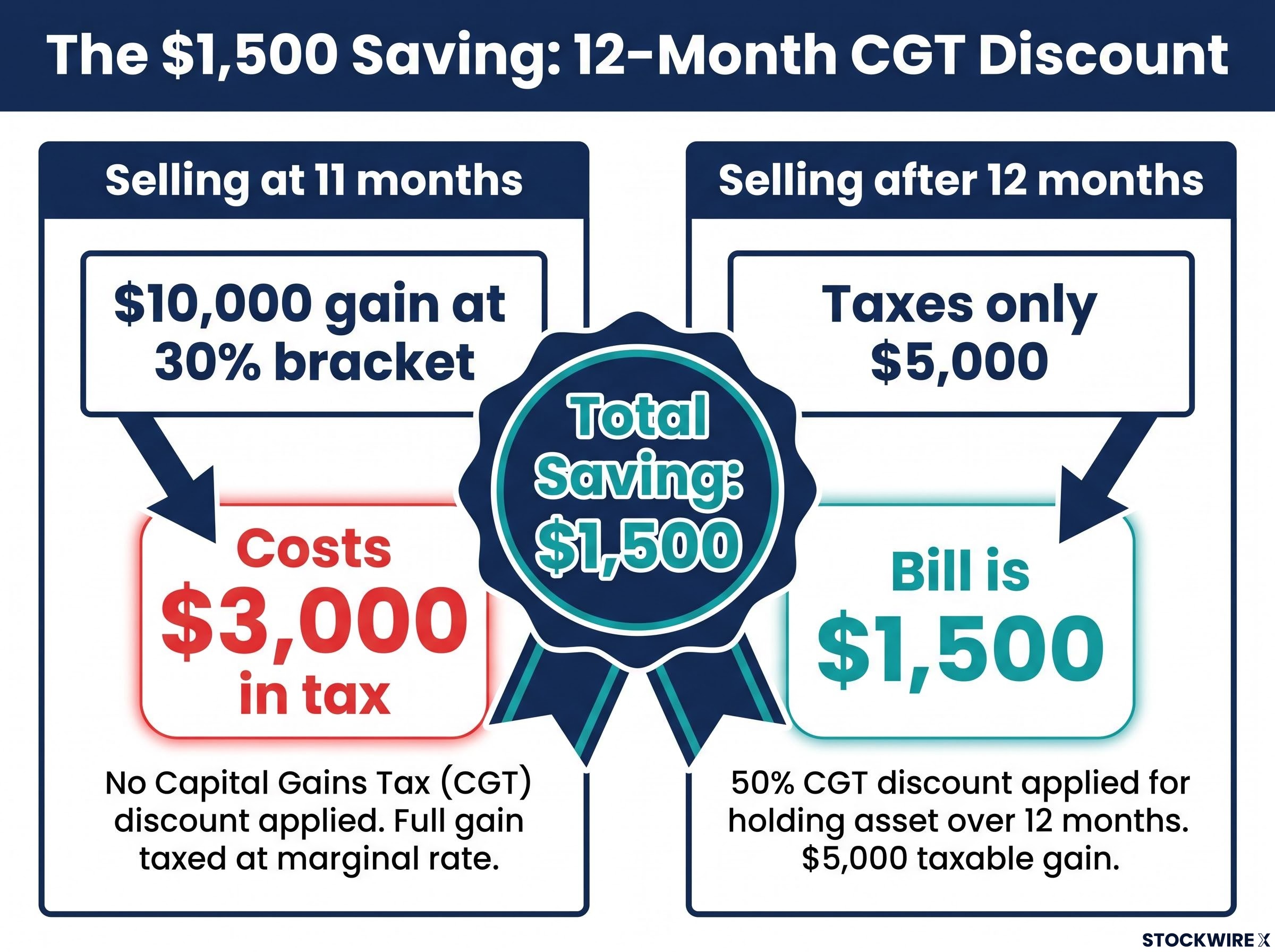
A few days of patience can halve the tax on a gain, so check your holding dates before you press sell.
Sell in a lower-income year
A gap year, study, part-time work or retirement can lower the rate applied to a gain. A $5,000 discounted gain costs $1,500 at 30% but $750 at 15%.
Calculate your total income first. If the gain pushes you into a higher bracket, the benefit disappears.
Use capital losses carefully
Realising losses on underperforming holdings offsets capital gains, and unused losses carry forward. A $4,000 gain offset by a $4,000 loss leaves no net gain.
The sale must be genuine. Under the ATO’s general position, a wash sale (selling to create a loss, then immediately rebuying) can be disallowed.
Check these before you sell:
- Have you passed 12 months, excluding purchase and sale days?
- What is your total income for the year, including this gain?
- Do you hold losses to offset it, including carried-forward ones?
- Is the sale genuine rather than a quick rebuy?
Which strategies reduce tax on interest and dividends?
Income-side tax is shaped by who owns the asset and where it sits. Start with franking credits, then move to super and ownership.
Franking credits
Many Australian companies pay 30% tax before they pay dividends. Franking credits pass that tax to shareholders, reducing your tax or producing a refund when your rate is below 30%.
A $700 fully franked dividend carries a $300 credit, so $1,000 is declared. At a 15% rate, tax is $150, and the other $150 is refunded.
If your credits total $5,000 or more in a year, you must hold the shares at least 45 days, excluding purchase and sale days.
Super contributions
Pre-tax contributions are generally taxed at 15%, often below personal rates, and earnings in super are generally taxed at 15% or less. $5,000 of pre-tax income at the 30% bracket costs $1,500 outside super but $750 inside, a $750 saving.
The concessional cap is $32,500, including employer contributions. Unused cap carries forward up to five years if your balance was under $500,000 at the prior 30 June; the non-concessional cap is $130,000.
The trade-off is that the money is locked until preservation age and a condition of release is met. Keep short-term money outside super.
Many households solve the lock-up problem by using super and ETFs together, directing long-term retirement money into super while keeping a liquid ETF portfolio outside it for needs before preservation age.
Splitting ownership between partners
Income is taxed to the owner, so holding investments in the lower earner’s name can cut household tax. $2,000 of interest costs $740 at 37% but $300 at 15%, a $440 yearly saving.
The ownership must be genuine. Consider future changes too, such as a return to work or a promotion.
Deductions and records
Interest on money borrowed to buy income-producing shares is usually deductible. Keep these records:
- Purchase dates and prices for every holding
- Each reinvested dividend, which is a separate purchase with its own cost base
- Loan statements showing interest paid
| Strategy | Example | Saving | Key catch |
|---|---|---|---|
| Franking credits | $300 credit, 15% rate | $150 refund | 45-day rule at $5,000+ credits |
| Super | $5,000 pre-tax at 30% | $750 | Locked until preservation age |
| Lower earner’s name | $2,000 interest, 37% vs 15% | $440 a year | Ownership must be genuine |
For many households the biggest saving comes from structure, meaning who owns what and whether it sits inside super, not from picking investments. Review it before your next payment date.
What changes on 1 July 2027, and how should it shape when you sell?
From 1 July 2027, the 50% discount is replaced by indexation: the cost base is adjusted for inflation (measured by CPI) for assets held over 12 months. A 30% minimum tax also applies to gains for individuals, trusts and partnerships.
What replaces the 50% discount
Treasury says the change means “you only pay tax on your real capital gains, after inflation.” The government’s factsheet says indexation works similarly to arrangements in place between 1985 and 1999.
Treasury: Investors “only pay tax on their real capital gains, after inflation.”
Reuters reports the regime covers all CGT assets held by individuals, trusts and partnerships, so company settings are unaffected. The family home and super funds sit outside the changes, and people on income support are exempt from the minimum rate.
| Feature | Current rules | From 1 July 2027 |
|---|---|---|
| Discount method | 50% discount after 12 months | CPI indexation of cost base |
| Minimum rate | None | 30% on gains |
| Pre-2027 gains | 50% discount | Keep the 50% discount |
| Negative gearing, established property | Losses offset other income | Quarantined if acquired after 7:30pm AEST, 12 May 2026 |
What happens to gains you have already built
Only gains accruing from 1 July 2027 face the new rules. Gains before that date keep the 50% discount, so a long-held asset splits into two components.
If you sell after 1 July 2027, the dual-calculation grandfathering rules mean you apply the 50% discount to gains up to the changeover and indexation plus the 30% minimum to gains after it, so your asset splits into two parts.
I found no detailed ATO guidance on valuing assets at the changeover, so confirm the approach with a registered tax agent. Keep your cost-base records in order meanwhile.
Established residential property acquired after the budget-night cut-off has its rental losses quarantined from 1 July 2027. They can offset only rental income and realised residential capital gains, and carry forward; earlier holdings are grandfathered and new builds keep their treatment.
Who gains and who loses
Commentary suggests higher-bracket investors mainly see a change in calculation, real rather than nominal. Those with a marginal rate below 30% may pay more.
Inflation matters too. Low inflation weakens indexation, while high inflation strengthens it.
Commentators discuss accelerating sales of heavily discounted assets before the date, or deferring after it when inflation runs higher. Selling earlier is not automatically better.
The pre- and post-2027 split tells you that holding period alone no longer decides your tax. Model both outcomes for any asset you plan to sell in the next few years.
These statements are speculative and subject to change based on market developments and ATO guidance.
What mistakes could cost you more than the tax saves?
Tax is one factor in an investment decision, not the whole decision. These pitfalls are listed roughly in order of potential cost:
- Rushed selling. Selling before the change can lock in gains at poor prices and add volatility.
- Over-gearing. Without modelling lost salary offsets under loss quarantining, you risk liquidity stress. Baker McKenzie notes highly leveraged investors will be hit hardest.
- Poor records. MLC says investors will need granular tracking of acquisition dates, property type and cash flow; EY expects more complexity and record-keeping demands.
- Mixed portfolios. Advisers suggest separating holdings by acquisition date and property type, and avoiding restructuring that might change deductibility.
- Ignoring market effects. ABC and Reuters report concern that limiting negative gearing on established property may soften investor demand.
- Locking up the wrong money. Super is locked until preservation age and a condition of release.
I did not locate body-level guidance from the Tax Institute, CPA Australia or Chartered Accountants ANZ, so the picture may still shift.
Confirm before you act: Speak to a registered tax agent before any major sale.
The best-prepared investor in 2027 is the one with clean records and a calm timeline, not the one who sold first.
Building a tax plan that survives 1 July 2027
Work through the decisions in order: know your bracket, check holding periods, use losses and franking credits, review super and ownership, then model the 2027 split before you sell.
The law is settled but its detailed application is still maturing, so revisit your plan as ATO guidance emerges. Gather your cost-base records now, and book a registered tax agent or adviser before any large sale.
This article is for informational purposes only and should not be considered financial advice. Investors should conduct their own research and consult with financial professionals before making investment decisions. Past performance does not guarantee future results. Financial projections are subject to market conditions and various risk factors.