
WOA completes industrial scale study for 10,000tpa lupin protein facility
Wide Open Agriculture (ASX: WOA) has completed its Industrial Scale Manufacturing Study (IMS) for a proposed 10,000 tonne per annum lupin protein isolate facility in Western Australia, where over 80% of global lupin production is located. The study forms part of the company’s Building Better Economics strategy.
The proposed facility is designed around WOA’s proprietary whole-of-seed processing technology, with lupin fibre and lupin oil as co-products from the same feedstock. WOA describes the IMS as a technical and commercial blueprint to support engagement with strategic industry partners, governments and potential funding sources.
The 10,000tpa figure is a nameplate design capacity adopted as the basis of the study. It is not a production target or a forecast of future production.
Craig Swan, Chief Executive Officer
“Completion of the IMS is an important milestone for WOA…”
“…the IMS gives us a credible foundation to continue engaging strategic partners, governments and potential funding sources around the longer-term opportunity.”
When big ASX news breaks, our subscribers know first
What the study modelled
The IMS assessed the technical, engineering, operational and commercial requirements for the proposed facility. It was undertaken with Process Partners, with independent engineering review and compilation by MO Consultants.
Indicative revenue and capital cost
The study included indicative financial modelling based on the engineering design, operating assumptions and market inputs adopted. The table below summarises the headline parameters as disclosed.
| Parameter | Modelled outcome | Context |
|---|---|---|
| Annual revenue at full nameplate production | A$240M to A$295M | Current values; corresponds to ±10% movements in assumed prices; not a forecast |
| Capital cost | Approximately A$311M | Q4 2025 dollars; accuracy of approximately ±30%; further 15% contingency applied in the financial modelling |
| Indicative timeline | Definitive feasibility study during 2027; final investment decision in mid-2028 | Construction and commissioning of around 30 months; first production from 2031 at the earliest |
| Structure and delivery | Standalone special purpose vehicle | Modelled as funded 50% by debt, government grants excluded, EPCM delivery model, 25-year design life |
The revenue range is not a forecast of, or guidance on, WOA’s own revenue or earnings. The study assumes full production is achieved and maintained after construction and ramp-up periods, and none of the modelled revenue is contracted or covered by offtake arrangements.
Neither the revenue range nor the capital cost estimate includes escalation or inflation over the development period. The facility is unfunded, WOA has not secured debt, equity, government or partner funding, and no decision to proceed has been made.
The modelling also examined operating costs, profitability and investment returns. WOA has chosen not to disclose those outcomes, stating they are commercially sensitive and require validation through further stages of study.
Whole-of-seed product streams
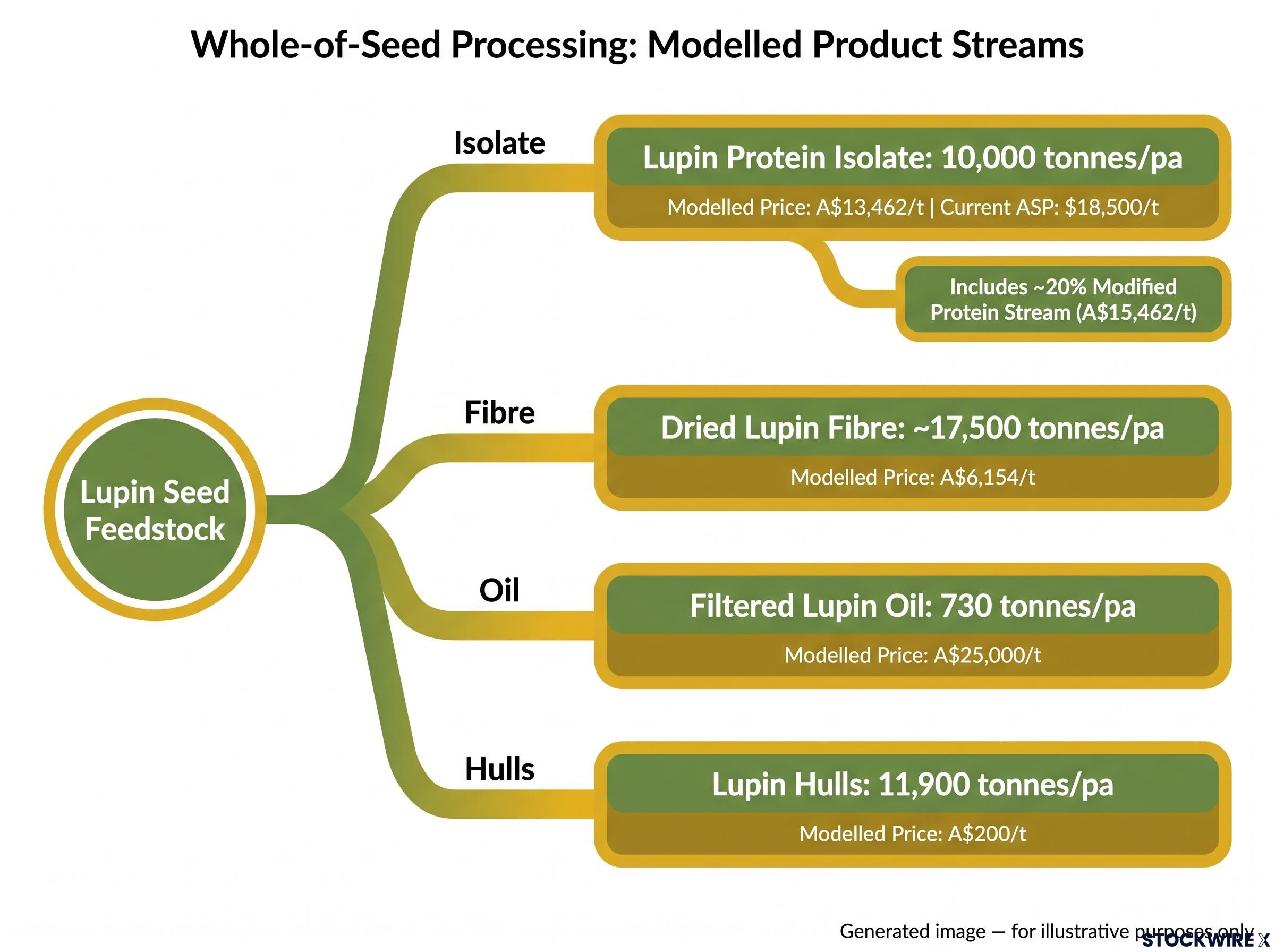
The Appendix sets out the modelled production basis:
- Nameplate design capacity of 10,000 tonnes per annum of lupin protein isolate, of which approximately 20% is a modified protein stream
- Approximately 17,500 tonnes of dried lupin fibre
- 730 tonnes of filtered lupin oil
- 11,900 tonnes of lupin hulls per annum
The announcement body refers to up to 700MT of lupin oil and 17,000MT of lupin fibre, which differs slightly from the Appendix. The Appendix figures are used here.
Modelled product pricing is expressed in current values, and the Appendix notes that future pricing is based on large-scale volumes.
| Product | Modelled price per tonne |
|---|---|
| Lupin protein isolate | A$13,462 |
| Modified protein stream | A$15,462 |
| Lupin kernel fibre | A$6,154 |
| Lupin oil | A$25,000 |
| Lupin hulls | A$200 |
The Appendix also states that WOA’s current average selling price for lupin protein isolate is $18,500 per tonne.
Lupin protein isolate explained
Lupin protein isolate is a concentrated protein ingredient derived from lupin seeds. WOA’s company description notes applications including plant-based dairy alternatives, meat substitutes, baked goods and health-focused products.
Whole-of-seed processing aims to produce several ingredient streams from each seed, including protein, fibre and oil. WOA states that the incremental economics of this model is central to its strategy, which is relevant for investors assessing how additional streams from the same feedstock may contribute to overall economics.
Western Australia was confirmed as the preferred location for the proposed facility, producing more than 80% of the world’s lupins and providing secure access to high-quality feedstock, according to the announcement.
Near-term value: process optimisation and contract manufacturing
The IMS also has direct application to WOA’s current operations. The engineering work establishes a baseline of process design, mass balances, yields, utility consumption and cost drivers across the whole-of-seed process, and is relevant wherever WOA manufactures, regardless of whether the facility examined in the IMS proceeds.
WOA will use this baseline to direct process optimisation studies aimed at:
- Improving protein yield and recovery
- Reducing energy, water and other operating costs
- Refining equipment selection
The study also defines the process requirements, equipment specifications, utility loads and quality parameters a partner facility needs to meet. WOA says this gives it a stronger technical basis for selecting partners, negotiating terms and scaling production under its capital-efficient model. Potential contract manufacturing partners have shown initial interest in jointly exploring large-scale facilities in the future.
The company’s near-term focus is the first three stages of Building Better Economics: reducing fixed costs through the wind-down of its German manufacturing operations, transitioning to contract manufacturing, and expanding commercialisation of its whole-of-seed ingredient platform. Stage Four evaluates the longer-term opportunity for industrial scale Australian manufacturing, and the IMS helps understand the viability of such a facility.
The company’s four-stage scale-up plan began with the German plant shutdown and a move to Asian contract manufacturing, with the industrial scale Australian facility sitting at the far end of that roadmap.
What’s next for WOA
WOA’s immediate priority is execution of Building Better Economics, including reducing fixed costs, transitioning to contract manufacturing, growing protein sales and progressing its whole-of-seed model to improve unit economics.
In parallel, the company will use the completed IMS to continue exploring the manufacturing economics of a 10,000tpa facility, including engagement with potential strategic and commercial partners, government agencies and funding bodies.
The Proeon framework agreement is one early example of the capital-light model in practice, with no minimum order volumes or exclusivity obligations and a possible joint investigation of larger-scale manufacturing in India.
Any future development would be expected to sit in a standalone vehicle funded largely by external partners and debt rather than from WOA’s balance sheet. The interest WOA might hold in any such vehicle has not been determined.
Get Consumer Staples News Before the Market Moves
Join 20,000+ investors receiving FREE breaking ASX news within minutes of release, complete with in-depth analysis. Click the “Free Alerts” button at Big News Blast to get the next agriculture and food ingredient announcement in your inbox the moment it breaks, ahead of the crowd.