
CSIRO validation confirms commercial potential of WOA’s lupin fibre ingredient
Australia’s national science agency CSIRO has independently validated the functional performance of Wide Open Agriculture (ASX: WOA) lupin kernel fibre, supporting its commercial potential across food and beverage applications.
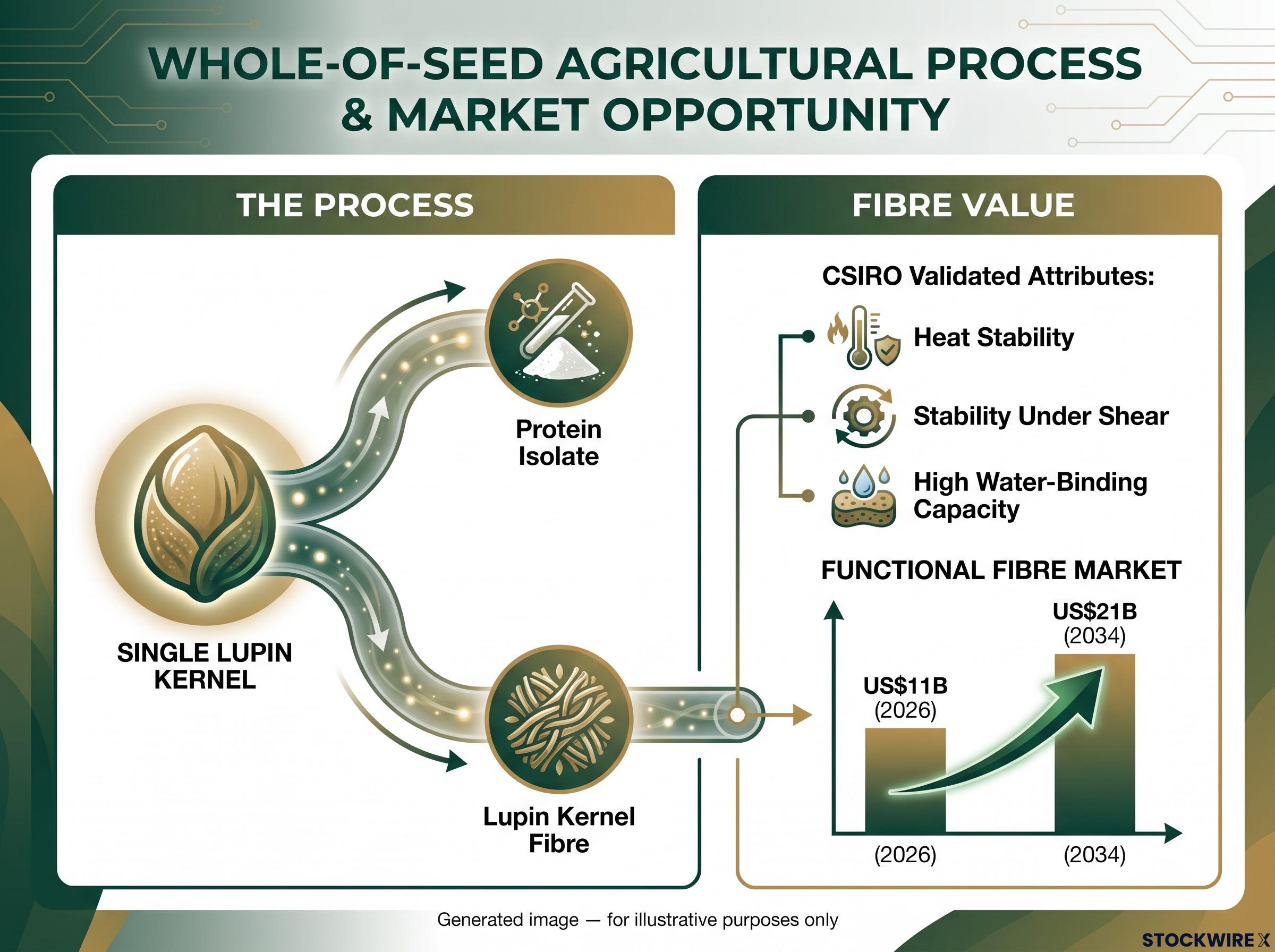
The testing confirmed three key attributes: heat stability, stability under shear, and high water-binding capacity. Critically, the fibre is recovered as a co-product of WOA’s lupin protein isolate process, reinforcing the Company’s whole-of-seed strategy and strengthening potential unit economics.
The development positions WOA within a functional fibre market estimated at approximately US$11 billion in 2026, forecast to reach roughly US$21 billion by 2034.
When big ASX news breaks, our subscribers know first
What CSIRO’s testing confirmed
CSIRO assessed the fibre against the properties that determine suitability for commercial food and beverage use. Each of the three validated characteristics addresses a specific concern for food manufacturers.
Heat stability means the fibre retains its functional and structural properties through thermal processing, with minimal change to texture or water distribution. Stability under shear indicates consistent performance under the mechanical stresses of manufacturing. High water-binding capacity is a key driver of texture, yield and mouthfeel in finished products.
These findings complement WOA’s internal testing, which showed the fibre has a neutral aroma and flavour, smooth mouthfeel, and superior water and oil-binding capacity. Because these are the attributes manufacturers screen for during ingredient selection, independent validation helps de-risk potential commercial adoption.
| Property | What it means | Why it matters to manufacturers |
|---|---|---|
| Heat Stability | Retains functional and structural properties through thermal processing. | |
| Stability Under Shear | Performs consistently under the mechanical stresses of manufacturing. | |
| High Water-Binding Capacity | Key driver of texture, yield and mouthfeel in finished products. |
Craig Swan, Managing Director & CEO, Wide Open Agriculture
“CSIRO’s testing showed our lupin kernel fibre holds up under heat and shear and binds water well. These are important indicators of whether an ingredient will work in manufacturing and offer real benefits for customers and consumers. It also shows that the same lupin seed can deliver an additional high-value ingredient for WOA, allowing us to up-cycle fibre into commercial reality in future. This would strengthen the economics of our business model and broaden the markets we can serve.”
Understanding lupin kernel fibre and why it matters
WOA’s lupin kernel fibre is a natural dietary fibre, largely insoluble, with a neutral colour, clean taste and smooth texture. It is recovered as a co-product of the Company’s lupin protein production process, forming part of a whole-of-seed strategy designed to extract maximum value from every kernel.
That dual output is central to the investment case. The same kernel yields both a protein isolate and a fibre, creating two distinct high-value ingredient streams from a single raw material and processing line. Improved unit economics and broader addressable markets follow from producing two ingredients from one input.
The whole-of-seed strategy extends beyond protein and fibre: WOA’s lupin oil co-product has cleared independent hypoallergenic safety testing and entered early commercial activity, adding a third high-value ingredient stream from the same kernel.
Lupin also contains markedly higher dietary fibre than most legumes, with a distinctive mix of fermentable and non-fermentable fractions. According to WOA, the fibre’s characteristics support applications across:
-
Bakery and cereals
-
Beverages
-
Dairy and dairy alternatives
-
Dressings and sauces
-
Confectionery
-
Nutrition bars
-
Snacks
-
Dietary supplements
-
Pet food
-
Products targeting digestive health
Emerging research on gut health and SCFAs
In an in vitro fermentation model, lupin kernel fibre produced the highest total short-chain fatty acids (SCFAs), and substantially more acetate, than each of the other fibres assessed, including psyllium husk, wheat dextrin, acacia gum and inulin.
Short-chain fatty acids are compounds produced when gut bacteria ferment dietary fibre. Published research generally recognises SCFAs as playing a role in gut health, supporting the microbiome, supplying energy to colon cells, and influencing metabolic pathways. The literature also links SCFAs to the release of GLP-1, a natural hormone associated with appetite regulation and satiety.
Importantly, WOA’s lupin fibre has not yet been evaluated in dedicated human clinical studies. The scientific literature referenced relates to dietary fibre generally and, where applicable, published studies on lupin kernel fibre. Accordingly, no therapeutic or health claims are made in relation to the Company’s ingredient.
For investors, the positioning offers optionality rather than a proven claim, aligning WOA with several structural tailwinds in global nutrition:
-
A widening fibre gap, with fewer than one in five Australian adults consuming enough dietary fibre
-
The rise of “fibremaxxing”, a consumer movement around gut health and the microbiome
-
Growing interest in satiety and metabolic health, including in the context of GLP-1 medicines
-
Increasingly sophisticated fibre science moving beyond the traditional soluble-versus-insoluble classification
Pathway to commercialisation and next steps
WOA’s near-term focus is advancing the fibre in step with a capital-light manufacturing strategy, so the ingredient is commercial ready at the point the Company secures a contract manufacturing partner. Commercial-scale production is contingent on securing that partner, as outlined in WOA’s ASX announcement of 2 July 2026.
Sampling is currently underway to universities, research bodies and potential commercial partners, ahead of planned customer application trials.
| Phase | Milestone | Status |
|---|---|---|
| Internal functional testing and prototype development | Lupin kernel fibre developed and tested | Complete |
| Independent validation | Functional validation of WOA’s fibre by CSIRO | Complete |
| Sampling | Distribution to universities, research bodies and potential partners | Underway |
| Customer trials | Application trials and techno-functional optimisation | Forward Looking |
| Commercial pilot | Commercial pilot scale manufacture of fibre | Forward Looking |
| Health research | Research on fibre impact to health and characterisation | Ongoing |
By sequencing the work this way, WOA aims to convert validation into commercial readiness without committing capital ahead of demand. The approach positions the Company to move to first sales once manufacturing capacity is secured. WOA has stated it will update the market as material milestones are achieved.
For investors wanting to understand how the capital-light model works in practice, our full explainer on WOA’s Asia contract manufacturing strategy covers the four-stage scale-up roadmap, the German facility wind-down timeline, and the criteria WOA is applying to shortlist production partners.
Don’t Miss the Next Consumer Sector Breakout
Big News Blast delivers FREE breaking ASX news straight to your inbox within minutes of release, complete with in-depth analysis already done for you. Join 20,000+ subscribers who stay ahead of the market the moment announcements drop. Click the “Free Alerts” button to start receiving alerts today.