
Eurozone inflation is running at 3.8% and the European Central Bank (ECB) has raised rates twice this year, yet traders have stripped roughly a quarter of a hike out of their expectations since mid-September. The reason is a selloff in French government bonds. The ECB rate hikes French bond selloff story is a bet that bond-market stress will do some of the central bank’s tightening for it.
French bonds sold off hard, and the gap between French and German 10-year yields reached 1.54 percentage points on 2 October, the widest since 2011. Germany’s two-year yield, a clean read on where traders expect ECB policy to go, swung from 3.32% to about 3.02%.
Two meetings will test the wager: 29 October and 17 December.
Here is whether history supports the bet, which tools separate stress management from rate policy, and which few gauges will show who is right.
What are traders betting on, and how far have they gone?
The repricing is smaller than the headlines suggest. The ECB deposit rate, the rate banks earn on cash parked at the central bank, sits at 2.50% after hikes in June and September 2026. Since mid-September, traders have removed about a quarter of a hike, and substantial tightening is still priced in.
As of 5 October, markets priced 0.28 of a hike for 29 October, 0.89 by 17 December and 2.69 by September 2027. In mid-September, an October move was priced at about three in four.
| Meeting/Horizon | Hikes priced (mid-September) | Hikes priced (5 October) | Change |
|---|---|---|---|
| 29 October | About three in four | 0.28 | Sharply lower |
| 17 December | Not confirmed | 0.89 | Not confirmed |
| September 2027 | Not confirmed | 2.69 | Not confirmed |
The logic is straightforward. Higher market yields raise borrowing costs for governments and firms without any ECB action. ECB President Christine Lagarde made the point to the European Parliament on 28 September, and Chief Economist Philip Lane repeated it on 5 October.
Lagarde, 28 September Higher long-term rates would curb growth, and would spread energy costs into other prices more than ECB staff had forecast.
The pressure on the central bank has not vanished. September flash inflation was 3.8%, with energy at 18.8% and core at 2.5%. ECB staff projections put headline inflation at 3.0%, 2.5% and 2.1% across the next three years, and core at 2.5%, 2.6% and 2.3%.
The ECB staff projections behind these numbers were revised upward in September on a Middle East energy shock, extending the above-target overshoot well into 2027 and keeping core inflation above 2% across the horizon.
Sources also disagree on the mid-September baseline, so treat any single pre-selloff figure with caution. What this tells you is that the market is pricing a slower ECB, not a stopped one, and any portfolio assumption that the hiking cycle is over rests on a thinner bet than the headlines imply.
When big ASX news breaks, our subscribers know first
Did stress stop the ECB before? 2022 and 2023 against 2011
Stress has changed the timing of ECB moves before. It has reversed policy only once.
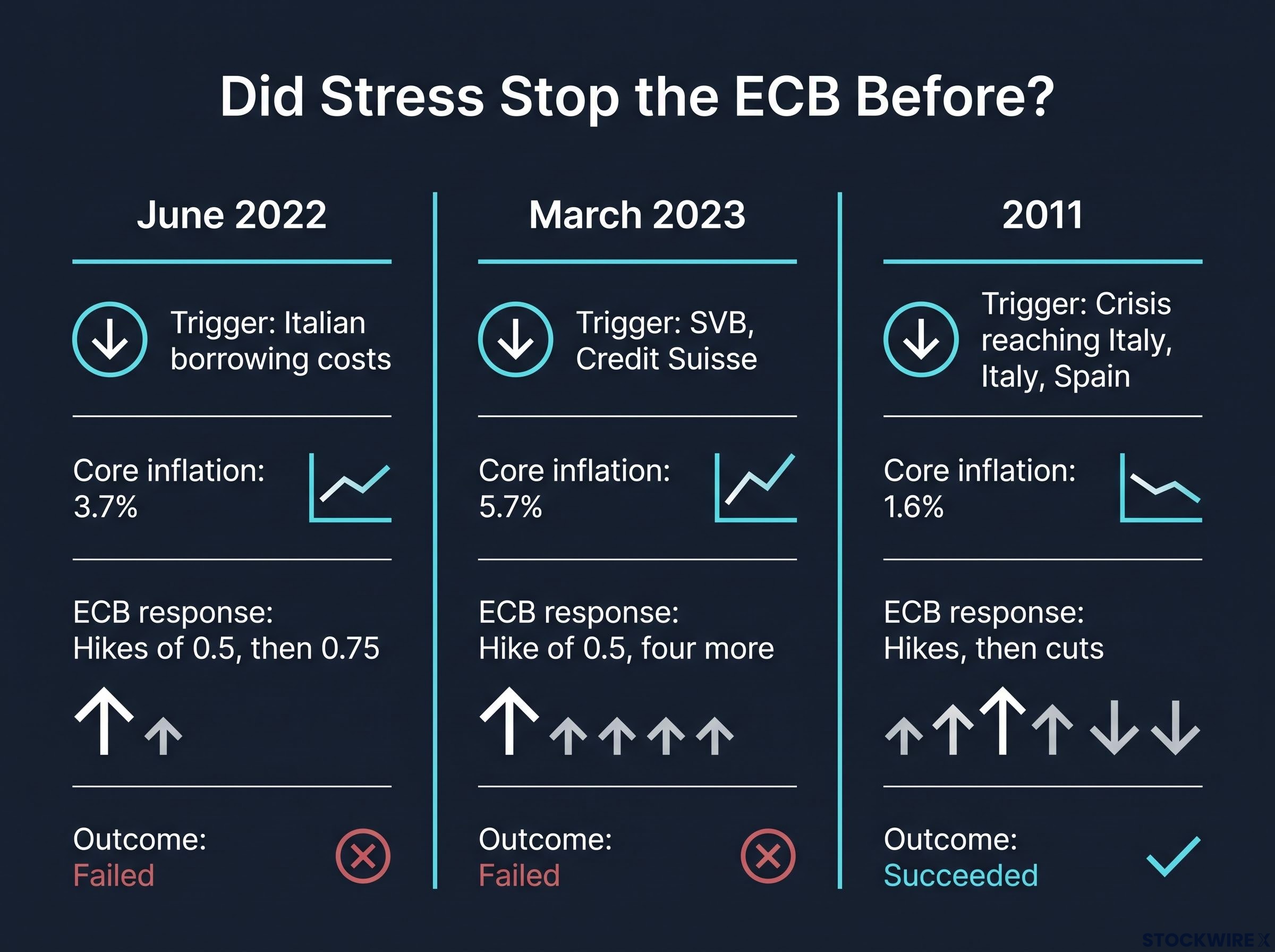
2022 and 2023: the bet failed
In June 2022, a jump in Italian borrowing costs sent Germany’s two-year yield down 1.05 points to 0.10% by 2 August. The ECB hiked 0.5 points on 21 July, then 0.75 in September and October, with core inflation at 3.7%.
In March 2023, Silicon Valley Bank’s failure and a record-low Credit Suisse share price cut the yield by 1.09 points over eight sessions, and traders cut their peak-rate view from about 4% to near 3%. The ECB hiked 0.5 points on 16 March, then four more times to 4%, with core inflation at 5.7%.
2011: the case for the bet
The ECB hiked in April and July 2011 on energy-driven inflation, then cut in November and December as the crisis reached Italy and Spain. Italy’s 10-year premium averaged 5.19 points in November 2011.
Three differences stand out today. Contagion beyond France is limited so far, core inflation of 2.5% sits nearer 2011’s 1.6% than 2023’s 5.7%, and headline inflation of 3.8% exceeds 2011’s 3.0% peak.
| Episode | Trigger | Core inflation | ECB response | Outcome for the bet |
|---|---|---|---|---|
| June 2022 | Italian borrowing costs | 3.7% | Hikes of 0.5, then 0.75 | Failed |
| March 2023 | SVB, Credit Suisse | 5.7% | Hike of 0.5, four more | Failed |
| 2011 | Crisis reaching Italy, Spain | 1.6% | Hikes, then cuts | Succeeded |
The lesson for you is that two variables decided those episodes: how low core inflation was, and whether contagion reached large peripheral economies. Today’s mix is split, which is why neither side can claim the precedent.
How central bank tools separate stress management from rate policy
Central banks run two toolkits at once. The deposit rate sets the general price of money across the economy. Other tools, such as the Transmission Protection Instrument (TPI), flexible reinvestment of maturing bonds and targeted purchases, repair disorderly pricing in specific markets.
The deposit rate matters most because it reprices overnight funding for every bank in the system at once, which is why traders treat it as the true policy signal rather than the other ECB rates.
Two toolkits, two jobs
Four precedents show the pairing:
- ECB 2022: Pandemic-portfolio reinvestments were redirected to pressured countries, and the TPI launched on 21 July alongside a 0.5-point hike.
- Bank of England 2022: Gilt purchases ran from 28 September to 14 October to stop pension-fund forced selling, followed by a 0.75-point hike.
- Fed 2023: It hiked 12 days after SVB failed, and raised twice more despite Chair Jerome Powell’s suggestion that tighter bank lending could substitute for a hike.
- ECB 2012-2014: The Securities Markets Programme and Outright Monetary Transactions stabilised sovereign markets while rate decisions followed inflation and growth.
A bond-market rescue, in other words, need not mean a rate pause.
Why the TPI may not fit France
The TPI has never been used. France has been under the EU’s excessive deficit procedure since July 2024, and a country under that procedure is eligible only when the EU has not judged it to be falling short on deficit correction. Using it could also raise moral-hazard concerns, with investors seeing the ECB backstop large deficits.
Gulf Times described the ECB as “caught between a rock and a hard place” and reported that analysts do not expect TPI use for France. Bundesbank President Joachim Nagel framed the limit on 1 October:
Nagel, 1 October The ECB’s mandate is price stability, not fixing spreads between countries.
Lagarde told La Croix this is not 2011. If France is neither eligible nor politically suitable, the second toolkit may be missing exactly where it is needed, which would leave the deposit rate as the only tool.
Which gauges will show whether the bet holds before 29 October and 17 December?
Think of these as a short dashboard rather than a forecast:
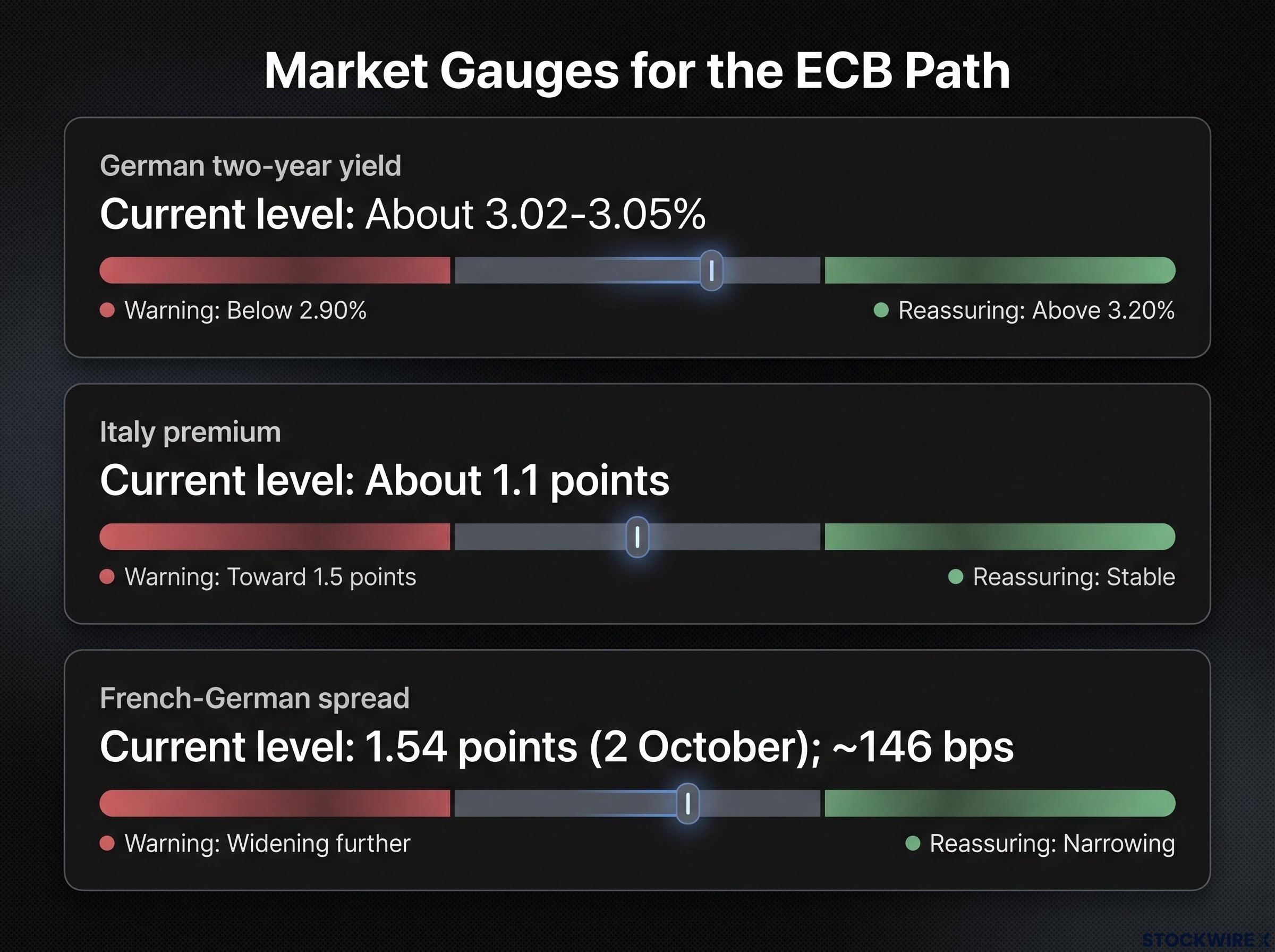
- German two-year yield: Above 3.20% suggests stress is leaving ECB pricing; below 2.90% erases the additions around the September hike.
- Italy’s 10-year premium over Germany: About 1.1 points now; drifting up toward 1.5 would signal that the selling has spread beyond France.
- The euro: It hit its lowest against the dollar since May 2025 on 5 October, and would be expected to gain if a December hike is repriced.
| Gauge | Current level | Reassuring signal | Warning signal |
|---|---|---|---|
| German two-year yield | About 3.02-3.05% | Above 3.20% | Below 2.90% |
| Italy premium | About 1.1 points | Stable | Toward 1.5 points |
| French-German spread | 1.54 points (2 October); other snapshots about 146 bps | Narrowing | Widening further |
If the two-year recovers and Italy stays calm, the bet is failing. Joshua Gibson of FXStreet leans that way, expecting the 17 December hike to be delivered and removed 2027 hikes to be priced back in. His view would be undermined if the ECB stood pat on that date while core inflation was 2.5% or higher, since that would suggest bond markets, rather than inflation, were driving rates.
What would make this look like 2011
Three things would: contagion to Italy, no tool that fits France, and inflation easing enough to give the ECB room. France’s government targets a 5.0% deficit in 2027, while the European Commission projects 5.7% with debt above 120% of GDP, so fiscal slippage is a live risk.
French fiscal risk is rooted in a minority government and a 2027 budget that may roll over rather than pass intact, which could push the deficit toward 6.0% of GDP and keep the spread under pressure.
What the selloff changes about the ECB path, and what it leaves alone
The balance of precedent says stress tends to alter the pace and composition of ECB action, not the need to respond to energy-driven inflation. 2011 is the exception, and it depended on contagion and low core inflation.
So watch the German two-year yield, Italy’s spread and the core inflation print rather than French headlines alone. The 29 October meeting brings no new staff forecasts; 17 December does, which makes it the likelier decision point.
Sources conflict on some figures, and no ECB Executive Board commentary has explicitly tied the selloff to either decision. These statements are speculative and subject to change based on market developments. Past performance does not guarantee future results.
This article is for informational purposes only and should not be considered financial advice. Investors should conduct their own research and consult with financial professionals before making investment decisions.
—