

A Big Four bank just added FlexiRoam to its premium credit cards
One of Australia’s four major banks, each designated by the Australian Prudential Regulation Authority (APRA) as a domestic systemically important bank, has selected FlexiRoam Limited (ASX: FRX) global data roaming as a complimentary benefit on its premium rewards Mastercard credit cards. The company signed the onboarding document on 5 October 2026, marking a significant step in its strategy to convert channel agreements into deployed recurring revenue.
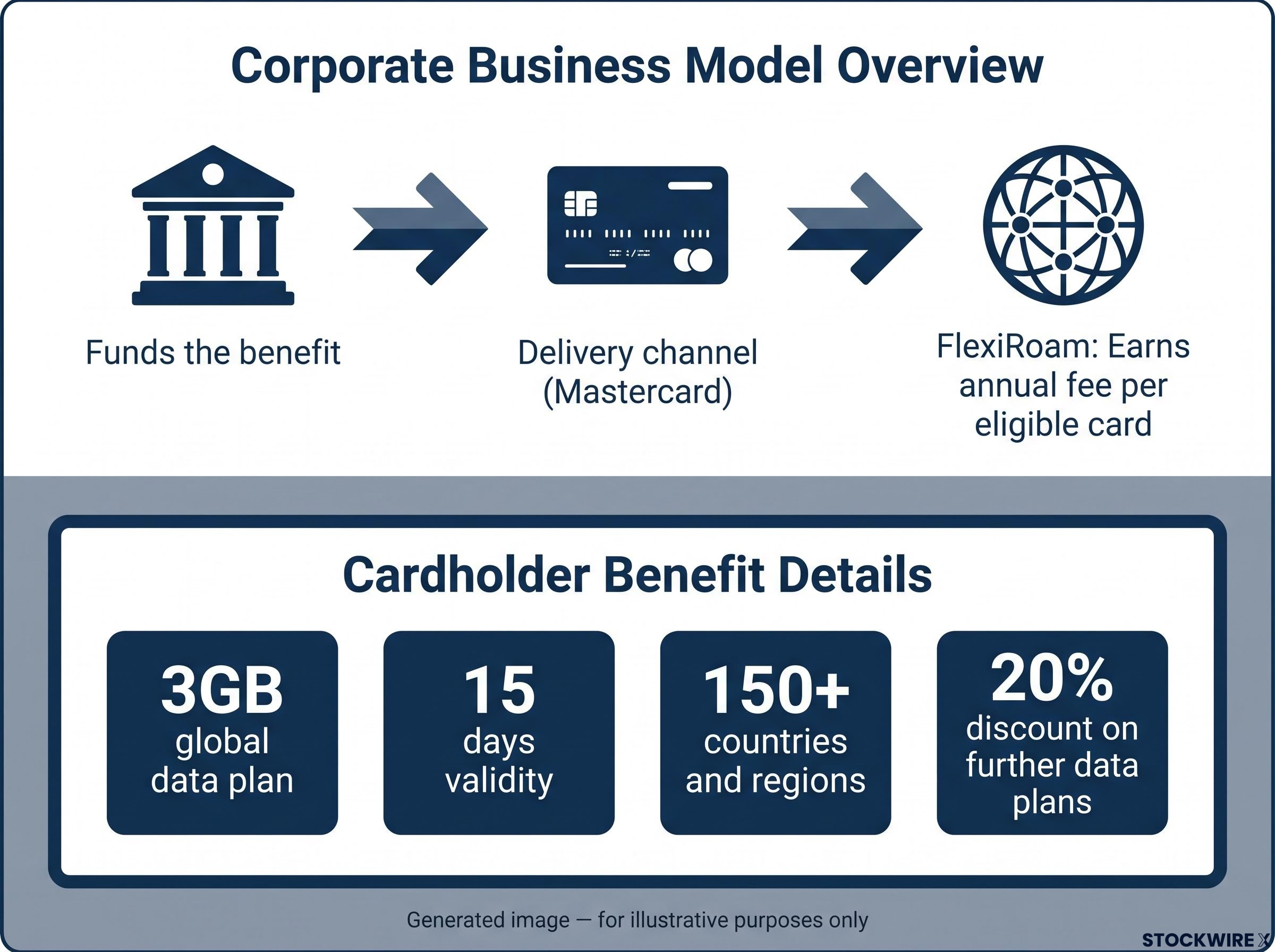
The model is straightforward: the bank funds the benefit for its cardholders, Mastercard serves as the delivery channel, and FlexiRoam earns an annual fee for every eligible card — not per data unit used. Each eligible card account can claim a complimentary 3GB global data plan once per calendar year, valid for 15 days across more than 150 countries and regions, along with a 20% discount on further FlexiRoam data plans.
Under management’s current planning case, the benefit as currently offered would generate fee revenue of approximately USD 140,000 (approximately A$200,000) per year. It is important to note that this is a planning case only, not a forecast for any financial period, a minimum commitment, or revenue guidance. FY27 will include a partial year of fees, with FY28 representing the first full financial year.
Per the terms of the company’s agreements with Mastercard, the bank’s identity has not been disclosed. FlexiRoam has confirmed that the bank’s identity is not information that a reasonable person would expect to have a material effect on the price or value of the company’s securities, and that the announcement contains all material information relevant to assessing the program’s impact.
Jefrey Ong, CEO & Executive Director
“Having one of Australia’s Big Four banks offer FlexiRoam data on its premium cards is a milestone for us. It is our model working as designed: the bank funds the benefit, Mastercard is the channel, and FlexiRoam earns a fee on every eligible card.”
When big ASX news breaks, our subscribers know first
How the Mastercard channel model works
The bank win is best understood within the structure of FlexiRoam’s broader Mastercard partnership and the economics of premium credit card issuance.
Why banks attach benefits to premium credit cards
Premium credit card issuers routinely use cardholder benefits — such as lounge access, travel insurance, and data plans — to attract and retain customers. Travel data is a natural fit for this purpose: it is used directly on the trip, saves cardholders a cost they would otherwise pay themselves, and can be funded by the issuer at a modest annual cost per card.
The Mastercard partnership as a distribution engine
The bank’s adoption sits within a much larger channel. As at 30 June 2026, FlexiRoam’s Mastercard partnership reached 418 banks and 1,270 card programs across 78 countries. Key implications for investors:
The FY26 full-year results confirmed that recurring revenue had climbed to 56% of the revenue mix by year end, with Q4 FY26 reaching 66%, as the Mastercard channel expanded to 418 banks and 1,270 card programs across 78 countries.
- Each bank that adopts the benefit adds recurring fee revenue without FlexiRoam acquiring individual cardholders
- The channel model means incremental bank additions add recurring revenue for FlexiRoam without FlexiRoam having to acquire each cardholder itself
- The bank’s identity is not required to assess program value; the standing and creditworthiness of any APRA-designated major bank is sufficient context
The table below summarises the program mechanics:
| Element | Detail | Who pays | FlexiRoam earns |
|---|---|---|---|
| Benefit | 3GB global data plan + 20% discount on further data plans | Bank funds | Annual fee per eligible card |
| Delivery channel | Mastercard partnership | – | – |
| Geography | 150+ countries and regions | – | – |
| Program term | No fixed term, no minimum commitment | – | Ongoing while bank offers benefit |
A structural tailwind from Australian interchange reform
A concurrent regulatory shift in Australia’s card payments market may further strengthen FlexiRoam’s position as a provider of cardholder benefits.
The Reserve Bank of Australia (RBA) cut the cap on interchange fees for domestic consumer credit cards from 0.8% to 0.3% of transaction value, effective 1 October 2026. Interchange is the fee paid to the card-issuing bank each time the card is used for a purchase, and it helps fund the rewards and benefits attached to those cards. The RBA estimates its reforms will reduce issuers’ interchange revenue by approximately A$660 million per year, noting issuers’ indications that they are likely to review their card products, including rewards programmes. FlexiRoam has not independently verified this figure.
For context, consumer credit card interchange is already capped at 0.3% in both the European Union and the United Kingdom. FlexiRoam sees the Australian reform as a structural tailwind for benefits that cardholders value highly and that are cost-efficient for issuers to fund. Three reasons travel data fits the post-interchange environment:
- Cardholders value it directly — it saves a real cost incurred on the trip itself
- It is cost-efficient for issuers to fund at a modest annual per-card fee
- It potentially positions FlexiRoam as a preferred benefit in markets where interchange is already capped
Delivering on the FY27 strategic priority
The bank’s adoption directly executes FlexiRoam’s stated number one priority for FY27, as set out in its FY26 Annual Report: converting agreements into deployed recurring revenue. The benefit is live, and FlexiRoam earns a fee on every eligible card.
The Board considers the bank’s participation strategically material. While fee revenue under the current planning case is not individually material to Group revenue, adoption by one of Australia’s four major banks validates FlexiRoam’s travel data benefit in the Australian premium credit card market and demonstrates the Mastercard partnership delivering deployed recurring revenue in Australia.
Jefrey Ong, CEO & Executive Director
“In our Annual Report we said our first priority for FY27 was converting agreements into deployed recurring revenue. This is that priority delivered.”
Looking ahead, the key timeframes and parameters for investors to note:
- FY27: Partial year of fee revenue only, reflecting the 5 October 2026 onboarding date
- FY28: First full financial year of fee revenue under the current planning case
- Any further benefit or card portfolio addition would require its own separate onboarding; no assurance is given that any will be added
The planning case covers only the benefit as currently offered and excludes revenue from cardholders’ further data purchases or any additional benefits or card portfolios. Actual revenue will depend on the number of eligible cards and may differ materially from the planning case figure.
Don’t Miss the Next ASX Fintech Winner
Big News Blast delivers FREE breaking ASX news straight to your inbox within minutes of release, complete with in-depth analysis already done for you. Join 20,000+ subscribers staying ahead of the market on Tech, Finance, and beyond. Click the “Free Alerts” button at StockWire X to start receiving alerts the moment news breaks.