
FlexiRoam delivers first full-year profit since listing in FY26 turnaround
In its FY26 results presentation for the financial year ended 30 June 2026, FlexiRoam (ASX: FRX) reported its first profitable, cash-generative full year since listing on the ASX in 2015. The connectivity platform delivered a statutory profit and positive operating cash flow, funded internally with no equity raised and no new debt drawn.
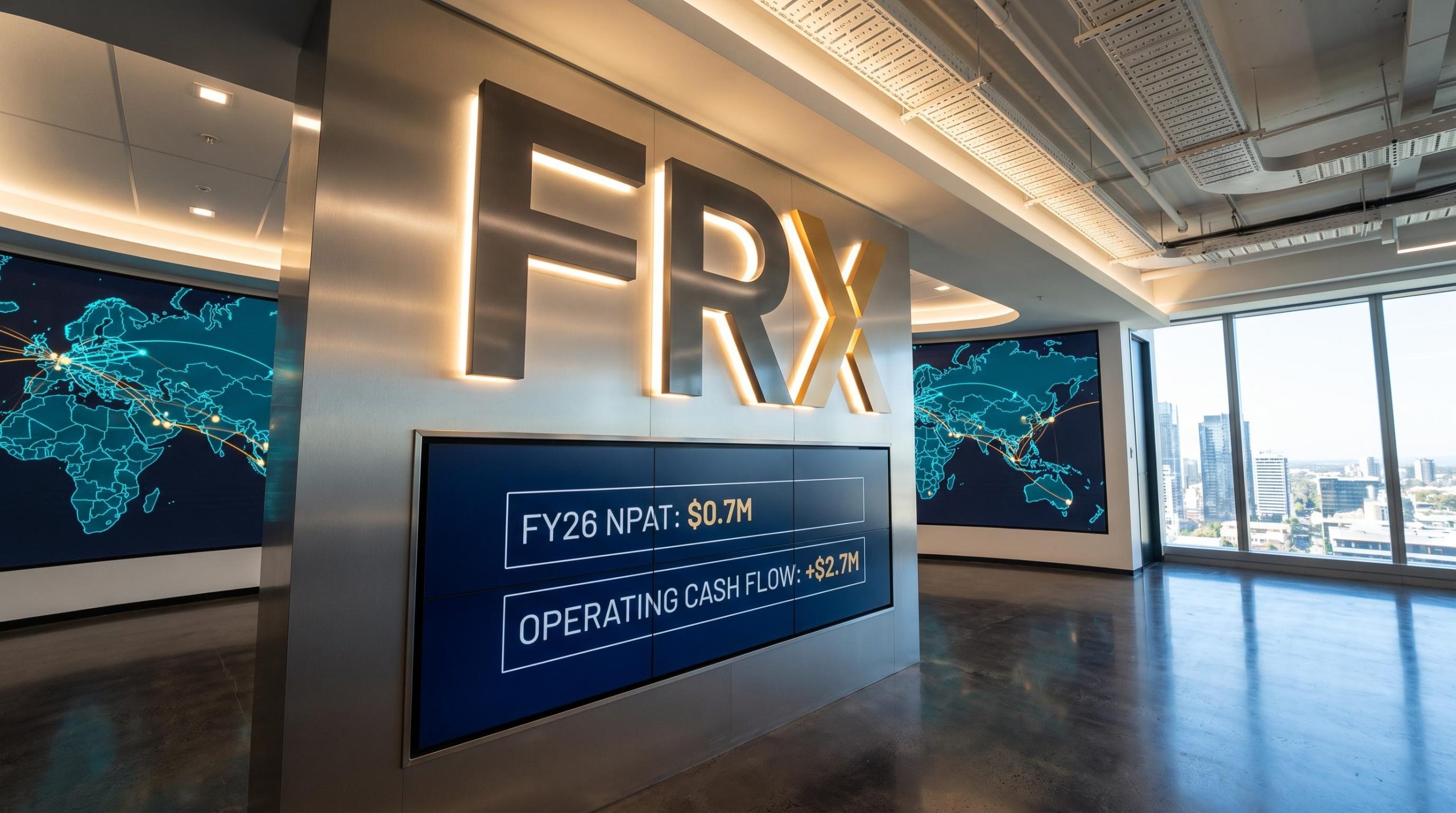
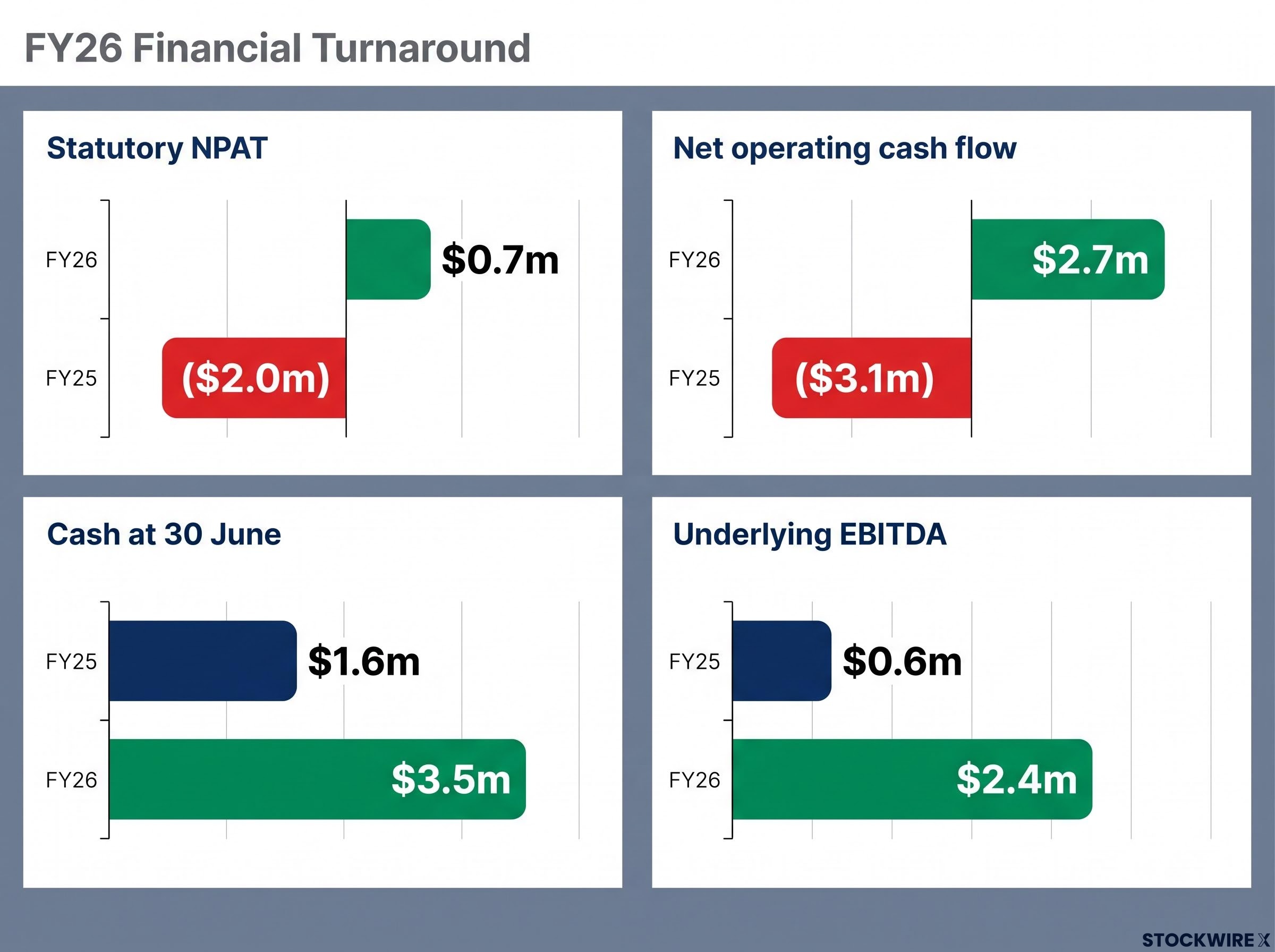
The company recorded statutory net profit after tax (NPAT) of $0.7m, a +$2.7m swing from the $2.0m loss in FY25. Net operating cash flow reached $2.7m (FY25: −$3.1m) and was positive in each of the four quarters.
Revenue came in at $10.2m, down 25% on FY25, a decline management attributed to the deliberate exit from unprofitable consumer acquisition channels alongside softer travel demand. Cash more than doubled to $3.5m, up 120% on the June 2025 position.
The result marks the completion of a reset-to-execution arc: FlexiRoam rebuilt its balance sheet from cash generated by the business rather than from external capital.
When big ASX news breaks, our subscribers know first
FY26 results scorecard — profit, cash and a stronger balance sheet
The FY26 statutory result was driven by a reset cost base carrying a higher-quality revenue mix. The presentation framed the revenue decline as a quality-over-volume shift rather than a straightforward contraction.
Group revenue fell as the company withdrew from consumer acquisition channels that were not generating positive unit economics. The presentation also noted that the Middle East conflict weighed on airfares, consumer confidence and discretionary international travel through the second half.
Operating leverage was a central theme. Underlying EBITDA, a non-IFRS and unaudited measure, reached a record $2.4m at a margin of 24%, up from 5% in FY25. Operating expenses, also a non-IFRS measure, fell 40% from $13.0m to $7.7m. No dividends were paid or declared for FY26.
The FY26 statutory result built on a foundation laid in H1, when FlexiRoam recorded its first half-year profit with a 19 percentage point gross margin expansion to 72.7% and record operating cash flow of $1.9m, validating that the cost reset was generating durable rather than one-off gains.
The table below summarises the key financial metrics, with statutory measures presented ahead of the non-IFRS figures.
| Metric | FY26 | FY25 | Change |
|---|---|---|---|
| Revenue | $10.2m | $13.6m | −25% |
| Statutory NPAT | $0.7m | ($2.0m) | +$2.7m |
| Net operating cash flow | $2.7m | ($3.1m) | +$5.8m |
| Cash at 30 June | $3.5m | $1.6m | +120% |
| Underlying EBITDA (non-IFRS, unaudited) | $2.4m | $0.6m | +292% |
Underlying EBITDA and its margin are non-IFRS measures used by management and the Board. They have not been audited and should not be given greater prominence than the statutory measures.
The balance sheet strengthened without new capital. Net current assets turned positive at $0.4m, the first positive year-end position since 2017, while net assets rose 66% to $4.1m.
Why recurring revenue reaching 56% of the mix matters
A defining feature of FY26 was the shift toward recurring revenue. Under FlexiRoam’s brand-partnership model, a partner such as a bank, insurer or loyalty program funds the connectivity as a benefit for its own customers, and the Group earns recurring fees “for making the entitlement available rather than for the volume of data consumed.”
This structure matters because entitlement revenue is structurally independent of short-term consumer travel demand. That makes the recurring base more predictable and more resilient to travel cyclicality than transactional consumer sales.
Recurring revenue rose to 56% of the mix, up from 39% in FY25, with the Q4 FY26 mix reaching 66%. These recurring revenue mix figures are non-IFRS and unaudited management measures.
FlexiRoam operates across three customer channels:
-
Consumer travel (D2C): travel eSIMs sold via the app, website and WhatsApp AI agent.
-
Brand partner (B2B2C): data embedded as a benefit inside partner brands such as Generali, Mastercard and Tune Protect.
-
Enterprise (B2B): multi-network connectivity for payment terminals, aircraft and IoT devices, with partners including Etihad and DIALOG.
Partnership model expands across banking, insurance, loyalty and enterprise
The presentation detailed a broadening base of channel and enterprise agreements. Most were signed late in FY26 or after year end, so their contribution is expected to build progressively from FY27 rather than materially affecting FY26 revenue.
In financial services, the Mastercard channel reached 418 banks, 1,270 card programs and 78 countries at 30 June 2026, up from 410 banks and 1,187 programs since February. FlexiRoam earns fees based on cards in force, not on data consumed.
In travel insurance, Tune Protect went live in early rollout following the 11 May 2026 agreement, with a data entitlement on every eligible Preset policy sold through White Label Sdn Bhd’s partners. In loyalty, a two-year Dragonpass agreement signed on 4 September 2026 carries a first campaign for the loyalty program of a top-three global hotel group (by number of rooms). The hotel group is not named and is not a party to the agreement.
FlexiRoam also entered a non-binding telecommunications MoU on 14 July 2026, which creates no revenue, customer or volume commitment. A definitive agreement is targeted within 90 days as a non-binding target, with the counterparty unnamed at its request.
The company disclosed several planning cases, each labelled a management estimate rather than guidance. For the Australian payments group agreement, which commenced on a three-year term from 23 July 2026, the planning case is annualised recurring revenue of A$0.32m to A$0.44m at 31 December 2027, described as a run-rate and not a forecast or guidance, with near-term contribution expected to be modest. The Dragonpass planning case is approximately US$100,000 (around A$140,000) for the initial three-month campaign, also a management estimate. The DIALOG minimum annual commitment is approximately A$60,000 and is not individually material.
| Partner | Sector | Announced | Status |
|---|---|---|---|
| Etihad Airways | Aviation | 4 Aug 2026 master agreement | Live |
| DIALOG (MyKasih) | Payments | 8 Jan 2026 | Live, terminals activating |
| Paydibs | Payment terminals | 18 Mar 2026 | Live, deploying |
| Australian payments group | Payments | 24 Jul 2026 | Signed, activations pending |
AI platform cuts partner deployment from months to days
The presentation positioned the flexiroam.ai platform and its zero-integration deployment pathway as both an efficiency driver and a differentiator.
The WhatsApp AI agent lets travellers find, buy, activate and get support for a data plan in 70+ languages, with nothing to download. It launched commercially in December 2025.
For partners, the zero-integration pathway allows deployment of a co-branded connectivity offer without building an app, SDK or release cycle on the partner side. As an efficiency proof point, AI and automation reduced human-handled customer service tickets by 31% in January 2026 versus November 2025, while maintaining service levels.
This automation supports operating leverage by allowing the company to scale partners without a proportionate increase in cost.
FY27 outlook — deploy what’s been signed while holding financial discipline
Management set out four priorities for FY27, framed as statements of focus rather than formal guidance. No formal revenue or earnings guidance was provided.
-
Deploy and scale signed channel partnerships and direct deals, with B2B contribution building progressively from FY27.
-
Extend the model into further industries and progress the telecommunications MoU toward a definitive agreement (a non-binding target).
-
Continue investing in the AI connectivity platform.
-
Maintain financial discipline, with a focus on sustaining positive Underlying EBITDA and operating cash flow.
The company noted it expects softness in discretionary consumer travel demand to persist in the near term. Balanced against this, the presentation emphasised the stronger financial position entering the new year.
Management commentary
Founder and Chief Executive Officer Jefrey Ong positioned FY26 as the transition from reset to execution: a year that delivered a profitable, cash-generative result funded internally, leaving FlexiRoam entering FY27 with a stronger balance sheet and a broader base of signed agreements to deploy.
Following a profitable and cash-generative FY26, the Group enters FY27 with a stronger balance sheet and signed agreements to deploy.
Don’t Miss the Next Tech Turnaround on the ASX
Big News Blast delivers FREE breaking ASX announcements straight to your inbox within minutes of release, complete with in-depth analysis so the work is already done. Join 20,000+ investors who stay ahead of the market the moment news breaks. Click the “Free Alerts” button at Big News Blast to start receiving alerts today.