#
OPEC+ is set to confirm that its November production quotas will stay unchanged, but in an oil market where war has already forced Saudi Arabia, Iraq and Kuwait to cut actual output by a combined 7.9 million barrels per day, the announcement barely moves the needle on what really matters.
The formal decision, expected at an early-October video conference of a seven-producer sub-group led by Saudi Arabia and Russia, follows a roadmap drawn up before the Iran conflict escalated. That roadmap paused quota increases through the end of 2026. In normal circumstances, an OPEC+ quota freeze would carry clear implications for traders and investors.
These are not normal circumstances. The Strait of Hormuz, which carries roughly 20% of global oil trade, has been severely disrupted, filling onshore storage and pushing producers well below their formal targets regardless of what the quotas say on paper.
Here is a clear framework for separating the signal from the noise in OPEC+ communications while a war actively reshapes physical supply. By the time you finish this, you will know which numbers to watch instead of the quota headline.
OPEC+ confirms November quotas hold, but the decision was never really in doubt
The alliance has reached an agreement in principle to keep its November 2026 quotas steady, confirmed by OPEC+ delegates ahead of a Sunday video conference of the seven-producer sub-group. Bloomberg reported the outline on 4 October 2026, citing unnamed delegates, with the formal decision expected to rubber-stamp a plan that was already set.
The freeze sits inside an existing roadmap. A series of incremental quota increases ran through August 2026, nominally unwinding the production cuts the group established in 2023. That process has now stopped, with targets held flat through the end of 2026. A separate Bloomberg report on 6 September 2026 confirmed the roadmap had already kept October targets steady.
The voluntary cuts unwinding that produced the 188,000 bpd September increment also completed the full reversal of 1.65 million bpd in reductions first introduced in April 2023, a three-year arc that the freeze now interrupts, with the compliance gap between quota and physical supply remaining the variable that actually determines what barrels reach the market.
The scale of those earlier increases tells its own story. The July 2026 addition of 188,000 bpd was described at the time as contingent on a US-Iran peace pact holding, a reminder that security conditions, not quota arithmetic, now govern real output.
Here is what this freeze actually tells you. OPEC+ is in a holding pattern, not making a strategic call, so no supply signal should be read into this decision. The next genuinely consequential moment is the ministerial meeting on 29 November 2026, when 2027 production policy goes on the table.
The roadmap breaks down into three dates worth tracking:
For anyone pricing oil-exposed assets, the takeaway is that the quota decision confirms OPEC+ is not adding voluntary barrels. It does nothing to change the physical supply picture, which is being determined by geography and conflict.
When big ASX news breaks, our subscribers know first
The scale of what war has actually taken offline
Start with the country-by-country numbers, because the cumulative weight is what makes the quota headline look small. Figures consolidated by the Sasakawa Peace Foundation’s International Information Network Analysis (IINA), published on 30 September 2026, set pre-war output against production after the conflict forced cuts.
Saudi Arabia pumped 10.11 mbpd in February 2026. By April 2026 that had fallen to 6.87 mbpd, a reduction of roughly 3.24 mbpd, or about 32%. Iraq fell from 4.14 mbpd to 1.49 mbpd, a drop of around 2.65 mbpd, or roughly 64%. Kuwait collapsed from 2.58 mbpd to 0.56 mbpd, a cut of about 2.02 mbpd, or roughly 78%.
| Country | Pre-War Output (mbpd) | Current Output (mbpd) | Reduction (mbpd) | Percentage Loss |
|---|---|---|---|---|
| Saudi Arabia | 10.11 | 6.87 | ~3.24 | ~32% |
| Iraq | 4.14 | 1.49 | ~2.65 | ~64% |
| Kuwait | 2.58 | 0.56 | ~2.02 | ~78% |
Source: IINA, Sasakawa Peace Foundation, figures to April 2026.
Add the UAE into that trio and the combined loss widens further.
The global oil supply crisis that the conflict ignited has been documented in granular detail by IEA inventory data, which showed draws running at 8.5 million barrels per day in Q2 2026, more than double any previously recorded pace, with emergency SPR releases providing no meaningful offset at that scale.
Other estimates stretch the range wider still. Rystad Energy, cited by AGBI, puts shut-in capacity at 11.8 mbpd across the broader Gulf producer group. Argus Media estimates 6.2-6.9 mbpd of regional supply taken offline. The figures differ on scope and method, but they all point in the same direction: losses measured in millions of barrels.
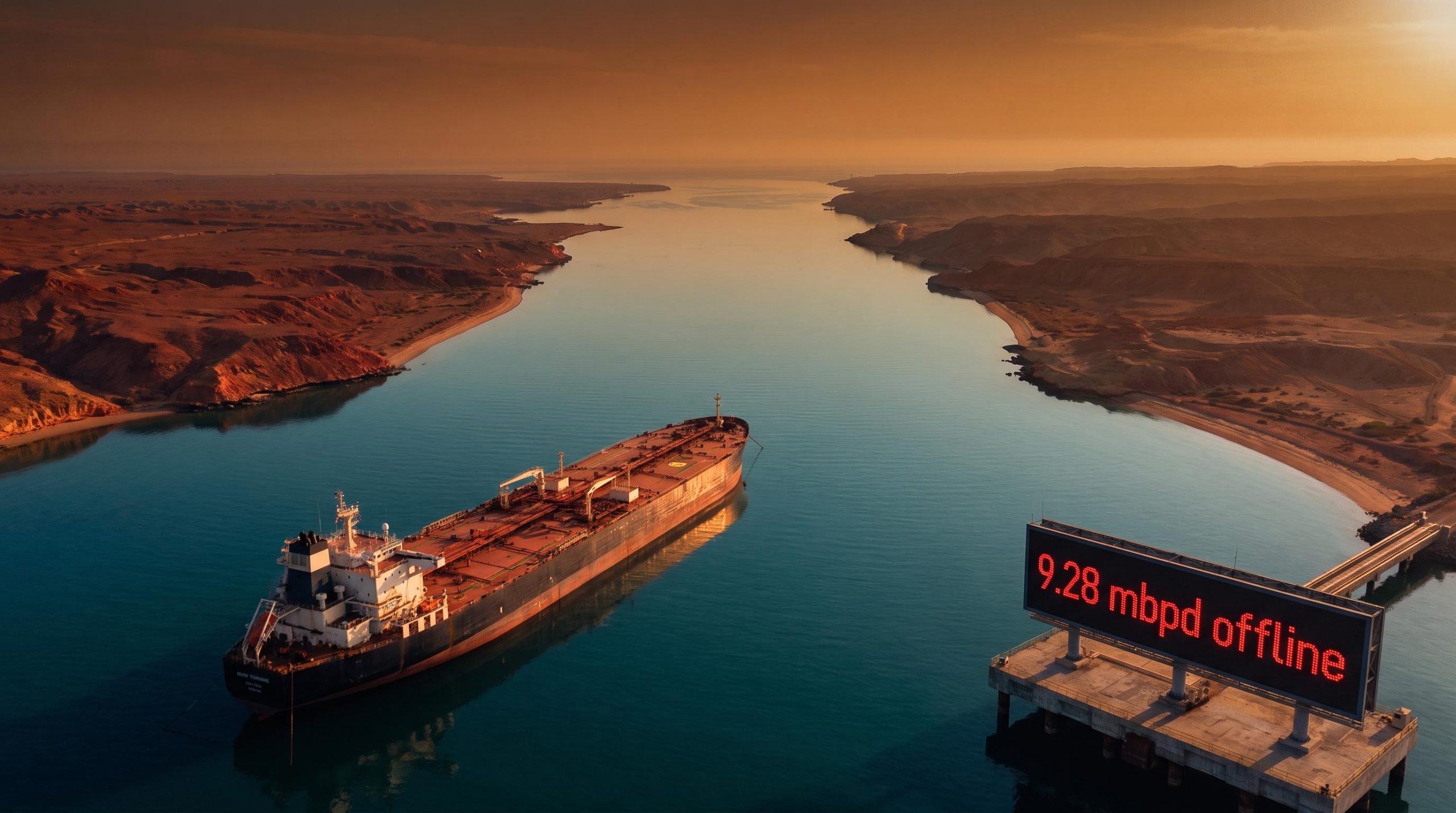
Now set that against the quota framework. The July 2026 addition was 188,000 bpd. Place that number next to a combined loss of 9.28 mbpd and the proportion is stark: the policy lever is adding a fraction of a single barrel for every forty-plus barrels the war has removed.
The read for you is simple. Anyone pricing oil-exposed assets off OPEC+ quota headlines is working from an incomplete picture. The actual supply gap dwarfs anything the quota framework can address while the conflict persists, which means the formal policy mechanism has been rendered arithmetically marginal.
Why quotas stopped mattering: the Hormuz mechanism explained
The signal to watch is not an oilfield. It is a shipping lane. Tankers have all but stopped moving through the Strait of Hormuz, and that single logistical fact explains the production collapse better than any upstream damage.
The chain runs in a clear sequence. Argus Media reports that the near-halt in tanker traffic cut Gulf producers off from their main export route, rapidly filling storage and forcing Saudi Arabia, the UAE, Bahrain, Iraq and Kuwait to curb output, taking an estimated 6.2-6.9 mbpd offline. Anadolu Agency attributes the crisis to shipping through Hormuz grinding to a halt after US and Israeli strikes on Iran.
Here is how the mechanism unfolds step by step:
The important detail is that this is a logistics problem, not a structural one. Rystad Energy‘s analysis via AGBI describes producers shutting in nearly half their pre-war output because exports stopped and storage reached capacity. Gulf Times noted missile strikes on Bahrain‘s Sitra refinery, but identified export disruption, not oilfield destruction, as the primary cause of the output curbs.
The Hormuz shipping crisis has produced a gap between official declarations and physical reality that matters enormously for how markets price recovery: commercial transits collapsed to as few as 3-14 vessels per day against a pre-war baseline of 120-140, and war-risk insurance premiums running at approximately 30 times normal rates mean a diplomatic ceasefire alone cannot restore commercial flows.
That distinction matters enormously for how you think about recovery. A logistical constraint is potentially reversible on a far shorter timeline than physical oilfield damage. The supply outlook is therefore binary and event-driven, hinging on whether shipping lanes reopen, rather than a slow structural rebuild.
What a Hormuz recovery would actually look like
The path back does not run through OPEC+ headquarters. The sequenced bottlenecks are physical: restarting shut-in fields, clearing maintenance backlogs that built up while wells sat idle, and restoring export infrastructure to full working order.
Gulf Times reports that flows through Hormuz resumed partially after a preliminary US-Iran deal, though they stayed below pre-war levels. That partial reopening is evidence the recovery pathway is open but fragile.
Analysts expect Gulf producers to ramp relatively quickly once shipping normalises, precisely because the binding constraint is logistical. For you, that means a stabilisation in the Strait could move the physical supply picture faster than typical post-conflict timelines would suggest.
Reading OPEC+ announcements in a wartime supply environment
The practical question now is how to process OPEC+ communications at all when the quotas are disconnected from the barrels. Three interpretive camps have formed, and knowing which one you sit in changes how you read every announcement.
The first camp is the delegates themselves, who defend the frozen roadmap as a cohesion tool. Holding quotas steady preserves group discipline and forward guidance even when war prevents members from hitting those numbers. The second camp, voiced through Argus Media and Anadolu Agency, argues that quota changes carry little practical effect while Hormuz is blocked and storage is full. The third, led by technical analysts at Rystad Energy, says the focus should shift entirely to deliverable barrels and physical shipping data.
Bloomberg has characterised the recent quota changes as “symbolic.”
If the quota headline is noise, the following metrics carry the signal in a wartime environment: actual export volumes, tanker tracking data, field shut-in reports, and the shipping conditions in the Strait of Hormuz itself. Those are the numbers that describe real supply.
The current environment generates four distinct risk categories worth holding in view:
For context on the alliance’s own backdrop, Argus Media notes that OPEC+ cuts had already taken more than 5.5 mbpd offline across 18 producers since October 2022, before the war added its own layer. The Sasakawa Peace Foundation has also linked the multi-million-barrel reductions to strain on the petrodollar order, hinting at wider macro-financial consequences if the shock persists.
The takeaway for you is to treat OPEC+ quota announcements as signals of group intent and cohesion, not as operational forecasts of physical supply, for as long as the conflict continues. Filter out the quota noise, focus on physical flow data, and you are working with a materially more accurate picture than those reading the headlines as the primary signal.
What the November 29 meeting needs to resolve
The date that actually matters is 29 November 2026. That ministerial meeting is the first occasion where OPEC+ will set 2027 production policy with full visibility of how war has reshaped the supply landscape, which makes it a genuine decision point rather than a routine calendar event.
The meeting will have to confront a structural question the current framework was never built to answer. If the binding constraint is physical logistics rather than member willingness to produce, is a standard quota system still the right tool? The roadmap running through end-2026 was inherited from the pre-war planning period, designed for a market that no longer exists.
Whether the November outcome carries real weight depends almost entirely on conditions outside the alliance’s control. Watch these three variables in the run-up:
For you, this is the horizon to watch rather than the October video conference. The partial resumption of Hormuz flows shows the recovery pathway is open but fragile, which means the weeks leading into 29 November are when commodity market risk is most actively in play. Whether the meeting produces a credible 2027 framework or defers the hard questions will depend on how those three variables move.
For readers wanting a concrete checklist of what genuine normalisation looks like, our dedicated guide to Hormuz reopening conditions details the five observable signals, from a formal signed agreement through mine-clearance completion and insurance underwriting resumption, that must all be in place before traders can treat any deal as a real supply catalyst.
This article is for informational purposes only and should not be considered financial advice. Investors should conduct their own research and consult with financial professionals before making investment decisions. Past performance does not guarantee future results. Financial projections are subject to market conditions and various risk factors.
When the quota roadmap and the physical market diverge, follow the barrels
OPEC+ has done exactly what its roadmap required by confirming the November freeze. But the quota framework is now operating in a different register from the physical market, which is being shaped by war, logistics and geography rather than by ministerial decisions. The combined 9.28 mbpd loss and the Hormuz chokepoint, not the 188,000 bpd quota lever, are what price the oil market today.
The action point follows directly. Track Hormuz shipping status, actual export volumes, and the 29 November 2026 ministerial outcome as the three sources that carry genuine information in this environment. That meeting is the first formal test of whether OPEC+ can adapt its policy tools to a supply landscape it did not design for, and the run-up to it is where the real risk now sits.