Here is a fact about the Federal Reserve that rarely gets stated plainly: the minutes of any given policy meeting reach the public weeks after the meeting itself, which means the economic world those minutes describe may have already been overturned by the time you open them.
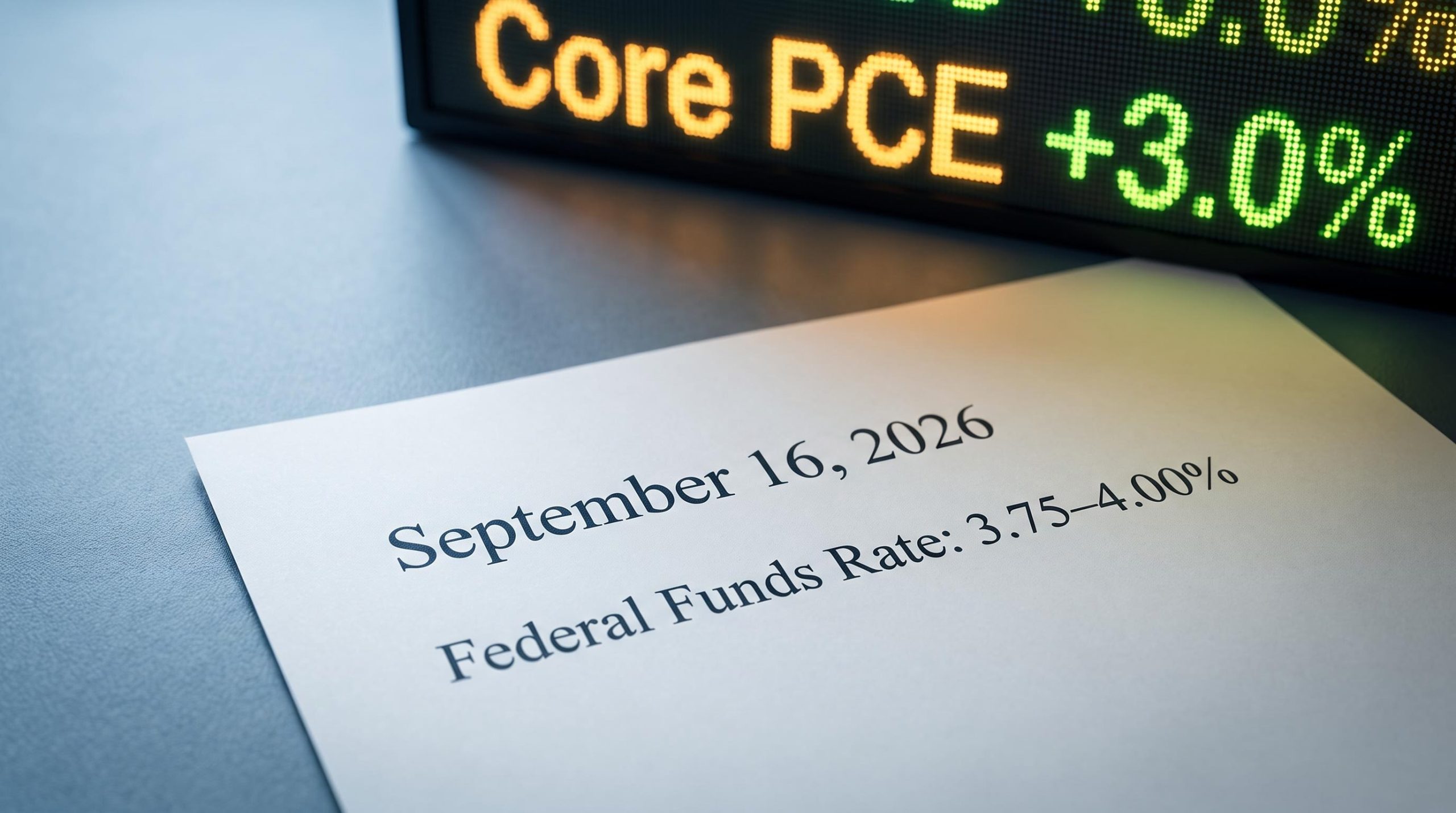
That gap stopped being an abstraction last month. The September 16, 2026 FOMC meeting raised the federal funds rate to 3.75-4.00%, and the minutes of that meeting were scheduled to arrive only after the August Personal Consumption Expenditures (PCE) inflation report had already landed on September 30, 2026. By the time those minutes reached investors, a major inflation print had already reshaped the market’s view on whether more rate hikes were urgent.
This is the sequencing trap, and it is the single most important thing to grasp when you want to interpret FOMC minutes correctly. What follows here gives you a working framework for knowing which Fed signals to weight and when, so you are not building decisions on a document the market has already moved past.
Why FOMC minutes arrive with a built-in expiration date
The Fed does not release everything at once. On the day of the meeting, you get two things immediately: the policy statement and the Summary of Economic Projections (SEP), which is the Committee’s quarterly snapshot of where it expects rates, inflation, and growth to go. The minutes, the detailed account of who argued what inside the room, come weeks later.
Here is the sequence laid out:
- FOMC statement – released on meeting day. The terse official decision that sets the actual rate.
- Summary of Economic Projections (SEP) – released on meeting day. The forward-looking roadmap of the Committee’s expectations.
- FOMC minutes – released weeks after the meeting, by design.
That delay is not a backlog or a processing glitch. It is structural, built into the Fed’s communication calendar to allow time for the deliberations to be prepared and reviewed before publication.
The sequencing problem only makes sense once you understand how the Federal Reserve works: the dual mandate, the FOMC voting structure, and the layered communication tools the Fed uses between meetings all determine which signals carry real policy weight and which are context only.
The statement and the SEP land the moment the meeting ends. The minutes follow weeks later. That spacing is permanent, and it is the root of the interpretation problem.
The consequence is the part that matters for you. In a stretch of active economic data, several high-impact releases can fall inside that multi-week window and change the entire policy backdrop before the minutes ever surface. The August PCE report arriving on 30 September, two weeks after the September meeting but before its minutes, is exactly that.
Treat the lag not as a flaw to engineer around but as a fixed feature of how the Fed talks. The practical takeaway is simple. Every time you reach for a set of minutes, your first question should be: what data have landed since the meeting date? That question determines how much the document in front of you is still worth.
When big ASX news breaks, our subscribers know first
The September 2026 case study: how one PCE report made the minutes secondary
Walk through what actually happened, and the point makes itself.
On 16 September 2026, the Committee lifted the federal funds rate by a quarter point to 3.75-4.00%. Alongside the decision, the SEP sketched a cautious path: most policymakers projected inflation returning to the Fed’s 2% target only by 2029, with at least one further quarter-point increase anticipated beyond the September move. The tone inside the meeting was restrictive and watchful.
Then, on 30 September, the August PCE figures arrived.
| Event | Date | Market significance |
|---|---|---|
| FOMC meeting and rate decision | 16 September 2026 | Rate raised to 3.75-4.00%; SEP signals possible further tightening |
| August PCE inflation release | 30 September 2026 | Softer-than-expected reading reduces urgency for near-term hikes |
| September FOMC minutes | After 30 September 2026 | Describe a policy debate that intervening data had already overtaken |
The PCE numbers came in softer than markets had braced for. Headline PCE rose +0.3% month-over-month and +3.4% year-over-year, while core PCE, which strips out volatile food and energy prices, rose +0.2% on the month and +3.0% on the year. Reuters noted that inflation increased less than expected, and the broad read was that these more moderate price pressures had taken some of the heat out of the case for another immediate hike.
Real PCE readings are not a single number: the July 2026 print showed nominal spending up 0.2% while inflation absorbed that entire gain, leaving real consumption growth at effectively zero, which is exactly the kind of internals mismatch that changes the policy urgency picture faster than any headline figure signals.
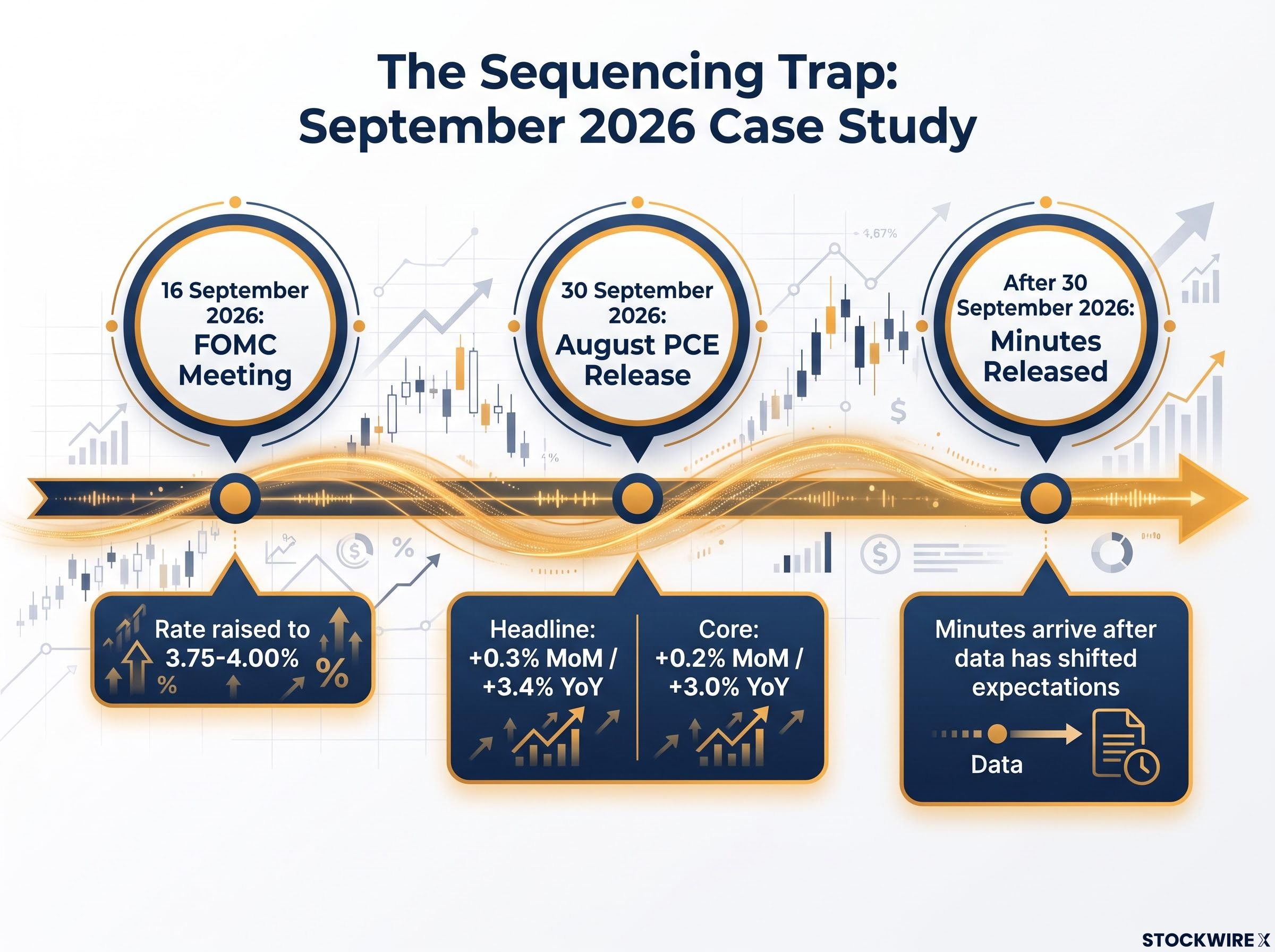
That is the pivot. The softer inflation print shifted market expectations about the near-term rate path while the September meeting’s deliberations were still in the process of being published. By the time investors could read what the Committee had debated, the debate’s central question had already been partly answered by fresher data.
TD Securities analysts, as reported by FXStreet, assessed the September FOMC minutes as carrying limited current relevance, precisely because the more recent employment and PCE data had already superseded the context in which the meeting took place.
None of this makes September an oddity. This is what the sequencing problem looks like when it plays out in real time. In any period of active data flow, the minutes are already speaking from the past by the time they are published. The September case gives you a reference point you can hold onto: next time minutes drop, measure them against whatever data has landed since the meeting, exactly as the August PCE release outran the September deliberations.
What to watch instead: the Fed signal hierarchy
If the minutes sit near the bottom of the pile, what sits above them? Market analysts broadly describe a three-tier hierarchy for reading Fed policy, and building it from the top down shows you why minutes rank where they do.
The weight of each tier in the signal hierarchy has shifted considerably since Kevin Warsh scrapped Fed forward guidance in June 2026, because the removal of pre-committed rate signalling means individual data releases and speeches now carry the repricing load that the prior regime spread gradually across scheduled communications.
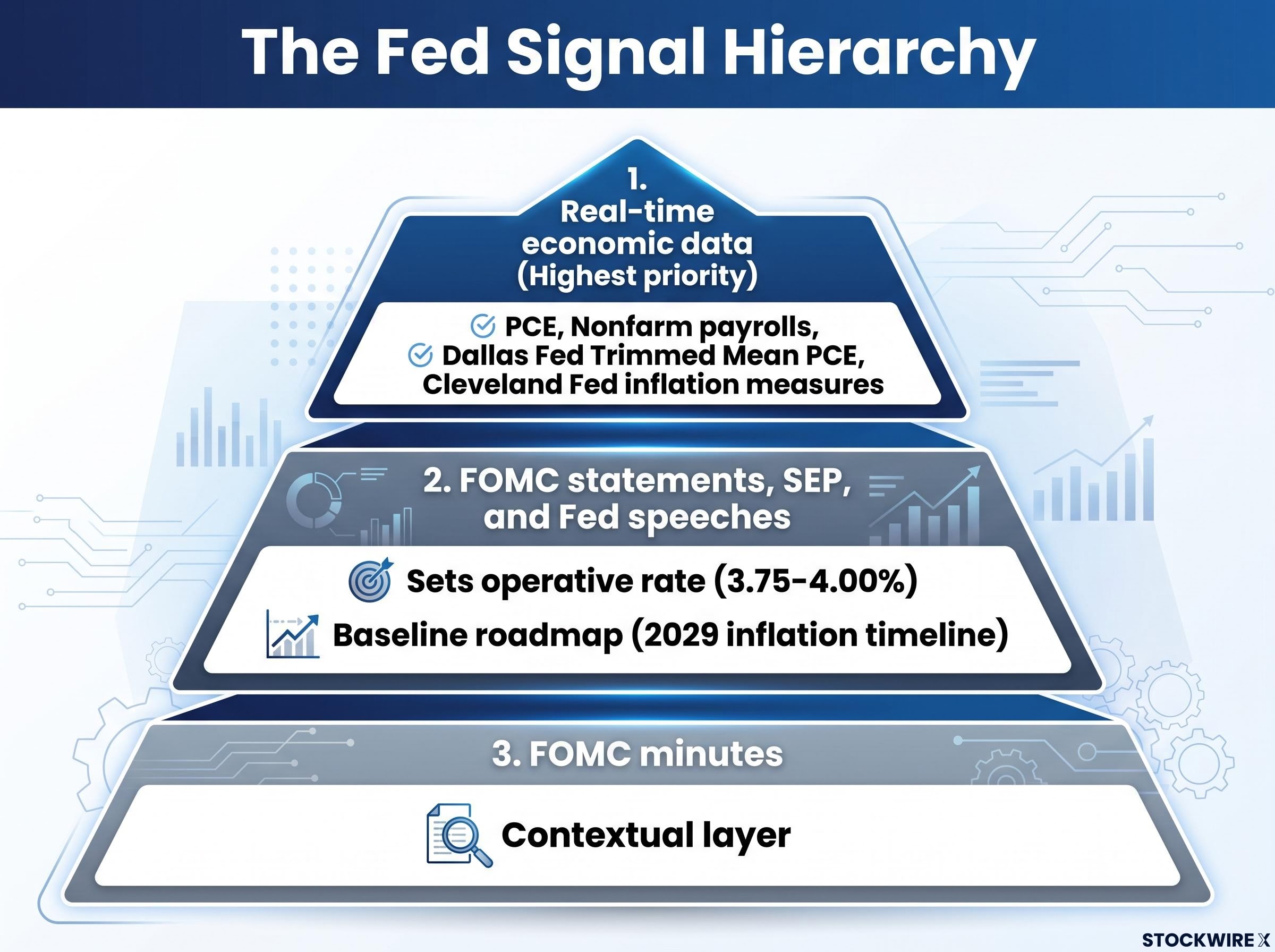
- Real-time economic data (highest priority). Fresh releases are what actually move markets, because they are the concrete evidence against which every stated policy path gets judged. The August PCE episode is the proof: softer readings immediately recalibrated expectations about future hikes, faster than any scheduled Fed communication could. The releases to watch most closely:
- Personal Consumption Expenditures (PCE), the Fed’s preferred inflation gauge
- Nonfarm payrolls, the monthly employment headline
- Dallas Fed Trimmed Mean PCE, a high-frequency supplementary inflation measure
- Cleveland Fed inflation measures, for additional real-time texture
- FOMC statements, the SEP, and Fed speeches. The meeting-day statement sets the operative rate (currently 3.75-4.00%), and the SEP lays out the baseline roadmap, including that 2029 inflation timeline. Between meetings, speeches and press conferences update the tone, revealing how individual policymakers are reading new data and whether they see risks tilting toward more or less tightening.
- FOMC minutes (contextual layer). The narrative record of the discussion. Useful texture, but secondary to the two tiers above, and most vulnerable to being overtaken by intervening data.
Once you hold this hierarchy, you have a decision rule. When minutes arrive, your first step is to locate which tier of more recent information has landed since the meeting date, then read the minutes as a lens on that information rather than a replacement for it.
When minutes still matter
The minutes are not worthless. They retain genuine analytical value in three specific situations.
- Internal consensus breadth. They reveal how broad or narrow agreement was inside the room, including the substance of any dissent that the terse statement hides.
- Conditional action triggers. They clarify the specific conditions under which the Committee would consider further tightening or easing, detail the short statement never carries.
- Intra-Committee risk assessments. They surface concerns, such as financial stability worries or labour-market overheating, that do not show up in the headline projections or SEP tables.
Treat these as supplementary inputs, not primary signals. Their value is highest when the data environment since the meeting has not dramatically shifted the policy backdrop. When it has, as in September, even these uses fade.
Four ways retail investors misread FOMC minutes (and how to avoid them)
None of these are mistakes made by careless people. They are cognitive traps that are genuinely easy to fall into, and naming them is the fastest way to catch yourself before you repeat one.
- Acting on a stale tone. The trap: you read the restrictive mood of a meeting and position for it, not realising the mood pre-dates data that has since softened the picture. The corrective: before reacting to the tone, check what has been published since the meeting date, exactly as the September minutes pre-dated the August PCE release that cooled the urgency case.
- Misreading dissent as broad opposition. The trap: minutes describe differing views with phrases like “some participants” and give no numerical weighting, so you over-read a handful of concerns as a Committee-wide revolt. The corrective: treat dissent as informational only, and judge its real market weight by how subsequent data and speeches evolve.
- Inverting the forward-guidance hierarchy. The trap: you treat the minutes as the top-tier signal and quietly underweight the documents that actually set policy. The corrective: remember the statement and SEP set the operative rate (3.75-4.00%) and the baseline path, while the minutes supply narrative detail only.
- Overreacting to qualitative language. The trap: words like “concern,” “uncertainty,” or “some participants” trigger a strong reaction in isolation. The corrective: read that language against the latest inflation and employment data and the SEP’s baseline (inflation projected to hit 2% only by 2029) before drawing any trading conclusion.
The September minutes captured a policy environment that had already shifted by the time investors read them. That is the staleness trap in its purest form: a backward-looking document reacted to as if it were live.
Every one of these is a version of the same underlying error: treating a backward-looking record as though it carries the same authority as forward-looking signals. Catch yourself before you make that substitution, and the minutes become a useful supplement rather than a misleading one.
Reading the next set of minutes with the right frame
You now have everything you need to approach the next FOMC minutes release as a practitioner, not a reactor. The job is to assign this document its correct role inside a broader information-gathering process, and that process fits into three steps.
- Check the meeting date. Note exactly when the discussion you are about to read actually took place.
- Identify the intervening data. List every major release, PCE, nonfarm payrolls, key Fed speeches, that has landed between the meeting and the minutes.
- Read the minutes as contextual texture. Layer them on top of that fresher data, using them for consensus, triggers, and risk colour, never as a substitute for what has come since.
The stakes for getting this right remain high. With the federal funds rate at 3.75-4.00% and the SEP still projecting inflation reaching 2% only by 2029 alongside the prospect of at least one further quarter-point increase, reading Fed signals correctly carries real weight for how you position.
Between now and the next meeting, keep your attention on the highest-priority signals:
- Personal Consumption Expenditures (PCE)
- Nonfarm payrolls
- Fed speeches and press conferences
The habit is simple and repeatable. Before you open the minutes, audit what has changed since the meeting date, because that audit tells you precisely how much interpretive weight the document deserves.
For readers wanting to see the sequencing framework applied to a prior minutes release in full detail, our deep-dive into the July FOMC minutes walks through the 9-3 hawkish dissent, how analysts weighted it against concurrent employment data, and what the committee’s internal debate signalled about the September rate path.
This article is for informational purposes only and should not be considered financial advice. Investors should conduct their own research and consult with financial professionals before making investment decisions. Financial projections are subject to market conditions and various risk factors, and forward-looking statements regarding policy and inflation are speculative and subject to change based on incoming data.