

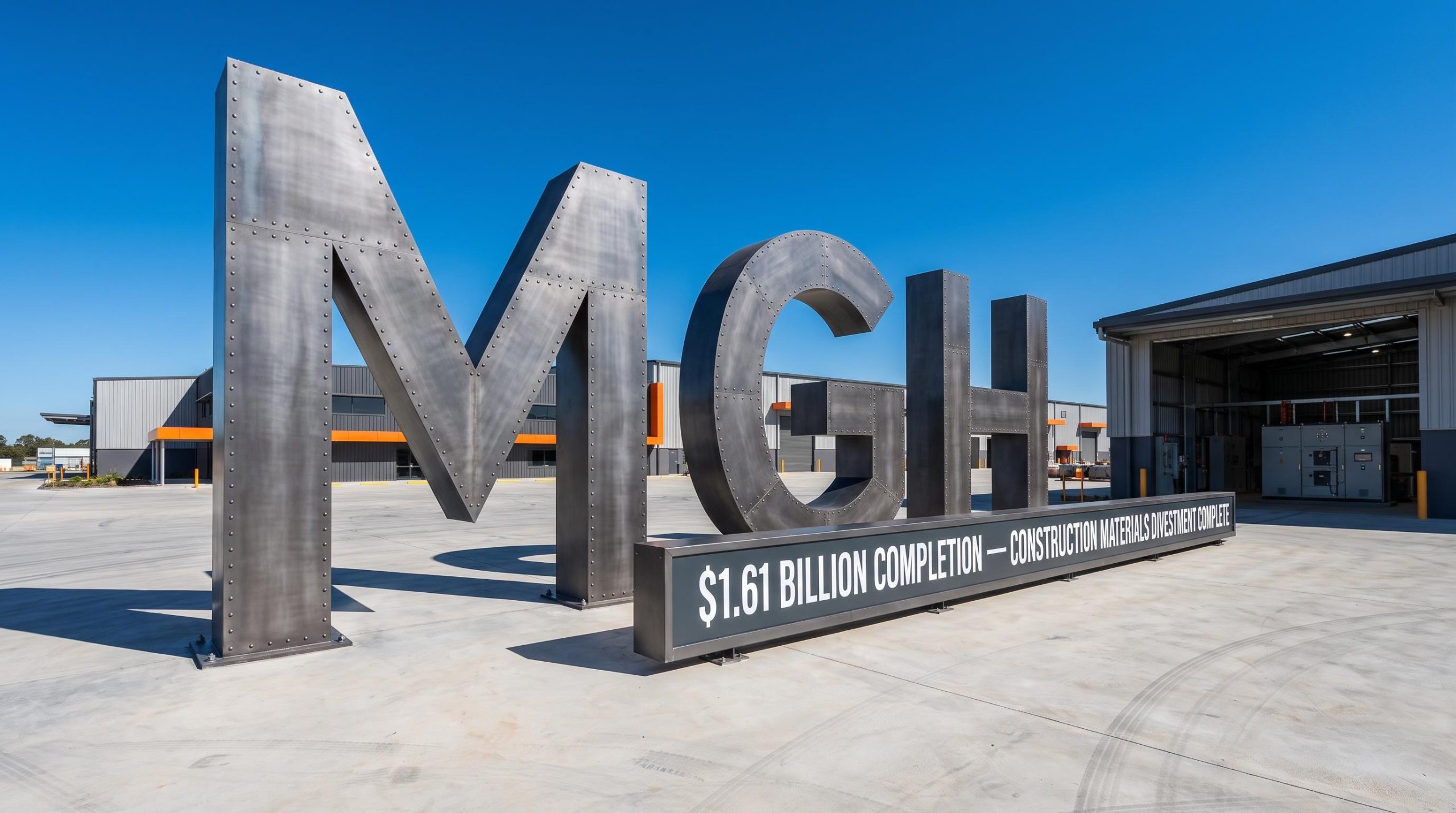
$1.61 billion divestment of construction materials division now complete
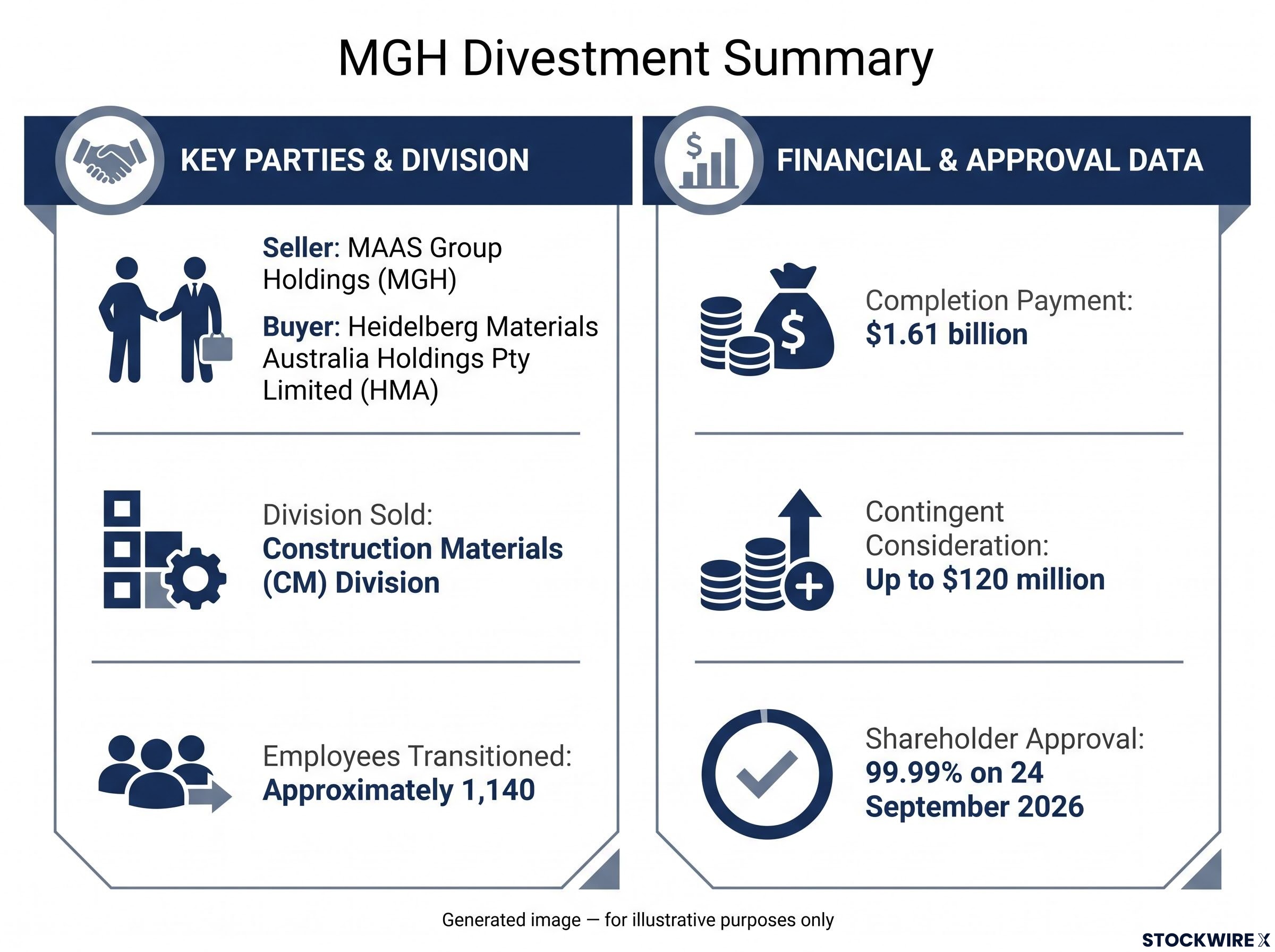
MAAS Group Holdings (ASX: MGH) has confirmed that the sale of its Construction Materials (CM) Division to Heidelberg Materials Australia Holdings Pty Limited (HMA) has now completed. MGH received a completion payment of $1.61 billion, reflecting the purchase price and estimated completion adjustments, marking the full transfer of one of the group’s largest business units.
The transaction reached completion following the satisfaction or waiver of all conditions precedent, including regulatory approvals and shareholder sign-off. Shareholders approved the divestment at the Company’s Annual General Meeting on 24 September 2026, with Resolution 5 carried by 99.99% of votes cast.
FIRB and ACCC approvals were secured in the weeks leading into the AGM, with both regulatory conditions satisfied before shareholders voted 99.99% in favour of the resolution on 24 September 2026.
Approximately 1,140 employees have transitioned with the CM Division. The transaction was structured to support an orderly separation and continuity for employees, customers, and suppliers.
When big ASX news breaks, our subscribers know first
Transaction structure and what MGH stands to receive
Beyond the $1.61 billion received on completion, MGH retains entitlement to contingent consideration of up to $120 million, subject to the achievement of agreed commercial and operational milestones. The transaction also remains subject to customary post-completion purchase price adjustments, the outcome of which has not yet been finalised.
The contingent tranche keeps MGH financially exposed to the CM Division’s post-sale performance without carrying the operational burden of running the business.
| Component | Amount | Status |
|---|---|---|
| Completion payment | $1.61 billion | Received on completion |
| Contingent consideration | Up to $120 million | Subject to agreed commercial and operational milestones |
| Post-completion price adjustments | TBC | Customary process ongoing |
MGH has stated it will provide further information regarding the application of the proceeds and its capital management priorities as appropriate. No further detail on the deployment of proceeds has been disclosed at this stage.
What is a business divestment, and why does it matter for MGH investors?
A corporate divestment occurs when a company sells a division or business unit to a third party in exchange for cash or other consideration. Rather than continuing to operate that business, the selling company transfers ownership entirely and redeploys the capital released, or returns it to shareholders.
Companies typically divest for three core reasons:
- Unlocking trapped capital — assets that are valuable but capital-intensive can be monetised, freeing up cash that may not have been accessible while the division was operating within the group.
- Reducing operational complexity — a smaller, more focused business is generally easier to manage, allocate resources to, and execute strategy across.
- Enabling reinvestment into higher-growth segments — proceeds from a divestment can be directed toward divisions or sectors with stronger growth prospects, improving the overall quality of the portfolio.
For MGH investors, the sale of the CM Division represents exactly this dynamic. The group now operates as a leaner industrial business, with its remaining divisions in civil construction, real estate, and electrical infrastructure through the JLE Group. The JLE Group electrical division designs and manufactures mission-critical power distribution equipment for data centre, utility, and infrastructure customers across Australia. Given the accelerating demand for data centre infrastructure, this segment represents a high-growth exposure that remains firmly within the group.
Streamlined portfolio and what comes next for MGH
Following completion of the divestment, MGH’s remaining business profile spans three divisions: civil construction, real estate, and electrical infrastructure via the JLE Group. The data centre and infrastructure power distribution focus of JLE Group positions it within a sector experiencing strong structural demand, driven by the continued buildout of digital infrastructure across Australia.
The JLE Group Firmus order, an $855 million purchase order for modular electrical infrastructure to be delivered over 18 months, positions the electrical division as MGH’s dominant earnings driver from FY27 and underpins the strategic logic behind retaining this segment after the CM Division sale.
On the question of capital allocation, the Company has stated it will communicate its capital management priorities as appropriate. No specific plans regarding dividends, share buybacks, or acquisitions have been disclosed in this announcement.
Investors seeking further information can contact Group CEO Wes Maas or Group CFO Craig Bellamy at investorrelations@maasgroup.com.au.
As a diversified industrial group, MGH enters its next chapter with a substantially simplified portfolio, a materially strengthened balance sheet, and retained financial exposure to its former CM Division’s performance through the contingent consideration structure.
Stay Ahead on ASX Industrials News
Get FREE breaking ASX announcements delivered to your inbox within minutes of release, complete with in-depth analysis already done for you. Over 20,000+ subscribers rely on Big News Blast to stay ahead of market-moving developments the moment they happen. Click the “Free Alerts” button to start receiving alerts today.