Every time the Federal Reserve adjusts interest rates or even hints at a shift in direction, currency markets move billions within minutes. Yet almost all the coverage you read of a Fed meeting fixates on one thing: what it means for borrowing costs at home. The Dollar itself, the currency sitting in your bank account, barely gets a mention.
That gap matters more than it looks. The strength or weakness of the Dollar shapes the price of everything you import, the real value of your savings, and the relative return of nearly every asset you own.
The 2025-2026 rate cycle is a sharp reminder of how fast the picture can change. The Fed cut rates three times in a row through late 2025, then turned around and hiked in September 2026. Anyone reading those moves purely through the lens of mortgage rates missed half the story.
This explainer builds you a working framework for the relationship between the Federal Reserve and the US Dollar, so the next Fed announcement reads to you as a currency event, not just a domestic borrowing-cost event. You will know why the Dollar reacts, through which channels, and what signals to watch.
The world’s currency: how the Dollar earned its dominant role
To understand why Fed decisions ripple across the planet, you first need to appreciate how hard it is to unseat a reserve currency. The Dollar did not stumble into its position. It earned it, layer by layer, and the weight of each advantage is exactly what makes it so difficult to dislodge.
From Bretton Woods to the floating-rate era
The modern story starts in 1944, when allied nations met at Bretton Woods and formally anchored global trade and finance to the Dollar, which was itself fixed to gold. The Dollar had just displaced the British pound as the world’s primary reserve currency, and the agreement cemented that shift.
That gold anchor held until 1971, when President Nixon suspended the Dollar’s convertibility into gold. On paper, this should have weakened the currency. It did not.
What filled the vacuum was structural: petrodollar recycling, where oil was priced and settled in Dollars, the sheer depth of US capital markets, and the institutional habits of a financial system already built around the Dollar. The gold peg ended; the dominance did not.
Why the Dollar stays on top today
The Dollar’s grip today rests on five structural pillars, not inertia alone. First, the unmatched depth and liquidity of US financial markets. Second, US Treasuries functioning as the world’s premier safe and liquid asset. Third, powerful network effects, where the more widely a currency is used, the more costly it becomes to switch away from it. Fourth, a strong institutional and legal framework. Fifth, the Dollar’s central role in global bank funding, corporate borrowing, and derivatives.
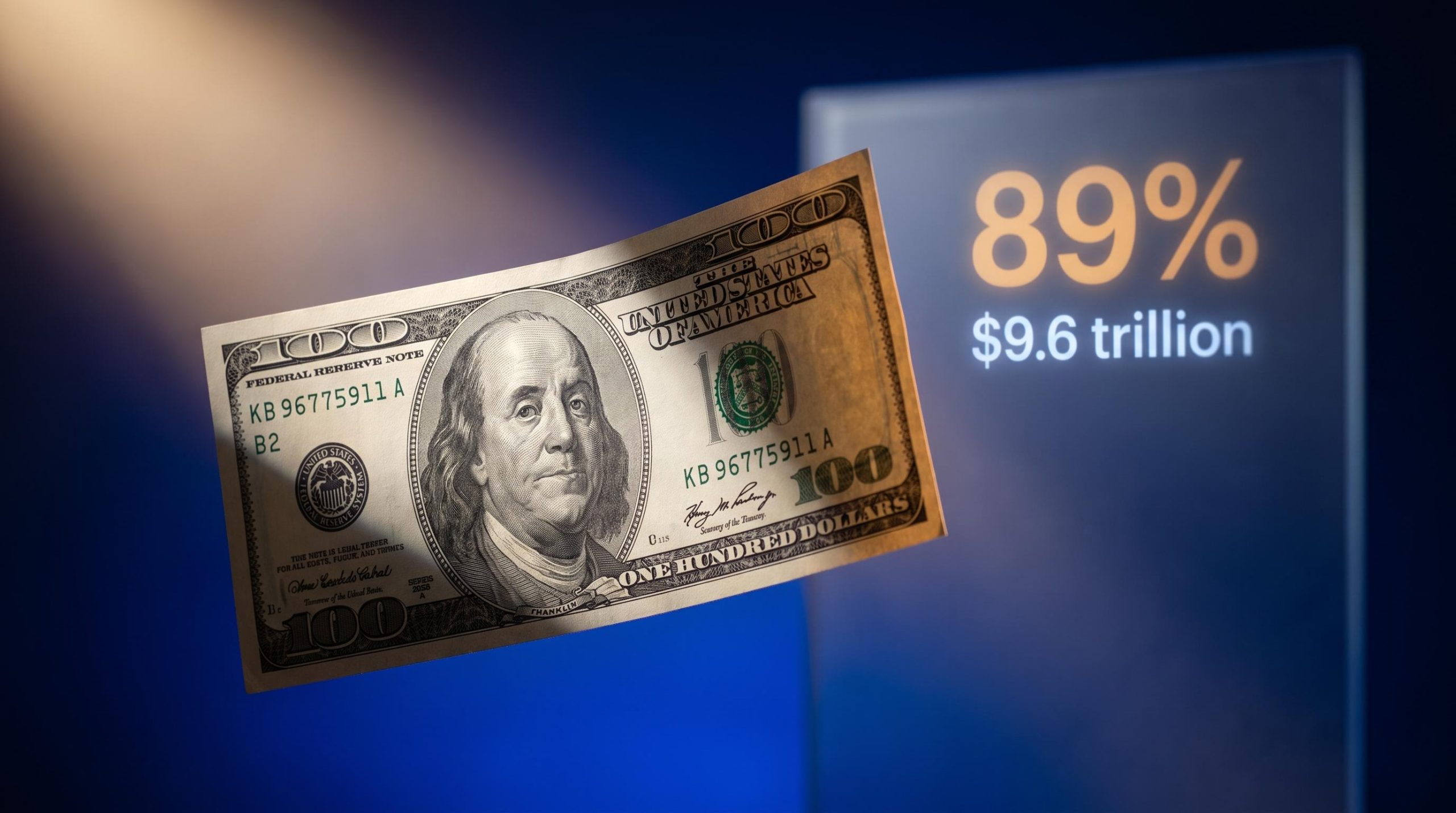
The scale of Dollar dominance The US dollar was on one side of 89% of all foreign exchange trades in April 2025, with $9.6 trillion changing hands daily, according to the BIS Triennial Survey 2025.
That 89% figure tells you something important: the Dollar is not merely America’s currency. It is the operating system of global trade and finance, which means any change in its value touches nearly every cross-border transaction on earth.
Dollar dominance rests on a structural gap that surprises most readers: the US accounts for roughly 10% of world trade yet the Dollar appears on one side of 89.2% of all FX transactions, a disproportion that explains why Fed decisions reverberate far beyond America’s borders.
Economist Barry Eichengreen’s work on reserve-currency incumbency captures why challengers have grown without displacing the Dollar. The switching costs embedded in trade invoicing, derivatives, and reserve management are enormous. The euro, second in line, is constrained by an incomplete fiscal union. The Chinese renminbi is held back by capital controls and limited convertibility.
| Currency | Share of global FX reserves | Share of FX turnover | Primary structural constraint |
|---|---|---|---|
| US Dollar | 57.13% (2026 Q1) | 89% (one side, April 2025) | Few, dominant incumbent |
| Euro | Second-largest | Second-largest | Incomplete fiscal union |
| Renminbi | Small but growing | Small but growing | Capital controls, limited convertibility |
According to IMF COFER data, the Dollar held 57.13% of official global reserves in 2026 Q1. Even in a more multipolar world, that structural lead means the Dollar is likely to remain the core reserve currency for the foreseeable future.
When big ASX news breaks, our subscribers know first
What the Fed is actually trying to do: the dual mandate explained
Once you see the Dollar as the world’s operating system, the question becomes: what drives the Federal Reserve to turn the dials that move it? The answer is a single conceptual engine behind every decision, and once you understand it, Fed announcements stop looking arbitrary.
Congress charged the Federal Reserve with two jobs at once: maximum employment and price stability. These goals can pull in opposite directions. Fighting inflation often means cooling the economy, which can cost jobs; protecting jobs can mean tolerating more inflation.
The Federal Reserve’s monetary policy framework, published by the Fed itself in August 2025, sets out in precise terms how the FOMC pursues both sides of the dual mandate and the communication conventions it uses to signal direction to markets.
The twin objectives The Fed’s dual mandate is maximum employment and stable prices. The quantitative anchor for price stability is a 2% inflation target.
Why 2% rather than zero? A small positive buffer protects against deflation, where falling prices can freeze spending, and it gives the Fed room to cut real interest rates when it needs to stimulate the economy. Zero leaves no cushion.
The 2025-2026 rate sequence shows the dual mandate in action, with the Fed constantly weighing which risk, inflation or unemployment, was the more pressing threat at the time.
- March 2025: held at 4.25-4.5%. The Fed kept rates steady, signalling it saw no urgent reason to move in either direction.
- September 2025: cut to 4.0-4.25%. The first of three cuts, responding to perceived downside risks to growth.
- October 2025: cut to 3.75-4.0%. A second consecutive reduction as the easing bias continued.
- December 2025: cut to 3.5-3.75%. The third straight cut, though FOMC dissent was recorded over the size and timing.
- September 2026: hiked to 3.75-4.0%. A 25 basis point increase, the first hike since 2023, signalling renewed inflation vigilance.
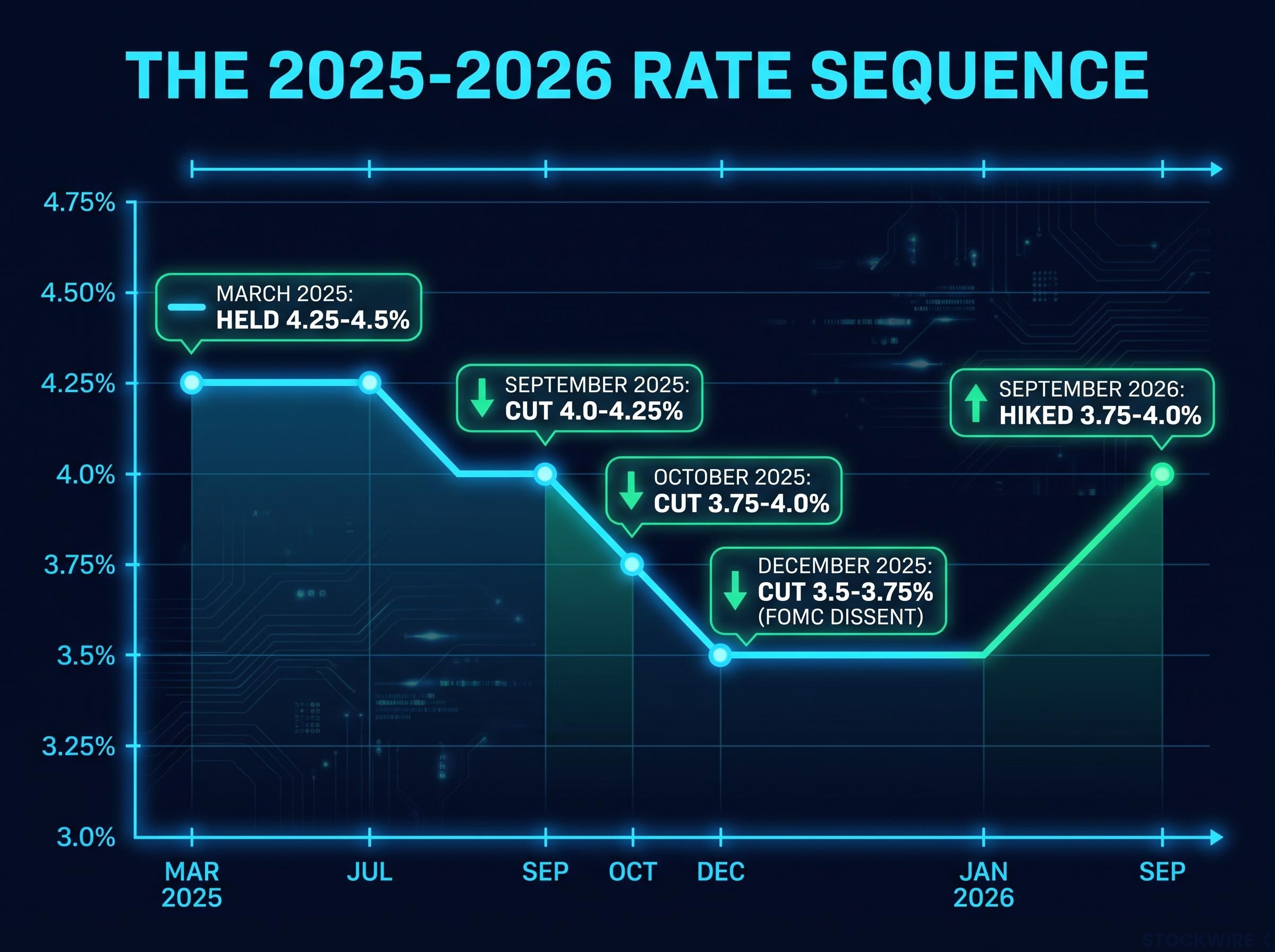
That December dissent matters. It tells you the dual-mandate trade-offs are contested even inside the Fed itself, so a single decision rarely reflects unanimous conviction.
The bigger lesson sits in the September 2026 hike. The Fed reversed part of a 75 basis point easing cycle within less than a year. Reading any single decision in isolation will always give you an incomplete picture, because the policy path is not a one-way street.
For you, the practical value is this: once you can read Fed statements as signals about which risk is currently dominant, you can form a view on the likely direction of the next move, and therefore on the probable pressure on the Dollar.
How a rate decision travels from the Fed to your Dollar
Knowing that the Fed moves rates is one thing. Understanding exactly how those moves reach the Dollar in your account is another. The transmission works as a causal chain, and each link is worth clicking into place.
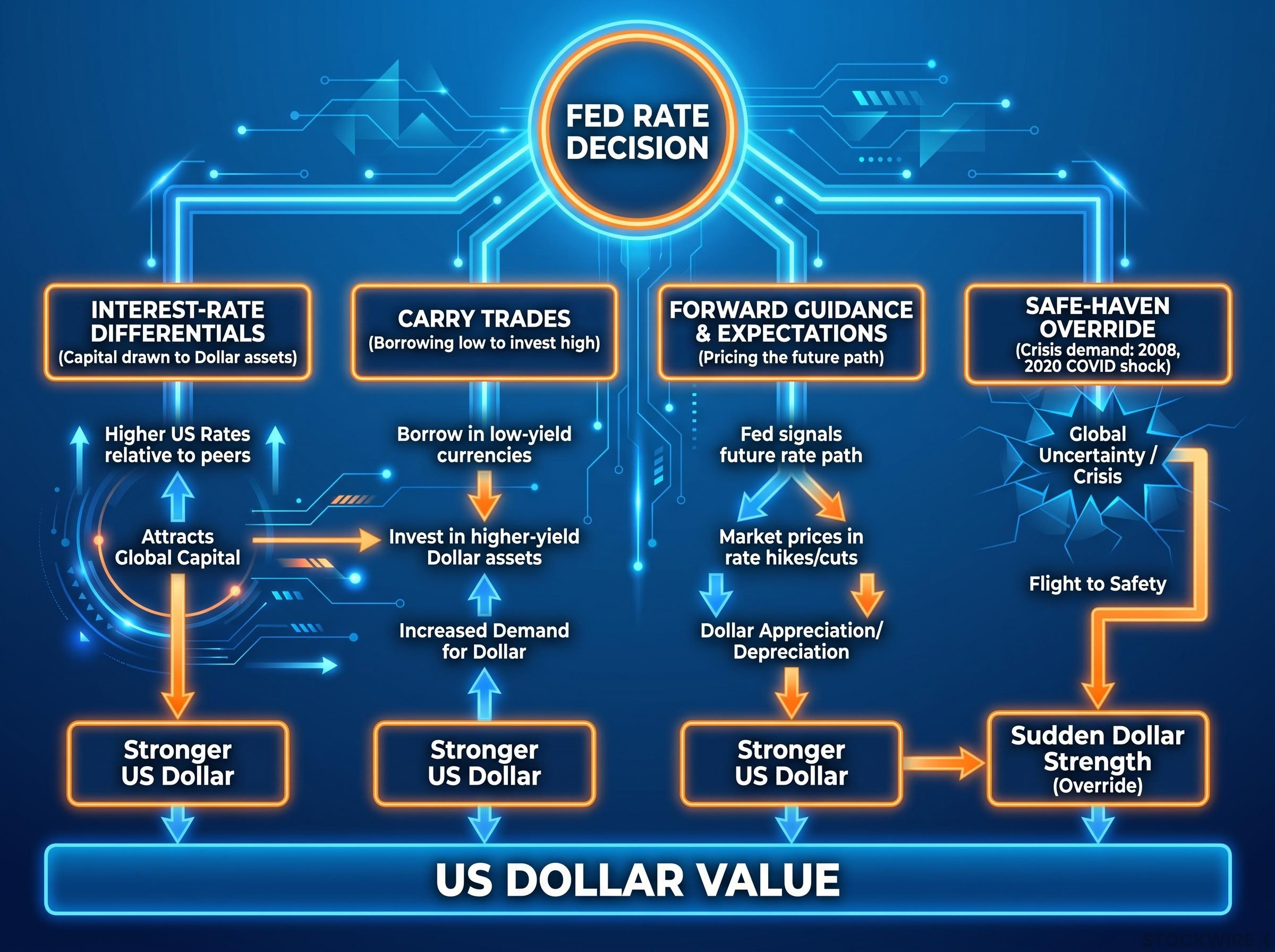
Here are the four channels at work:
- Interest-rate differentials: the gap between US rates and those abroad draws capital toward Dollar assets.
- Carry trades: investors borrowing in low-rate currencies to invest in higher-rate ones.
- Forward guidance and expectations: markets pricing the future path of policy, not just today’s rate.
- The safe-haven override: crisis demand for Dollars that can defy the usual logic.
The standard channels: rates, carry trades, and expectations
When US rates sit higher than those of other major central banks, Dollar-denominated assets become more attractive to global investors. To buy those assets, they must first buy Dollars, and that demand pushes the currency up. This is the interest-rate differential channel, formalised in international finance through interest-rate parity, the framework associated with economists Maurice Obstfeld and Kenneth Rogoff.
The carry trade sits close to this. Investors borrow in a low-rate currency and park the money in a higher-rate one to capture the spread. The Dollar is frequently one side of this trade, so a Fed rate move can trigger large, rapid capital flows as the maths of the trade changes.
Then there is the expectations channel, and it often matters most. Markets price the expected future path of policy, not just the current rate. A hawkish statement can strengthen the Dollar even when rates are unchanged, and a dovish pivot can weaken it before any cut is actually delivered.
Forward guidance operates as a rate decision in its own right: a hawkish Jackson Hole speech can reprice the Dollar and long-duration bonds within minutes, even when no formal rate change accompanies it, because markets are continuously pricing the expected policy path rather than the current rate level.
The 2025 cutting cycle illustrates the standard logic. Three 25 basis point cuts narrowed the gap between US and foreign rates, reducing the carry-trade appeal of Dollar assets and encouraging flows toward higher-yielding markets. Economist Hélène Rey’s work on the global financial cycle adds a layer here: US monetary policy and US asset returns move global capital flows, and therefore exchange rates, by more than simple interest-rate parity would predict.
When the usual logic breaks down: the safe-haven effect
Sometimes the standard playbook inverts entirely. During acute financial stress, the 2008 crisis and the early 2020 COVID shock being the clearest cases, the Dollar strengthened even as the Fed cut aggressively.
Why? Because in a panic, global investors scramble for Dollar liquidity regardless of yield. The safe-haven demand temporarily overrides the interest-rate differential logic that normally governs the currency.
For you, this is an early-warning sign. When a genuine crisis hits, the Dollar’s behaviour may not follow the rate-differential script at all, and tracking a rate decision in isolation will not be enough. What usually moves the Dollar on the day is whether the decision surprised the market or merely confirmed what it already expected.
QE and QT: the Fed’s heavy artillery and what it means for the Dollar
Interest rates are the Fed’s everyday tool. But when rates hit zero and ordinary cuts lose their power, the Fed reaches for something bigger. Understanding these balance-sheet tools, and their genuinely counterintuitive effect on the Dollar, separates a sophisticated reader from a headline-skimmer.
What QE and QT actually do to the Fed’s balance sheet
Quantitative easing (QE) is what the Fed does when the policy rate has already fallen to zero and cannot go lower usefully. The Fed creates new reserves and buys long-term government bonds and mortgage-backed securities. This pushes down long-term interest rates, eases financial conditions, and signals that rates will stay low for a long time.
Two mechanisms do the work. The portfolio-balance channel removes safe, long-duration assets from the market, nudging investors into riskier ones and compressing yields. The signalling channel reinforces expectations that short-term rates will stay low, pulling down yields across the curve.
Quantitative tightening (QT) is the mirror image. The Fed stops reinvesting the proceeds of maturing bonds, shrinking its balance sheet and gradually withdrawing the liquidity QE injected. Over time, this is generally supportive of the Dollar.
The Fed deployed QE twice at scale. In the 2008 crisis, with the policy rate near zero, it needed to lower long-term rates and stabilise mortgage markets. In the 2020 COVID shock, it moved even faster and larger to stabilise funding markets under acute stress. Both episodes drew heavy criticism:
- Asset-price distortions and bubbles, as cheap money inflates stocks, bonds, and housing.
- Distributional effects, where rising asset prices disproportionately benefit wealthier households that own them.
- Exit risk and “QE addiction”, where markets grow reliant on the Fed backstop and unwinding becomes disruptive.
- Fiscal-monetary entanglement, where large Treasury purchases blur the line between policy and debt financing.
- Uncertain long-run inflation effects, particularly when QE combines with fiscal stimulus and supply shocks.
| Feature | Mechanism | Balance sheet effect | Typical Dollar impact | Primary risk |
|---|---|---|---|---|
| QE | Buys long-term bonds and MBS | Expands | Ambiguous (context-dependent) | Asset-price distortion |
| QT | Stops reinvesting maturing bonds | Shrinks | Generally supportive | Market turbulence on exit |
Why QE does not always weaken the Dollar
Here is the part that trips up most commentary. The simple story says QE prints money and therefore weakens the Dollar. The reality is more complicated.
QE does tend to compress Dollar yields, which can push capital toward higher-yielding markets abroad and weigh on the currency. That is the Dollar-negative case. Yet during crisis periods, the Dollar often strengthened while QE was running, because global investors prized Dollar liquidity above yield.
This tells you to be sceptical of anyone claiming QE straightforwardly devalues the Dollar. The outcome depends on context. In a crisis, safe-haven demand tends to dominate and the Dollar can firm. In a recovery phase, carry-trade and risk-on flows tend to dominate and the Dollar can soften. Context, not a fixed rule, decides which force wins.
Reading the Fed like a currency trader: what to watch and why it matters
You now have the full picture: the Dollar’s structural dominance, the dual mandate, the transmission channels, and the balance-sheet tools. The payoff is turning that understanding into a repeatable habit. Every time the Fed meets, you can run through a structured set of questions.
- Direction and size of the rate move. Is the Fed easing or tightening, and by how much?
- The surprise factor. Did the decision match market expectations, or did it catch the market off guard?
- The FOMC statement language. Is the tilt hawkish (worried about inflation) or dovish (worried about growth)?
- Balance-sheet guidance. What is the pace of QT, and is there any hint of a pivot back toward QE?
The core insight The Fed’s rate decision often matters less than whether it surprised the market, because the Dollar tends to move on the gap between expectation and reality.
The stakes here are not abstract. Because the Dollar underpins 89% of FX trades and roughly 57% of official reserves, Fed decisions reverberate into import prices, commodity costs, and emerging-market debt burdens. All of those eventually reach you, as a US consumer and investor, through what you pay and what you earn.
The longer-term challenge deserves honesty. The Dollar faces real structural questions around reserve diversification and geopolitical fragmentation. But the network effects and institutional advantages from the first section mean any displacement would be a decades-long process, not a sudden event. The September 2026 hike, reversing part of a recent easing cycle, is a fresh reminder that the Fed’s path stays live and unpredictable, which is precisely why a monitoring framework beats a single prediction.
Reserve diversification, measured by the Dollar’s declining share from roughly 72% in 2001 to approximately 56.8% in Q4 2025, is frequently overstated as a threat because a significant portion of the measured decline is a statistical artefact of exchange-rate movements rather than active central bank selling.
What the Fed’s next move means for you and the Dollar you hold
Pull the threads together and the arc is clear. The Dollar’s dominance is structurally grounded, not accidental. The dual mandate is the engine driving every rate decision. Those decisions reach the Dollar through identifiable channels, and QE and QT add a balance-sheet dimension that complicates any simple story about currency debasement.
The uncertainty ahead is genuine. The 2025-2026 cycle showed the Fed can cut three times and then hike within twelve months, and the Dollar’s reserve share faces long-run questions even as its near-term dominance looks secure.
What you now hold is a durable lens, not a crystal ball. The next Fed announcement, the next QE rumour, and the next “the Dollar is dying” headline will all read more precisely to you than they did before.
For readers wanting to stress-test the structural pillars described above against current fiscal and geopolitical conditions, our deep-dive into fiscal pressures on Dollar dominance examines how $40 trillion in federal debt and ongoing military outlays are compounding in ways bond markets are already pricing in.
This article is for informational purposes only and should not be considered financial advice. Investors should conduct their own research and consult with financial professionals before making investment decisions. Past performance does not guarantee future results, and financial projections are subject to market conditions and various risk factors.