The Bank of Japan has just published its most hawkish board language since it last held rates at this level in 1995, with members openly debating faster hikes and one explicitly arguing for accelerating increases if inflation overshoots. The yen, by any textbook logic, should be climbing. It is not.
Instead, as the new quarter opens on 1 October 2026, the US dollar is holding firm above 101.50 on the USD Index, and USD/JPY is sitting near 158. A central bank publishing opinions that favour quicker tightening is failing to lift its own currency, and that disconnect is the live story driving currency market moves this session.
This piece gives you a clear read on where the major pairs stand at the Q4 open, what the BoJ’s September Summary of Opinions actually signals for USD/JPY direction, and which specific catalysts could shift the dynamic before the next policy meeting. Think of it as practical orientation before you position into the new quarter.
Where major pairs stand as the new quarter opens
The dollar is the anchor, and almost everything else is moving against it. The USD Index held above 101.50 during European trading on Thursday after a volatile close to Q3, and the pattern across the majors tells you this is a broad dollar bid rather than a single-pair story.
USD/JPY traded in a roughly 157.60-158.20 range on the day, with the European morning session touching 158.20, up more than 0.5%. EUR/USD extended Wednesday’s slide toward 1.1300. Spot gold managed a modest rebound toward $4,200 after shedding around 0.6% the prior day.
The one exception is sterling. GBP/USD pulled back marginally to near 1.3250 in the early European session, but that followed Wednesday gains driven by positive UK macro data, so it reads as a pause rather than a reversal.
| Pair | Level (1 October) | Weekly USD Change |
|---|---|---|
| USD/JPY | ~157.60-158.20 | +0.59% vs JPY |
| EUR/USD | ~1.1300 (lower) | +0.52% vs EUR |
| GBP/USD | ~1.3250 (marginally lower) | -0.13% vs GBP |
| Spot Gold | ~$4,200 (recovering) | n/a |
| USD Index | Above 101.50 | n/a |
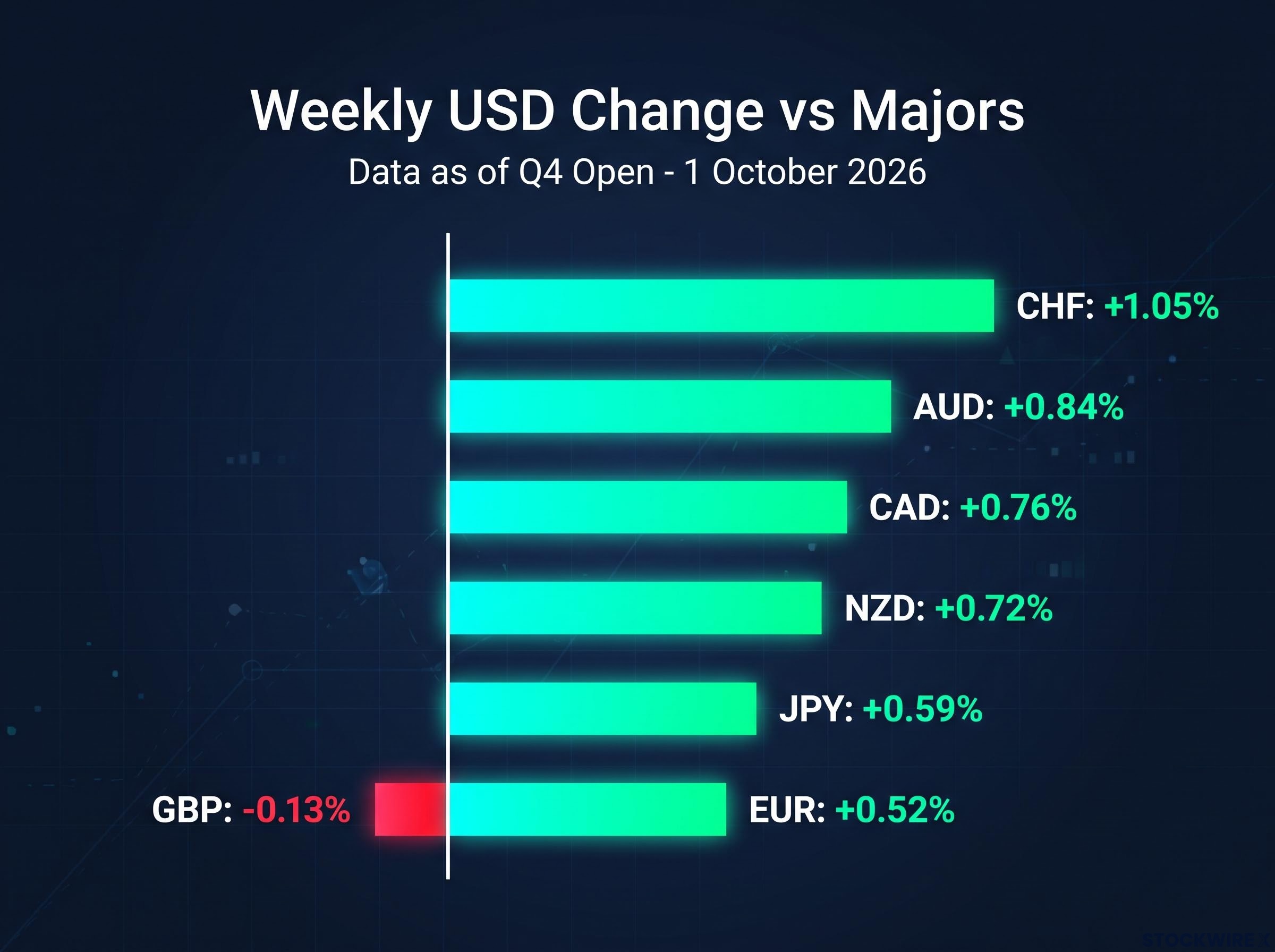
Weekly USD gains against the majors show where the dollar’s grip is strongest:
- 1.05% versus CHF (the broadest gain)
- 0.84% versus AUD
- 0.76% versus CAD
- 0.72% versus NZD
- 0.59% versus JPY
- 0.52% versus EUR
- Down 0.13% versus GBP (the only major where the dollar lost ground)
That near-uniform strength against every peer except sterling matters for how you read your own exposure. If a pair you hold is moving, this breadth tells you whether it is responding to something specific to that currency or simply riding a systemic dollar bid.
Cross-asset dollar transmission in the week of 23 September 2026 illustrated the same dynamic in real time: the DXY climbing back above 101 pushed EUR/USD lower, broke USD/JPY above 158, and dragged gold to four-day lows simultaneously, confirming that current dollar strength is a systemic macro variable rather than a pair-specific story.
When big ASX news breaks, our subscribers know first
What the BoJ’s September opinions actually signal for the yen
Take the language at face value and this looks decisively yen-positive. The Bank of Japan raised its policy rate to 1.25% at the 17-18 September 2026 meeting on a 7-2 vote, the highest level since 1995, and Governor Kazuo Ueda signalled afterwards that back-to-back hikes or 50-basis-point moves were not off the table.
The BoJ communication shift that lowered the threshold for future hikes began in August 2026, when Deputy Governor Himino declared the Bank did not need complete information before acting, a structural departure from a decade of data-confirmation-first policy that changed how every subsequent Summary of Opinions has been read.
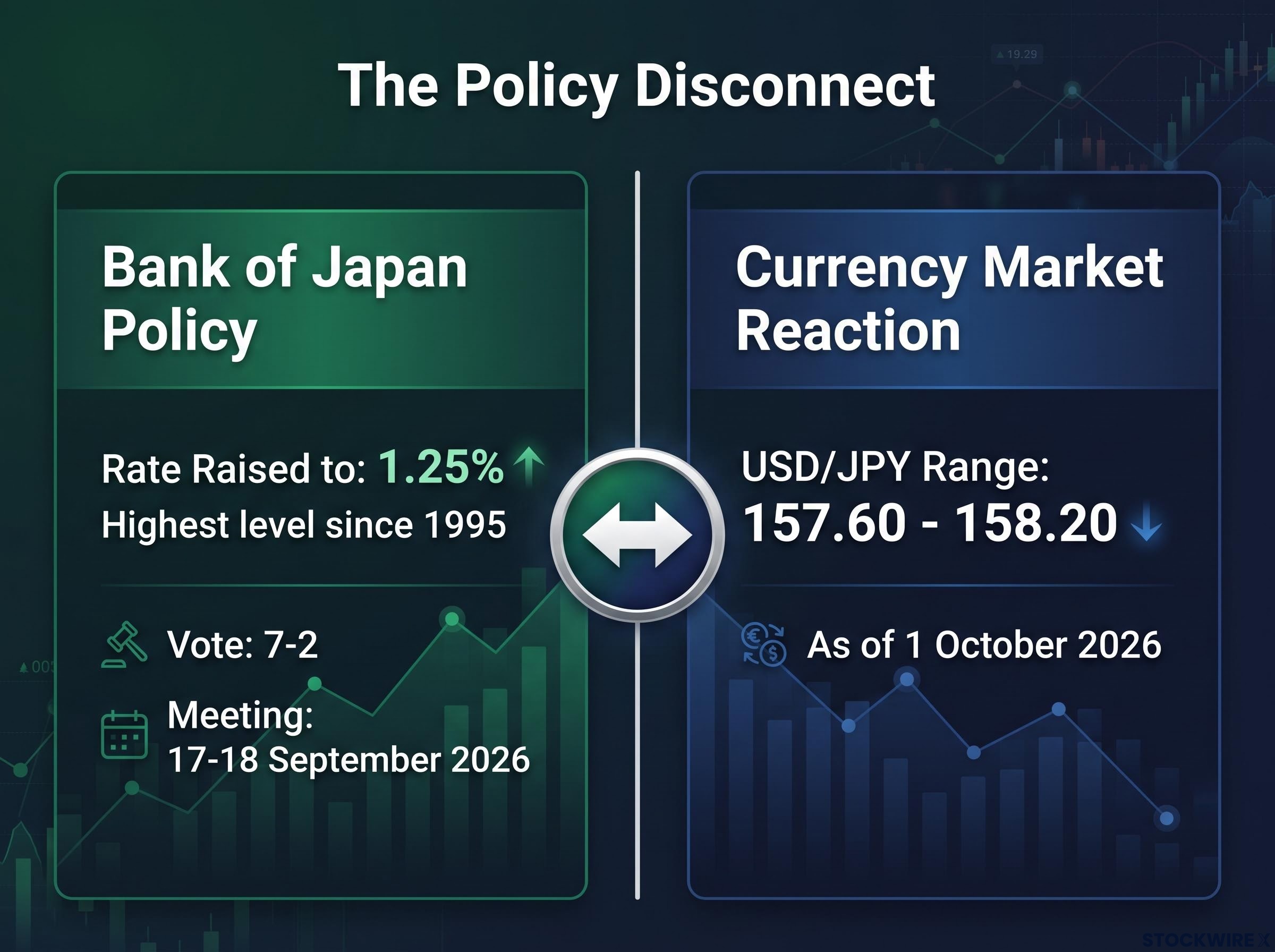
The Summary of Opinions, published on 1 October, hardened that tone. Multiple members backed further increases and wanted the policy rate brought closer to the Bank’s approximate goal “relatively soon.” One opinion went further, arguing the Bank must be ready to speed up if prices deviate upward.
The BoJ September 2026 Summary of Opinions published on 1 October confirmed multiple board members backed further rate increases, with language explicitly tying the pace of hikes to any upside deviation in inflation, a harder line than the Bank has taken at any point in this tightening cycle.
One board member judged the Bank must accelerate the pace of rate increases if inflation exceeds the target, directly tying the speed of hikes to any upside inflation surprise. Source: BoJ Summary of Opinions, September 2026
Junko Ishikawa of Nomura Research Institute, in her “Review of MPM: September 2026,” argued that external inflation risks, including Middle East developments and stronger-than-expected AI-related demand, reinforce the case for the BoJ’s vigilant stance. In her read, the Summary is a genuinely hawkish document.
How markets priced the hawkish signal
And yet the yen did not budge. Reuters observed that the hawkish message failed to rally the currency, with USD/JPY holding in that elevated 157.60-158.20 range despite the Summary’s tone.
The reason, as Reuters framed it, is that markets still view the US-Japan rate gap as wide and BoJ tightening as incremental. The non-reaction tells you something important: conviction about that differential currently outweighs any single policy signal out of Tokyo. For anyone holding yen-denominated assets, the yen’s path back depends on the Fed as much as it does on the BoJ.
The rate differential story: why USD strength has more than one engine
To understand why a hawkish Tokyo cannot move its own currency, start with the carry trade. When US rates sit well above Japan’s, investors can borrow cheaply in yen and park the proceeds in higher-yielding dollar assets, earning the gap. That mechanism lifts demand for dollars and supply of yen, keeping USD/JPY elevated even as the BoJ nudges rates higher.
The yen carry trade mechanics that keep USD/JPY elevated are rooted in a 2.5-2.75 percentage point spread between US and Japanese rates, a gap wide enough that incremental BoJ tightening does not change the fundamental arithmetic for yen-funded investors.
The problem for yen bulls is that this week’s US data gave the Fed little reason to close the gap quickly. The September ISM Manufacturing PMI came in at 54.8, up from 54.6, pointing to resilient factory activity. The detail that matters most is the prices sub-index at 71.1, a sign that inflation pressure in the manufacturing sector is not fading.
| ISM Sub-Index | September 2026 Reading |
|---|---|
| Prices | 71.1 |
| Production | 58.3 |
| New Orders | 53.7 |
| Employment | 51.2 |
| Inventories | 50.6 |
The labour data pointed the same way:
- Initial jobless claims of 200,000 for the week ended 26 September 2026, versus 197,000 previously
- Continuing claims of 1,719,000, a net rise of just 2,000
A prices reading of 71.1 alongside a still-tight labour market tells you the Fed’s higher-for-longer stance is data-supported right now. With Japan’s rate at 1.25% and US rates materially above it, the BoJ’s hawkish tilt alone is simply not enough to narrow the gap or meaningfully weaken the dollar. The upshot for your positioning: any bet on a sharp USD/JPY reversal needs a catalyst beyond the current BoJ language, most likely a credible Fed pivot or a BoJ hike pace that genuinely surprises the market.
What shifts the picture before the next BoJ meeting
So what would actually change the trajectory? Three variables are worth watching in order of near-term timing:
- Fed communication. Multiple Fed policymaker speeches are scheduled for 1 October. Any hint that cuts are closer than markets assume would compress the differential that is holding USD/JPY up.
- US inflation signals. An upside surprise in forthcoming data would push cut expectations further out, reinforcing the dollar and extending the current setup.
- A BoJ pace surprise. Signs that the board is weighing a faster tightening path than current pricing implies would be the outer scenario for yen bulls.
Governor Ueda indicated that back-to-back rate hikes or 50-basis-point moves are not ruled out, the most market-moving single statement from this policy cycle. Source: BoJ post-meeting remarks, September 2026
There is also an external dimension. Ishikawa’s NRI analysis ties the BoJ’s hawkish tilt to Middle East risks and AI-related demand, which means a deterioration in either could weaken the inflation case and ease pressure on yen bears.
Gold is the wildcard here. Its rebound toward $4,200 while the dollar holds firm tells you safe-haven demand is layered on top of the rate-differential story. That matters because any escalation in geopolitical risk could complicate straightforward dollar-long and yen-long positions at the same time, which makes gold a useful secondary read on whether risk sentiment, rather than rates, is driving flows.
The divergence trade is not breaking, but it is being tested
Pull the two findings together and the picture is coherent. The dollar is holding broad gains across the G10, supported by resilient US data, while the BoJ has published its most explicitly hawkish board language of this tightening cycle. The yen still has not rallied.
That is the equilibrium to hold in mind. The carry trade stays intact as long as US data keeps meaningful Fed easing off the table, and the BoJ’s incremental tightening is yen-positive over the medium term but too gradual to force a sharp near-term reversal. The current USD/JPY level reflects a genuine fundamental balance, not a distortion waiting to snap back.
The dollar valuation premium driving the current setup has structural limits: Morningstar’s mid-2026 model flagged the DXY as approximately 15% overvalued, and the rate-differential pillar carrying the rally means any credible Fed pivot toward easing would compress the yield advantage that is doing the heaviest lifting.
For positioning, that means treating the rate differential as the primary variable and the BoJ’s hawkish language as a medium-term directional signal rather than an immediate trigger. Three conditions would disrupt the balance:
- A credible Fed signal that rate cuts are approaching
- A BoJ tightening pace that surprises markets to the upside
- A geopolitical shock large enough to reroute safe-haven flows
This article is for informational purposes only and should not be considered financial advice. Investors should conduct their own research and consult with financial professionals before making investment decisions. Past performance does not guarantee future results, and forward-looking statements are speculative and subject to change based on market developments.