Private employers added 90,000 jobs in September 2026, according to ADP’s National Employment Report, comfortably clearing the roughly 70,000 economists expected. For USD traders, that beat is less a reason to celebrate than a puzzle to solve, because ADP itself says its figure is not built to predict Friday’s Nonfarm Payrolls.
Today, 1 October 2026, sits in the middle of a three-day data sequence that will shape the dollar’s direction. The ADP print is already done. The ISM Manufacturing PMI lands at 10:00 a.m. ET today. The Bureau of Labor Statistics’ Nonfarm Payrolls report arrives Friday. Each release either sharpens or muddies the picture the one before it painted.
Here is a practical framework for reading today’s ISM print against the ADP beat, so you can walk into Friday’s jobs report knowing which signals deserve your conviction and which ones you should set aside.
What the ADP beat is actually telling you
The headline looks clean. 90,000 private-sector jobs in September against a 70,000 consensus, and a sharp step up from August’s downwardly revised 36,000 (first reported as 38,000). That sequential jump from 36,000 to 90,000 is the story inside the story, and it is what moved markets before the composition had a chance to temper the reaction.
Look underneath the headline, though, and the quality of the gain gets more complicated. The hiring was concentrated in lower-wage service industries, while two of the better-paid white-collar categories actually shed jobs.
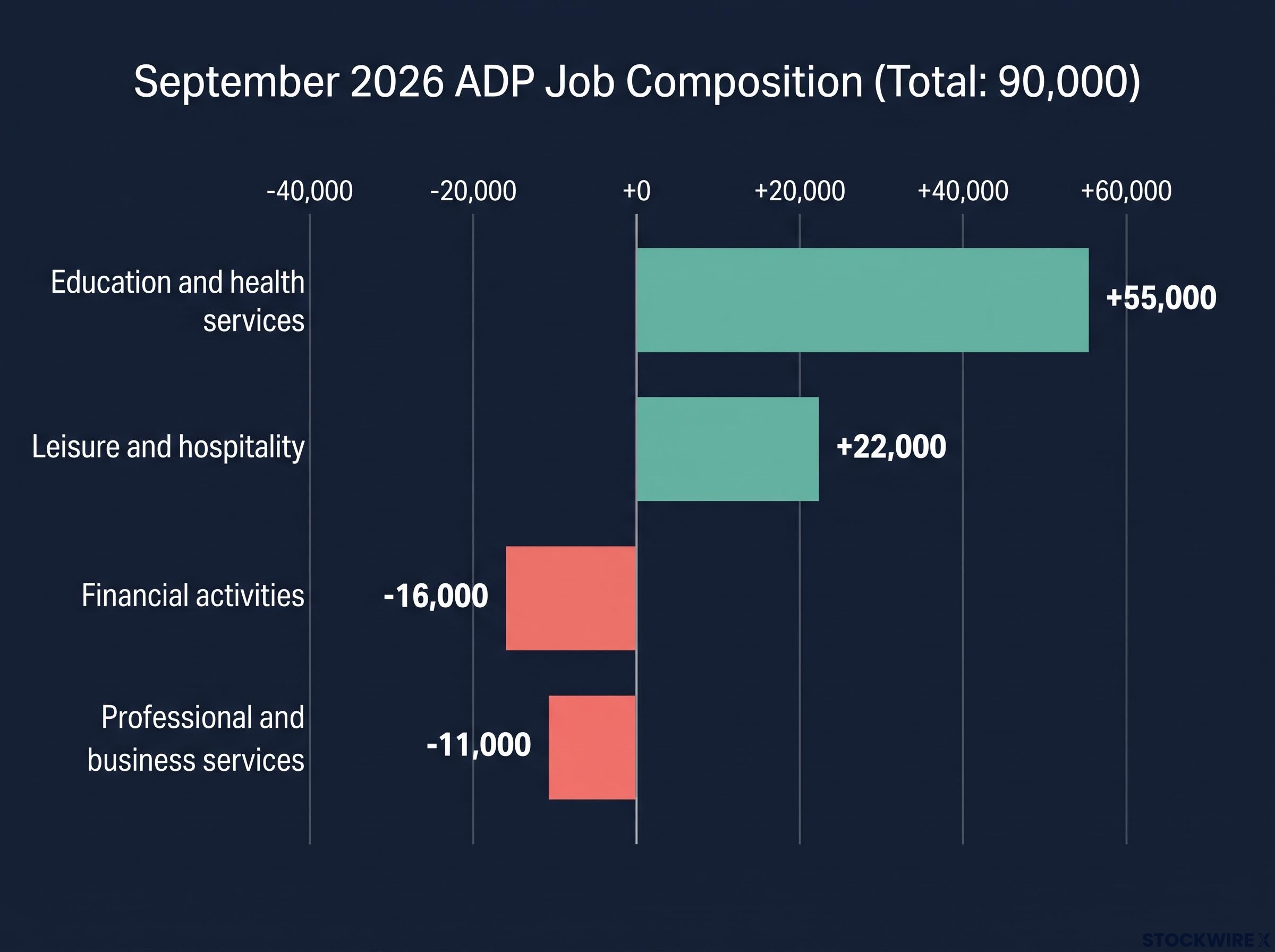
| Sector | Jobs Added / Lost |
|---|---|
| Education and health services | +55,000 |
| Leisure and hospitality | +22,000 |
| Financial activities | -16,000 |
| Professional and business services | -11,000 |
That tilt toward lower-wage sectors matters for how you read the number. A labour market adding mostly hospitality and healthcare support roles while contracting in finance and professional services is a different market than the 90,000 headline implies. If you treated the beat as uniformly bullish for the dollar, you missed a real qualification.
The risk of headline beats masking labour market weakness has appeared before in 2026: April’s 115,000 print looked solid until the three-month average of 48,000 and simultaneous contraction in both ISM Manufacturing and ISM Services Employment sub-indices reframed it as stabilisation rather than acceleration.
The wage data reinforces the point. ADP reported year-over-year base pay growth of 3.2% and gross pay growth of 4.7%, a solid but not accelerating pace.
This is not a fringe dataset. ADP builds the report from anonymised payroll records covering more than 26 million private-sector employees, produced with the Stanford Digital Economy Lab, which is why the number carries weight even before the official figures land.
ADP states that its National Employment Report is an independent, payroll-based measure and is not intended to forecast the Bureau of Labor Statistics’ Nonfarm Payrolls series.
That caveat is the hinge for everything that follows. The number is real, the sample is large, and the beat is genuine. But over-sized dollar positioning on ADP alone, ahead of NFP, has a well-documented habit of producing sharp reversals.
When big ASX news breaks, our subscribers know first
Why ADP and NFP regularly disagree, and what that means for Friday
If ADP and NFP measured the same thing, you could treat Wednesday’s beat as a near-certain preview of Friday. They do not, and the gaps between them are structural rather than random.
Three differences drive most of the divergence:
- Coverage: ADP measures private-sector payrolls only. NFP includes government jobs, so any swing in public-sector hiring can push the official headline well away from ADP’s figure.
- Sampling and weighting: The two series draw from different populations, treat small firms differently, and apply their own weighting schemes.
- Seasonal adjustment: Each series uses a separate methodology to strip out seasonal patterns, which can produce different results from the same underlying hiring.
Of those three, the government payroll exclusion is the one most likely to catch you out on Friday. ADP cannot see public-sector hiring at all, so a large federal or state swing could make Wednesday’s 90,000 beat almost irrelevant to the NFP headline that actually moves dollar rates markets at scale.
Government payroll swings have repeatedly distorted the relationship between private-sector beats and NFP headlines in 2026: April’s total headline of 115,000 understated private hiring strength because federal employment fell by approximately 9,000 positions during the same month, exactly the divergence ADP’s private-only coverage cannot anticipate.
The March 2019 case and what it taught FX desks
The textbook warning here has a date attached to it.
In March 2019, ADP reported roughly 180,000 private-sector job gains. The official NFP release that followed showed only around 20,000.
Traders who had repositioned bullishly on the strong ADP print faced a sharp reversal when the official data contradicted it two days later. The signal that looked solid on Wednesday evaporated on Friday.
The lesson experienced desks took from that episode is that this is not a one-off anomaly. It is a structural feature of how the two series are built, and it has repeated across multiple months in the years since.
That is why institutional FX desks treat ADP as a directional hint rather than a precise predictor. When they adjust NFP expectations after an ADP surprise, they apply a wide error band around it, because the month-to-month correlation is genuinely volatile. Sizing Friday’s risk as though ADP were a miniature NFP is the specific mistake March 2019 was built to prevent.
How ADP functions as a labour market leading indicator, and when to trust it
So if ADP is not a reliable one-to-one preview of NFP, when is it actually worth trusting? The answer is a framework, not a single rule, and it comes down to confirmation.
ADP is most reliable as a leading indicator when its direction lines up with other concurrent labour signals, and least reliable when those signals conflict. A beat that stands alone is weaker than a beat corroborated by the data around it.
That gives you a repeatable three-step process for reading any ADP print:
- Check the ADP direction and magnitude relative to consensus.
- Cross-reference it against the ISM Employment sub-index and initial jobless claims to see whether the labour signal is confirmed.
- Assess the wage trajectory before you adjust any dollar positioning.
Think of this as building a signal cluster. For September 2026, an aligned cluster would look like this: the 90,000 ADP beat, base pay growth holding at 3.2%, jobless claims staying contained, and the ISM Employment sub-index confirming hiring strength when it lands this morning. When those point the same way, you have conviction. When they fan out in different directions, the ADP headline is just one noisy input.
Here is the practical fork for today. If this morning’s ISM Employment sub-index confirms strength and jobless claims remain low, the ADP beat becomes a higher-conviction input for dollar bulls heading into Friday. If ISM Employment weakens instead, the 90,000 figure starts to look like an outlier you should discount.
What the S&P Global PMI data adds to the picture
You already have one piece of corroboration in hand. Preliminary S&P Global PMI figures for September came in above expectations, pointing to solid private-sector activity and lending support to hawkish Fed sentiment.
That matters because it partially confirms the ADP beat before the ISM print even arrives. Two independent readings now point toward firm private-sector momentum, which raises the prior probability that today’s ISM headline prints firm as well.
It is not proof. But it tips the odds, and it means you walk into the 10:00 a.m. ET release already leaning slightly toward a strong result rather than a surprise miss.
What to watch in today’s ISM Manufacturing PMI
The ISM Manufacturing PMI drops at 10:00 a.m. ET (14:00 GMT) today, and it is the last major data point before Friday’s jobs report. Rather than waiting for the headline alone, you can decide in advance exactly which numbers to read and what each one tells you about the dollar.
Start with the headline in context. August printed at 54.6, down from 55.6 in July, and consensus expects a rise to 55.0 in September. Anything above 55.0 is a positive surprise that strengthens the ADP-led bullish case. Anything below 54.6 signals deterioration and challenges it.
On the ISM scale, a reading above 50 signals the manufacturing sector is expanding. A reading above 55 signals solid, broad-based expansion rather than marginal growth.
Beyond the headline, three sub-indices do the real work for FX traders.
| Sub-Index | What It Measures | USD Implication |
|---|---|---|
| New Orders | Forward demand and future production momentum | Strength signals durable growth, supportive of the dollar |
| Prices Paid | Input cost pressure and inflation risk | A rise feeds rate-hike expectations and can lift the dollar harder |
| Employment | Manufacturers’ hiring intentions | Confirms or contradicts the ADP beat directly |
Employment is the one to watch most closely today, because it either corroborates or undercuts Wednesday’s 90,000. A firm Employment sub-index turns the ADP beat into the start of a data cluster. A weak one isolates it.
Prices Paid is where the nuance lives. If the headline is firm but Prices Paid eases, you get a growth-without-inflation mix that supports the dollar without forcing markets to price imminent rate hikes. If Prices Paid rises alongside a strong headline, rate-hike expectations intensify and the dollar’s upside could be more pronounced.
Fed rate expectations transmit into dollar pricing through three sequential channels: rising hike probabilities lift Treasury yields, wider yield differentials attract foreign capital into US assets, and improved carry appeal strengthens the dollar on a total-return basis, which is why a single data surprise can reprice the currency well before the FOMC meets.
So here is the scenario that gives dollar bulls the most confidence: a headline at or above 55.0 with an Employment sub-index that confirms hiring strength. That combination makes the ADP beat look like the opening of a trend rather than a one-month fluke, and it is the cleanest setup heading into Friday.
Reading the full data sequence before Friday’s NFP
Step back and the three releases form a single process of refinement. ADP landed on 30 September, ISM arrives today, and NFP closes the week on 2 October. Each one adds confidence to or complicates the directional read the previous release established.
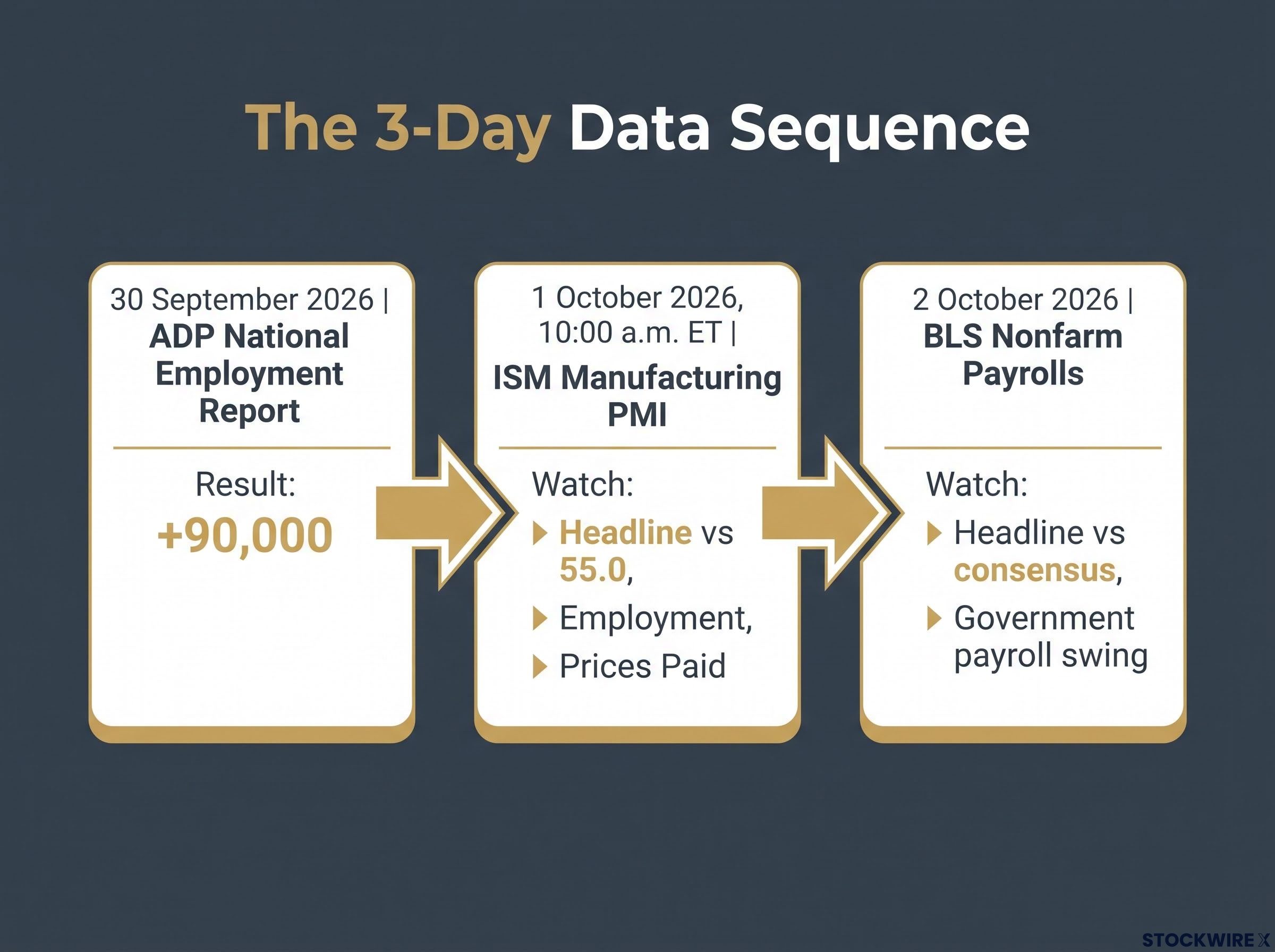
| Release | Date | Time (ET) | What to Watch |
|---|---|---|---|
| ADP National Employment Report | 30 September 2026 | Released | +90,000; sector mix and wage growth |
| ISM Manufacturing PMI | 1 October 2026 | 10:00 a.m. | Headline vs 55.0; Employment and Prices Paid |
| BLS Nonfarm Payrolls | 2 October 2026 | TBC | Headline vs consensus; government payroll swing |
The real danger sits in the two-day window between ADP and NFP: over-positioning on the early signal before the official data has a chance to validate or contradict it. Across multiple desk commentaries, 2023 is remembered for exactly this kind of two-stage reaction, where an upside ADP surprise prompted repositioning that NFP then reversed.
To avoid that trap, judge the data by convergence. The more of these four signals point the same way, the more confidence a directional dollar trade deserves:
- ADP private payrolls
- ISM Employment sub-index
- Initial jobless claims
- Wage growth
When all four align, you have a rare, high-conviction setup. When they conflict, the practitioner response is to cut risk or shift toward relative-value positioning rather than forcing a directional bet.
Applied to this week, the test is simple. If today’s ISM Employment sub-index and Friday’s NFP both confirm the ADP beat, you have an aligned signal cluster and the dollar case strengthens materially. If either one diverges, the honest read is that the data environment is genuinely mixed, not quietly bullish.
This article is for informational purposes only and should not be considered financial advice. Investors should conduct their own research and consult with financial professionals before making investment decisions.
Where the data leaves USD traders before the week’s defining print
The state of play is clear enough. ADP beat expectations with a composition that flatters the headline, the ISM print is now live, and NFP sits roughly 24 hours away. None of those on its own settles the dollar’s direction.
What settles it is the pattern across them. Headline surprises start the conversation, but composition, convergence across indicators, and the government payroll wildcard in Friday’s report are what determine whether the initial dollar move actually holds.
So carry one posture into the rest of the week. If today’s ISM Employment sub-index and Friday’s NFP both confirm Wednesday’s beat, that rare convergence justifies higher conviction on the dollar. Any divergence in either release is your signal to reassess rather than defend a view you formed on Wednesday.
For readers wanting to model how a specific NFP outcome translates into Fed rate decisions, our dedicated guide to jobs data and Fed policy breaks down the three variables inside the report, payroll headline, average hourly earnings, and unemployment, that actually determine whether the hawks hold or adjust their rate path.
Past performance does not guarantee future results. These scenarios are conditional on upcoming data and subject to change based on market developments.