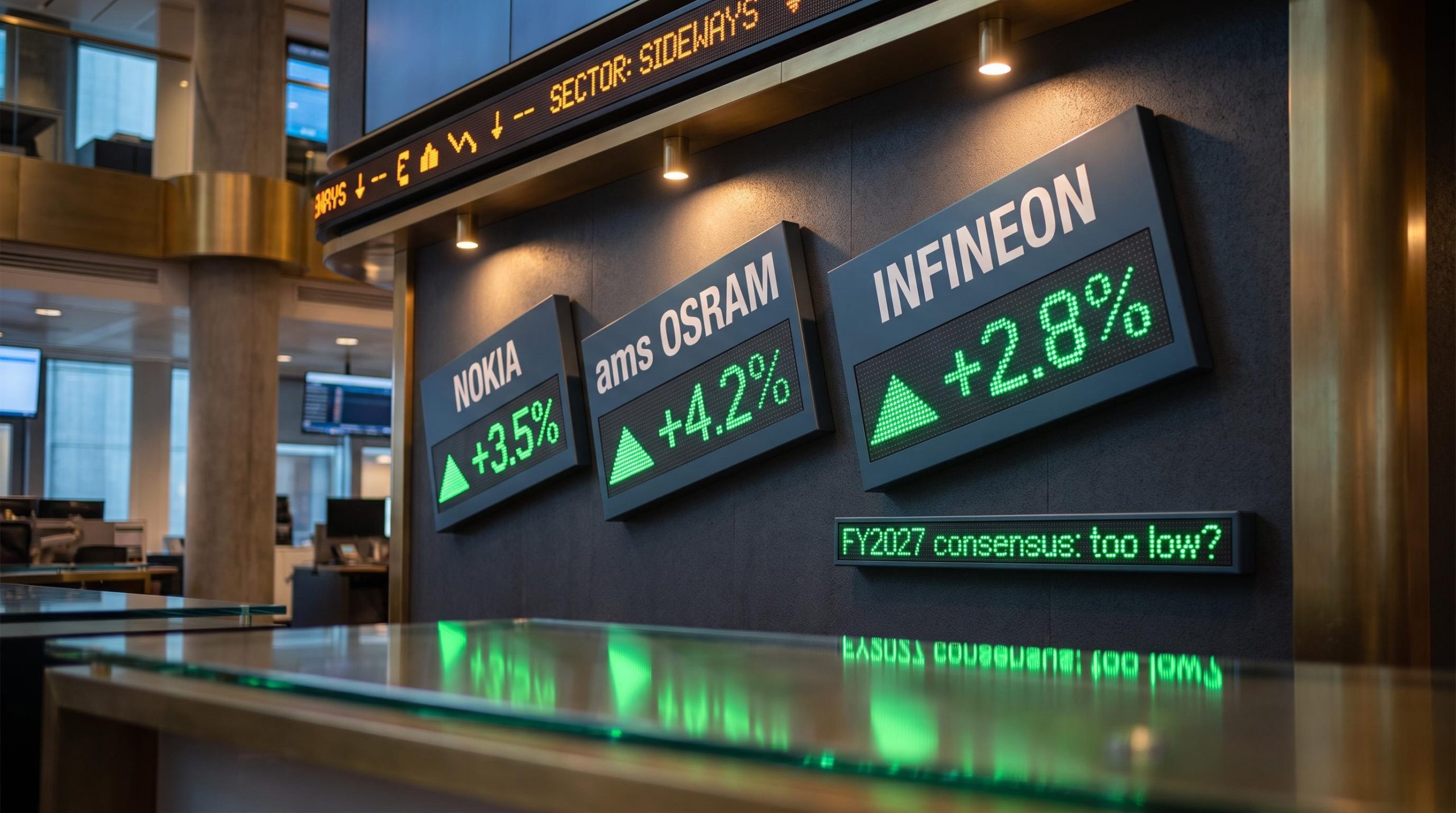
Here is a puzzle worth sitting with. One of the most respected brokers on the sell-side has just told clients it is cautious on European semiconductors as a sector, and in the same breath named three specific companies it expects to outperform.
That contradiction is not a mistake. It is the entire argument.
Jefferies analyst Janardan Menon set out the case in a Q3 2026 earnings preview covering semiconductors and tech hardware. The logic is narrow and specific: for Nokia, ams OSRAM, and Infineon Technologies, market consensus on FY2027 earnings is viewed as too low, and Menon believes actual results will force those estimates upward. That gap between where consensus sits and where earnings actually land is the re-rating catalyst.
This is a commercial read on the top European chip stocks worth watching into results season, and it deserves a careful walk-through. The sections below cover which names Jefferies favours and the distinct reason behind each, why the automotive cycle sits at the heart of the Infineon thesis, and where in the sector strong demand has already been priced in, leaving valuation as a ceiling rather than a floor.
Why Jefferies is bullish on select names while cautious on the sector
The first thing to understand is that a sector view and a stock view are not the same instrument. A cautious sector call is a statement about averages: the typical European semiconductor name faces a demanding valuation, a maturing cycle, or limited estimate upside. A stock-level conviction call is the opposite. It is a claim that specific companies are mispriced against that cautious backdrop.
Menon’s selection criterion is precise. He is looking for companies where the market’s FY2027 earnings expectations are set too conservatively, which creates a mechanical path to outperformance. When actual results come in ahead of a low bar, analysts revise their models up, and the share price tends to follow the revision.
That is a different bet from simply buying the sector on optimism. Buying a sector expects the tide to lift everything. This call expects three specific boats to rise while the water stays flat.
For the reader, the distinction changes what you watch. If you are betting on estimate revisions, the thing to monitor is not the sector index. It is whether analysts actually move their FY2027 numbers up after each earnings print. If the revisions do not arrive, the thesis has no other leg to stand on.
Here are the three preferred picks and the one-line case behind each:
- Nokia: consensus underestimates the durability of network infrastructure, the pace of margin recovery, and the upside in high-margin patent licensing.
- ams OSRAM: restructuring completion is the margin catalyst the market has not fully modelled, as the company exits commodity lighting for higher-value automotive and sensor applications.
- Infineon Technologies: rising chip prices and an accelerating automotive semiconductor cycle through 2027 support earnings that consensus has set too low.
Finding outperformers inside a cautious sector call requires a different analytical lens than buying the sector wholesale. You are not asking whether European chips are attractive. You are asking where the crowd has its numbers wrong.
When big ASX news breaks, our subscribers know first
Nokia and ams OSRAM: what “underestimated 2027 earnings” actually means in practice
The phrase “consensus is too conservative” sounds interchangeable across companies, but the mechanics behind it differ sharply between Nokia and ams OSRAM. Reading them as the same idea is the fastest way to mis-size a position.
Start with Nokia. The bull case rests on three separate levers, and each one is a place where Menon believes analysts have modelled too little.
The first is demand durability. Nokia’s Network Infrastructure and Cloud and Network Services segments are exposed to continued 5G rollout, IP and optical upgrades, and rising private wireless and enterprise networking demand. The argument is that consensus leans too heavily on the cyclical Mobile Networks business and undercounts the steadier, higher-margin parts of the portfolio.
The Nokia bull and bear case spans a wider analyst range than most European tech names, with Morgan Stanley projecting a €14 Helsinki price target and Goldman Sachs holding a Neutral at €8.00, a gap that reflects genuine disagreement over how durable the AI infrastructure demand tailwind is for optical and IP networks.
The second is margin recovery. Management has been running cost-reduction programmes and pruning the product portfolio toward higher-margin software and services. If execution holds, operating margins could clear current model assumptions through 2026 and 2027 as supply-chain costs normalise and older contracts roll off.
The third is patent licensing. Nokia’s licensing business throws off high-margin revenue that can jump when new agreements are signed or renewed. Some models embed only cautious assumptions here, which leaves room for an upside surprise.
The competing view is real. Nokia faces persistent competitive pressure in mobile networks from Ericsson and Huawei, and telecom capex can be delayed or compressed when operators tighten budgets. The cost programmes also carry execution risk.
The Dell’Oro Group telecom capex outlook projects a 2% decline in global spending for 2026 but a positive 1% CAGR through 2030, with long-term momentum supported by AI infrastructure investment, a market context that informs how much of Nokia’s infrastructure demand durability is structural versus cyclical.
ams OSRAM is a different animal entirely. Its thesis hinges on restructuring as a margin catalyst rather than on estimate revision alone. Following the OSRAM acquisition, the company has been exiting low-margin commodity lighting and re-focusing on automotive LED, optical sensors, and specialty applications, while integrating operations.
The bullish reading is that consensus underestimates how much cost synergy and portfolio pruning will lift EBIT margins once restructuring is largely complete. On top of that sits content growth: automotive LED lighting, matrix headlights, machine vision, and 3D sensing in smartphones all support better average selling prices and mix.
Jefferies’ core framing is that FY2027 consensus earnings for both Nokia and ams OSRAM are set too low, and that upcoming results will force analysts to revise those estimates upward.
Here again the counterargument is worth respecting. Large restructurings can overshoot on timeline and budget, and synergies may not fully land. Both automotive and consumer electronics are cyclical, so a downturn could compress margins at precisely the moment restructuring benefits were meant to appear.
| Company | Key upside driver | Key risk | Catalyst timeline |
|---|---|---|---|
| Nokia | Estimate revision on infrastructure durability, margin recovery, and licensing upside | Competition from Ericsson and Huawei; telecom capex cyclicality | Next one to two earnings prints |
| ams OSRAM | Margin recovery as OSRAM restructuring completes; automotive and sensor content growth | Restructuring overshoot; automotive and consumer cyclicality | As restructuring completes into 2027 |
Both bull cases are contingent arguments, not structural certainties. The practical test is whether the specific catalyst, margin recovery for ams OSRAM and estimate revision for Nokia, becomes visible in the next one to two earnings prints. That distinction matters for how you position: a restructuring-margin story and an estimate-revision story validate on different timelines and carry different risk profiles.
The automotive semiconductor cycle and Infineon’s 2027 earnings case
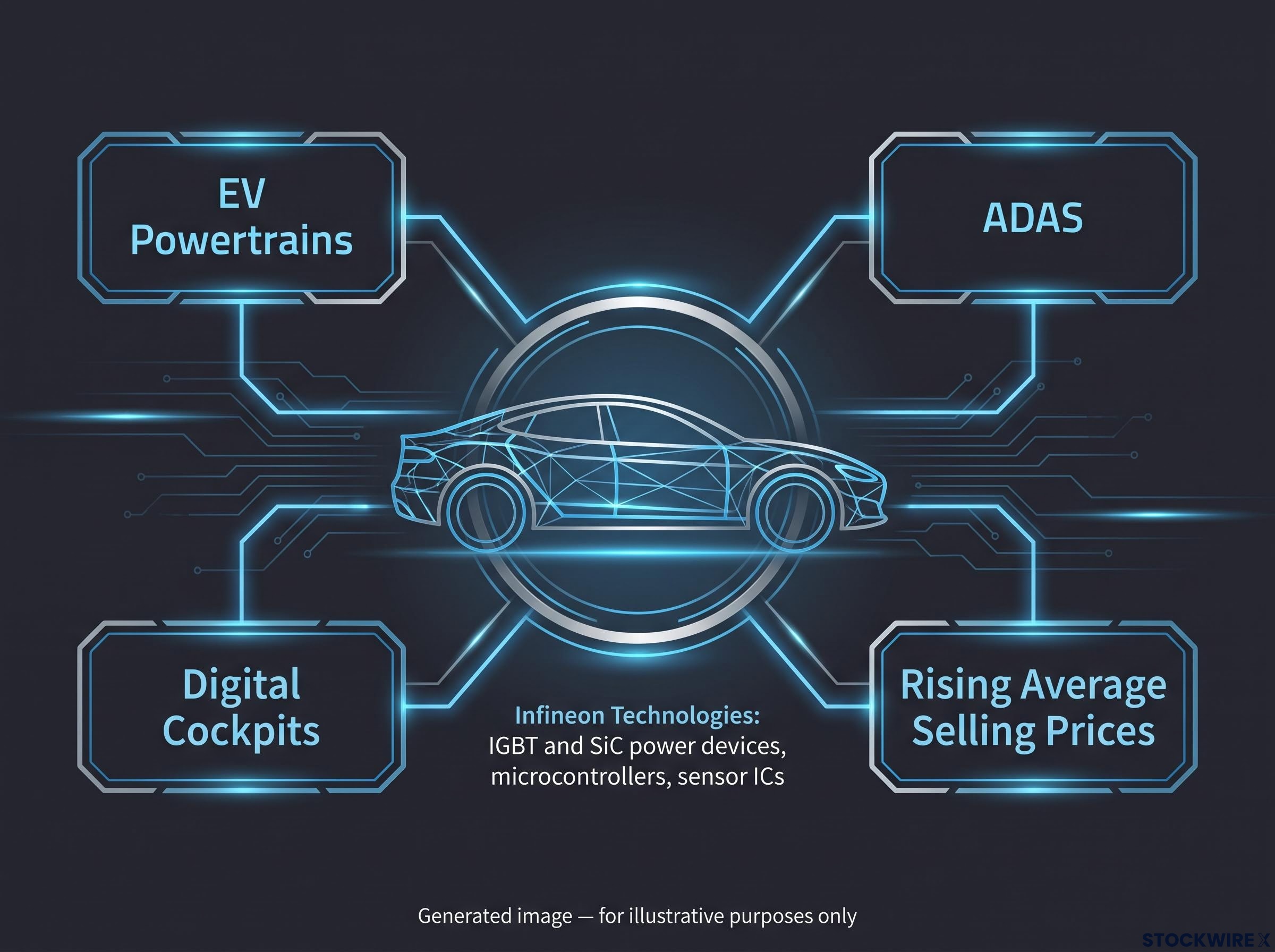
To understand why Infineon sits at the centre of Jefferies’ automotive thesis, start with what the company actually sells into a modern vehicle. Infineon is a leading supplier of IGBT and SiC power devices, microcontrollers, and sensor ICs. These are the chips that run EV inverters, onboard chargers, advanced driver assistance systems (ADAS, the sensors and processors behind features such as automatic braking), and digital cockpits.
The structural case is that semiconductor content per vehicle keeps rising. An electric vehicle needs far more power electronics than a combustion car, and every step up in driver assistance adds more sensors and processing.
Here are the four structural drivers pushing automotive chip content higher:
- EV powertrains, which require significantly more power semiconductors for inverters and charging than combustion vehicles.
- ADAS, where each new safety and assistance feature adds radar, vision, and processing content.
- Digital cockpits, which raise the microcontroller and display-driver content inside the cabin.
- Rising average selling prices in power modules and safety-critical ICs, where higher-value content supports better margins even if unit volumes grow only modestly.
Layered on top of that structural story is a cyclical one. Following the shortages of 2021 and 2022, automakers and their suppliers over-ordered and built up buffer inventory. The 2024 to 2026 period has been a working-down phase, with channel inventory and order books converging back toward true end demand.
Jefferies expects that normalisation to open a cleaner path. As inventory stabilises into 2027, ordering patterns should become more predictable, and Menon anticipates Infineon benefiting from rising chip prices alongside an accelerating automotive cycle. Industry-level expectations for automotive semiconductor revenue growth sit in the mid-single-digit to low-double-digit range.
Here is the detail that tells you how the thesis is actually built. Jefferies flags Infineon as the clearest example of multiple compression in the sector, meaning the market has already marked down the valuation multiple it is willing to pay, yet still keeps it as a top pick. That combination reveals something important: the conviction rests entirely on earnings revision, not on the multiple re-rating higher.
Where the automotive thesis could break down
Because the case leans so heavily on the cycle, the risks are worth tracking as specific, observable conditions rather than vague worries.
Auto cyclicality is the first. A global light-vehicle downturn would pressure volumes directly, and the indicator to watch is monthly vehicle production and sales data.
EV demand variability is the second. Subsidy cuts or consumer hesitation can slow EV adoption, which feeds straight into power-semiconductor content. Watch EV registration figures and government incentive changes.
Competitive pressure in SiC is the third. Rivals ramping silicon carbide capacity could squeeze Infineon’s share or pricing, so competitor capacity announcements are the signal here.
The fourth is inventory over-correction. If OEMs cut orders too aggressively even as end demand holds, a short-term demand air pocket can open. Watch Infineon’s own commentary on order visibility and channel inventory.
Infineon’s bull case is the most cycle-dependent of the three picks, which makes it the most binary. Either the automotive cycle accelerates as Jefferies expects, or there is no fallback pillar holding the thesis up.
Auto-industrial cycle anxiety is already embedded in Infineon’s market positioning in a way that distinguishes it from pure-play equipment names, a dynamic visible in the July 2026 session where Infineon fell 4.4% without company-specific news while ASML fell only 1% on the same tape.
Capital equipment: constructive demand, stretched valuations, and the ASML-ASM International read-through
Now to the part of the sector where the demand is genuinely strong and Jefferies still stays on the sidelines. The chip equipment makers, led by ASML and ASM International, are seeing near-term demand Menon describes as constructive. The catch is that 2027 forecasts already look bullish, leaving little room for a positive surprise to move the stock.
ASML is the sharpest illustration of both halves of that statement. On demand, the numbers speak for themselves. The company’s own Q2 2026 earnings release on 15 July 2026 guided to roughly 65 low-NA EUV systems in 2026, with a planned capacity increase of around 30% for 2027 and a further step toward more than 110 systems by 2028.
JPMorgan, following a September 2026 meeting with ASML CFO Roger Dassen, described the company as “nearly sold out” of EUV machines for 2027 (Reuters, 14 September 2026).
That is about as strong as a demand signal gets. There is a modest source spread on the exact 2027 shipment figure, and it is worth being clear about. Jefferies and Bank of America both estimate 85 systems for 2027, while JPMorgan puts a floor of “at least 80” from that September CFO meeting. Both are consistent with ASML’s stated roughly 30% increase over the 65-unit 2026 base, so this is a narrow range rather than a genuine disagreement. Bank of America, in its 7 May 2026 analysis, also raised its 2027 EPS estimate for ASML to €46.5.
| Year | EUV shipment volume | Source or estimate type |
|---|---|---|
| 2026 | Approximately 65 systems | ASML Q2 2026 guidance (15 July 2026) |
| 2027 | 80 to 85 systems | Analyst estimates (Jefferies, Bank of America, JPMorgan) |
| 2028 | More than 110 systems | ASML company target |
Here is the read you should take from all of this. Strong demand and a full order book do not automatically translate into share-price upside when the market has already priced in that strength. ASML is clearly a good business. Whether it is a good stock at current levels depends on beating forecasts that are already optimistic, which is a taller order than the three preferred picks face.
ASM International and the MATCH Act risk
ASM International tells a similar story with a different starting point. The company saw weakness in DRAM revenues through the first half of 2026, with recovery anticipated in the second half of 2026 and into 2027. Jefferies highlights the A14 node as a meaningful contributor to that 2027 growth.
The demand logic mirrors ASML: advanced node transitions and memory investment support the earnings trajectory. But the same valuation-stretch concern applies, because the market already discounts several years of robust orders.
Jefferies also flags the MATCH Act as a continuing legislative risk for the equipment segment, specifically in the context of ASML and ASM International. The practical provisions and current status of that legislation require further verification before any detailed commentary, so treat it for now as a named risk factor on the watchlist rather than a quantifiable variable.
The takeaway for the equipment names is consistent. Both companies are operating well, but the upside depends on clearing an already-high bar, which is why they sit outside the preferred list despite the demand.
For investors wanting to model the specific risk profile of ASML and ASM International separately from the broader chip sector, our deep-dive into semiconductor equipment sub-sector divergence examines how equipment and memory stocks diverge by as much as 49 percentage points across a single cycle, with documented windows from 2015-2016 and 2021-2022.
How to position across Jefferies’ European chip spectrum this earnings season
Step back and the analysis resolves into two distinct investment regimes. The first is the three preferred picks, Nokia, ams OSRAM, and Infineon, where the entire thesis rests on estimate revision: consensus for FY2027 is judged too conservative, and results are expected to force it upward. The second is capital equipment, ASML and ASM International, where demand is strong but already discounted, leaving valuation as the constraint.
Q3 2026 earnings season is the near-term validation window. This is not a long-duration thesis waiting years to prove itself; results from these names will either confirm or challenge the “consensus too conservative” argument within the next few prints.
Earnings estimate revisions drive post-results price action more reliably than the absolute level of reported earnings, because markets price the gap between actual results and prior expectations rather than whether the numbers are good in isolation.
Your practical decision is not whether Jefferies is right in aggregate. It is which of the two regimes you are positioned to act on. The revision-driven picks demand tolerance for interim volatility if a result misses, while the equipment names demand patience for a valuation reset before re-entry makes sense.
Here are the observable indicators to track as results arrive:
- Whether analysts actually revise FY2027 earnings estimates upward after each preferred pick reports.
- Infineon’s automotive order volumes and channel inventory commentary, the tell on whether the cycle is accelerating.
- ams OSRAM’s EBIT margin trajectory as restructuring completes.
- Nokia’s patent licensing revenue and any new or renewed agreements.
This article is for informational purposes only and should not be considered financial advice. Investors should conduct their own research and consult with financial professionals before making investment decisions.
Past performance does not guarantee future results, and these forward-looking estimates are speculative and subject to change based on market developments and company performance.