Most retail forex readers assume the Fed’s actual rate decision is what moves the dollar. It isn’t. The real action happens weeks or months earlier, when futures markets silently reprice what the Fed is likely to do next.
Consider what happened on 4 September 2026. The August Nonfarm Payrolls report landed at 162,000 jobs against a Reuters consensus of just 56,000. Within hours, the probability of a September rate hike on the CME FedWatch Tool climbed from roughly 49% to 62%, dragging the dollar up with it. No Fed official said a word.
The Fed has held a late-cycle tightening posture through mid-2026. As of late September, FedWatch shows October hike odds at 73% and December odds near 95%. Understanding why these numbers exist, and how they connect to the monthly jobs report, is what separates reactive trading from informed positioning.
After reading this, you will know exactly which numbers to watch before an NFP release, why those figures move the dollar before the Fed even meets, and how to read CME FedWatch probabilities as a live signal rather than an afterthought.
What the CME FedWatch tool is actually telling you
You have probably seen a percentage on FedWatch and wondered what it actually represents. It is not a poll. It is not an average of analyst forecasts. It is a live, market-implied bet.
FedWatch probabilities are derived from 30-day Fed funds futures contracts, which trade continuously on the CME. Each contract prices where the Fed funds rate, measured in basis points, is expected to land after a specific FOMC meeting. When you see a 73% October hike probability, you are looking at the collective wager of everyone trading those futures.
The CME FedWatch methodology translates 30-day Fed funds futures contract prices into market-implied probabilities by comparing the contract’s priced rate against prevailing and expected policy-rate levels, which means every tick in those futures shows up immediately as a probability shift in the tool you see quoted on data days.
Because those contracts trade all day, the probability updates the moment new information hits the market. Three things move it:
The FOMC voting structure matters here: only 12 members vote at each meeting, and public comments from non-voting regional presidents, while market-moving, are context rather than binding policy signals, which is why FedWatch probabilities shift on some Fed speeches and barely move on others.
- New economic data, especially employment and inflation releases
- Speeches and commentary from Fed officials
- Shifts in market inflation expectations
Even a small move in probability produces a measurable dollar response. On 26 August 2026, September hike odds ticked up from about 36% to 40.1% after US data firmed. On the same day, the US Dollar Index (DXY) rose 0.24% to 99.145, its biggest daily gain in nearly three weeks.
The mechanics in one line When FedWatch shifts by even a few percentage points on data day, that is not noise. It is the market repricing the expected return on holding dollars versus other currencies, and the DXY move that follows is the direct consequence.
What the current FedWatch readings signal about the dollar’s near-term path
The current numbers tell a specific story. The October hike probability sits at 73%, up from 68% before hawkish Fed commentary and hot inflation data updated the read. December odds sit near 95%.
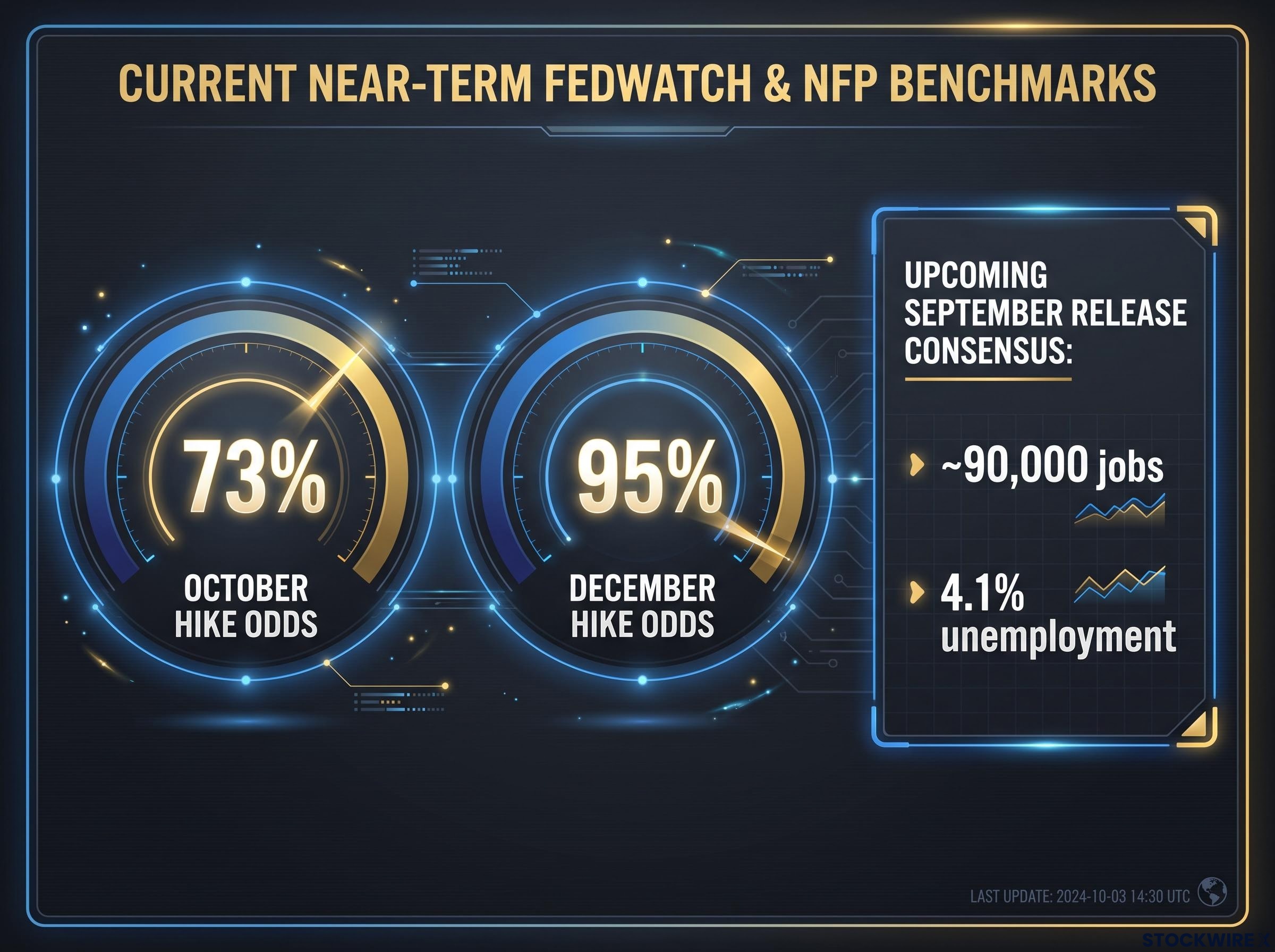
Read that as a market consensus that tightening continues, not as certainty. The gap between the two readings matters most. At 73%, the October meeting is still where genuine debate lives; at 95%, December is effectively locked in. For you, that gap defines where surprises can still move the needle and where they mostly cannot.
When big ASX news breaks, our subscribers know first
How rate expectations transmit into dollar strength
The dollar’s reaction to a data surprise is not a mysterious headline response. It is the output of a mechanical process you can trace from start to finish. Follow the chain and you can estimate the size of the move before it happens.
It begins with yields. When hike expectations rise, US Treasury yields move higher relative to other major economies. That widens the interest-rate differential, the extra return you earn holding dollar-denominated assets versus alternatives. Reuters reported in June 2026 that the dollar climbed to a 13-month high as Fed rate-hike bets pushed US yields up while other central banks were seen as less hawkish.
A wider yield advantage pulls capital. Foreign investors chasing higher relative returns buy US bonds and money-market instruments, and to do that they must buy dollars first. That spot demand is the direct link between an abstract probability and a real bid under the currency.
Then there is carry, the return you earn from the rate differential simply by holding the higher-yielding currency. As the expected Fed funds rate rises, the dollar’s carry profile improves against lower-yielding currencies, making it attractive on a total-return basis even to investors who are not primarily in forex. Deutsche Bank’s CIO research in May 2026 tied stronger-than-expected payrolls directly to repriced policy expectations, higher yields, and a stronger dollar.
Here is the sequence as an ordered chain:
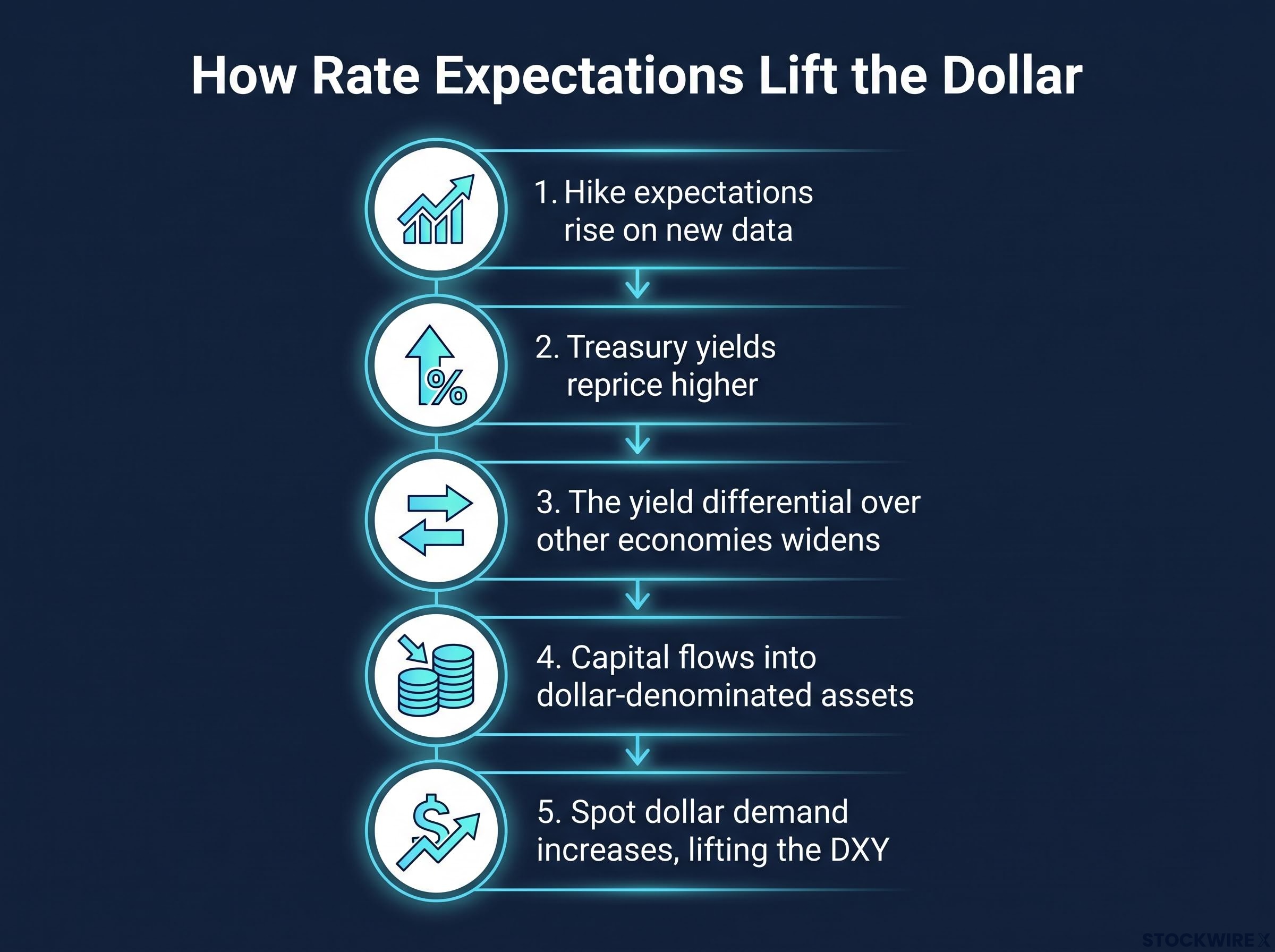
- Hike expectations rise on new data
- Treasury yields reprice higher
- The yield differential over other economies widens
- Capital flows into dollar-denominated assets
- Spot dollar demand increases, lifting the DXY
| Channel | Trigger | Observable market outcome |
|---|---|---|
| Yield differential | Hike odds rise, US yields move up relative to peers | Widening spread between US and foreign government bond yields |
| Capital flows | Investors chase the higher relative return | Foreign buying of US bonds requires dollar purchases, lifting spot demand |
| Carry | Expected Fed funds rate rises against low-yielders | Improved total-return appeal of long-dollar positions |
The mechanism runs symmetrically. Reuters’ late-2025 FX survey noted that prior Fed rate cuts had narrowed those differentials and weighed on the currency. The practical takeaway for you: the more room the yield differential has to widen, the larger the dollar move a given surprise can produce.
Why Nonfarm Payrolls can reprice the Fed’s entire path in a single morning
The number flashes on the screen. FedWatch moves within minutes. The dollar follows. This is not arbitrary market sensitivity; it is a logical consequence of how the Fed is required to operate.
The Fed carries a dual mandate: maximum employment and stable prices. NFP is the highest-frequency, broadest measure of labour-market momentum available, which makes it a direct read on one of the two targets the Fed is legally bound to pursue. When hiring surprises to the upside, it signals the economy can withstand higher rates, reduces the justification for accommodation, and shifts the Fed funds futures curve toward more tightening.
The forward guidance removal under Chair Warsh amplifies the market impact of every data release: with no Fed-provided rate-path buffer, each NFP print now carries the full interpretive weight that official commentary once shared, making the FedWatch repricing dynamic described here more pronounced than in prior cycles.
The recent record shows the pattern clearly. In May 2026, payrolls jumped 172,000 against a consensus of roughly 80,000-88,000, and Deutsche Bank’s CIO analysis described the result triggering a repricing of policy expectations, higher yields, and a stronger dollar. In August, the 162,000 print against a 56,000 consensus lifted September hike odds from about 49% to 62% in a single session.
| Release date | Actual jobs added | Consensus estimate | FedWatch probability shift |
|---|---|---|---|
| May 2026 | +172,000 | ~80,000-88,000 | Repriced toward tightening; yields and USD higher |
| 4 September 2026 (August data) | +162,000 | +56,000 | September hike odds ~49% to ~62% |
Deutsche Bank’s framing Strong payrolls are treated as evidence that the economy can withstand higher rates, which discourages cuts and lifts hike odds at the margin.
For the upcoming September release, the benchmark is a consensus of approximately 90,000 jobs with unemployment forecast to hold at 4.1%. A beat of a similar magnitude to August’s would likely push October hike odds further above 73%, strengthening the dollar through the yield and carry channels described above.
The revision problem and why traders watch two months at once
A single monthly print is noisy, which is why professional traders treat the prior month’s revision as no less important than the headline. The August report revised July from a decline of 23,000 to a gain of 21,000, a swing large enough to rewrite the labour-market narrative on its own.
This matters for your read of any release. A strong headline paired with a large downward revision to the prior month can produce a muted or mixed dollar response, even when the standalone number beats consensus. Never treat one weak print as a sustained signal without confirmation.
Where the dollar-rate expectation relationship breaks down
Everything above describes a powerful feedback loop. It is also fragile. Knowing the conditions under which it breaks is what separates an informed reader from one who over-applies a rule.
The first risk is peak hawkishness. When markets already price an aggressive hiking path, even a strong NFP print may not push hike odds meaningfully higher. That can produce a buy-the-rumour, sell-the-fact dynamic, where the dollar stalls or even weakens after a beat because there is simply nothing left to price in.
The second is Fed credibility. Reuters’ 17 June 2026 coverage described a sharply divided committee holding rates while projecting a future hike, with conflicting inflation signals. A visibly split Fed makes forward guidance less reliable and caps how far markets will price extended hawkishness.
The third set of risks is structural. Reuters profiled dollar bears in June 2026 who argued that US fiscal deficits, stretched valuations after a prolonged rally, and the prospect of other central banks catching up on tightening could all erode the yield advantage, even if the Fed holds rates higher for longer.
The conditions that weaken or reverse the link:
- FedWatch already prices near-certain hikes across multiple meetings, leaving little room for a surprise to add support
- The Fed signals internal division that undermines the credibility of its guidance
- Peer central banks accelerate their own tightening, compressing the yield differential
The 2026 counter-view A Reuters survey of FX strategists in December 2025 concluded that, despite a late-year rebound, strategists still expected a weaker dollar in 2026, judging the tightening cycle to be near or past its peak.
The takeaway is precise. The rate-hike-to-dollar-strength chain works most reliably when the market is underpricing hikes relative to where the data points. Once FedWatch shows high-probability hikes at every meeting, the incremental boost from another strong NFP diminishes, and the risk of a positioning unwind grows.
The asymmetric dollar response to a jobs miss versus a jobs beat is not a one-off observation: the June 2026 NFP preview identified the same pattern, with a dollar that was mildly overbought and long positioning crowded, meaning downside on a miss was projected to outweigh upside on a comparable beat.
Reading NFP day with a framework, not a reaction
The mechanics only help if you can apply them before the number lands. The goal is not to predict the print. It is to narrow the uncertainty around how the dollar is likely to respond.
Build your read around three questions, in order:
- What does consensus expect? This sets the benchmark for surprise magnitude. For September, that is roughly 90,000 jobs and 4.1% unemployment.
- What does FedWatch currently show? This is your baseline for how much further hike odds can realistically move. October sits at 73%, December near 95%.
- What did the prior month’s revision do? This is the context that tells you whether a beat is genuinely strong or partially offset by a downward revision elsewhere.
The dollar’s response to a beat is proportional to two things: the gap between the print and consensus, and the remaining room for FedWatch probabilities to rise from their current level. The August episode is the framework in action. Consensus was 56,000, the actual came in at 162,000, July was revised upward, September hike odds jumped from 49% to 62%, and the dollar moved higher.
The two sub-components that can override the headline
The headline number is not the whole report. Two sub-components most often modify its impact on hike expectations:
- Average hourly earnings, which the Fed watches for signs of wage-driven inflation
- The unemployment rate, which shapes the Fed’s read on labour-market slack
A jobs beat paired with falling average hourly earnings can produce a muted dollar response, since wage disinflation gives the Fed cover to pause even with solid hiring. Likewise, the direction of the unemployment rate matters: a falling rate reinforces hike expectations, while a rising rate complicates them even when the headline beats.
What stays true regardless of the next NFP print
Strip away any single release and the durable principles remain. Fed rate hike expectations and dollar strength are linked through yield differentials, capital flows, and carry. But the strength of that link is itself a variable, dependent on market positioning and how much is already priced in.
NFP is the highest-frequency reset mechanism for Fed pricing. Its impact on the dollar, though, is always conditioned by the size of the surprise relative to consensus and the remaining room in FedWatch probabilities. The June 2026 DXY 13-month high shows where sustained rate-hike expectations have already taken the dollar.
The asymmetry to carry forward With December hike odds near 95%, another strong NFP has limited scope to add to the dollar, while a weak print has meaningful room to unwind recent support faster than a beat could build it.
The three principles worth keeping:
- Yield differentials drive the direction
- NFP is the primary repricing catalyst
- The magnitude of the dollar’s response depends on how much is already priced in
At 95% December odds, the dollar’s rate-expectations tailwind is largely priced. Recognising that asymmetry, that the downside on a weak September print now outweighs the upside on a strong one, is itself a meaningful signal about positioning risk.
For readers who want the complete picture behind these transmission channels, our dedicated guide to Fed and dollar mechanics covers balance sheet policy, QE and QT effects on yields, and the specific conditions under which the standard higher-rates-stronger-dollar logic breaks down entirely.
This article is for informational purposes only and should not be considered financial advice. Investors should conduct their own research and consult with financial professionals before making investment decisions. Past performance does not guarantee future results. Financial projections are subject to market conditions and various risk factors, and forward-looking statements are speculative and subject to change based on market developments.