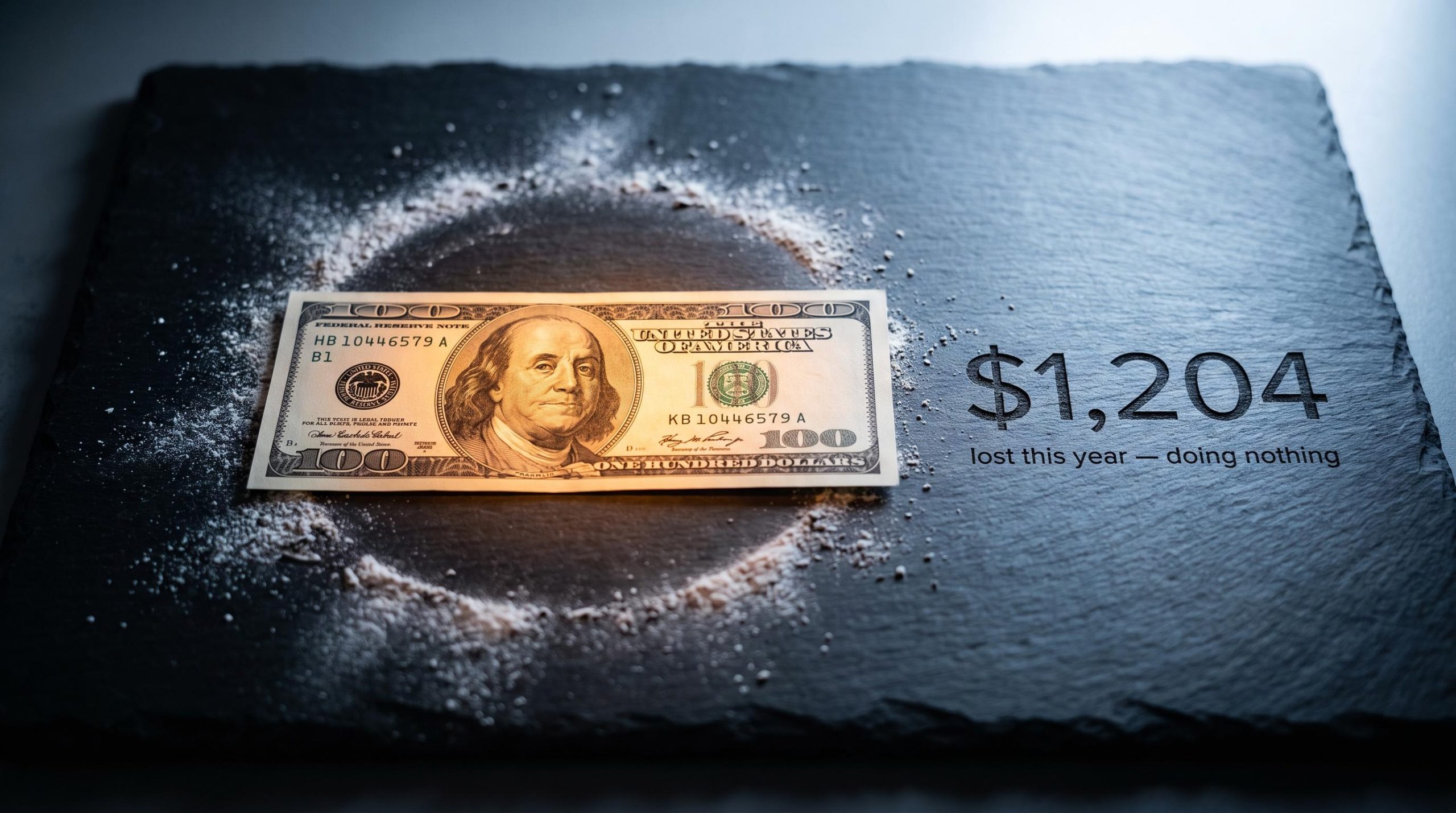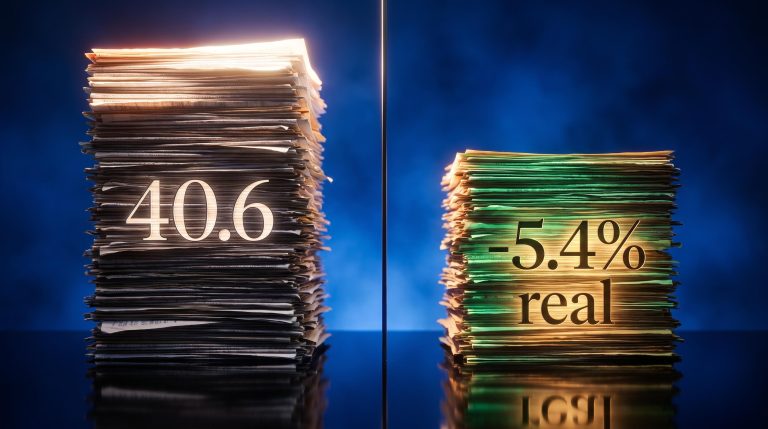
Picture a homeowner sitting on $200,000 in home equity. Someone tells them their paid-down mortgage is “dead money,” quietly losing value to inflation every year, and that opening a home equity line of credit to buy an inflating asset is the smart, financially literate move. That pitch sounds sophisticated. It has a seam running right through the middle of it.
The seam matters right now because Americans are tapping home equity at scale. HELOC balances have risen for 11 consecutive quarters and now stand at $396 billion nationally, while the average HELOC rate sits at 7.28% as of 23 September 2026. Any investment funded at that cost starts life in a significant hole.
This is not a blanket argument against debt. It is a specific argument against one version of it: borrowing against your home at a variable rate to buy a speculative asset like cryptocurrency.
By the time you finish reading, you will be able to tell the difference between the situations where the inflation-hedge logic genuinely holds and the situations where it is being bent to justify this particular trade. You will also know precisely what the numbers look like when it fails.
Why the inflation argument is real, and where it stops applying
Start with the part that is actually true, because it is worth understanding on its own terms. Fixed-rate debt does erode in real value when inflation runs hotter than expected. You borrowed dollars today and repay them over years in dollars that buy less. The lender absorbs that loss; you keep the benefit.
At 3.4% inflation, the real burden of fixed-rate debt falls by roughly 3.29% each year. Your income tends to drift upward with inflation while your fixed payment stays frozen. That is a genuine transfer of risk from you to your lender.
The fixed-rate mortgage advantage over variable borrowing is most visible when rates are rising: a homeowner locked at 3% pays the same dollar amount in month 60 as in month one, while a HELOC holder in the same environment faces a payment that has climbed with every Fed decision.
Here is the part the pitch skips over. If you already hold a fixed-rate mortgage, you already capture this benefit. You do not need to borrow another dollar to enjoy it. The inflation erosion is working in your favour right now, silently, without a HELOC attached.
The entire mechanism depends on the debt being fixed-rate. A HELOC is not. It is variable, which means when inflation rises and the Federal Reserve responds by lifting rates, your borrowing cost rises with it. The lender simply recaptures the erosion you were supposed to enjoy.
| Fixed-rate debt | Variable-rate debt (HELOC) |
|---|---|
| Payment locked for the life of the loan | Payment moves with the prime rate |
| Inflation erodes the real balance in your favour | Lender raises the rate to offset inflation |
| You capture the benefit automatically | You carry both inflation and rate risk |
The arithmetic makes the reversal plain.
A HELOC at 7.5% minus 3.4% inflation leaves a real annual cost of roughly 3.97%. You are not benefiting from erosion. You are paying a net real cost for the privilege of borrowing.
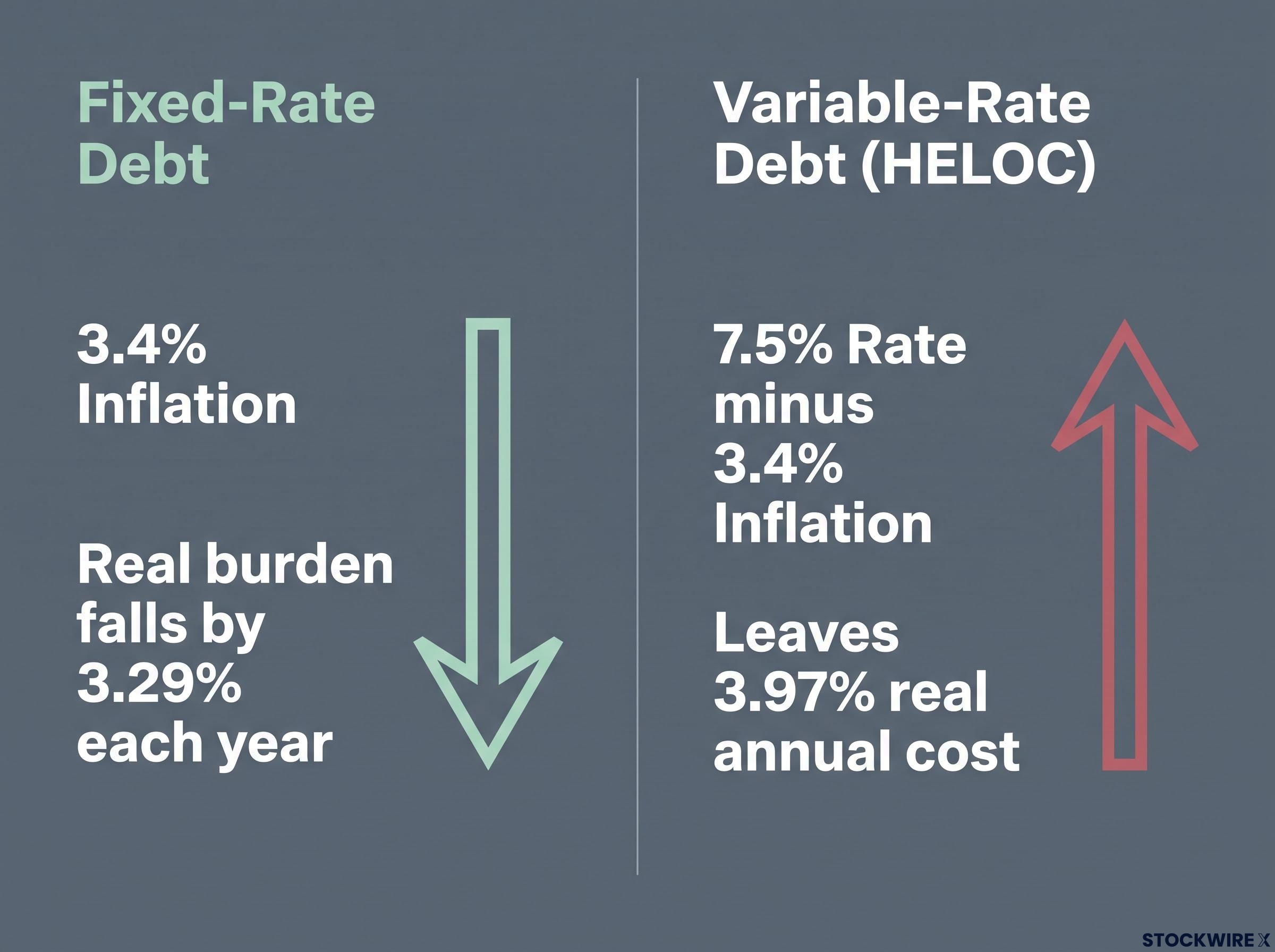
So the fixed-versus-variable distinction is not a technicality. It is the whole mechanism. If your debt is fixed, inflation helps you. If it floats, the argument collapses.
When big ASX news breaks, our subscribers know first
What a HELOC actually costs right now, and why that baseline matters
Ignore the theory for a moment and look at the monthly payment. That is where the strategy meets reality.
HELOCs are priced at the prime rate plus a margin your lender sets. After the September 2026 Federal Reserve rate increase, prime moved to 7.0%. Add a typical 0.5% margin and you land at 7.5%. Every time the Fed moves, your rate moves with it, because the prime rate tracks Fed policy directly.
That means borrowed money has to earn at least 7.5% annually just to cover the interest before it produces a single dollar of net benefit. That is your hurdle rate, and most promoters of this strategy never mention it.
Watch how it climbs. On a $50,000 interest-only HELOC, the September rate rise pushed the monthly payment from about $302 to $312.50. Two further Fed increases would take it to $333.33 a month.
| Rate | Monthly interest payment | Annual cost |
|---|---|---|
| 7.25% | $302.08 | $3,625 |
| 7.5% | $312.50 | $3,750 |
| 7.75% | $322.92 | $3,875 |
| 8.0% | $333.33 | $4,000 |
The point is not the size of any single payment. It is the direction. Your cost rises with every Fed decision, and you have no control over any of them.
How widespread HELOC borrowing has become
This is not a niche behaviour. According to Federal Reserve Bank of New York Household Debt and Credit data, HELOC balances rose by $9 billion in Q4 2024, the eleventh straight quarterly increase since Q1 2022, bringing outstanding balances to $396 billion. Credit limits have grown by 14% over two years.
New York Fed household debt data puts the scale of this shift in concrete terms: HELOC balances rose by $9 billion in Q4 2024 alone, the eleventh consecutive quarterly increase since Q1 2022, with credit limits expanding by 14% over the same two-year window.
The New York Fed estimates roughly 1.3 million HELOCs were originated in 2023 alone. Much of that demand traces to the mortgage lock-in effect: homeowners sitting on cheap fixed-rate mortgages will not refinance into higher rates, so they open a HELOC to reach their equity instead.
What that tells you is simple. Millions of households are now on the same treadmill, carrying variable borrowing costs that ratchet up with each Fed move, with the family home serving as collateral the entire time.
How the debt is structured to survive and the investment is not
Here is where the structure of the trade becomes the story. The layered version of this strategy works like a stack. Your HELOC draws cash secured by your home. That cash buys cryptocurrency. The crypto is then pledged as collateral for a second loan, and that second loan is deployed into something else. Each layer adds leverage on top of the one below it.
The problem is that these layers do not fail equally. To see why, you need to understand how a crypto-backed loan is monitored.
Lenders track your loan-to-value ratio, or LTV, continuously. LTV is simply how much you owe measured against the value of the collateral. When crypto prices fall, your LTV rises. Once it crosses a set threshold, the lender liquidates your collateral automatically, without asking your permission.
Leveraged position mechanics follow the same loan-to-value logic whether the instrument is a crypto-backed loan, a CFD, or a margin account: as collateral value falls, the lender’s exposure rises and automatic liquidation thresholds protect the lender, not the borrower.
The 2021-2022 Bitcoin crash as a stress test
Run the numbers on a real scenario. Suppose you take a crypto-backed loan at 50% LTV: $25,000 owed against $50,000 in crypto.
- Loan initiated. LTV sits at 50%, comfortably inside the limit.
- Price decline of roughly 37.5% pushes LTV to 80%, triggering a margin call.
- Price decline of roughly 44.4% pushes LTV to 90%, triggering forced liquidation.
- Post-liquidation position. Your collateral is sold at the bottom, and the loan is repaid from the proceeds.
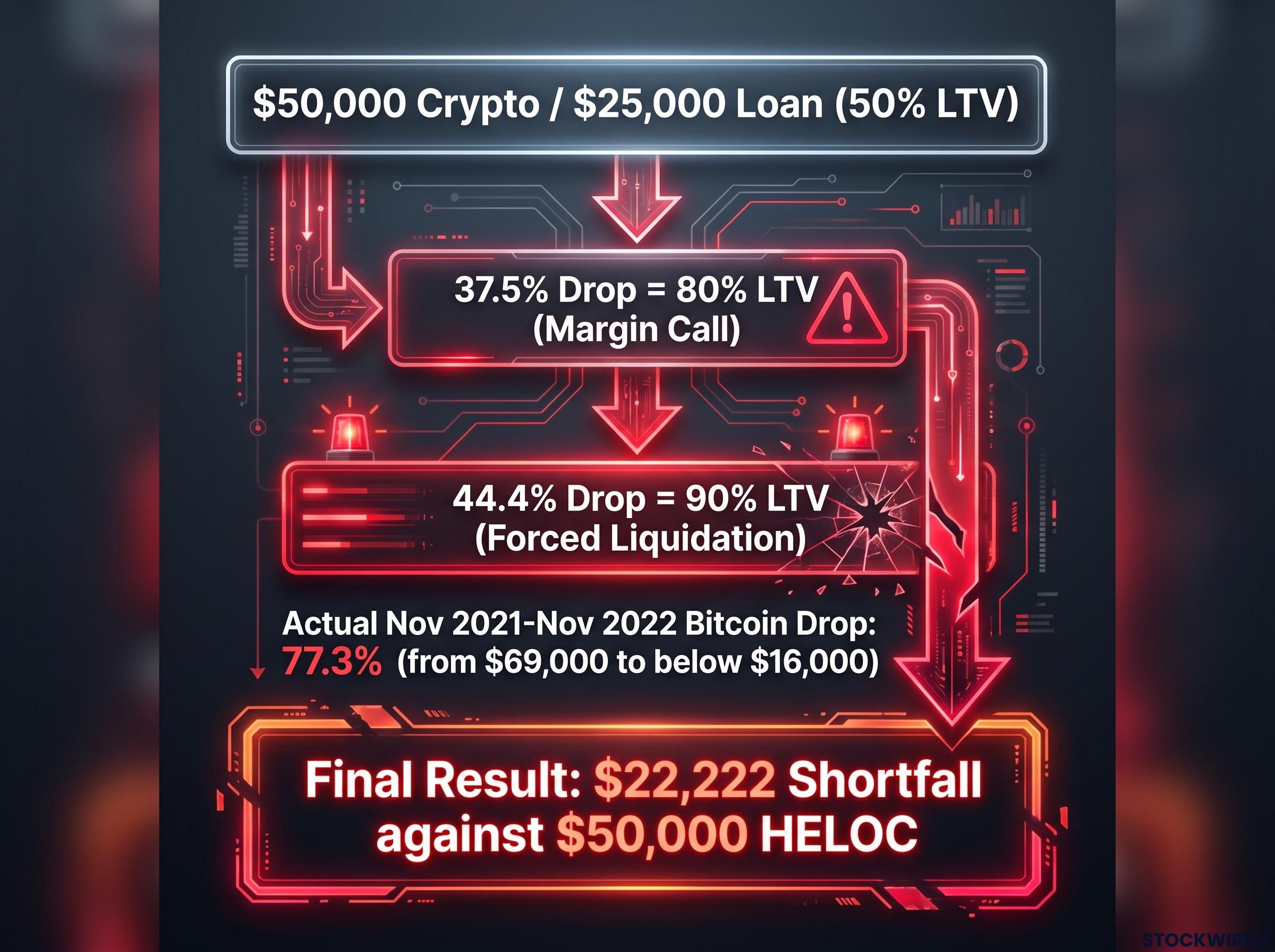
Now map that against history. Bitcoin fell approximately 77.3% from its November 2021 peak near $69,000 to its November 2022 low below $16,000. The decline needed to force liquidation was 44.4%. The actual decline was nearly double that.
The math after liquidation is brutal. Repaying the $25,000 loan leaves you roughly $2,777.78 in crypto proceeds. Add the $25,000 income asset the second loan bought, and your remaining assets total about $27,778.
Against a $50,000 HELOC still fully outstanding, that leaves a shortfall of roughly $22,222 before a cent of interest is added, with your home still pledged as collateral.
That is the asymmetry in one figure. The crypto position was fragile and got wiped out. The HELOC was durable and survived intact. Forced liquidations also feed on themselves: selling into a falling market drives prices lower, tripping more loans across the market and deepening the drop. Your worst-case outcome is not a portfolio loss. It is a threat to the roof over your head.
What makes crypto a particularly poor fit for this structure
You might reasonably ask whether this problem is specific to crypto or true of any asset bought with a HELOC. It is sharpest with crypto, and the reason is worth understanding, because it gives you a filter for evaluating similar pitches.
Some assets have a defensible claim to tracking inflation over time: income-producing real estate, or broad equity indexes held over long horizons. Their prices connect, however loosely, to the price level in the wider economy.
Crypto does not sit in that group. Its price is driven far more by liquidity conditions, investor sentiment, and regulatory cycles than by consumer-price inflation. The correlation with inflation has been limited and unstable, which means it does not deliver the inflation offset that is supposed to justify borrowing in the first place.
Crypto price volatility in late 2026 has been amplified by regulatory headwinds, with the Senate Clarity Act failing a cloture vote in September and Bitcoin breaking below its 200-day moving average, reinforcing why the asset class carries risk characteristics that do not map onto a stable inflation-hedge thesis.
The timing makes it worse. When the Fed tightens to fight inflation, two things happen at once: your HELOC rate rises, and crypto prices tend to fall. You face higher costs and lower collateral value in the same moment, which is exactly what unfolded through 2022.
- Crypto trades 24/7 with no circuit breakers to pause a crash.
- Order books thin out sharply in downturns, so forced selling moves prices further than it would in deep, regulated markets.
- There is no centralised clearing backstop comparable to what supports regulated securities markets.
Even the small minority of advisers who defend HELOC-funded investing restrict the argument to diversified equity portfolios held for the long run. They exclude single-asset speculative bets precisely because of these traits.
So the combination is speculative on both sides of the balance sheet at once. The inflation-hedge argument is being aimed at an asset that does not hedge inflation, funded by a product that does not benefit from inflation.
The sequence risk that makes recovery nearly impossible
There is one more mechanism, and it is the one that turns a bad trade into a permanent loss. It is called sequence-of-returns risk, and with leveraged investing it is decisive.
The idea is straightforward. When you invest with borrowed money, the order in which returns arrive matters enormously. An early loss can force you out of the position before any later recovery arrives, which makes the recovery irrelevant to you.
Sequence-of-returns risk is not a retirement-only problem: any leveraged investor who faces mandatory cash outflows, whether margin calls or monthly HELOC payments, is exposed to the same dynamic where early losses force selling at the worst possible moment and eliminate any chance of recovery.
Contrast the two positions. A buyer with no debt can hold through a 77% drawdown and wait for a rebound, because nothing forces their hand. A HELOC borrower cannot. The monthly payment is due regardless of what crypto is doing.
Now stack the pressures. Through 2022 and 2023, the Federal Reserve raised rates aggressively, the same window in which Bitcoin fell roughly 77.3%. HELOC holders watched their borrowing costs climb while their funded asset collapsed.
Trace the failure chain:
- Crypto price falls.
- A margin call triggers, or the HELOC payment becomes hard to meet.
- The position is sold at a depressed price.
- The $50,000 HELOC balance remains, still accruing interest.
- Crypto later recovers, but you hold no position to benefit from it.
On the worked example, the $22,222 shortfall is not a paper loss you can wait out. The position was liquidated. There is no recovery scenario for collateral that has already been sold.
Debt removes the choice to hold through volatility, and in speculative markets, that choice is often the only path back to breakeven.
That is the real lesson. It is not the volatility itself that ruins you. It is the loss of the option to wait.
What this means before signing a HELOC for any investment purpose
Pull the threads together and three structural problems compound on one another. The variable rate strips out the inflation benefit. Crypto’s price does not reliably track inflation, so there is no offset. And the HELOC survives the crypto loss while your home stays pledged throughout.
This is not a case for never borrowing against your home. Debt-financed investing does have defensible logic under narrow conditions.
- The debt is fixed-rate, so inflation works in your favour.
- The asset is diversified with a long track record, not a single speculative bet.
- Your income can service the debt on its own, even if the investment goes to zero.
Before using home equity for any investment, run it through three questions.
- Is the debt fixed-rate? A HELOC at the 7.28% national average is variable, so it fails.
- Does the asset reliably correlate with inflation, or produce income? Crypto does neither.
- Could you service the debt if the investment went to zero? On the worked example, you would be left with about $27,778 against a $50,000 balance, with the home still on the line.
The HELOC-crypto combination fails all three. That is not a coincidence, and it is why no reputable financial planner endorses it. The same three questions work on any pitch that uses “debt as an inflation hedge” language, whatever asset is being sold.
This article is for informational purposes only and should not be considered financial advice. Investors should conduct their own research and consult with financial professionals before making investment decisions. Past performance does not guarantee future results, and the scenarios described are illustrative and subject to market conditions and various risk factors.