
Nearly a third of European accounting professionals say they plan to leave the profession within the next twelve months. In the UK, that figure climbed from 9% to 43% in a single year. Those are not retention statistics. They are a structural alarm.
The alarm is sounding at the same moment that 47% of European accountants identify AI and automation as the dominant force set to reshape their profession, and when private equity deal volumes in accounting firms reached roughly 200 transactions in 2024 alone. Each of these forces carries weight on its own. Together, they are reshaping who does accounting work, how it gets done, and which firms will survive the decade with their quality and independence intact.
These are the European accounting challenges that will define the profession’s next decade, and they are best understood in sequence. This piece works through the evidence on each pressure, then examines what happens when they compound. Anyone tracking the professional services sector, whether as an investor, an adviser, or an observer, will find a clear read on where the structural stress is greatest and what the trajectory looks like from here.
What the attrition numbers actually reveal about a profession under strain
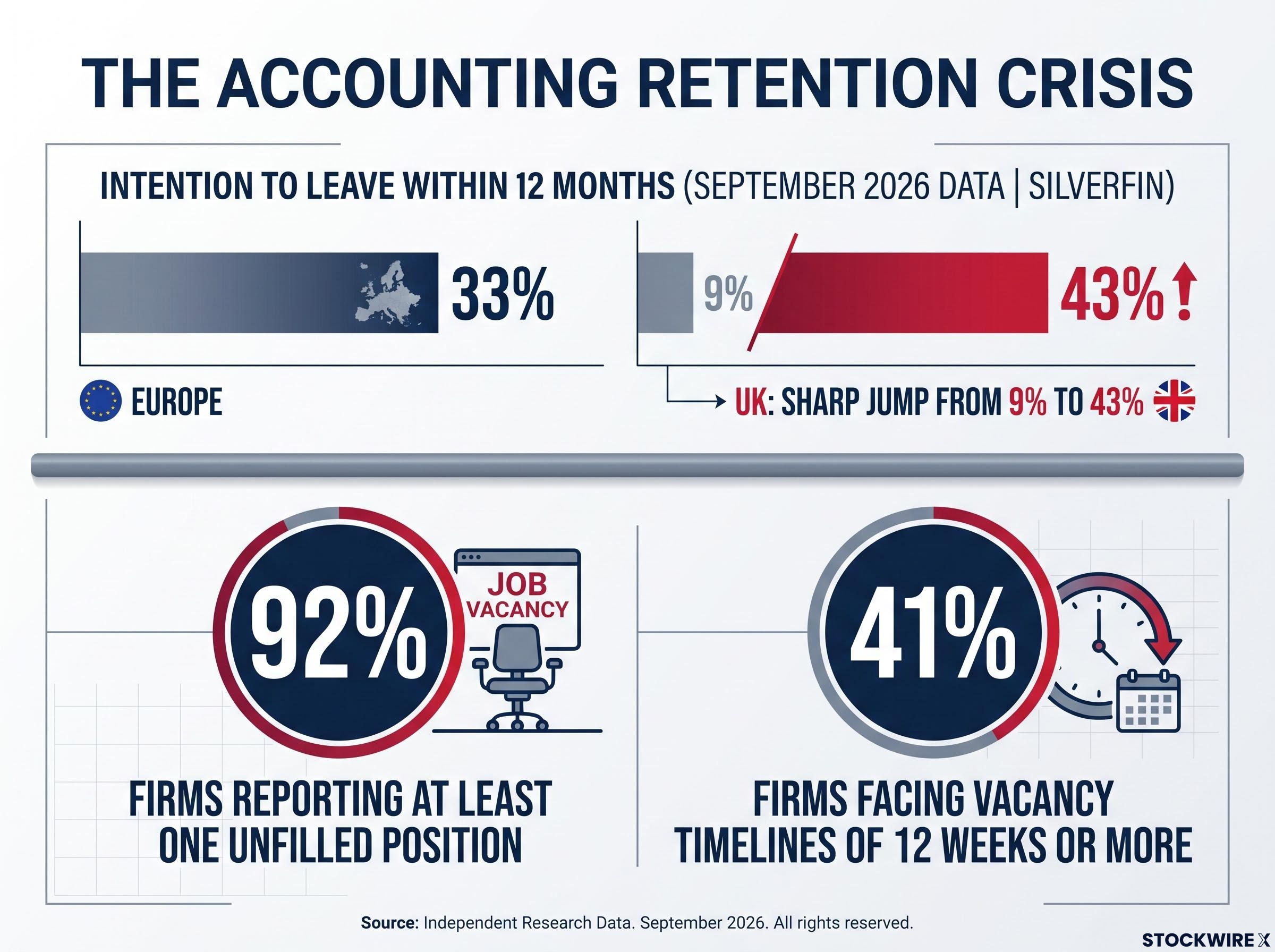
Start with the raw scale. A survey published by Silverfin in September 2026, covering mid- to senior-level respondents across five European markets, found that 33% of accounting professionals plan to leave the profession within the next twelve months. That is one in three practitioners in a sector already short of people.
Then look at the UK number, and the picture changes character entirely.
In the UK, the share of accountants planning to leave the profession within twelve months rose from 9% to 43% in a single year.
A jump of that magnitude is not cyclical noise. A workforce does not shed nearly five times its exit intention in twelve months because of a bad busy season. It tells you that something in the underlying conditions of the work changed sharply, and the profession has not yet identified a structural fix. The UK figure reads less like an outlier and more like a leading indicator of where other European markets may head, given how much these practices share in workload, regulation, and technology pressure.
The intention-to-leave data becomes more alarming when set against the operational reality already on the ground:
- 33% of professionals across the five surveyed markets plan to leave within 12 months.
- The UK figure reached 43%, up from 9% the prior year.
- 92% of firms report at least one unfilled position.
- 41% of firms face vacancy timelines of 12 weeks or more.
What makes this a genuine crisis rather than a soft patch is that demand is not falling to meet the shrinking supply. RSM’s European member firms, for instance, reported a 20% increase in headcount driven by seven acquisitions, evidence that the work is expanding even as the willingness to do it contracts. The result is firms carrying sustained capacity constraints into a period of rising complexity, which is precisely the condition under which quality gets squeezed.
When big ASX news breaks, our subscribers know first
Why accountants are leaving, and what the profession has failed to fix
Behind those numbers sits a causal architecture, and its most important feature is that the drivers reinforce one another. Burnout, regulatory overload, pay dissatisfaction, and technology anxiety are not four separate grievances that happen to coincide. They form a self-reinforcing set of conditions that make the profession structurally unattractive to the very cohort it most needs to keep.
The four primary drivers cited across professional bodies and institutes look like this:
- Workload and burnout. ICAEW and ACCA commentary through 2023 and 2024 identifies workload intensity, persistent overtime, and busy-season pressure as leading reasons members consider leaving. Younger accountants in particular cite stress and exhaustion as decisive.
- Regulatory and compliance overload. Accountancy Europe points to expanding regulatory expectations that arrive without matching investment in tools or staffing. In smaller practices especially, this has turned large portions of the job into a compliance treadmill that erodes professional autonomy.
- Pay and progression. Professionals report dissatisfaction with compensation relative to the liability and workload of audit and tax roles, while younger staff cite slow promotion pathways and limited exposure to higher-value advisory work.
- Technology anxiety. Some accountants exit toward roles where digital capability is central and future-proofed. Others leave because their firm is not investing in technology at all.
The generational dimension is what makes these drivers so corrosive. Younger accountants face the slowest promotion pathways, the least advisory exposure, and the sharpest uncertainty about whether their entry-level skills will still be relevant once AI absorbs routine bookkeeping and simple audit work. A pay rise does not answer the question of whether an entry-level audit role will exist in five years. That is why retention fixes aimed at any single variable tend to underperform: the pressures interlock.
What the professional bodies are calling for, and where the gaps remain
The prescriptions themselves are not mysterious. ICAEW and ACCA have advocated redesigning workload and staffing models, embedding automation to strip out low-value manual tasks, building advisory-focused career paths, and strengthening mentoring structures so tacit knowledge actually transfers.
The problem is the gap between what is prescribed and what firm-level behaviour makes achievable. Redesigning workload and building slower, mentorship-heavy career paths costs money and margin in the short term. That runs directly against the profitability priorities of private equity-backed consolidation, which increasingly shapes how mid-tier firms are run. The interventions most likely to stabilise attrition are the ones the sector’s dominant ownership trend has the least incentive to fund. Until that tension resolves, the intention-to-leave numbers have little structural reason to fall.
AI as both the profession’s best tool and its most disorienting uncertainty
If attrition is the visible crisis, artificial intelligence is the force everyone in the profession is watching, and the adoption data shows this is no longer a future question. It is already operational.
According to the Wolters Kluwer Future Ready Accountant Report published on 8 October 2025, 71% of European accounting firms use AI on a weekly basis, and 75% plan to increase their AI investment. Use cases already span tax research, bookkeeping automation, document summarisation, and client communication. The European Central Bank’s Corporate Telephone Survey points in the same direction, with around 75% of large euro-area firms reporting AI in daily operations.
| Source | Region/Segment | Key Finding | Date |
|---|---|---|---|
| Wolters Kluwer Future Ready Accountant Report | European accounting firms | 71% use AI weekly; 75% plan to increase AI investment | 8 October 2025 |
| ECB Corporate Telephone Survey | Large euro-area firms | Around 75% use AI daily; fewer than 25% of employees use it regularly; most plan no headcount cuts | March 2025 (survey June 2024) |
The ECB finding contains the detail that matters most. Most AI-using firms report that fewer than 25% of their employees actually deploy AI regularly, and most say they do not intend to reduce headcount as a result. On the surface, that supports the augmentation narrative that currently dominates firm-level thinking: AI as a tool to ease a talent bottleneck rather than a mechanism to cut jobs.
But the gap between 75% of firms using AI and fewer than 25% of employees using it regularly is exactly where the hidden risk sits. It means AI capability is concentrated in a small team inside each firm rather than distributed across the workforce. When those few AI-proficient individuals leave, and the attrition data suggests they well might, the firm loses an operational capacity that the headline adoption figures never revealed it had. That reframes the retention crisis: it is not only a headcount problem but a capability-concentration problem, and losing your handful of digitally fluent staff may hurt more than the raw vacancy numbers imply.
The AI agent adoption gap between platform capability and actual practitioner use is not unique to accounting firms: Xero’s data shows that only around 300,000 of its 4.6 million subscribers have adopted newer generative AI features, a ratio that mirrors the ECB’s finding that fewer than a quarter of employees at AI-using firms deploy it regularly.
None of this is settled, and the professional debate reflects genuine disagreement:
- Pace of change. How fast AI reshapes core work, and whether firms can adapt governance quickly enough.
- Advisory fees. Whether AI enhances demand for high-value advisory work or compresses the fees firms can charge for it.
- The capacity divide. Whether small and mid-tier firms can keep pace with the investment and governance demands that larger platforms absorb more easily.
47% of European accountants identified AI and automation as the primary driver of anticipated change in the profession.
That figure, from the Silverfin survey, dwarfs the next-closest drivers. UK respondents were more distributed, with 24% citing AI and automation and 22% citing regulatory change, but the direction is consistent. The vendor side underlines the point: Wolters Kluwer’s acquisition of Isabel Group’s accountancy portfolio for 325 million euros in July 2024 shows AI and workflow tools being positioned as essential infrastructure rather than optional extras.
The vendor side of this transition is moving at least as fast as the firm side: usage-based AI pricing models from platform providers like Xero are beginning to link automation volume directly to cost, a structural shift that will change how practices budget for technology and what return they need from AI-assisted workflows to justify the investment.
Where consolidation amplifies the risk rather than resolving it
The two pressures examined so far are usually treated as problems that consolidation can help solve. Larger platforms, the argument runs, have the capital to fund AI and the scale to widen talent pools. Stress-test that argument, and a different picture emerges: M&A consolidation is not just a solution to the first two pressures. It is a third pressure that amplifies both.
The scale of consolidation is the structural context. According to Accountancy Europe, private equity deal volumes in the sector rose from 10-20 transactions annually before 2022 to over 100 in 2023 and approximately 200 in 2024. Data points to more than 500 accounting-services transactions globally across a three-year period once bolt-ons are included. This is a rapid re-ownering of the profession.
Accountancy Age consolidation analysis published in September 2026 puts the transaction count at 385 deals in 2025 and 131 in Q1 2026 alone, figures that reframe the 200-transaction reading for 2024 as a mid-ramp data point rather than a peak, and that sharpen the systemic concentration risk this article identifies.
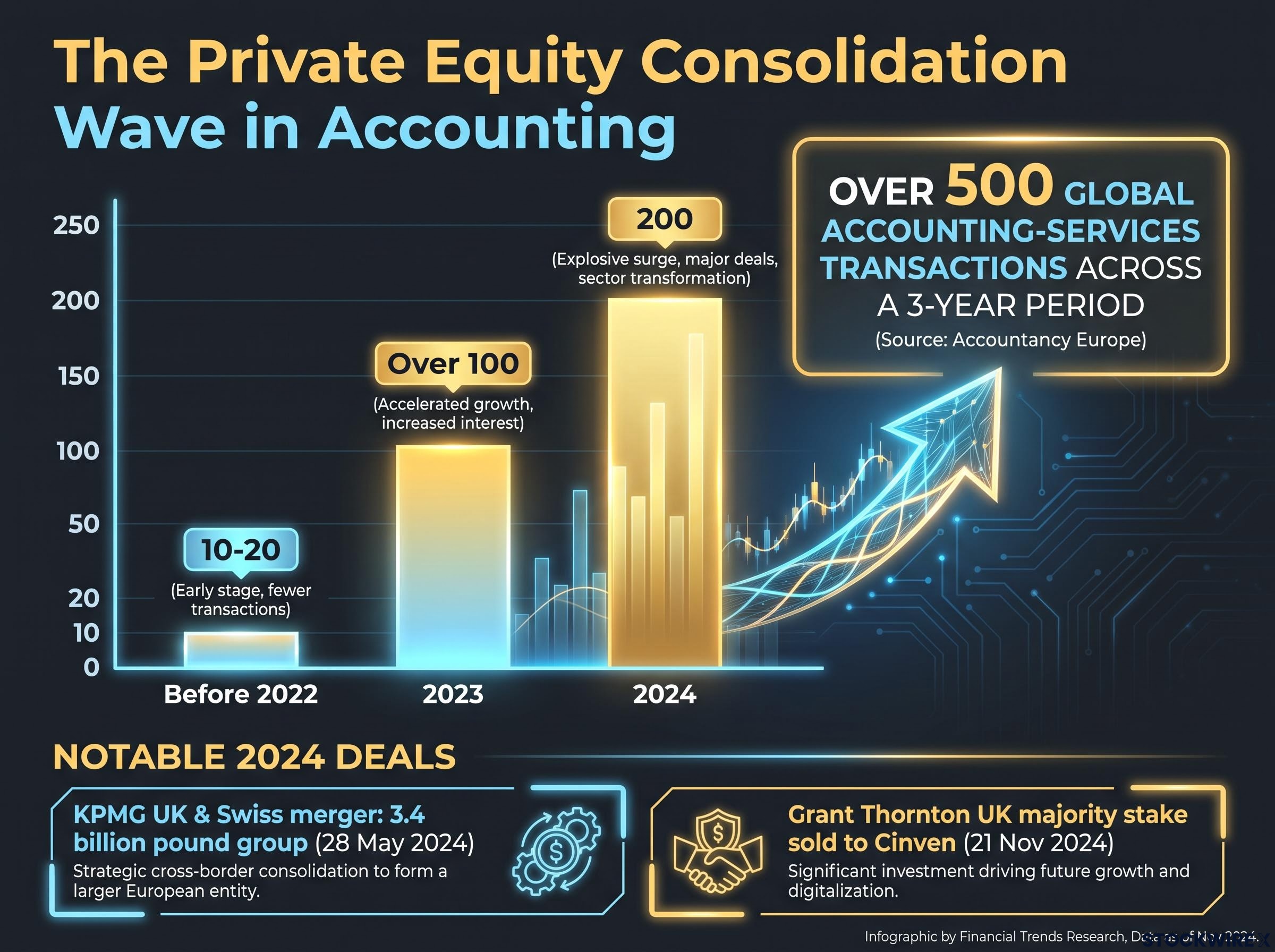
The case studies show consolidation being used to fund exactly the investments the profession needs. Grant Thornton UK agreed to sell a majority stake to private equity firm Cinven on 21 November 2024, the most significant PE investment in UK accounting to date, with the capital explicitly earmarked for technology and talent. KPMG’s UK and Swiss member firms voted to merge into a combined 3.4 billion pound group on 28 May 2024, enabling shared AI investment and cross-border staff deployment. RSM’s seven European acquisitions delivered 8% revenue growth and a 20% headcount increase.
The counterweight arrives immediately. The same structures that fund AI can also intensify workload, sharpen performance pressure, and worsen the retention risk that consolidation was meant to ease. Analysts expect the Grant Thornton deal to accelerate AI adoption alongside heightened pressure on partner performance, and the two do not sit comfortably together. Private equity’s arrival at scale means the incentive structures governing quality, independence, and staff wellbeing are shifting in ways that are not yet fully legible. That is the risk the profession’s own consolidation narrative tends to understate.
The compounding effect when attrition and AI change happen inside consolidating structures
The genuine danger is not any one pressure but the way all three interact inside the same firm structures, producing risks larger than the sum of their parts:
- Knowledge transfer erosion. In judgement-heavy work such as cross-border tax planning and impairment testing, AI can support analysis but cannot replace professional scepticism. As senior specialists exit and junior roles shrink, the tacit knowledge that governs those judgements may simply fail to transfer.
- Quality and regulatory risk from AI over-reliance. Stretched teams leaning on unfamiliar AI outputs without adequate governance raise the prospect of superficial audits, errors in tax advice, and liability from automated work. Firms integrating AI already cite lack of staff experience as a top challenge.
- Systemic concentration. As fewer, larger platforms control more of the market, quality and reputational incidents carry more systemic weight than they did when the market was fragmented.
The mechanics of the compounding are worth stating plainly. Consolidation funds AI but intensifies workload. Attrition removes the experienced staff needed to govern AI outputs responsibly. And because AI capability is concentrated in fewer than a quarter of employees, as the ECB found, that same attrition exposes a fragility that the augmentation narrative assumes away. Accountancy Europe has noted that PE ownership can influence how quality and independence are prioritised. For investors and sector observers, the read is that the consolidation wave is not a clean value-creation story: retention risk, AI governance gaps, and PE performance pressure now sit inside the same balance sheets.
The road ahead is navigable, but only for firms that treat these pressures as connected
None of this points to a death spiral. The profession has the data and the tools to navigate this period, and the same forces reshaping accounting are reshaping every knowledge-intensive profession. What separates the firms that emerge with structural advantages from those that compound their own risk comes down to a small number of deliberate choices.
Three variables will most determine how this period resolves:
- AI governance and broad digital literacy, not just tools for a specialist team. With 75-77% of firms planning to increase AI investment, the infrastructure layer is arriving. Whether firms build firm-wide fluency, rather than concentrating capability in a fragile few, is the differentiator.
- Workload redesign with substance, not automation layered on top of existing demand. Adding AI without cutting the underlying burnout pressure does not solve the retention problem the ICAEW and ACCA prescriptions target.
- Consolidation cultures that retain mid-career professionals. Whether PE-backed platforms build cultures that hold experienced staff, or simply extract value before the talent gap becomes a quality crisis, will decide their trajectory.
There is genuine evidence of firms responding well. KPMG’s cross-border merger creates pathways for shared technology investment, RSM’s acquisition programme is building scale to fund training and tooling, and the ECB’s finding that most AI-using firms do not intend to cut headcount grounds a near-term augmentation outlook rather than a displacement one.
Most large euro-area firms that use AI say they do not intend to reduce headcount as a result, supporting an augmentation narrative over the near term.
The firms that fare best will recognise that the retention crisis and the AI reckoning are the same problem seen from different angles. Both come down to whether the profession can make itself worth staying in and worth doing at the highest level of judgement. That question, measured against the 33% still planning to leave, will not be answered by technology investment alone.
This article is for informational purposes only and should not be considered financial advice. Investors should conduct their own research and consult with financial professionals before making investment decisions. Past performance does not guarantee future results, and forward-looking statements are speculative and subject to change based on market developments.