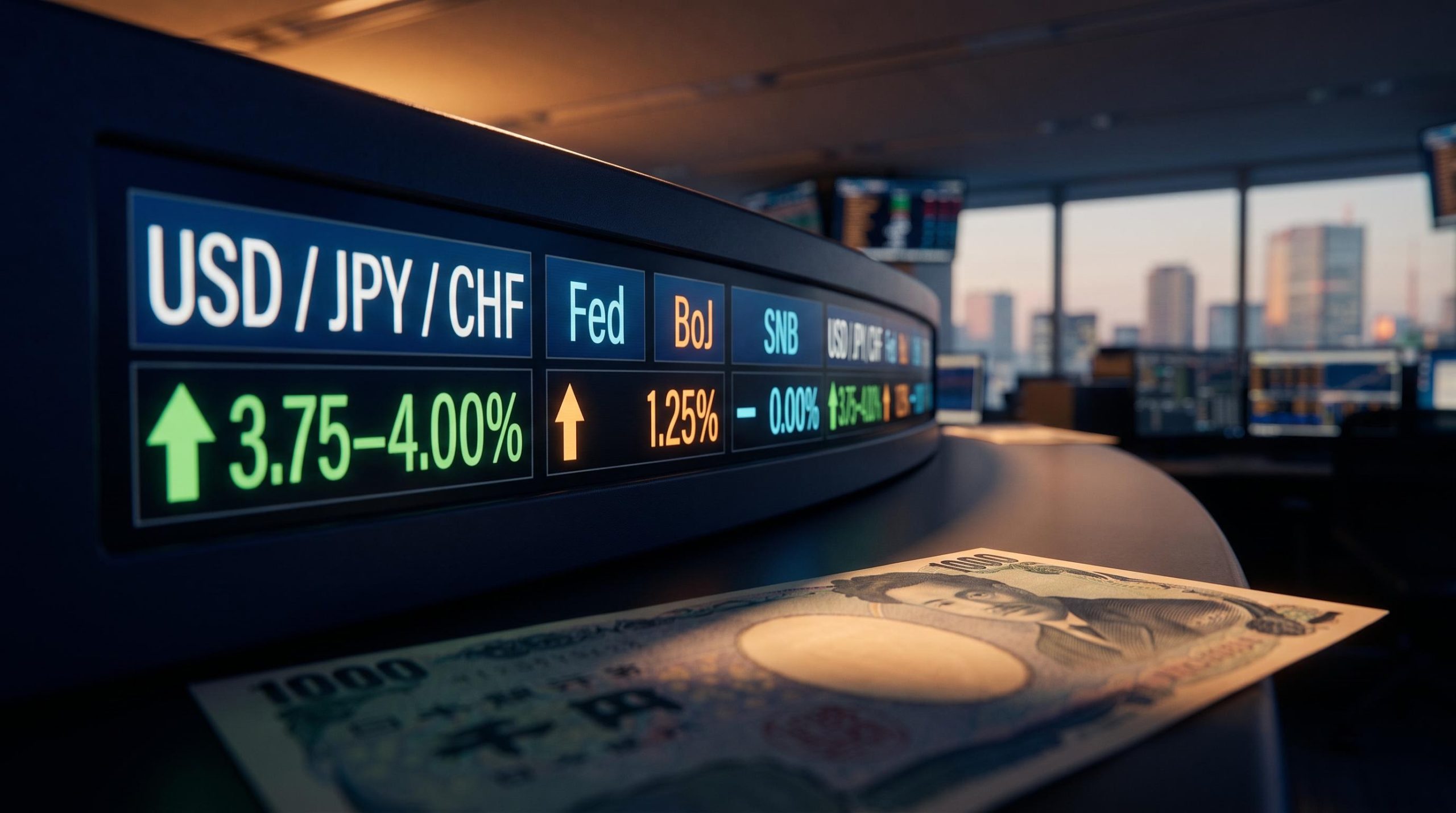
On the same day in September 2026, three of the world’s most closely watched central banks moved in three different directions. The Federal Reserve raised its benchmark to 3.75%-4.00%. The Bank of Japan pushed its short-term rate to 1.25%. The Swiss National Bank held flat at 0%.
This is what diverging central bank policy looks like at full stretch, and it matters far beyond the headlines. Carry trades built on years of near-zero yen and franc funding are now running through a rate map that is shifting beneath them, and the unusually calm FX volatility of recent months may be masking accumulated risk rather than confirming its absence.
Here is what those rate gaps actually mean for the currencies you may hold or fund positions through, and how to read the specific conditions under which the current calm gives way.
Three central banks, three directions: reading the September 2026 policy snapshot
Look at the three decisions together and a single picture emerges: the institutions that anchor global funding and reserve currencies are no longer moving in step, and each is following a mandate the others do not share.
The Fed is re-tightening. Its FOMC voted 12-0 on 16 September 2026 to lift the target range by 25 basis points, the first increase since 2023, with a statement that inflation “remains elevated” and that the move “will support a timelier return to the Committee’s 2 percent goal.”
The Bank of Japan is doing something structurally different: continuing a deliberate walk away from decades of near-zero rates. It raised its short-term target to 1.25% from 1.00% on a 7-2 vote, extending a normalisation path that ran from 0.25% after its surprise 2024 hike.
BoJ rate normalisation has also pulled Japanese institutional investors toward domestic assets, reducing their structural demand for US Treasuries and European sovereign debt at the margin and keeping global yields higher than they would otherwise be.
The Swiss National Bank simply stood still. It held at 0% while nudging its 2026 Swiss inflation forecast up to 0.7% from 0.6%, a signal that conditions do not yet demand action but are not entirely static either.
| Central Bank | Current Rate | Prior Rate | September 2026 Decision | Vote Margin |
|---|---|---|---|---|
| Federal Reserve | 3.75%-4.00% | 3.50%-3.75% | +25 bps hike | 12-0 |
| Bank of Japan | 1.25% | 1.00% | +25 bps hike | 7-2 |
| Swiss National Bank | 0% | 0% | Held, inflation revised up | Not disclosed |
For anyone holding internationally diversified assets, this snapshot is the operating environment. The gap between these institutions is not a statistical curiosity; it tells you the currencies you own are now priced by policymakers facing fundamentally different inflation realities, and that gap will govern currency flows for the foreseeable future.
What the vote margins reveal about forward trajectory
The vote counts carry more information than the rate levels. The Fed’s 12-0 unanimity signals a committee fully aligned behind re-tightening. The BoJ’s 7-2 split tells you something more delicate: meaningful internal dissent about how far and how fast normalisation can credibly proceed.
That matters because the pace of BoJ tightening, not just its direction, is what carry traders price. And the SNB’s decision to hold while revising inflation upward quietly preserves optionality. Zero may not be the floor indefinitely, which gives you a second policy axis to watch.
When big ASX news breaks, our subscribers know first
How carry trades work, and why the current rate map makes them vulnerable
Start with the mechanic itself. A carry trade means borrowing in a low-yielding funding currency, historically the yen or the Swiss franc, and investing the proceeds in a higher-yielding currency or asset. The profit is the interest rate differential, minus any FX move that runs against the position.
The strategy thrives on stability. Wide, persistent rate gaps and calm exchange rates are what make it work.
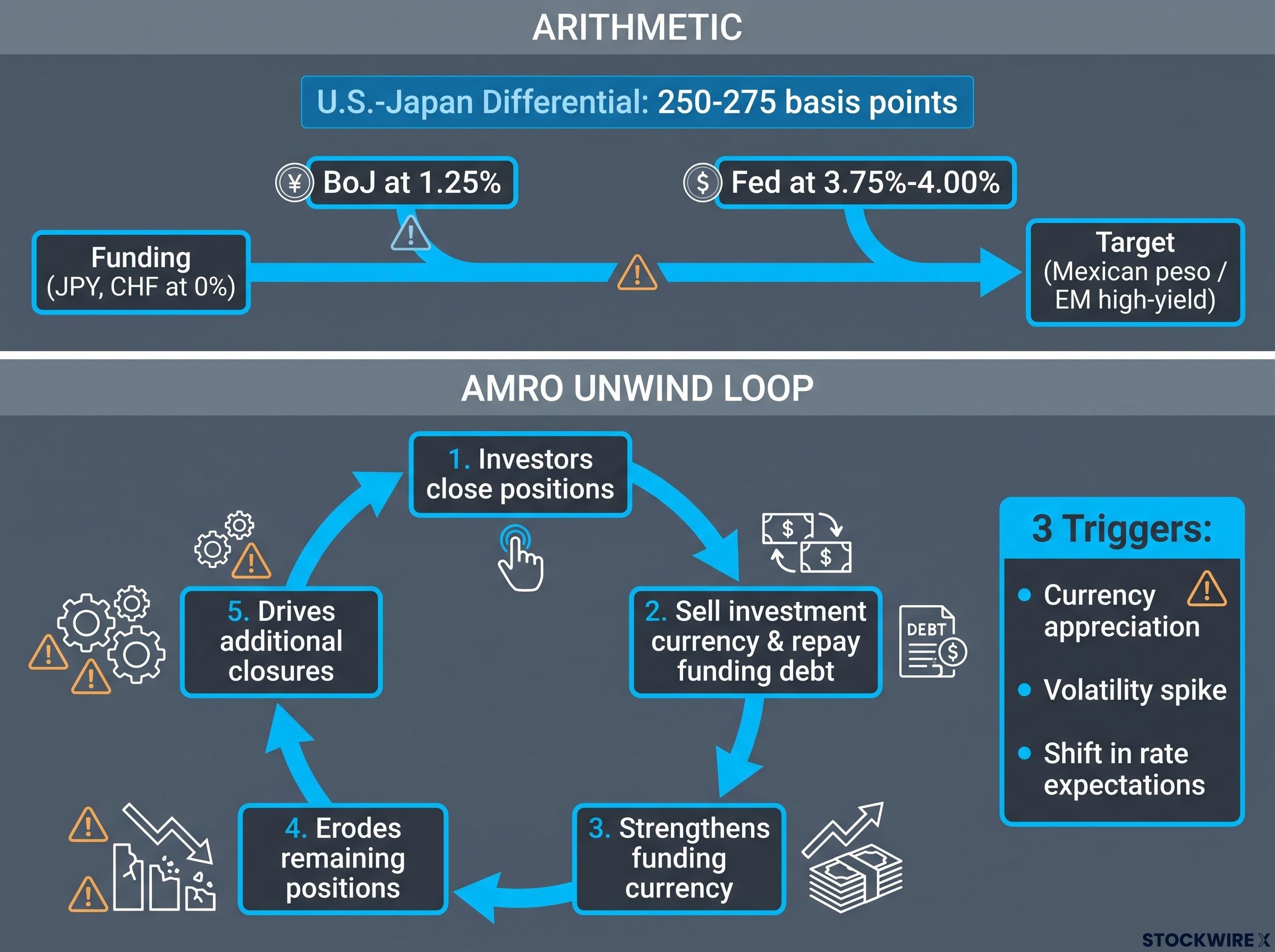
Run the September 2026 arithmetic and the trade is still structurally supported. The U.S.-Japan rate differential sits at roughly 250-275 basis points with the BoJ at 1.25% and the Fed at 3.75%-4.00%. The SNB at 0% keeps the franc alive as a secondary funding currency alongside the yen.
So the trade is not broken. But three specific conditions can break it, and the current map makes each one closer than it looks:
- Funding currency appreciation: if the yen or franc strengthens, the currency leg of the return erodes even while the rate gap stays wide.
- A volatility spike: rising volatility lifts margin requirements and forces leveraged positions to deleverage, often faster than orderly.
- A shift in rate expectations: it is the change in differentials, not their absolute level, that triggers exits.
The 250-275 basis point gap tells you the trade is alive in arithmetic terms. What it does not tell you is how quickly a static-looking risk turns dynamic once any one trigger fires. The ASEAN+3 Macroeconomic Research Office (AMRO) describes exactly why.
When the funding currency strengthens, carry profits are eroded. Investors close positions by selling investment-currency assets and repaying funding-currency debt, which strengthens the funding currency further and erodes the remaining positions, driving additional closures.
That self-reinforcing loop is the reason a modest initial catalyst can produce disorderly moves. As the Bank for International Settlements (BIS) frames it, strategies “predicated on contained volatility” significantly amplified the turbulence of August 2024.
Carry trade repricing and carry trade liquidation produce very different market signatures: the early September 2026 yen move saw speculative short positions in yen futures grow by 28,900 contracts, the opposite of what forced liquidation looks like, which is why distinguishing the two conditions matters before adjusting any position.
The August 2024 precedent: how fast the loop can close
August 2024 is the proof of concept. The BoJ delivered an unexpected second rate increase that year, lifting its policy rate to 0.25% against markets long accustomed to near-zero funding.
The yen appreciated rapidly. Yen-funded carry trades were among the hardest-hit strategies, according to the BIS, as deleveraging pressure and rising margin requirements forced rapid exits. Carry-target currencies fell sharply, with the Mexican peso a documented casualty.
The stress did not stay in FX. Equity indices came under pressure as leveraged investors cut positions across asset classes to meet margin calls. The episode moved in days, not weeks.
The BIS Bulletin on carry trade deleveraging documents how yen-funded strategies were among the hardest-hit positions during August 2024, with rising margin requirements forcing exits across asset classes as the BoJ’s unexpected hike triggered the self-reinforcing loop that the current rate map now keeps closer to activation.
Competing views on whether the calm will hold
Two camps are reading the same rate map and reaching different conclusions. This is not optimists against pessimists. Both accept the current arithmetic. They differ on what the current calm actually reflects.
Morgan Stanley makes the constructive case. In a report dated 8 September 2026, its Global FX and EM strategy team, led by James Lord, argues that yen strength alone is insufficient to disrupt EM carry trades while overall FX volatility stays contained. The still-wide U.S.-Japan yield differential continues to support carry returns, and gradual, telegraphed BoJ moves reduce the risk of surprise-driven unwinds.
The BIS and MUFG make the cautionary case. Their premise is that extended low-volatility environments let risk concentration build quietly, increasing the severity of any eventual reversal. The BIS Quarterly Review, “Carry off, carry on,” stresses that carry trades can unwind abruptly when rate expectations shift or volatility rises, producing sudden sharp moves in both funding and target currencies.
The prolonged period of low currency volatility has allowed carry trades to perform exceptionally well, which increases the potential severity of any reversal.
That MUFG warning captures the disagreement precisely. Reuters reporting from 6 August 2024 made the same underlying point: analysts stressed that the scale of unwinds depends more on changes in rate differentials than their absolute levels.
| View | Key Institution | Core Argument | Conditions Required to Be Right |
|---|---|---|---|
| Constructive | Morgan Stanley | Wide yield gap supports carry; telegraphed BoJ moves limit surprise risk | FX volatility must stay contained |
| Cautionary | BIS, MUFG | Extended calm builds concentration; expectation shifts drive abrupt unwinds | Confirmed only once the unwind arrives |
Here is what this tells you about the two positions. The Morgan Stanley view is not a statement about fundamental safety; it is a conditional bet that a specific low-volatility regime persists. The cautionary thesis, by contrast, is only confirmed when the unwind actually happens, by which point positioning has already moved against holders of EM high-yielders. Knowing which camp is right matters less than knowing what each one needs to stay right.
Which currencies face the most pressure, and under what conditions
Translate all of this into concrete positions and the map becomes clear. The risk is not symmetric, and that asymmetry is the point.
The yen and the Swiss franc are the currencies most likely to appreciate in an unwind. The mechanism is straightforward: both are low-yielding funding currencies, and when leveraged positions close, capital flows back into them. MUFG identifies both as likely safe-haven outperformers if carry unwinds.
Flow-driven yen appreciation ahead of the September meeting included an estimated 150-300 billion dollars in projected Treasury selling over a three-month window, with Japan’s GPIF tilt toward domestic assets adding an institutional repatriation layer on top of leveraged carry-trade closures.
Emerging market high-yield currencies sit on the opposite side. They are where yield-seeking capital concentrates in calm conditions, and where the stress lands first when the loop closes. The Mexican peso in August 2024 is the documented case, and the same logic applies to any currency that has become a crowded carry destination.
The franc deserves a second look because it plays two roles. At 0%, it functions as a low-cost funding currency while calm persists. But its safe-haven status means it appreciates in risk-off episodes regardless of rate levels, flipping from funding vehicle to refuge depending on the volatility regime.
| Currency | Role in Current Regime | Direction in Unwind Scenario | Key Risk or Caveat |
|---|---|---|---|
| JPY | Primary funding currency | Appreciates | BoJ pace, not just direction, drives the move |
| CHF | Secondary funding currency | Appreciates | Safe-haven status can override funding role |
| EM high-yielders | Carry destination | Depreciates sharply | Most crowded, first to be sold |
| USD | Higher-yielding leg | Mixed | Fed guidance sets the differential’s direction |
For an investor with EM exposure or internationally diversified holdings, the asymmetry is the practical takeaway. The currencies that gain in an unwind are not the ones most portfolios are long, and the currencies that lose are precisely where international yield-seeking capital tends to sit.
To pressure-test your own exposure, three trigger conditions are worth watching:
- The BoJ rate path: a faster or less-telegraphed hike would lift yen funding costs and raise the odds of a disorderly unwind.
- Global FX volatility readings: a sustained rise is the earliest warning that leveraged positions are being forced to deleverage.
- Fed forward guidance: a shift in tone would move the U.S.-Japan differential, widening or narrowing the carry incentive.
What the rate divergence actually changes for currency investors in 2026
The September 2026 snapshot does not resolve the carry-trade question. It resets the parameters. With the BoJ at 1.25% and the Fed at 3.75%-4.00%, carry is still supported in a low-volatility regime, but the margin for error is thinner than it was in the near-zero yen-funding era.
That is the core read: a regime best described as stable but narrowing. Carry trades still work in arithmetic. The buffer between sustainability and stress is simply smaller than it was in 2023 or 2024, and the institutions most able to move that buffer are already in motion.
Global central bank divergence has direct implications for bond and equity allocations beyond FX: Deutsche Bank projected 50 basis points of ECB hikes across summer 2026 even as euro area GDP growth was forecast at just 0.5%, creating stagflation pressure across European sovereign spreads that operates independently of the yen and franc carry dynamics.
You do not need to act on any single September data point. You do need three variables in your framework, because the conditions that would confirm or refute the cautionary thesis are observable in advance rather than only in hindsight:
- BoJ rate path and vote margin: the trajectory from 0.25% in 2024 to 1.25% now is unambiguous, and a widening dissent or faster pace would signal rising funding-cost pressure.
- Global FX volatility readings: a sustained climb would be the early warning that unwind risk is turning from theoretical to live.
- Fed forward guidance: the September statement set no preset path, so its language will determine whether the U.S.-Japan gap widens or compresses.
The SNB is the underappreciated axis. Holding at 0% while inflation ticks up to 0.7% creates a binary: if it eventually moves, franc dynamics shift materially for franc-funded positions, adding a second policy variable alongside the BoJ.
This article is for informational purposes only and should not be considered financial advice. Investors should conduct their own research and consult with financial professionals before making investment decisions. Past performance does not guarantee future results, and forward-looking scenarios are subject to market conditions and various risk factors.