

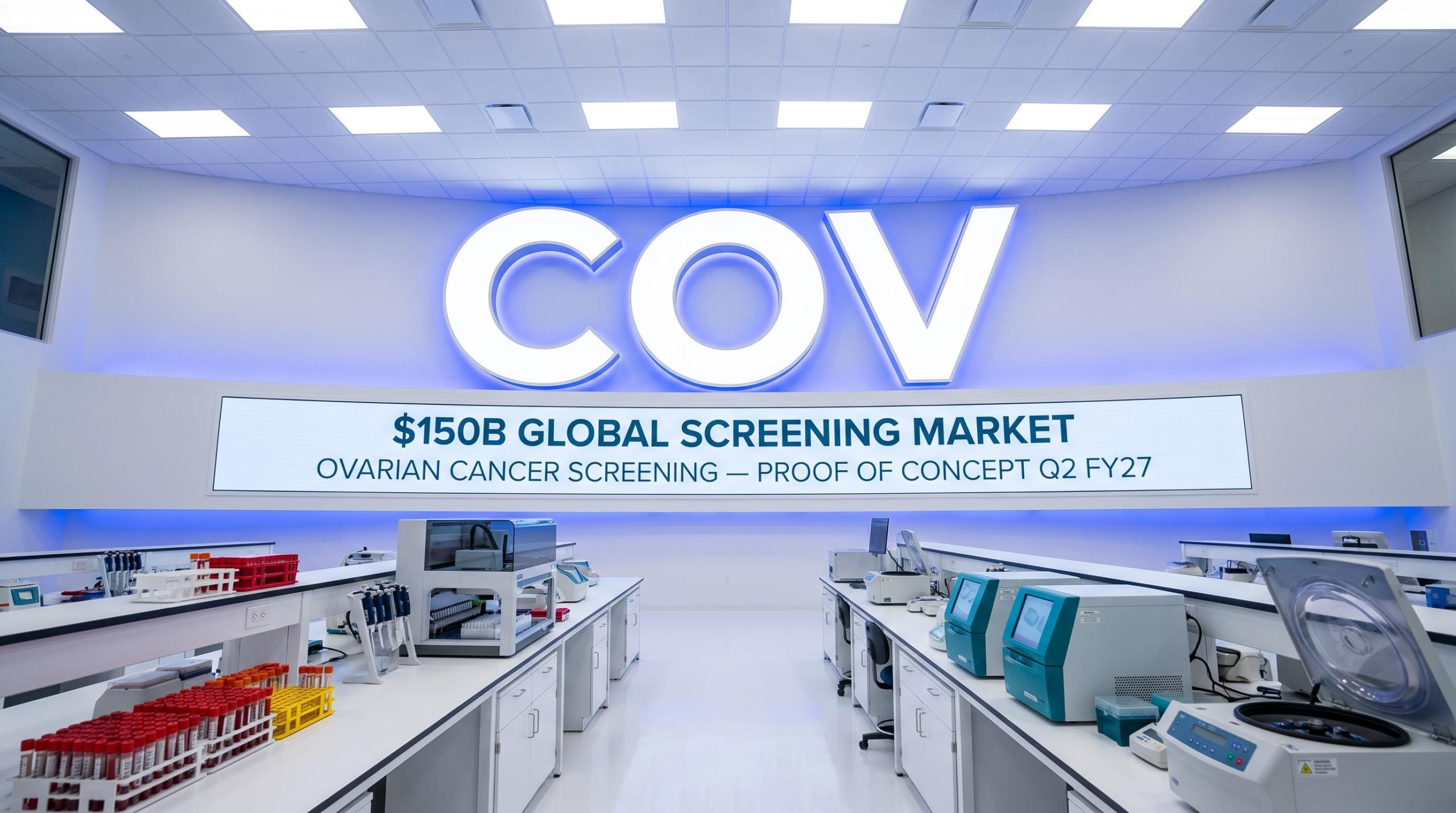
A $150B opportunity: CLEO moves into population screening
Cleo Diagnostics Limited (ASX: COV) has commenced prototype development of a multi-biomarker screening blood test targeting a $150B global addressable market for population-level ovarian cancer screening. The program runs in parallel with the company’s near-term pre-surgical triage test, which remains on track for FDA submission in H1 CY2027, addressing a separate $1.6B addressable market.
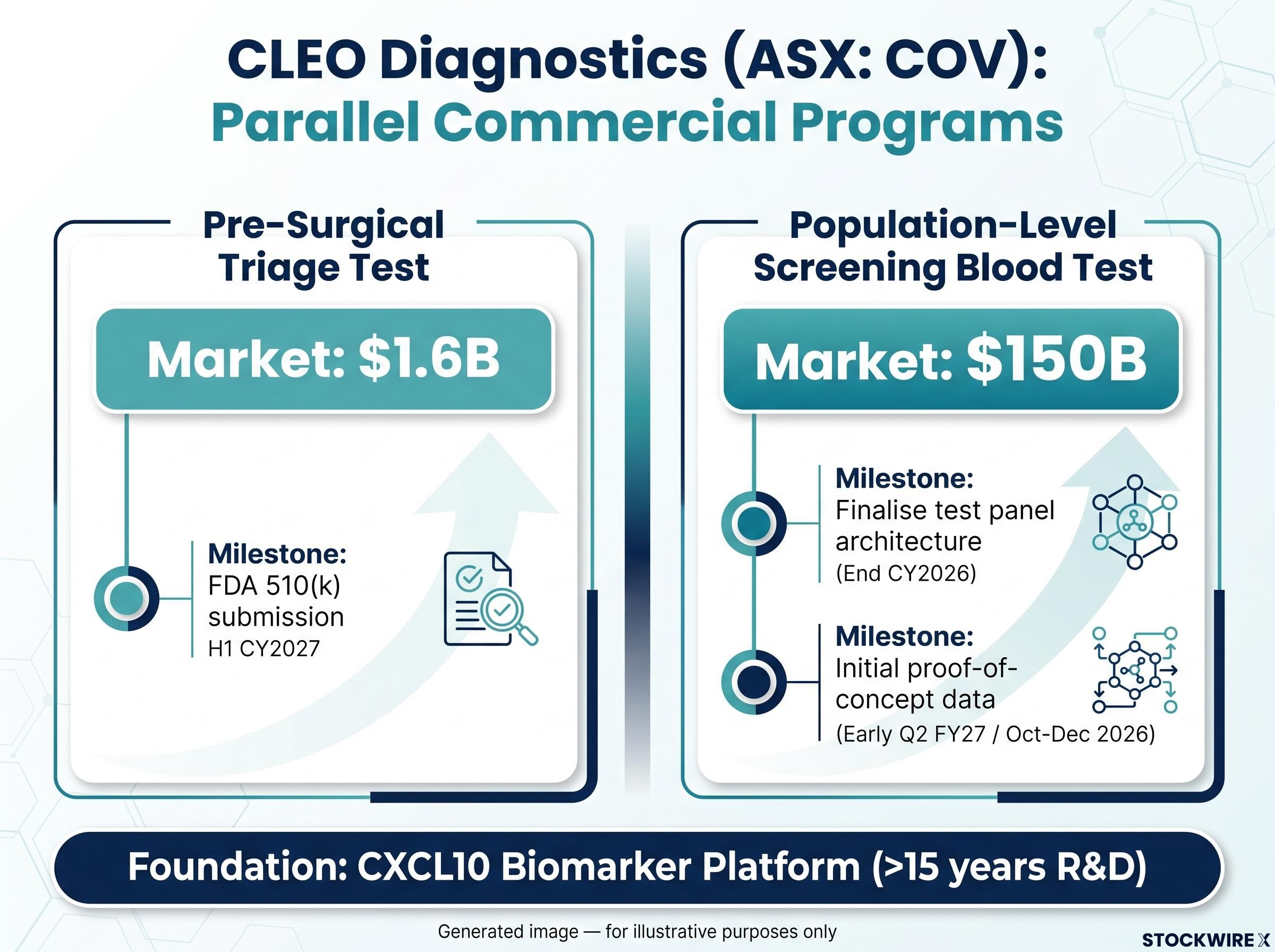
Near-term milestones are already in sight. Initial proof-of-concept screening data is expected early Q2 FY27 (the October–December 2026 quarter), with the company targeting finalisation of the test panel architecture by the end of CY2026.
When big ASX news breaks, our subscribers know first
CLEO’s staged commercial strategy: from triage to transformation
CLEO’s stated strategy is to address all ovarian cancer diagnostic markets through phased execution, beginning with the pre-surgical triage opportunity and ultimately expanding into population screening.
Pre-surgical test remains on track
The Pre-Surgical Ovarian Cancer Test remains the company’s primary commercial product. Its progression toward a scheduled FDA 510(k) submission in H1 CY2027 is unchanged. The screening development program is being progressed as a separate workstream and, according to the announcement, does not alter the company’s current regulatory and commercial focus on advancing the pre-surgical test toward U.S. market entry.
The Analytical Validation phase for the Pre-Surgical Ovarian Cancer Test formally commenced in September 2026 after 125 commercially manufactured test kits arrived from Bio-Techne, with three independently produced batches to be assessed before the program advances to Clinical Validation.
Biobank access already secured
A material element of development risk has already been addressed. Before prototype work began, CLEO established access to two internationally significant biobanks that provide representative intended-use populations for future evaluation:
- UKCTOCS biobank via a University College London (UCL) collaboration (announced 28 April 2025)
- PLCO (Prostate, Lung, Colorectal and Ovarian) biobank in the U.S., with access granted (announced 25 June 2025)
What is ovarian cancer screening — and why doesn’t it exist yet?
Ovarian cancer carries the highest five-year mortality rate of all cancers affecting women, with 51% of patients dying within five years. Late diagnosis is the primary driver of these outcomes, as most cases are detected only after the disease has advanced to a stage where treatment options are limited.
Developing a population screening test presents a fundamentally different technical challenge to developing a diagnostic test for symptomatic patients. A screening test must identify disease in asymptomatic women, a healthy population in which ovarian cancer prevalence is very low. When prevalence is low, the signal being detected is extremely rare, making it far harder to distinguish true positives from false positives with confidence.
There is a lack of effective population screening tools for ovarian cancer. This unmet clinical need is the gap CLEO is targeting, and it directly explains why the performance thresholds the company has established are exceptionally demanding.
Setting the bar: CLEO’s performance targets for the screening test
CLEO has established minimum performance thresholds that were set before development began, based on best-practice screening literature and calculated predictive probabilities appropriate to a low-prevalence disease.
| Target Population | Minimum Sensitivity | Minimum Specificity |
|---|---|---|
| High-risk (e.g. hereditary) screening | 90.0% | 90.0% |
| General population screening | 75.0% | 99.6% |
The 99.6% specificity requirement for general population screening is particularly stringent. In a low-prevalence population, a false positive result means a healthy woman is incorrectly flagged for further investigation, generating significant downstream cost and patient impact. By setting this bar in advance, CLEO is building toward both clinical credibility and regulatory positioning as the program progresses.
Three-stage evaluation pipeline: how CLEO gets from prototype to market
CLEO has designed a staged evaluation pipeline to build statistical confidence progressively and reduce technical and regulatory risk before committing to prospective clinical trials:
- Initial proof-of-concept — a 250-patient cohort, specifically enriched for Stage I ovarian cancers, to establish initial performance data
- Bridging and secondary confirmation studies — an expanded cohort to confirm overall performance with improved statistical power
- Evaluation in prospectively collected intended-use populations — reflecting real-world screening conditions across both high-risk and general population settings
Two near-term milestones anchor this pipeline. First proof-of-concept data is targeted for early Q2 FY27 (October–December 2026 quarter), with test panel architecture expected to be finalised by the end of CY2026. This staged design means CLEO progressively earns the right to advance, rather than committing substantial resources to large prospective trials before foundational performance is confirmed.
Investment thesis: two shots at transforming ovarian cancer diagnosis
CLEO now has two distinct value inflection points within a relatively short horizon. The FDA 510(k) submission for the pre-surgical test is targeted for H1 CY2027, while initial proof-of-concept screening data is expected in the next quarter. Both programs are built on the same CXCL10 biomarker platform, which is underpinned by more than 15 years of research and development, meaning the screening program leverages existing biomarker IP, clinical datasets, and development infrastructure rather than starting from scratch.
The pivotal U.S. clinical trial underpinning the pre-surgical test enrolled 624 women across 19 sites and secured 514 usable blood samples, surpassing the minimum recruitment threshold and removing a key execution risk from the FDA submission timeline.
Critically, biobank access across two internationally significant collections is already secured, removing a common early-stage bottleneck. The staged pipeline design is intended to de-risk the path toward the $150B addressable market, with each stage requiring demonstrated performance before the next is initiated.
Don’t Miss the Next Healthcare Breakthrough on ASX
Big News Blast delivers FREE breaking ASX healthcare news directly to your inbox within minutes of release, complete with in-depth analysis already done for you. Join 20,000+ subscribers staying ahead of the market on moves like this. Click the “Free Alerts” button at StockWire X to start receiving alerts the moment news breaks.