“Just buy the index” has become the default advice for Australian investors, and for most of your portfolio it is genuinely the right call. But treating it as universal law will quietly cost you money.
The latest Morningstar Active/Passive Barometer, drawn from the midyear 2026 edition, shows that active managers do not fail everywhere. In a handful of structurally inefficient corners of the market, they consistently beat the index after fees. The trick is knowing exactly where.
This matters because active management is expensive. Paying up for a stock-picker in an efficient market is money burned. But defaulting to a passive tracker in an inefficient one leaves genuine returns on the table.
Here is the framework for deciding which asset classes actually justify active fees, and which are better handed to a cheap index fund. The answer sits in three specific categories: Australian small caps, fixed income, and, with a large caveat, emerging markets.
The 40 per cent reality check: why passive stays the baseline
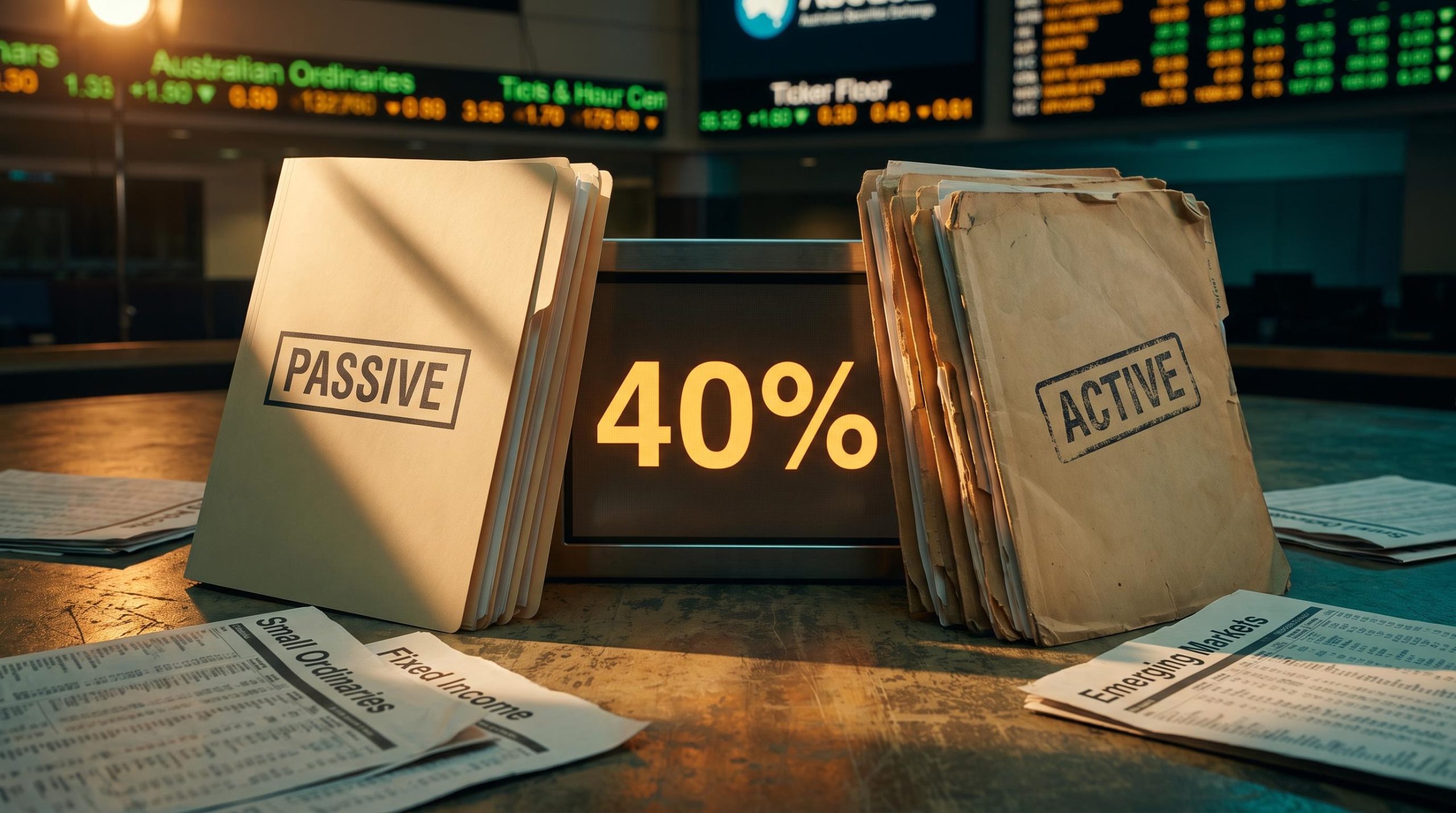
Start with the sobering number. Across the entire Australian fund universe, just over 40% of active funds both survived the period and beat their passive benchmark, according to the midyear 2026 Morningstar Barometer.
That is an improvement of roughly 7 percentage points on the prior year. It is still a minority.
The arithmetic behind that failure rate is not mysterious. Morningstar Australia reports that active funds charge an average of 0.53% in annual fees, against roughly 0.23% for their passive peers. That gap of about 0.30 percentage points every year is a headwind the active manager must overcome before delivering a single dollar of outperformance.
In efficient markets, most cannot. Large-cap Australian equities are the clearest example. These companies are picked over by dozens of professional analysts, priced with brutal efficiency, and tracked by stable, well-constructed benchmarks. Morningstar’s own conclusion is blunt: passive investing is more effective in large caps.
The SPIVA data underpinning the broader active vs passive investing debate in Australia reinforces the same conclusion: 87% of Australian equity general funds underperformed their benchmarks over 15 years, with the gap widening at every extended time horizon.
| Metric | Active funds | Passive funds |
|---|---|---|
| Average annual fee | 0.53% | 0.23% |
| Overall success rate (all categories) | ~40% | Benchmark |
| Large-cap Australian equities | Trails after fees | Advantage retained |
What this tells you is simple. Your default starting position for any allocation should be passive, and you should demand overwhelming structural evidence before agreeing to pay active fees. The exceptions that follow are exceptions precisely because they earn their keep.
When big ASX news breaks, our subscribers know first
Australian small and mid-caps: winning by avoiding the junk
The small-cap segment is where the case for active management stops being a sales pitch and starts being mechanics. The outperformance here is persistent and, importantly, explainable.
Using data summarised from Morningstar’s barometer for the periods ending 30 June 2025, the median Australian small-cap active fund beat the S&P/ASX Small Ordinaries Index by:
- 1.8 percentage points per year over three years, after fees
- 2.2 percentage points per year over five years, after fees
- 3.3 percentage points per year over 10 years, after fees
Those are meaningful, compounding margins. They exist because of how the passive index is built, not because small-cap managers are unusually gifted.
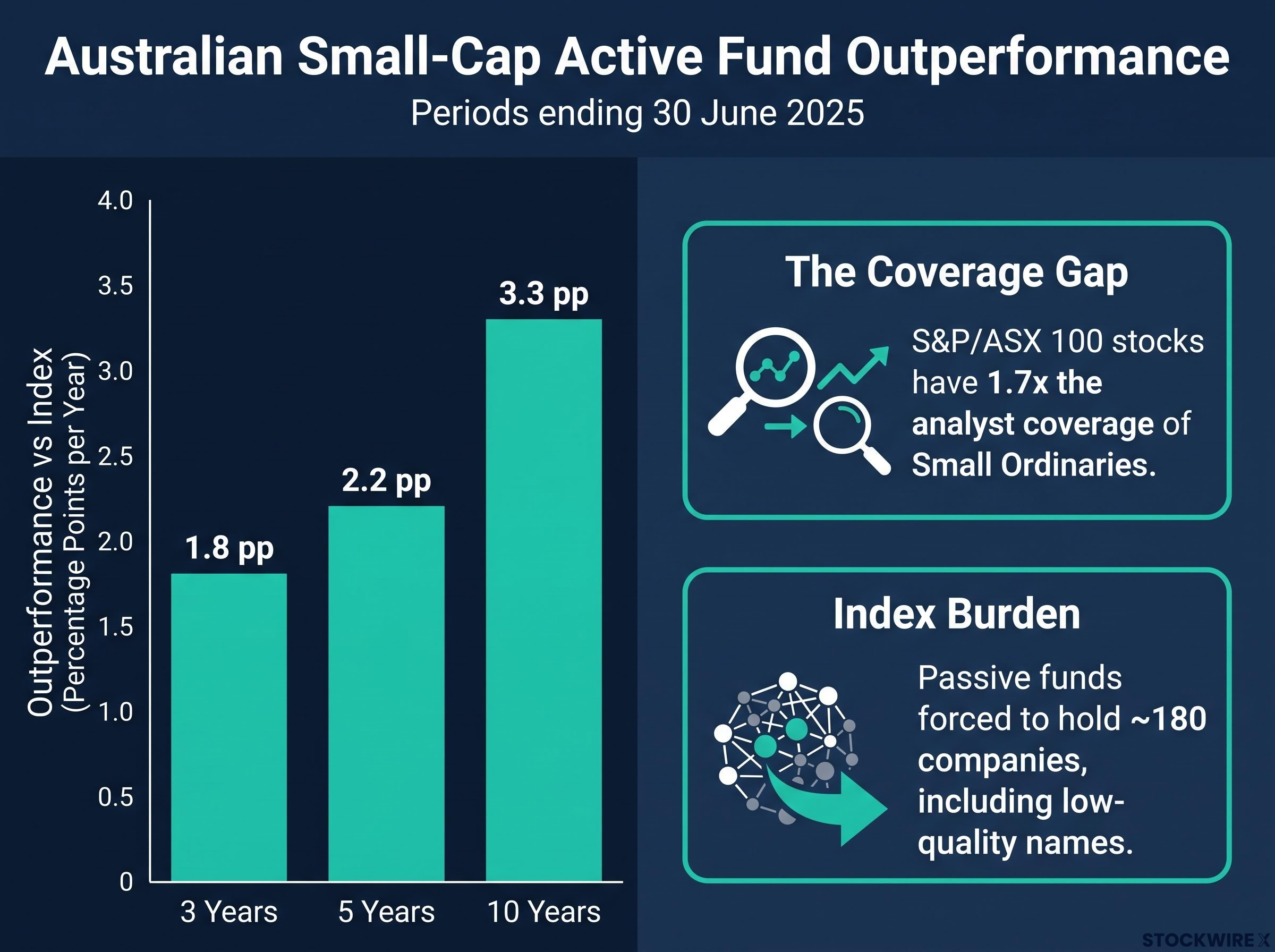
Consider the information gap first. Zenith Investment Partners, using data as of 31 December 2023, found that the average S&P/ASX 100 stock carried roughly 1.7 times the analyst coverage of the average Small Ordinaries stock. Fewer analysts means more mispricing, which is the raw material a skilled active manager works with.
Then consider what a passive small-cap index is forced to own. To track the Small Ordinaries, a fund must hold around 180 of the market’s smallest listed companies, including, as the Axis/Ausiex summary of Morningstar’s data puts it, many low-quality mining and industrial names that active managers typically avoid.
That is the pivot. A passive fund buys the junk because the rules say it must. An active manager screens it out.
The structural frictions working against passive small-cap investing come down to three things:
- The coverage gap: thin analyst attention leaves more stocks mispriced and available to be exploited.
- Liquidity dynamics: index mandates must trade even in illiquid names, while active managers can stagger trades or sidestep problem stocks, an advantage Fidante’s research highlights directly.
- Restrictive index rules: rules-based inclusion forces passive funds to hold speculative and structurally weak businesses regardless of quality.
Morningstar senior analyst Zunjar Sanzgiri makes the point plainly: passive indices rely on narrow, rules-based inclusions, while active managers have the flexibility to concentrate on higher-quality companies. Morningstar’s coverage even notes that the rare periods when the index beats active managers tend to coincide with low-quality cyclicals rallying, exactly the stocks active managers deliberately skip.
Illiquidity-driven price swings in the small-cap segment are frequently misread as signals of fundamental deterioration, when the underlying cause is thin order books and forced selling by index trackers rather than any change in business quality.
So here is the read you should take. When you pay a small-cap active manager, you are not just betting they can find hidden winners. You are paying them for quality control, to filter out the flawed companies a passive index would otherwise force into your portfolio.
Fixed income: how mandate flexibility generates yield
Bonds change the game entirely. The active edge here has nothing to do with picking clever stocks and everything to do with the tools a manager is allowed to use.
The numbers are striking. Surviving active managers in the global bond category posted a 100% success rate against the passive composite over both the five- and 10-year periods ending 30 June 2026, the strongest result of any category in the barometer.
Active bond funds in Australia produced one of the clearest documented exceptions to the lower-fees-win rule during the 2022-2025 rate cycle, with the mid-cost tier of fixed income strategies outperforming the cheapest passive ETFs precisely because duration flexibility mattered more than fee minimisation during sustained yield rises.
Australian bonds tell a similar story. Over the 10 years to 30 June 2023, active Australian bond managers achieved a success rate of roughly 87%.
The reason is structural. A passive bond fund is tethered to its benchmark and must hold duration close to the index, where duration measures how sensitive a bond portfolio is to changes in interest rates. When rates rise, that rigidity hurts.
An active manager can shorten duration to defend the portfolio as yields climb, or lengthen it when conditions favour it. In the rising-rate environment before mid-2023, Morningstar notes that precisely this flexibility drove active bond funds to substantial outperformance.
Credit selection is the second lever. Data from State Street, using Morningstar Direct figures, indicates roughly 90% of active Australian bond managers run an overweight position in corporate bonds versus the Bloomberg AusBond Composite index, which leans heavily toward government and semi-government debt. That positioning reaches for extra yield the passive benchmark simply does not capture.
Morningstar frames those excess returns as compensation for actively managing duration and credit risk, not a free lunch. Duration calls can be wrong, and a corporate overweight can backfire when spreads widen or downgrades hit.
What this means for you is that a passive bond allocation carries hidden benchmark risk. Paying for active management in fixed income buys you a defence mechanism against interest-rate volatility, provided you accept the added credit exposure that comes with it.
Global bond complexity
Global bonds amplify every one of these advantages. A single global index has to represent dozens of countries at once, each with its own yield curve, credit regime, and currency dynamics.
Capturing that efficiently through one rigid benchmark is close to impossible. Active managers can move between cross-country yield differentials, position around currency exposure, and lean into the credit regimes that offer the best value at a given point in the cycle.
That is why the surviving global bond managers cleared the passive composite so completely. The complexity that defeats a one-size index is exactly the terrain where an active toolkit earns its fee.
Emerging markets and the survivorship trap
Now the caution. Emerging markets look, at first glance, like another obvious win for active management. The reality is more dangerous, and it can destroy capital if you misread it.
The headline figure that matters most is the dispersion. Morningstar identifies emerging-markets equity as having the widest performance gap between the best and worst active managers of any category in the study.
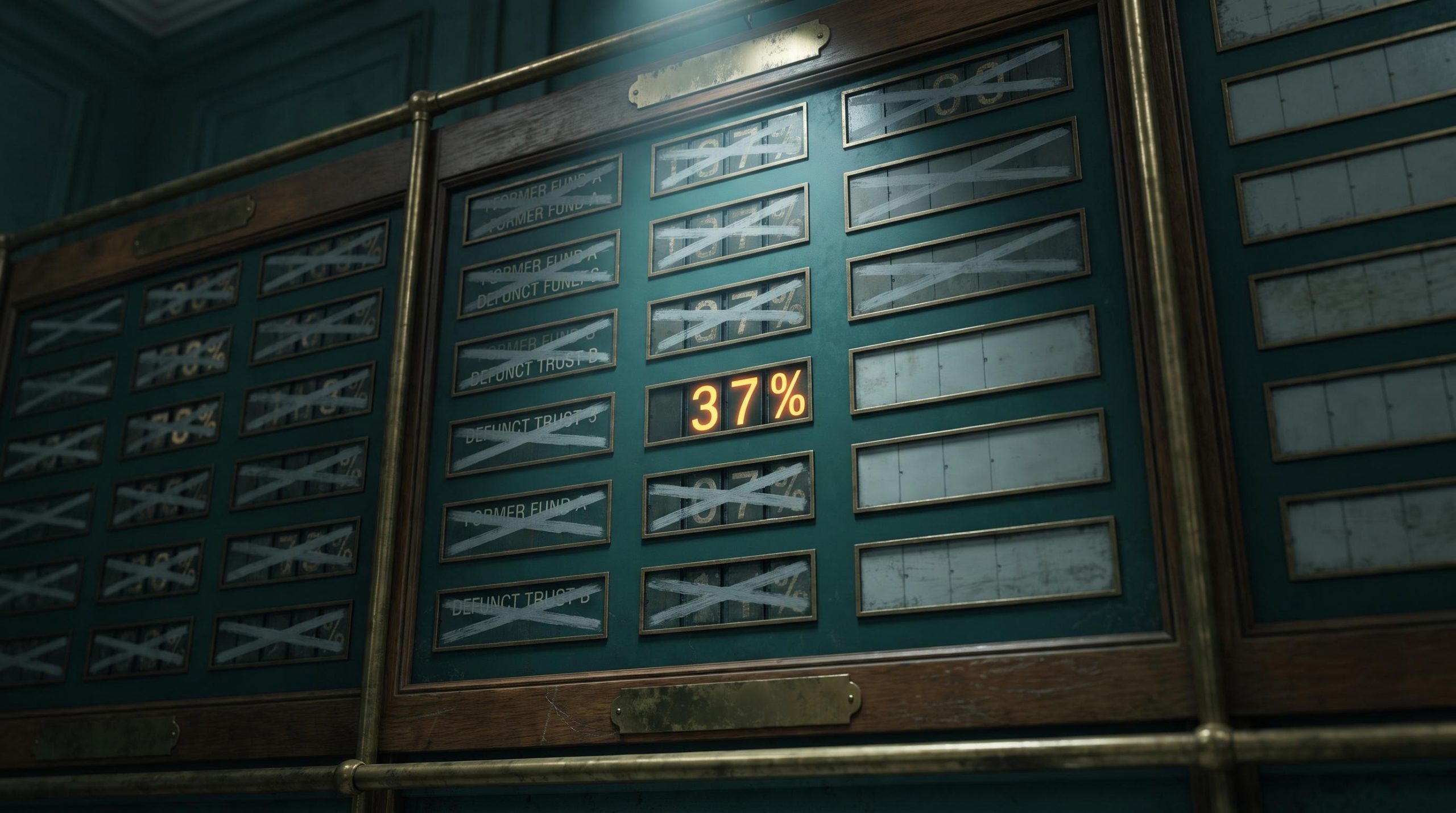
Look at the two success rates side by side and the trap becomes visible. Over the 10 years to 30 June 2026, more than 50% of surviving active emerging-market funds beat their passive alternative. But once you include the funds that closed, the overall success rate collapses to just 37%.
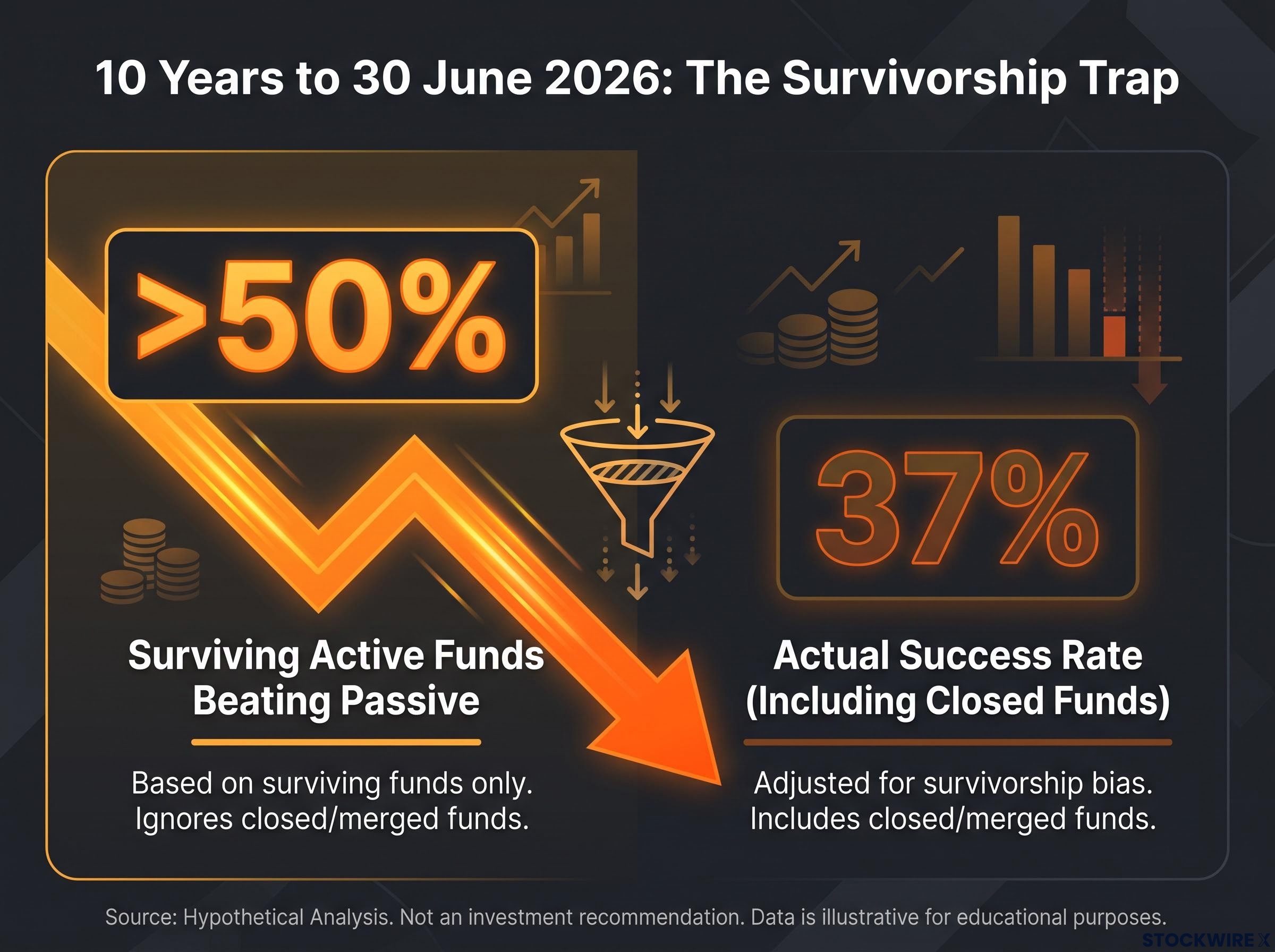
That gap between 50% and 37% is survivorship bias made concrete. A large share of emerging-market funds simply do not last the distance, and the ones that fail tend to fail badly before disappearing.
Here is the interpretation you cannot afford to miss. You cannot buy a random active emerging-markets fund and expect guaranteed outperformance. Pick a bottom-tier manager, or one that folds mid-cycle, and you will end up meaningfully worse off than if you had held a plain index tracker.
In this category, manager selection is not one risk factor among many. It is the risk factor. That makes a disciplined evaluation process non-negotiable before committing capital anywhere active management carries this much dispersion:
A structured fund screening framework built around people, process, and parent quality systematically eliminates the underperformers most likely to close mid-strategy, which is precisely the failure mode that drives the survivorship-adjusted active success rate in emerging markets below 40%.
- Assess the historical track record. Look for consistent outperformance across multiple market cycles, not a single strong year that flatters the numbers.
- Check fund size and stability. A fund with durable assets under management is less likely to close mid-strategy and leave you stranded.
- Evaluate the fee structure. Confirm the manager’s edge is large enough to clear both base fees and any performance fees, with margin to spare.
Run that process everywhere, but run it hardest here. The illusion of guaranteed active outperformance is at its most expensive in emerging markets.
Allocating your active risk budget
The takeaway is not that active beats passive, nor the reverse. They are complementary tools, and the skill is deploying each where the evidence says it works.
Treat your active fees as a limited budget. Audit your current holdings and keep your large-cap Australian equity exposure passive, where the odds are stacked against stock-pickers. Then redeploy the fee budget you free up toward active managers in small caps and fixed income, the categories where structural inefficiency genuinely rewards them.
Emerging markets stay on the list only if you are willing to do the manager-selection work the data demands. Everywhere else, cheap and passive remains the smart default.
As late 2026 unfolds, expect the next cyclical shifts, particularly in interest rates, to keep testing exactly how much active management is worth. The framework, though, holds: pay for skill only where the market’s structure lets skill win.
This article is for informational purposes only and should not be considered financial advice. Investors should conduct their own research and consult with financial professionals before making investment decisions.
Past performance does not guarantee future results. Financial projections are subject to market conditions and various risk factors.