The Canadian Dollar fell on Tuesday, and so did crude oil. That sounds like a tidy story until you look closer at the mechanics behind it.
A supply shock has been driving oil sharply higher through the Strait of Hormuz crisis, yet the Loonie has barely appreciated in response. The reflex most traders assume, oil up equals CAD up, is not firing the way it used to.
Tuesday’s session brought a tension that has been building for months into sharp focus. The Canadian Dollar is under pressure from softer oil, a cautious Bank of Canada, and shifting geopolitical signals around US-Iran diplomacy. But underneath all of that sits a quieter structural change: the relationship between oil and the Loonie has weakened considerably since 2018.
Reading Tuesday’s move correctly means separating the short-term triggers from that longer-term framework shift.
This gives you a working framework for interpreting Canadian Dollar moves that goes beyond the headline oil price. You will finish knowing when energy still drives the Loonie, when it does not, and which forces are actually in the driving seat right now.
What actually happened to the Canadian Dollar on Tuesday
The headline number was modest. USD/CAD rose roughly 0.27% to trade near 1.4070, extending the six-week low territory the Loonie has occupied since mid-September. On 16 September 2026, USD/CAD touched an intraday high near 1.3994; by 17 September it steadied around 1.3985, according to Reuters.
Crude did its part on the same session.
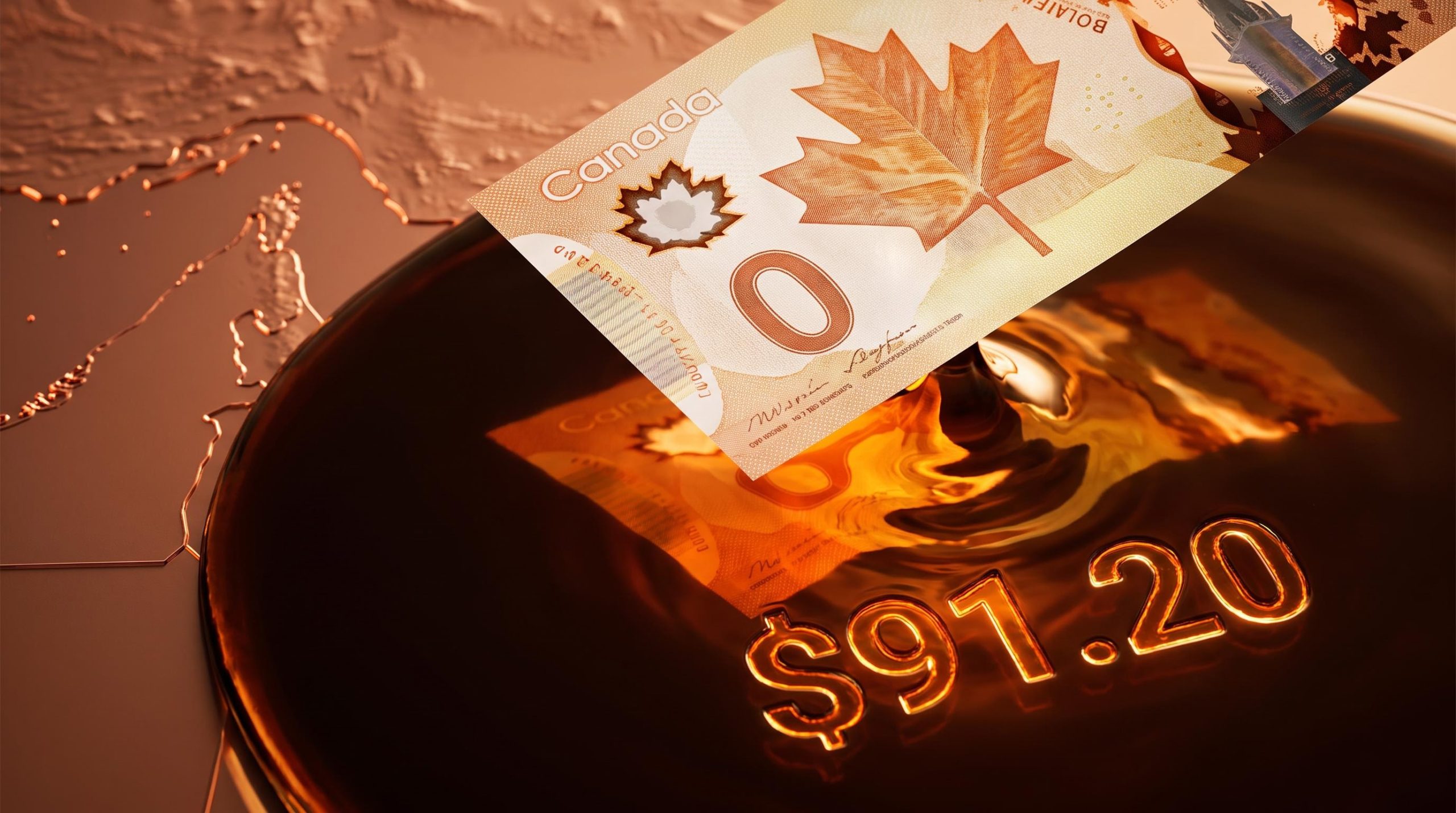
WTI crude West Texas Intermediate declined approximately 0.46% to settle near $91.20 per barrel on the Tuesday session.
So far, this looks like a clean commodity-currency story: oil down, Loonie down. The heat map complicates it.
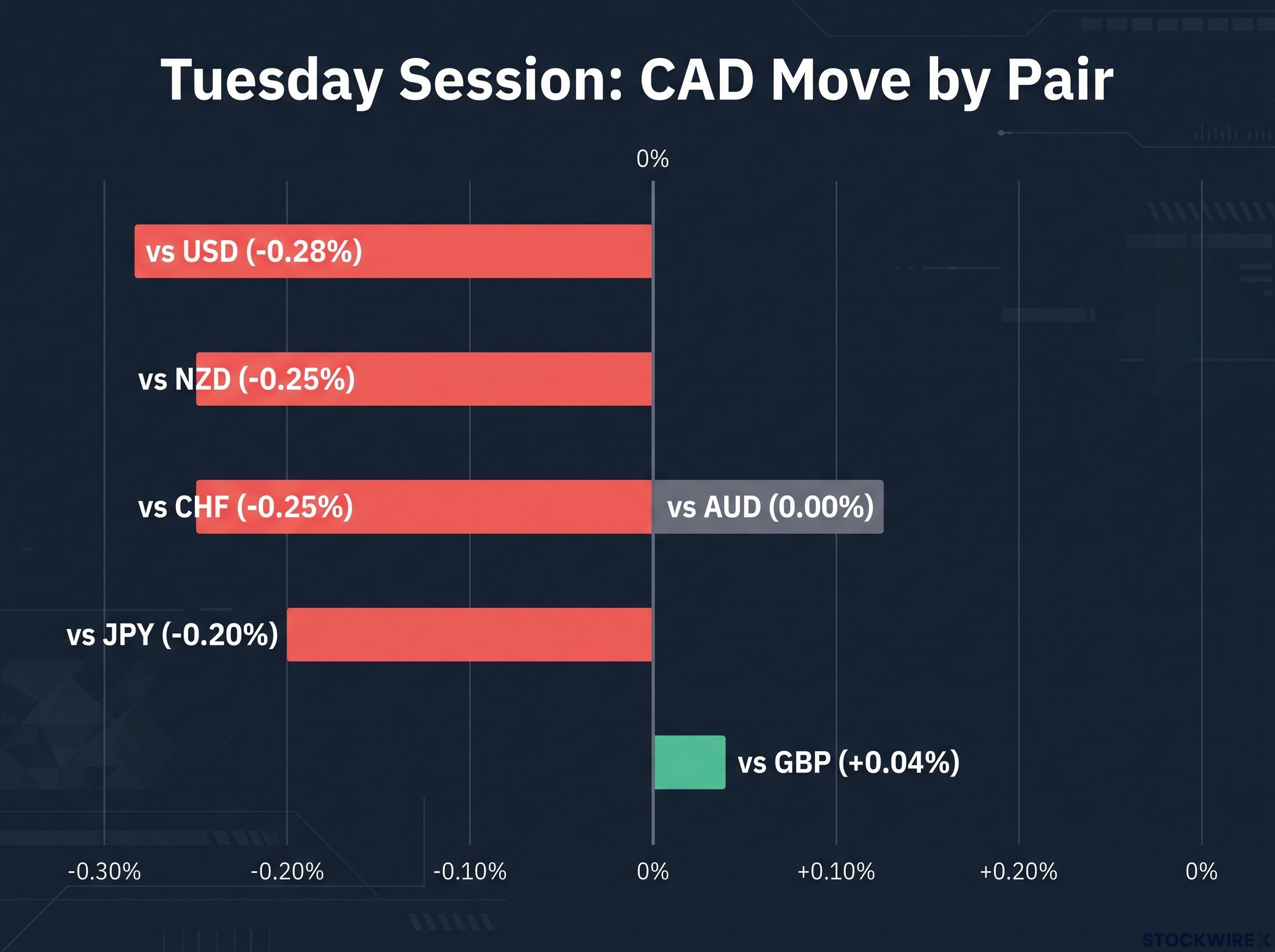
CAD weakness was selective, not universal. That distinction matters, because a genuine flight-to-safety day would push the Loonie lower against everything, and it did not.
| Pair | CAD move | Direction |
|---|---|---|
| vs USD | -0.28% | Weakened |
| vs NZD | -0.25% | Weakened |
| vs CHF | -0.25% | Weakened |
| vs JPY | -0.20% | Weakened |
| vs AUD | 0.00% | Flat |
| vs GBP | +0.04% | Strengthened |
The Loonie softened against the Dollar, the safe-haven Swiss Franc, the Yen, and the New Zealand Dollar. It held flat against the Australian Dollar, another commodity currency, and actually edged up marginally against the British Pound and the Euro.
That pattern tells you something a simple risk-off narrative cannot. This was not investors fleeing to safety across the board. It was a commodity-currency repricing driven by energy signals, with the CAD losing ground specifically to the Dollar bloc and safe havens while holding its footing against European currencies.
There is a data tension worth flagging. While WTI slipped on the session, broader crude benchmarks were stabilising around $90/barrel in August, and Brent pushed above $100/barrel in September as Hormuz risk escalated. The Loonie’s muted response to that supply-driven surge is the puzzle the rest of this analysis unpacks.
If you only track USD/CAD, you miss the cross-currency signal. The heat map is what narrows down causation from “the Loonie fell” to “the Loonie fell because of a specific energy-market repricing.”
When big ASX news breaks, our subscribers know first
Oil, Iran, and the Strait of Hormuz: how geopolitics priced into Tuesday’s session
To read Tuesday properly, you have to trace the arc that led there. The Hormuz situation did not appear overnight; it moved through three distinct phases across 2026, and each one shifted the risk premium embedded in oil.
- June easing. On 21-22 June 2026, high-level US and Iranian officials concluded talks in Switzerland. US Vice President JD Vance noted progress and an open Strait of Hormuz, and oil prices dropped more than 3%. Washington eased sanctions on Iranian crude through general licences and waivers.
- August collapse. By mid-August, an interim June ceasefire had broken down. Neither side compromised on Hormuz, and crude flows through the strait fell from a pre-war 18 million barrels per day to roughly 2 million barrels per day under Iranian attacks and a US naval blockade.
- September escalation. Markets were described as flying blind as Brent pushed above $100/barrel following Iran-aligned Houthi attacks on Saudi energy facilities and Tehran’s warnings of economic warfare. By mid-September, Washington claimed improving Hormuz traffic, but diplomatic deadlock persisted, and fresh attacks on a Saudi pipeline and an Iranian ship kept futures elevated.
Tuesday’s negative WTI move fits into that arc, and the reason matters. The oil decline reflected easing geopolitical risk sentiment on renewed diplomatic progress signals, not a collapse in demand.
That distinction is everything for reading the CAD impact. When supply-disruption fears ease, the risk premium in oil compresses, and commodity currencies lose the geopolitical support that had been partially propping them up.
Two distinct geopolitical risk transmission channels shape how Gulf tensions move currency markets: a short-lived risk-sentiment channel that reverses on calmer headlines within days to weeks, and a slower energy-price-shock channel that persists across weeks to months while physical supply remains disrupted.
For anyone holding commodity-currency exposure, the takeaway is that the oil risk premium is episodic, not structural. It can reverse on a single diplomatic statement, exactly as June demonstrated, which makes geopolitical support for the Loonie fragile and directionally unreliable.
How a diplomatic signal becomes a currency move
The transmission chain is short and mechanical. Diplomatic progress reduces supply-disruption fears, which compresses the risk premium priced into oil.
That compression pulls WTI lower. With crude falling, the Canadian Dollar loses its energy-sector tailwind, the improved terms of trade that higher oil normally delivers to a net exporter.
The result flows straight through to the currency: USD/CAD rises. That is the mechanism behind Tuesday, and it is why a de-escalation headline can weaken the Loonie even when nothing about Canada’s own economy has changed.
The petrocurrency assumption is breaking down
Most investors carry a simple rule into Canadian Dollar analysis: oil up, Loonie up. That rule was not invented from nothing. For a long stretch it was genuinely reliable.
Economist Werner Antweiler found that historically, up to 2016, a 10% rise in oil prices translated into a 1-3% CAD appreciation, with oil explaining up to 90% of exchange-rate variation. Canada is a serious net exporter of crude, with energy accounting for roughly 20-25% of merchandise exports, so the linkage made mechanical sense.
The problem is that the rule has quietly stopped working the way it once did.
The CAD-oil correlation has collapsed from 0.88 before 2018 to just 0.02 over 2025-2026, a structural break that reframes the petrocurrency heuristic from a reliable signal to a tail-risk monitor at best.
The first crack is the type of shock. Scotiabank Economics and CEPII research distinguish between demand-driven and supply-driven oil moves. A demand-driven price increase produces roughly a 3% CAD appreciation, while a supply-driven spike, the kind a geopolitical crisis generates, produces only about 1%.
That already tells you something uncomfortable about the current moment. The Hormuz situation is a supply shock, precisely the category that generates the weakest Loonie response.
The second crack is deeper. A 2024 Alberta Central report found the CAD-WTI correlation has diminished substantially: from 1997 to 2014 energy reliably drove the currency, but from 2016 to 2024 the energy coefficient became statistically non-significant.
The counterintuitive number Antweiler’s updated data shows the pass-through elasticity from oil to the Canadian Dollar hovering near zero, or slightly negative, since 2018.
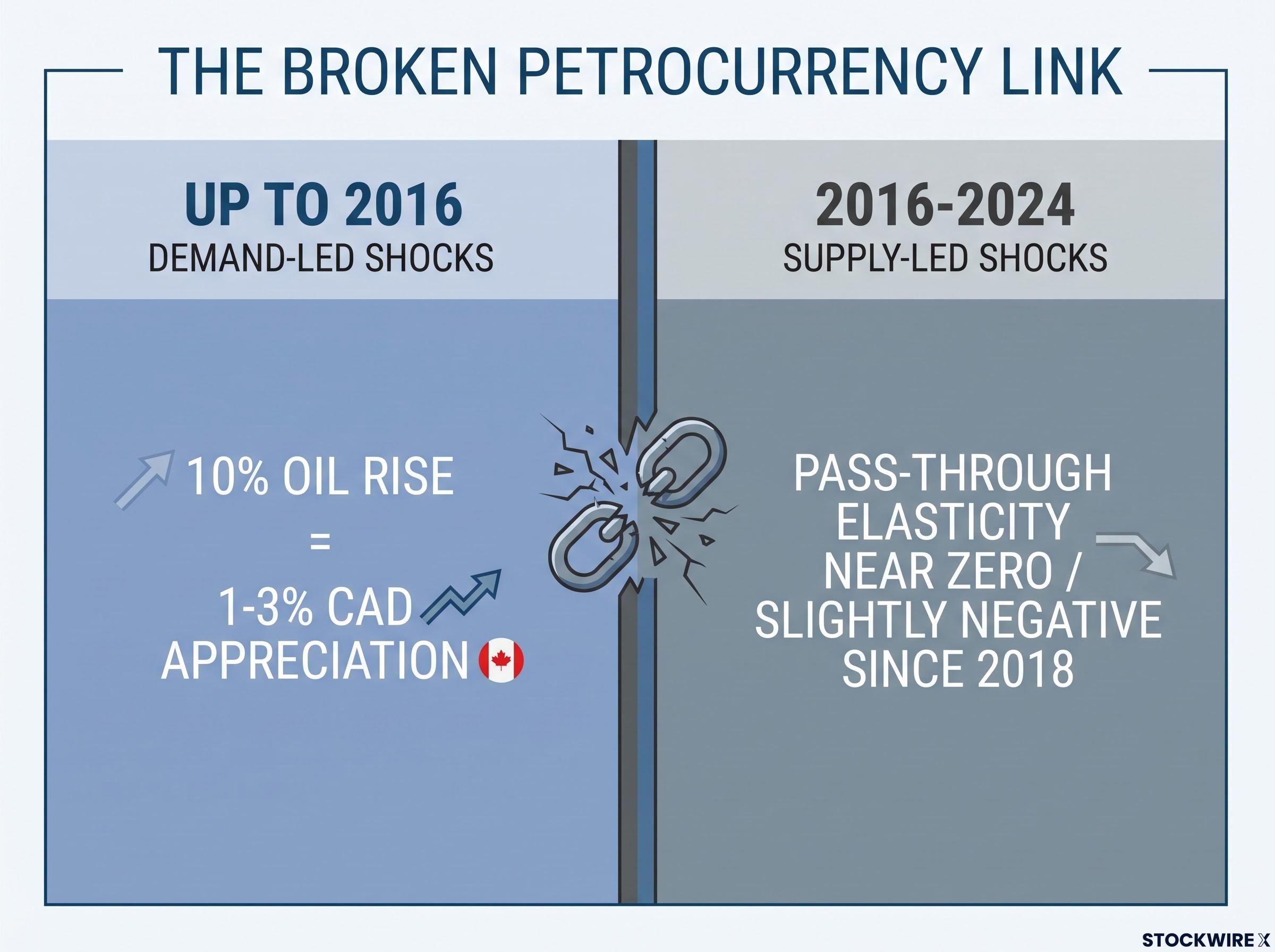
| Period | Oil-CAD correlation | Pass-through elasticity | Dominant shock type |
|---|---|---|---|
| Up to 2016 | Strong (up to 90% of variation) | 10% oil = 1-3% CAD | Demand-led |
| 2016-2024 | Statistically non-significant | Near zero / slightly negative since 2018 | Supply-led, geopolitical |
Here is the calibration you should take from this. The petrocurrency idea is not wrong, but it is time-bounded and shock-type dependent. Using oil as a Loonie proxy the way traders did before 2016 will now systematically mislead your positioning, and the current supply-driven Hormuz shock is exactly the case where that heuristic fails hardest.
What the Bank of Canada’s inaction signals for the Loonie
The central bank could, in theory, support a weak currency through rate policy. Right now it is choosing not to, and that choice is itself a headwind for the Loonie.
On 2 September 2026, the Bank of Canada held its target for the overnight rate at 2.25% for a seventh consecutive decision. The Bank Rate sits at 2.50% and the deposit rate at 2.20%, and the Bank noted the policy rate remains at the lower bound of its estimated neutral range.
Sitting at the bottom of neutral signals constrained flexibility. The Bank is not leaning hawkish or dovish; it is holding, and it is balancing four competing forces at once:
- Excess supply in the economy, with persistent slack pulling toward caution.
- Unemployment around 6.5%, reinforcing the case for patience.
- Sticky inflation near or above the 2% target, pulling toward action.
- CAD-imported inflation, where a weaker Loonie raises the cost of imports.
That last force creates a feedback loop worth understanding. Scotiabank strategists note that CAD weakness flirting with 1.40 is itself an inflation input, which could eventually force the Bank’s hand even if domestic conditions alone would not.
The feedback loop Scotiabank strategists have flagged that a Canadian Dollar near 1.40 is unhelpful for the Bank of Canada, because it builds inflation risks and may force policymakers to become more sensitive to exchange-rate depreciation.
The September minutes reinforced the tension. Governors agreed inflation was likely to remain elevated near or above target in the near term, and the Governing Council highlighted upside inflation risks while reiterating readiness to raise rates if inflation stays too high.
What this means for you is direct. A central bank holding at the neutral lower bound while inflation stays sticky is effectively telling markets it will not defend the currency through rate policy in the near term. That leaves the Loonie’s short-term path dependent almost entirely on exogenous forces: oil prices, geopolitical developments, and the relative pace of US Federal Reserve moves.
What would change the Bank of Canada’s calculus
Two scenarios would shift the Bank off the sidelines. The first is inflation persistence, Scotiabank’s behind-the-curve risk, where hot core inflation forces action to catch up.
Scotiabank projects an extended hold at 2.25% before migrating toward roughly 75 basis points of cumulative tightening by late 2026 into 2027. Accelerating that timeline would take a clear, sustained inflation overshoot rather than the current near-target readings.
The second is a sharp deterioration in domestic growth, which would pull the other way toward easing. Absent either trigger, the Bank looks set to stay put, offering the Loonie no rate-differential catalyst.
Reading the Loonie in a multi-driver environment
The genuine analytical divide here is not settled, and pretending otherwise would mislead you. Two camps read the Canadian Dollar through different lenses.
The geopolitics-and-terms-of-trade camp, including strategists at the National Bank of Canada and voices at Investing.com, argues that Hormuz strains embed a risk premium in oil that supports the Loonie via improved terms of trade. In this view, oil, geopolitics, and US rate expectations are the dominant drivers.
The rates-and-fundamentals camp, reflected in Reuters, Mitrade, and Scotiabank coverage, argues that US-Canada policy differentials and trade tensions matter more than short-term oil spikes. Their thesis is confirmed when the Loonie stays weak despite elevated oil, which is roughly what has happened.
That second camp points to a headwind that persists regardless of oil: trade. US tariffs of up to 50% on approximately $20 billion of Canadian goods, with Canadian retaliation in place, weigh on the currency whether crude rises or falls.
US tariffs of up to 50% on approximately $20 billion of Canadian goods have introduced a tariff-driven stagflationary drag that sits beneath the oil-CAD relationship, compressing the trade-balance benefit that elevated crude prices would ordinarily deliver to the Loonie regardless of where WTI settles.
Historical evidence leans toward the fundamentals reading. ECB and BIS analyses indicate oil-exporter currencies do not systematically appreciate during supply-driven oil shocks, because central bank reactions and broader macro conditions frequently offset the effect.
With oil transmission weakened, the Bank of Canada on hold, and trade tensions unresolved, the practical read is this. Treat any short-term Loonie rally driven purely by oil risk premia as fragile and potentially reversible, not as the start of a durable trend.
The framework you should carry forward comes down to three variables:
- The Hormuz diplomatic resolution timeline, which determines whether the oil risk premium builds or unwinds.
- The relative Fed-BoC rate path, which drives the policy differential behind USD/CAD.
- The trajectory of US-Canada trade tensions, an oil-independent headwind that keeps pressure on the Loonie.
Rather than defaulting to the oil-proxy heuristic, weigh which of these is actually in play, and whether the driver is durable or episodic.
Three variables to watch before the next Bank of Canada decision
The next hard deadline for Loonie direction is 28 October 2026, when the Bank of Canada meets again. That is when the accumulated evidence on inflation persistence, exchange-rate depreciation, and oil dynamics gets assessed at once.
Each of the three variables carries a forward reading. A Hormuz resolution would compress the oil risk premium and pressure the Loonie; a fresh escalation would rebuild it, though history suggests only temporarily. The Fed’s next move sets the rate differential, and continued trade tensions keep an oil-independent weight on the currency.
The market-implied probability of normalised Strait conditions by year-end dropped below 30% in early September 2026, embedding a Hormuz supply-disruption premium into oil that National Bank of Canada warned could unwind abruptly on any single de-escalation signal, pulling USD/CAD back toward 1.40 from below.
The consensus baseline Scotiabank projects an extended hold at 2.25% before roughly 75 basis points of cumulative tightening begins in the second half of 2026. That is the baseline against which any surprise will be measured.
History offers one steadying note. Geopolitical risk premia tend to induce temporary price bumps rather than permanently higher oil, so commodity currencies experience short-term volatility rather than structural strengthening from crisis episodes.
The October meeting will not resolve the structural tensions traced here. What it will signal is whether the Bank is becoming more sensitive to CAD depreciation as an inflation input, which is the single most important near-term signal to track.
The range of plausible outcomes is wide. The framework for interpreting each one is now in your hands.
This article is for informational purposes only and should not be considered financial advice. Investors should conduct their own research and consult with financial professionals before making investment decisions. Past performance does not guarantee future results, and financial projections are subject to market conditions and various risk factors. Forward-looking statements are speculative and subject to change based on market developments.