Here is a puzzle that trips up most people watching the Canadian dollar. A domestic central bank sets the price of money for its own economy, yet the currency it issues can shrug off strong local news and drift with forces set thousands of miles away.
The Bank of Canada is the institution at the centre of this. Its toolkit runs from the overnight interest rate to bond-market operations, all aimed at one goal: keeping prices stable. As of September 2026, the policy rate sits at 2.25%, held steady while the Bank’s balance sheet operates back at normal size after a multi-year contraction.
Yet the loonie often ignores what happens in Ottawa entirely. Understanding why means learning which levers actually move the currency and which are background noise.
This breakdown gives you a practical framework for decoding central bank statements, so you can separate the direct currency drivers from the headlines that sound important but change very little for your positions.
The foundation of Canadian price stability
Strip away the jargon and the Bank of Canada’s job comes down to a single number.
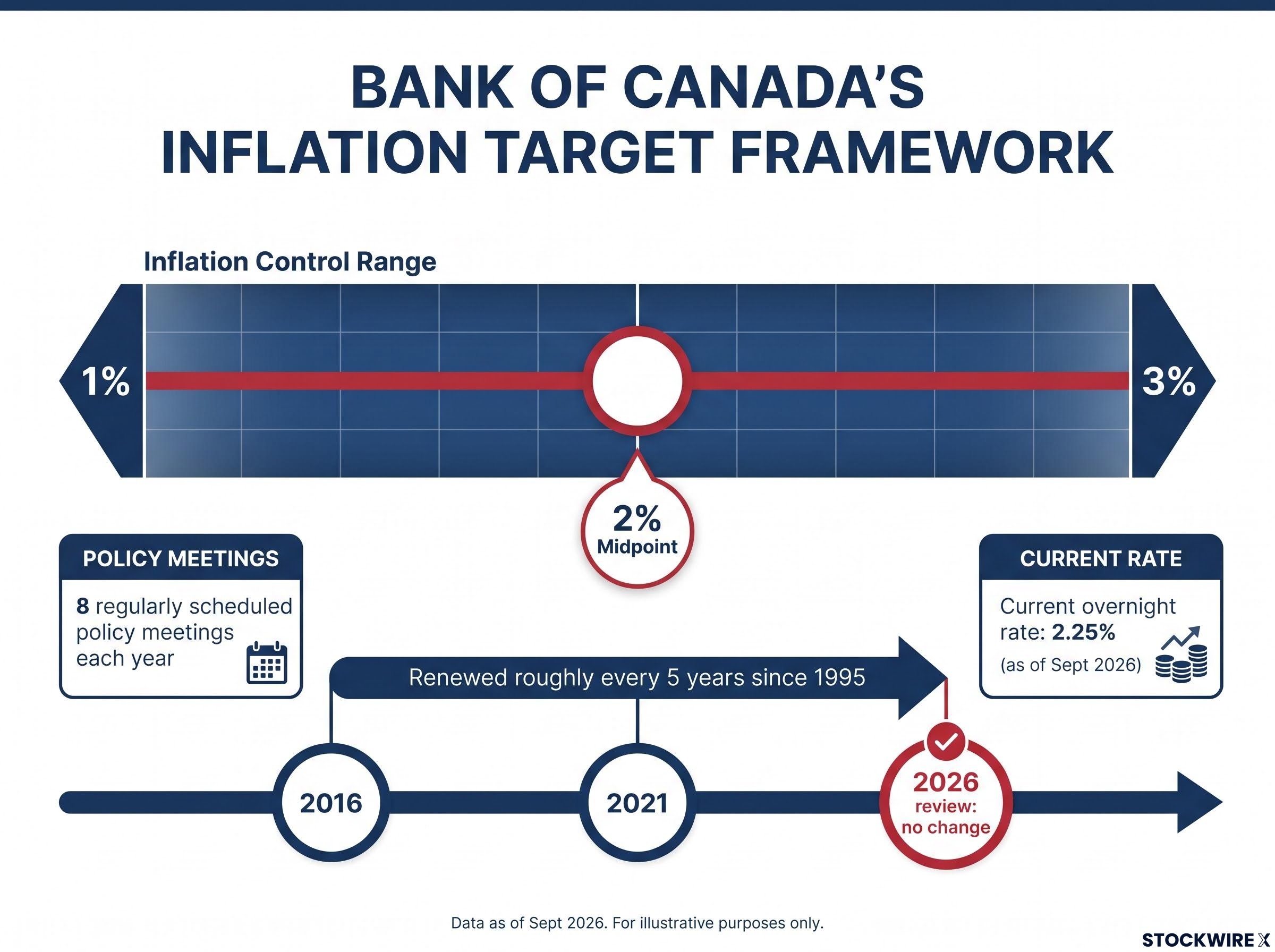
That number is 2%. Under the joint agreement between the Government of Canada and the Bank, inflation is targeted at a 2% midpoint, sitting inside a control range of 1% to 3% for consumer price inflation. Everything else the Bank does is built to defend that band.
This is not a new experiment. The framework has been renewed roughly every five years since 1995, and each renewal has reaffirmed the same target. The 2016 renewal locked in the 2% midpoint and 1-3% range through the end of 2021, and the review underway in 2026 reports no change to either figure. That consistency is the point. When markets trust that a central bank will hold its target for decades, expectations about future inflation stay anchored, and that credibility does real work in keeping the currency stable.
To manage this, the Bank meets on a fixed schedule rather than reacting on a whim.
- Eight regularly scheduled policy meetings take place each year, spaced across the calendar.
- Each meeting can result in a rate hike, a cut, or a hold.
- The Bank retains provision for additional emergency sessions when conditions demand action outside the normal timetable, as happened during the market stress of 2020.
The standard weapon for defending the target is the interest rate. When inflation runs hot, the Bank raises rates to cool spending. When it runs cold, the Bank cuts. Right now the overnight target rate is 2.25%, unchanged since 29 October 2025, when the Bank trimmed it from 2.50%.
Here is the practical takeaway for you. You can anticipate the Bank’s next move by watching how far current inflation strays from that 2% midpoint. The wider the gap, the more likely a policy response, which gives you a leading indicator for how rate-sensitive parts of your portfolio might behave in the months ahead.
Canada’s core inflation measures, specifically CPI-trim and CPI-median, were both tracking below 2% and beneath the Bank’s own quarterly forecasts as of August 2026, meaning the 2% midpoint that anchors all Bank of Canada policy decisions was being tested from below rather than above despite a still-elevated headline number.
When big ASX news breaks, our subscribers know first
Why interest rate differentials are the primary currency driver
Now to the mechanism that actually moves the loonie: not the Canadian rate by itself, but the gap between it and the rate next door.
Money chases yield. When the Bank of Canada sets its rate below the U.S. Federal Reserve’s rate, capital tends to flow south toward the higher return, weakening the Canadian dollar. When Canadian rates sit above U.S. rates, the flow reverses. This cross-border movement is the single most direct link between monetary policy and the currency.
A Bank of Canada staff analytical note published on 4 February 2025 gives you a clean rule of thumb for measuring it.
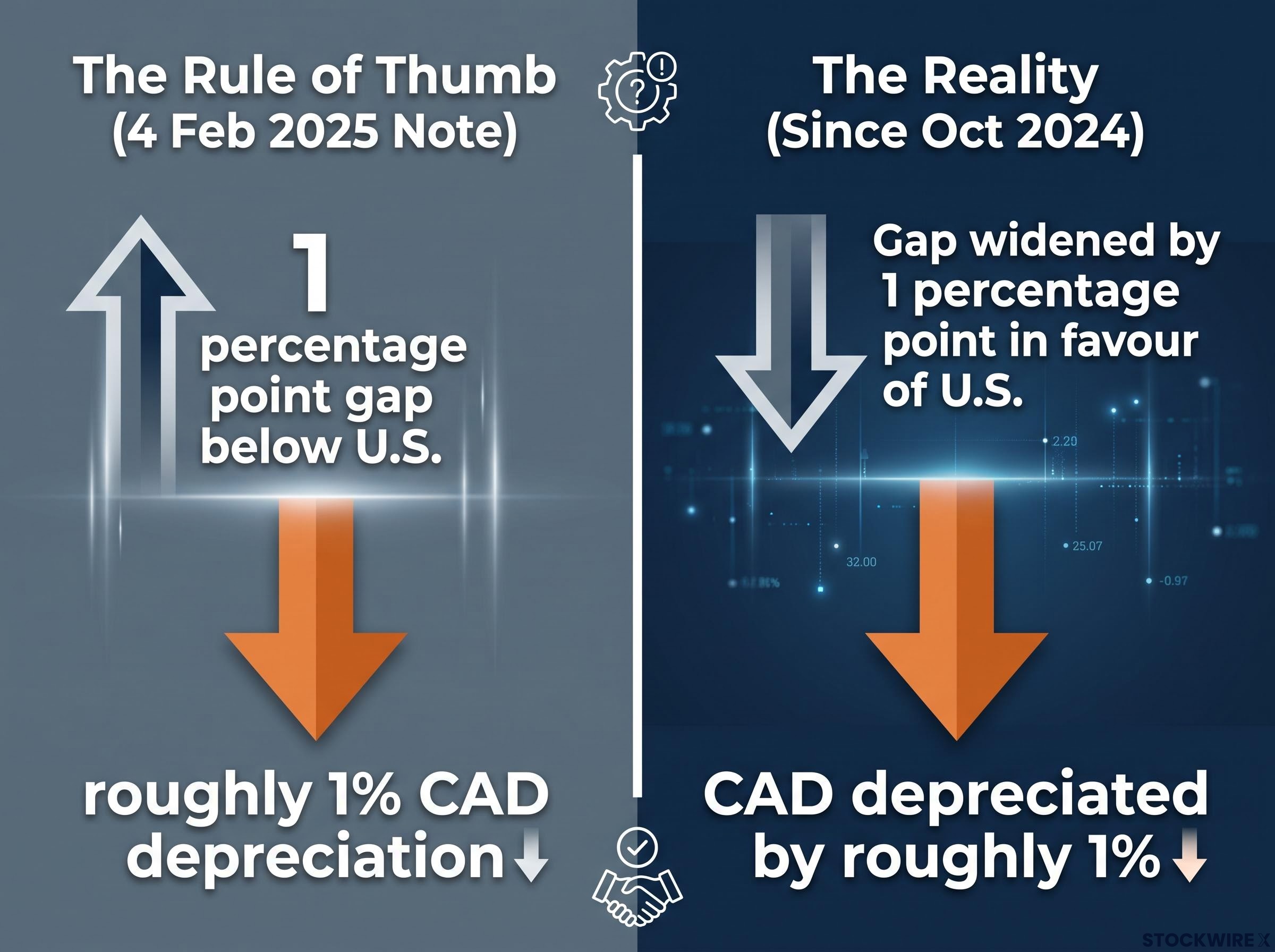
When the one-year interest rate in Canada falls one percentage point below the U.S. one-year rate, the Canadian dollar tends to depreciate by roughly 1%.
That is not theory. The Bank’s January 2025 Monetary Policy Report documented it in real time. Since October 2024, the Canada-US policy rate gap widened by about one percentage point in favour of the U.S., and the loonie depreciated by roughly 1% as a result. The Bank was careful to note this explained only part of the total move, but the relationship held.
This is where the carry trade enters the picture. A carry trade is when investors borrow in a low-yielding currency and park the money in a higher-yielding one, pocketing the difference. A currency offering better yield attracts this capital. When Canada offers less than the U.S., the flow works against the loonie, which is one reason its rallies often run out of steam even when domestic data looks solid.
One more layer matters, and it is the one most headline readers miss. The currency often moves before any decision is announced. Markets price in the expected path of rates, not just the current level. If traders believe the Bank will cut faster than the Fed, the loonie can weaken today on a decision that is still months away. The expectation is the driver, not the announcement itself.
Central bank divergence is the mechanism that gave the 1% rule its real-world proof: when the Fed widened its rate lead over the ECB in 2022, EUR/USD fell from roughly 1.137 to below parity, with markets pricing the entire future rate path rather than any single decision.
So when you read a rate decision, do not stop at the Canadian number. Immediately look at the gap between Canadian and U.S. rates, because that relative differential is what actually moves your capital. A hold in Ottawa can still weaken the loonie if the Fed is expected to stay higher for longer. The spread, not the headline, is your measure of currency risk.
How quantitative easing and tightening work behind the scenes
Interest rates are the loud tool. The balance sheet is the quiet one, and it works in a way that is easy to misread.
Quantitative easing (QE) is what a central bank does when cutting rates is no longer enough. The Bank creates new Canadian dollars and uses them to buy government bonds from financial institutions. This pushes longer-term interest rates down and compresses risk premiums, the extra return investors demand for holding riskier assets. The effect on the currency is real but indirect: lower yields make the loonie less attractive, which can weigh on it. The Bank deployed QE during the 2020 pandemic to keep credit markets functioning, not to steer the exchange rate.
Quantitative easing mechanics extend well beyond currency effects: the programme primarily inflated asset prices through a financial-market channel rather than stimulating bank lending, which is why the Bank of Canada’s deployment in 2020 left credit conditions looser without triggering the exchange-rate crash some observers predicted at the time.
Quantitative tightening (QT) is the reverse. Rather than actively selling bonds, the Bank simply stops replacing them as they mature, letting the balance sheet shrink on its own. This is a background normalisation process, not a lever aimed at the currency. It tends to firm up the loonie only to the extent that it reinforces an already restrictive stance.
The scale of the recent QT was substantial. Beginning in April 2022, the Bank let its bond holdings roll off, and by early 2024 it had reduced its balance sheet by roughly CAD 180 billion, an almost 40% decline to around CAD 300 billion. By mid-2024, Government of Canada bond holdings had fallen about 45% from the peak, and the Bank stressed this happened without disrupting markets.
The 2025 return to normal operations
QT is now finished.
On 29 January 2025, the Bank formally announced the plan to complete balance-sheet normalisation and end quantitative tightening. Term repo operations restarted in early March 2025, followed by regular Government of Canada treasury bill purchases to rebuild a balanced asset mix. The Bank was explicit that these purchases are ordinary liquidity management, not a return to QE.
The target guiding the wind-down was a settlement balance range of CAD 20-60 billion, roughly 1-2% of GDP, and once balances reached that zone the Bank shifted back to business as usual. Its 2025 Annual Report, published in April 2026, described the year as the transition back to normal balance-sheet management.
Here is how to treat all of this. View QE and QT as background climate conditions for your investments, not weather events that will spike or sink the loonie on the day. Investors who panic-sell or pile in on balance-sheet headlines are reacting to a tool whose direct currency impact is minimal. Once QT ended, the loonie kept trading on rate differentials and global factors exactly as before, which tells you the technical end of the programme changed very little for the currency itself.
The external market forces that overpower local policy
Ask most people what drives the Canadian dollar and they will say oil. It is a tidy story for a major energy exporter. It is also largely wrong.
A 2024 Bank of Canada staff study found that when you account for global dollar strength, interest rates, and oil together, the marginal explanatory power of the oil factor alone is only about 1%. Oil matters, but nowhere near as much as the petro-currency label suggests. Real episodes bear this out: there have been stretches where WTI crude traded near US$104 while the loonie still weakened toward 1.38 per U.S. dollar, because dollar strength and rate spreads overwhelmed the oil boost.
What actually dominates is the global U.S. dollar cycle. The loonie trades more like a satellite orbiting the greenback than an independent commodity currency. When global investors rush toward safe-haven U.S. assets during risk-off episodes, they buy dollars regardless of what Canada’s fundamentals look like, and the loonie gets dragged along. The Bank’s own analysis of the Canada-US exchange rate found that even after accounting for rate differentials, a large chunk of the loonie’s weakness since late 2024 stayed unexplained, with the residual pointing to broad dollar strength.
The currency does not move uniformly against every peer. A single trading session shows how differently it can perform depending on the counterpart.
| Currency pair | Intraday CAD movement |
|---|---|
| USD/CAD | CAD depreciated approximately 0.32% |
| EUR/CAD | CAD declined roughly 0.18% |
| GBP/CAD | CAD fell around 0.13% |
| CAD/JPY | CAD posted a marginal gain of approximately 0.02% |
| AUD/CAD | CAD dropped about 0.33% |
The lesson for you is direct. Always cross-reference Canadian policy news against the global dollar cycle, because a worldwide rush to safe-haven assets can render a domestic rate decision temporarily irrelevant to your trades. Strong Canadian data means little on a day when the greenback is bid across the board.
Reading the signals for future currency valuation
Put the hierarchy in order and the picture becomes usable.
At the top sit interest rate decisions and expectations about where rates are heading. This is the most direct and measurable driver, and the one-percentage-point-equals-1% rule of thumb gives you a way to size the currency risk of any rate move. Balance-sheet tools like QE and QT sit a rung lower; they shape financial conditions but rarely move the loonie on their own, and with QT concluded in 2025 that layer of complexity has largely cleared.
The wild card remains the U.S. economy. Global dollar cycles and risk sentiment can override domestic policy entirely, which is why a strong Canadian print can still coincide with a weaker loonie.
So weight your reading accordingly. Treat the Canada-US rate gap as your primary signal, check the global dollar backdrop before acting, and file balance-sheet headlines under background noise.
For readers wanting to map out the full rate path before acting on CAD positions, our full explainer on Bank of Canada rate expectations through 2026 walks through TD Securities’ hold-through-year-end projection and identifies the specific data releases most likely to move the needle before any decision.
This article is for informational purposes only and should not be considered financial advice. Investors should conduct their own research and consult with financial professionals before making investment decisions. Past performance does not guarantee future results, and currency movements are subject to market conditions and various risk factors.