
In China, roughly 60% of all e-commerce already runs through live formats. In North America and Europe, live commerce just crossed $22 billion in combined gross merchandise value (GMV). The interesting number is not the $22 billion. It is the distance between those two figures.
That gap is the entire commercial question. China’s structural trajectory suggests a ceiling that Western markets have barely started climbing toward, which is why the growth rate matters more than the current size to anyone weighing entry.
There is one unusually clean lens for reading the whole category: Whatnot, the dominant independent platform, holds roughly 60% of Western live commerce GMV. Its seller economics and funding trajectory function as a real-time proxy for the category as a whole.
This is an assessment of whether live commerce belongs in your commercial or investment thinking, and which specific signals separate a durable structural shift from a well-funded trend. The evidence points in a clear direction, but the ceiling remains genuinely contested, and that tension is the thing worth understanding before committing capital either way.
A $22 billion live commerce opportunity that is still in its early innings
Start with the baseline. Combined live commerce GMV across North America and Europe reached approximately $22 billion in 2025, and Whatnot accounts for around $13 billion of that, a share consistent with its estimated 60% dominance of the Western market. That figure itself roughly doubled from the prior year.
Held against total Western e-commerce, $22 billion is a rounding error. Held against China’s roughly 60% live penetration, it is a signal of how far Western markets have to travel. Research firms diverge on the size of the discrepancy, with Perplexity Deep Research citing a lower 17%-plus share of Chinese e-commerce from 2022 data, but the direction of the structural gap is not in dispute.
The forecasting firms agree on trajectory and disagree, wildly, on the ceiling.
| Research firm | Scope | 2025 baseline | Projection | CAGR |
|---|---|---|---|---|
| Grand View Research | Global | $172.86B | $2.55T by 2033 | 41.0% |
| Next Move Strategy Consulting | US / North America | $22.41B (US) | $166.99B by 2035 | 28.4% (NA) |
| DataIntelo | North America | 12.8% of global market | Through 2034 | 19.4% |
That divergence is itself the most useful data point in this section. When credible analysts disagree on the ceiling by orders of magnitude, from a 19.4% CAGR to 41%, the category is early enough that positioning decisions carry asymmetric risk. The read you should take is to weight the adoption trajectory more heavily than any single headline forecast.
The adoption trajectory is where the clearest signal sits.
The consumer shift, measured NIQ reported that only 5-7% of consumers in Europe, Latin America, and the US had shopped on live commerce apps in 2023. By 2025, 10-13% of surveyed consumers in Europe and North America reported increased purchasing through live commerce on social platforms.
For anyone evaluating commercial entry or investment exposure, the distance between current Western penetration and China’s path frames your timing risk, not just your upside. Enter too early and you underwrite adoption that has not proven it will retain. The growth figures tell you the direction; they do not tell you the pace.
European consumer spending momentum provides important context for the live commerce adoption curve: accelerating luxury expenditure and event-driven consumption cycles in Europe create exactly the conditions in which live commerce formats, with their high conversion rates in apparel and cosmetics, tend to gain retail traction among new user cohorts.
When big ASX news breaks, our subscribers know first
What Whatnot’s economics reveal about the category’s commercial logic
GMV inflates easily. The harder question is whether live commerce produces real business outcomes, and Whatnot’s unit economics are the ground-level test of that.
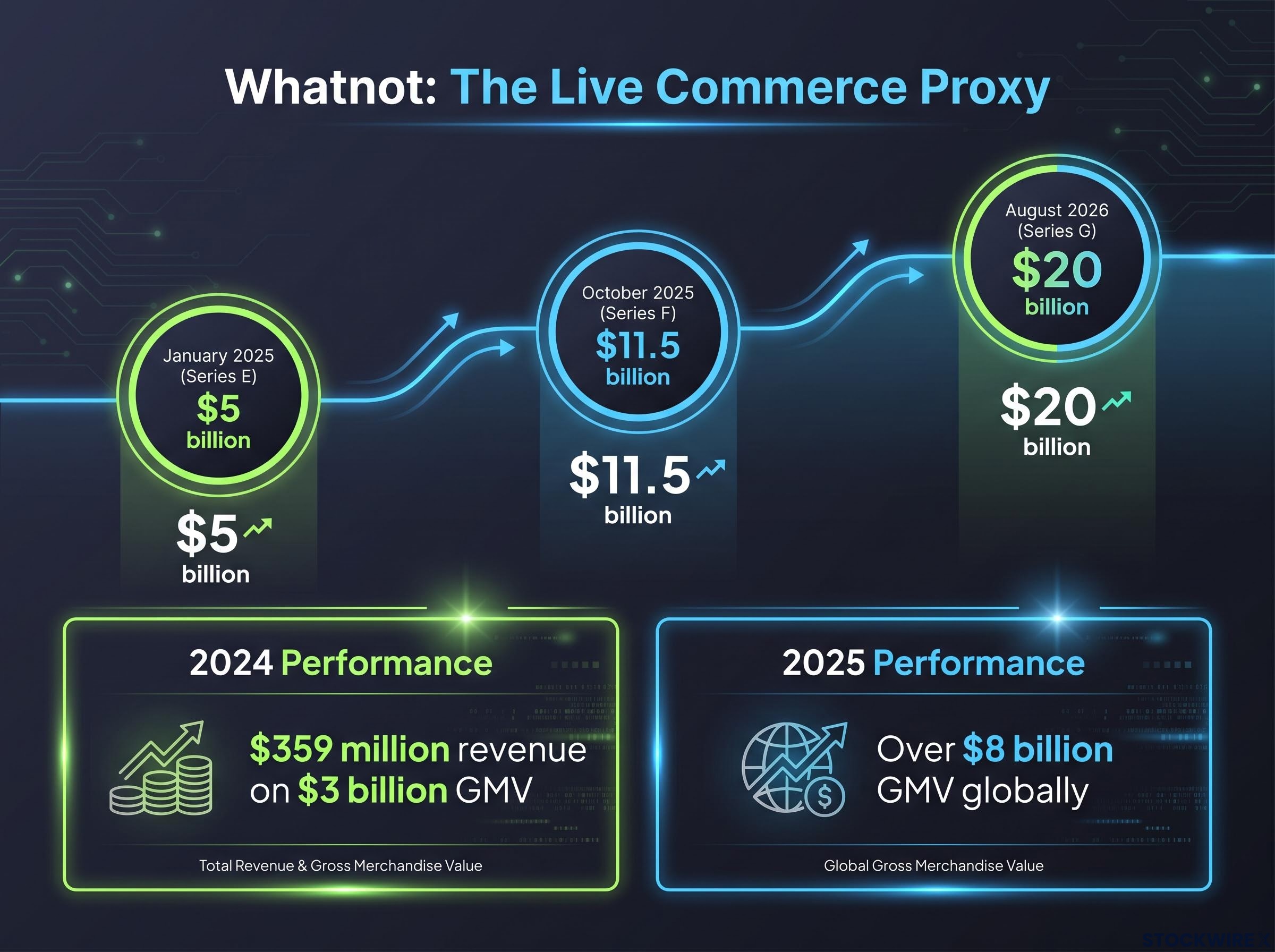
Analyst firm Sacra estimated Whatnot generated $359 million in revenue during 2024 on $3 billion in GMV, which implies a take rate of roughly 12%. That positions the platform comparably to established marketplace models, not to subsidy-driven growth engines that buy volume with discounted fees.
The signal sharpens with scale. Whatnot reportedly drove over $8 billion in GMV globally in 2025, roughly doubling year on year. A 12% take rate sustained through that kind of expansion tells you the platform is not purchasing growth by giving margin away, and for investors assessing the category, that durability matters more than any valuation headline.
Marketplace take rate dynamics across Latin American e-commerce, where MercadoLibre sustains fintech and logistics investment while maintaining revenue growth above 49% year-on-year, offer a useful comparator for evaluating whether Whatnot’s 12% take rate will compress or hold as the platform scales into new verticals.
From platform economics to seller formation
The seller side is where the commercial logic becomes tangible. Whatnot’s largest individual seller is estimated to generate well over $100 million in annual platform revenue, with several operators working at nine-figure scale.
One of those seller operations reportedly grew from a team of three to four people into an organisation of roughly 150 to 200 employees. That is not a side hustle. That is business formation, and business formation at that scale generates ancillary commercial demand for inventory, staffing, logistics, and software that did not exist three years ago.
Institutional capital has read the same signal in the funding arc.
- Series E (January 2025): approximately $5 billion valuation, co-led by DST Global and Avra
- Series F (October 2025): $11.5 billion valuation, more than doubling the prior round
- Series G (August 2026): reported at $20 billion with ICONIQ, Lightspeed, and Avra participation
The Series G figures were reported by CNBC and remain unconfirmed at the time of writing, so treat the $20 billion as a reported number pending verification. Even discounting it, the arc from roughly $5 billion to $11.5 billion inside a single year reflects institutional conviction in the category, not merely in the company. Whatnot is the proxy; the valuation is a vote on live commerce itself.
The ecosystem building around live commerce
Here is the part most headline coverage misses. Live commerce is not a single platform bet. It is a layered commercial system, and the investment surface area is considerably wider than the platform valuations suggest.
Two infrastructure categories have emerged around platforms like Whatnot. The first is wholesale supply marketplaces, which serve live sellers who need inventory at scale. The second is multi-channel networks (MCNs), businesses that aggregate and manage sellers across platforms, much the way MCNs formed around YouTube once that platform reached scale.
Institutional capital is backing the full stack, not just the platforms.
The MCN formation pattern playing out in Western live commerce has a direct parallel in Southeast Asia, where creator commerce infrastructure is consolidating around unified marketplace interfaces connecting sellers to Shopee and Lazada simultaneously, a structural model that mirrors the multi-channel aggregation dynamic emerging around Whatnot.
- Abound: $36.7 million Series B, a curated wholesale marketplace connecting brands and retailers
- Tilt: $18 million Series A in Q3 2024, led by Balderton Capital, a fashion resale live app
- CommentSold: growth investment from Permira, SaaS enabling boutique live selling
- Dachui Culture: $7.03 million, host training and live selling tools
For a reader considering where to participate, this layer is where the early-mover advantage is least crowded. The platforms already carry valuations in the tens of billions. The infrastructure serving them has only begun attracting serious institutional capital, which means entry points here do not require direct exposure to platform valuation risk.
What the brand case studies actually demonstrate
The infrastructure thesis only holds if live commerce produces repeatable outcomes. It does, across categories, platforms, and geographies.
| Brand | Platform / format | Outcome | Timeframe |
|---|---|---|---|
| Tarte Cosmetics | TikTok Shop | $15.33M weekend sales; $105M cumulative revenue | Black Friday 2024 to March 2025 |
| Charlotte Tilbury | Retailer live events | 37% conversion rate | Live shopping events |
| PatBO | Retailer channel | 300% sales increase; 79% higher AOV | Single event, NYFW 2024 |
| Lucchese | One-to-one live | 29.7% conversion; 62% higher AOV | Website consultations |
| Adidas | Shoppable livestream | Incremental €30,000 | Under two hours |
These are not anecdotes. They are evidence of repeatability: cosmetics, apparel, luxury footwear, sportswear, spanning the US, Europe, and Brazil, all pointing the same direction. Charlotte Tilbury’s 37% conversion rate and Lucchese’s 29.7% both sit far above what static e-commerce product pages typically achieve. That conversion gap is the structural argument for the format’s durability, and it is what makes the ecosystem worth building into.
Where the structural thesis is genuinely tested
Treating the West as a guaranteed replica of China is the mistake to avoid. The question of whether Western live commerce reaches China’s penetration or plateaus far lower is not settled, and anyone underwriting it as settled is betting on assumptions the evidence does not yet support.
The structural gap is real and partly historical. China’s scaling ran on conditions Western markets do not share.
- Consumer trust and retention. A 2023 McKinsey report found 57% of Chinese live-commerce users had used the format for over three years, while over 78% of users in the US, Europe, and Latin America were entirely first-time participants. The West has not yet proven it can retain and convert an audience at scale.
- Platform fragmentation versus super-app concentration. Publicis commerce strategist Jason Goldberg noted that US live streaming has lagged because Western consumers shop across many separate sites rather than within super-apps, whereas China’s Alipay and WeChat Pay enabled seamless in-app checkout years earlier.
- Regulatory compliance cost. The EU Digital Services Act, fully enforced for platforms in February 2024, mandates professional seller verification and prohibits manipulative dark patterns, adding compliance overhead. US FTC oversight creates ongoing conduct risk for platforms at scale.
Platform regulatory conduct risk extends well beyond live commerce compliance overhead: the litigation cycle now targeting Meta, Snap, and TikTok over engagement mechanics and age verification requirements is generating injunctive relief that could structurally constrain the same social platforms live commerce depends on for native checkout distribution.
Trust is not only a regulatory footnote; it is a commercial variable. Hong Kong’s Consumer Council reported a 2025 surge in livestream clearance scams where buyers paid into personal accounts and never received goods. Counterfeiting remains a concern in cosmetics and electronics, and consumer advocates have criticised manipulative design tactics like artificial scarcity and rapid bidding. TikTok has reportedly invested close to $1 billion in abuse prevention, an unconfirmed figure, but analysts warn platform-level safeguards do not equal item-by-item authentication.
The maturity gap, in one number As recently as 2023, over 78% of Western live commerce users were first-time participants, against 57% of Chinese users with more than three years of experience.
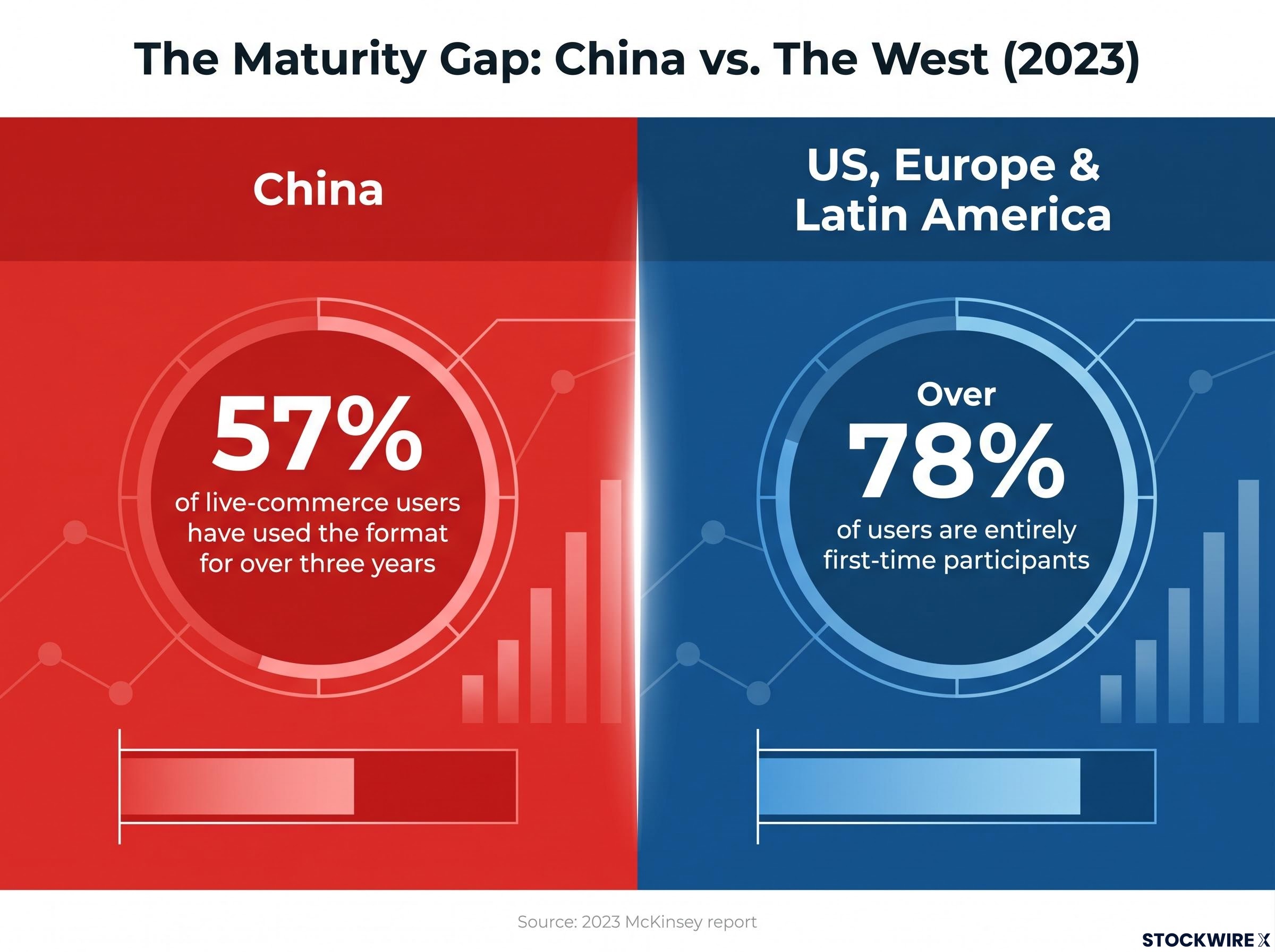
That maturity gap is the single most important data point here. If most Western users are still on their first live purchase, the category has not proven retention, and the next two to three years will run exactly that test. Understanding which specific conditions made China’s path possible lets you assess with more precision whether the West is on a parallel trajectory or a shallower one, which is the key variable in any five-year commercial or investment decision.
Reading the signals before the category matures
So the honest output here is not a verdict. It is a framework, built around the observable evidence that would confirm acceleration toward the China benchmark or divergence away from it.
Accelerating adoption would look like deepening native checkout integration on TikTok and Instagram, sustained GMV doubling at Whatnot, and MCN ecosystem formation gathering pace. NIQ noted in July 2026 that Western platforms are successfully replicating Asian models into mainstream retail components, which is early confirmation of that path. A cyclical plateau would look different: slowing repeat purchase rates, mounting fraud headlines, and regulatory friction concentrating in the EU.
Watch these signals specifically:
- Native checkout completion rates on Instagram and TikTok
- Whether Whatnot sustains its GMV doubling beyond the $3 billion to $8 billion run it posted from 2024 to 2025
- Formation and funding pace within the MCN and wholesale supply layer
- Repeat purchase and retention rates among first-time Western live shoppers
- Whether North America tracks toward Next Move’s projected 28.4% CAGR
Timing across the capital stack matters too. The wholesale marketplace and SaaS infrastructure rounds are earlier-stage and less richly valued than platform exposure, carrying a different risk and return profile for anyone evaluating where to enter.
Here is the frame that should anchor your thinking. The fundamental commercial argument does not depend on the West matching China. Live video converts at substantially higher rates than static product pages, evidenced by Charlotte Tilbury’s 37% and Lucchese’s 29.7%. As long as that conversion advantage holds, the incentive for platforms, brands, and investors to build into the format is structurally persistent, whatever penetration ceiling the West ultimately reaches.
This article is for informational purposes only and should not be considered financial advice. Investors should conduct their own research and consult with financial professionals before making investment decisions. Past performance does not guarantee future results. Financial projections are subject to market conditions and various risk factors. Several figures referenced, including valuation and funding data, are reported but unconfirmed at the time of writing and remain speculative pending verification.