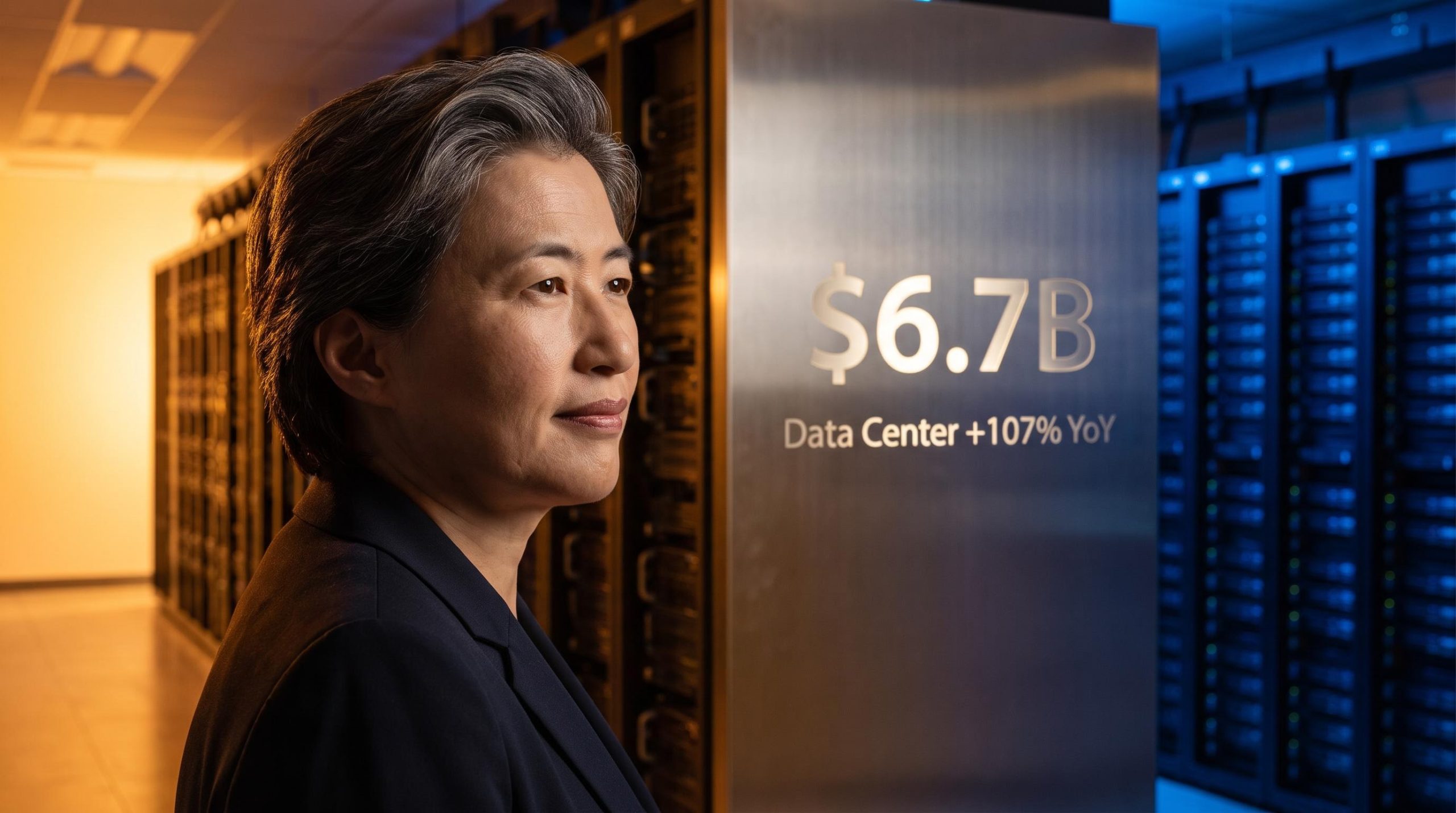
AMD’s data center segment grew 107% year over year in Q2 2026, generating $6.7 billion in a single quarter and accounting for 58% of the company’s total revenue. That figure would have looked implausible to anyone who knew AMD only as the maker of cheaper alternatives to Intel and Nvidia chips.
This is not a momentum story dressed up as a fundamental thesis. Under CEO Dr Lisa Su, AMD has repositioned itself as the primary alternative infrastructure provider for enterprise AI compute and server CPUs.
The question for anyone weighing an AMD long-term investment is whether that repositioning is durable, how much of it the market has already priced in, and what a realistic multi-year path actually looks like.
What you get here is a structured framework for evaluating AMD as a long-term holding: the evidence for the structural growth case, the honest competitive constraints, the bear case arguments that deserve real weight, and the financial projections Wall Street is currently pricing against. This is a framework for a decision, not a recommendation.
What the data center numbers actually tell you about AMD’s business transformation
Start with the sequence, because the sequence is the story.
In Q1 2026, AMD’s data center segment generated $5.8 billion, up 57% year over year. One quarter later, that same segment produced $6.7 billion, up 107% year over year. The growth rate did not just hold. It nearly doubled.
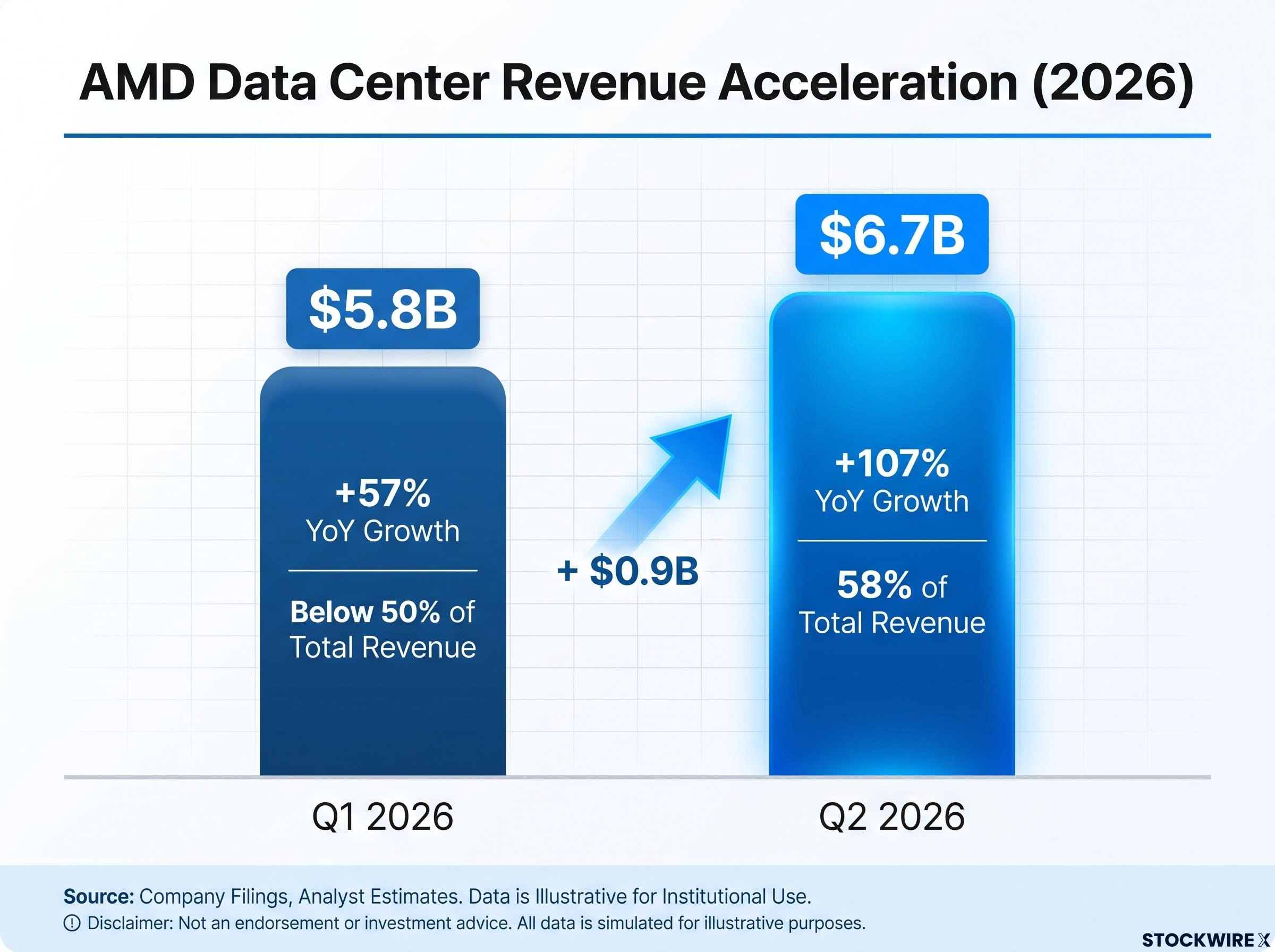
AMD Q2 2026 data center revenue: $6.7 billion, up 107% year over year
That kind of sequential acceleration is the signal that separates genuine demand pull from inventory restocking. When a segment moves from 57% to 107% growth in a single quarter, driven by EPYC server processors and the continued ramp of Instinct GPU shipments, you are not looking at a business filling channel inventory. You are looking at one struggling to keep up with orders.
AMD’s official Q2 2026 earnings results confirm data center segment revenue of $6.7 billion, representing 58% of total company revenue for the quarter, with the 107% year-over-year growth rate disclosed in the accompanying 10-Q SEC filing.
| Metric | Q1 2026 | Q2 2026 |
|---|---|---|
| Data Center Revenue ($B) | $5.8B | $6.7B |
| YoY Growth (%) | +57% | +107% |
| Share of Total Revenue (%) | Below 50% | 58% |
The 58% revenue-share figure is the structural proof point. When a segment crosses more than half of total company revenue while growing at triple-digit rates, the investment question changes shape. This is no longer a gaming chip company with a server side business. Enterprise AI cluster order backlogs are reportedly growing at triple-digit compound annual rates, supported by multi-billion dollar hardware agreements with hyperscalers.
For you, that distinction matters. The thesis has moved from “bet on future execution” to “evaluate a business already in the middle of its transformation.” That materially changes how you frame the risk.
AMD’s own long-term targets and what they require
AMD has set out its forward numbers explicitly, and these are the company’s projections, not analyst consensus.
AMD is targeting $120 billion in server CPU income by 2030 and aims to double data center revenue by 2027, tied to a projected $220 billion server market, according to DataCenterDynamics and TS2.tech coverage.
Hold those targets with appropriate scepticism. Both depend on continued EPYC share gains from Intel and on that $220 billion server market materialising as projected. If share gains slow or overall server spending undershoots, the targets could prove optimistic. The recent numbers are real. The forward numbers are ambition anchored to assumptions you should test rather than accept.
When big ASX news breaks, our subscribers know first
The Instinct GPU roadmap and the ROCm question that determines AMD’s AI ceiling
AMD’s accelerator hardware is not vaporware, and the customer list proves it.
By the end of 2025, AMD had shipped meaningful volumes of MI300X-class accelerators into production environments at real scale. The MI350 series followed, with DataCenterKnowledge reporting up to 3x AI training and inference performance versus MI300 in June 2025, and production shipments beginning in July 2026 per DataCenterDynamics. The MI350X uses CDNA 4 architecture on TSMC’s 3nm process with up to 288 GB of HBM3E memory. The MI400 (“CDNA Next”) is targeted for 2026, alongside the Helios rack-scale system.
| Product | Architecture | Process Node | Key Spec | Availability |
|---|---|---|---|---|
| MI325X | CDNA 3 refresh | Not disclosed | Refresh generation | 2024 |
| MI350X / MI355X | CDNA 4 | TSMC 3nm | Up to 288 GB HBM3E | 2025-2026 |
| MI400 (CDNA Next) | CDNA Next | Not disclosed | Next-gen accelerator | 2026 |
| Helios (rack-scale) | Rack-scale system | Not disclosed | Full-rack AI infrastructure | 2026+ |
The confirmed customers are the credibility anchor:
- Microsoft Azure: ND MI300X v5 instances generally available, running Copilot inference workloads
- Meta: Llama training and inference on MI300X clusters, plus recommendation and content-ranking inference
- OpenAI: MI300X deployments confirmed
- Oracle Cloud Infrastructure: Among the first cloud providers to offer MI300X-based shapes
- CoreWeave and Crusoe: AI-specialist cloud providers running MI300X at volume
That list tells you the hardware performs at scale in production. Now look at what the list shares, because that is where the ceiling sits.
Why the ROCm gap matters more than the hardware specs
Every one of AMD’s largest deployments belongs to a hyperscaler with significant in-house engineering capacity. That is not a coincidence.
Nvidia still commands an estimated 80-85% of AI accelerator market share, and the structural weight of that position shapes how every AMD GPU deployment is priced, contracted, and benchmarked by hyperscalers evaluating multi-vendor infrastructure strategies.
The reason, as Vaasblock argued in June 2026, is ROCm. AMD’s software stack, ROCm, is the equivalent of Nvidia’s CUDA, the software layer that lets developers program the chips. ROCm remains less mature than CUDA, which has become the default across the industry. Hyperscalers can compensate by investing heavily in internal ROCm optimisation. Mainstream enterprises cannot.
This is the single most important variable in the thesis. ROCm can close the performance gap for sophisticated customers who throw engineering resources at it, but it does not yet offer the plug-and-play accessibility that CUDA gives general enterprise workloads.
What that means for you is direct: AMD’s AI accelerator addressable market is currently gated by software ecosystem maturity, not by hardware performance. Whether you believe the long-term thesis depends primarily on how you assess AMD’s ability to close that gap. The MI400 and Helios generations are where that ecosystem investment has to show commercial results beyond the hyperscaler set. Until it does, AMD’s AI GPU revenue stays a hyperscaler-dependent story with limited self-sustaining demand across the broader market.
What Wall Street is pricing in, and where the bear case has genuine force
The consensus tells you what the market currently believes. Read it as a calibration tool, not a prediction.
As of mid-September 2026, twelve-month price targets cluster in the mid-$500s to mid-$600s.
| Source | Average Target | Analyst Count | Date |
|---|---|---|---|
| Zacks | $625 | 42 analysts | 18 Sept 2026 |
| Investing.com | $616.51 | 50 analysts | 18 Sept 2026 |
| MarketWatch | $627.63 (median $620) | Not disclosed | 10 Sept 2026 |
| MarketBeat | $553.72 (Moderate Buy) | 46 analysts | 4 Sept 2026 |
| Public.com | $561.45 | Not disclosed | 18 Sept 2026 |
Named actions reinforce the bullish drift. Raymond James analyst Simon Leopold upgraded AMD from Outperform to Strong Buy on 25 August 2026, raising his target to $641, roughly 40% upside at the time. Earlier, on 13 January 2026, KeyBanc’s John Vinh upgraded to Overweight at $270, citing sold-out server CPUs and strong hyperscaler demand.
The longer-term projections in the research stretch further: a three-year consensus range of $850-$975 and a five-year projection above $1,100, each contingent on continued EPYC dominance, PS6 production, and hyperscaler demand.
Here is the signal that matters most.
Reuters reported on 4 August 2026 that AMD’s AI revenue forecast “fails to wow investors,” despite data center revenue more than doubling.
A 107% growth print that fails to move the stock tells you the market has already embedded an aggressive forward trajectory into the valuation. For a long-term buyer, that means your entry point has to leave enough margin of safety for execution risk across the MI400, Helios, and EPYC roadmaps at the same time.
AMD valuation models from Evercore ISI and Barron’s converged on a mid-case fair value near $175 when AMD was trading at $424, a gap that illustrates how aggressively the market was pricing forward execution even before the Q2 2026 data center acceleration printed.
Now weigh the bear case with equal seriousness. Ordered from most structurally threatening to most cyclical:
- ROCm ecosystem failure. If ROCm never reaches mainstream enterprises, AMD’s AI accelerator market stays capped at the hyperscaler set. This is the argument that could invalidate the thesis outright.
- EPYC market-share ceiling. The $120 billion and doubling-by-2027 targets both assume continued share gains from Intel that may not materialise.
- Export-control exposure. US-China technology restrictions, flagged repeatedly by Capital.com, could compress the addressable market for high-end accelerators.
- Hyperscaler customer concentration. Revenue leans on Microsoft, Meta, OpenAI, and Oracle, leaving the thesis exposed to shifts in their capex priorities.
- Valuation and AI capex cyclicality. Rich multiples depend on continued AI enthusiasm, and a cooling capex cycle could trigger a re-rating.
The gap between a $625 consensus target and an $1,100 five-year projection is not free upside. It is a stack of assumptions that all have to be true at once, and knowing which of them is most fragile is the work that separates a position from a speculation.
Semiconductor valuation discipline has shifted materially in 2026: TSMC posted its most profitable quarter in history and its shares fell on earnings day, confirming that the market is now interrogating whether AI earnings growth justifies prices already paid rather than rewarding beats automatically.
The Sony PS6 contract and the multi-segment revenue visibility case
Most investors caught up in the AI infrastructure narrative overlook the part of AMD’s thesis that makes it more durable, not less.
AMD secured an exclusive custom silicon contract for Sony’s PlayStation 6, extending the relationship that already covered the PS5 and Xbox Series X. According to the source material underpinning the long-term thesis, that contract is expected to deliver recurring high-margin revenue over roughly a 7-10 year period, independent of consumer hardware upgrade cycles and independent of hyperscaler spending trends.
One honest caveat. The existence and strategic logic of the PS6 contract is confirmed in the original source, but specific financial terms, margin profile, and production timeline were not independently corroborated in institutional web research. Treat the strategic logic as established and the precise financial detail as a thesis-builder’s projection rather than verified fact.
What the contract represents is a third leg. AMD’s revenue visibility now spans three distinct segments:
The Meta chip supply agreement, a five-year $60 billion commitment covering MI300X and MI325X shipments beginning H2 2026, is the most concrete evidence that hyperscaler demand is contractually anchored rather than quarter-to-quarter discretionary, a distinction that materially changes how you should interpret revenue visibility across the Instinct GPU line.
- Enterprise AI compute: Instinct GPUs, long-term visibility, tied to the AI capex cycle
- Server CPUs: EPYC processors, medium-term to long-term visibility, established hyperscaler penetration
- Gaming and semi-custom silicon: PS6 and Xbox continuation, near-term to long-term visibility, contracted cash flow
For you, the PS6 contract matters less for its standalone revenue and more for what it does to earnings stability. It provides a recurring cash flow stream that can cushion the business during any period when AI infrastructure capex normalises or GPU roadmap execution hits friction.
Why multi-segment revenue visibility changes the risk calculation
The danger in any single-thesis investment is that when the central driver slows, nothing is left to soften the re-rating.
That is the whole point of the three-segment argument. AMD’s case is that it is not a pure-play AI trade but a diversified infrastructure company whose revenue streams peak and trough at different points in the cycle.
Investors who value AMD only through its AI GPU narrative are mispricing the earnings floor. The EPYC server CPU business alone, entirely separate from any Instinct GPU upside, already represents a defensible market position with strong hyperscaler penetration. Add locked-in gaming silicon revenue on top, and the downside case looks less like a cliff and more like a slope.
Making an informed call on AMD as a long-term position
The four analytical layers do not resolve into a single verdict, and they should not.
The structural transformation is not in question. A 58% data center revenue share growing at 107% year over year already validates that the business change is real, regardless of whether the more aggressive projections play out. What is in question is the pace and the price.
Consensus twelve-month targets sit near $620-$625, which tells you the market has already embedded a substantial re-rating. The three-year projection of $850-$975 and the five-year projection above $1,100 are the bull case destination, and each rests on a full stack of assumptions coming good together. Your decision hinges on whether current entry valuations leave enough room for roadmap friction without triggering a material re-rating.
You do not need to believe the $1,100 five-year projection to hold AMD long term. You need to believe three things: that the revenue-composition shift is durable, that ROCm matures enough to reach beyond hyperscalers within the MI400 window, and that multi-segment revenue provides enough of an earnings floor to absorb friction in any one segment.
Here are the observable signals worth monitoring over the next 12 to 24 months:
- ROCm adoption spreading beyond hyperscalers into mainstream enterprise
- MI400 and Helios ramp timing, and the breadth of the customer base it attracts
- EPYC server CPU share trajectory against Intel
- AI capex trends specifically at Microsoft, Meta, and Oracle
The ROCm ecosystem maturation timeline is the single variable with the most binary impact on whether AMD’s AI accelerator narrative extends from hyperscalers to mainstream enterprise. Watch it more closely than any quarterly print.
This article is for informational purposes only and should not be considered financial advice. Investors should conduct their own research and consult with financial professionals before making investment decisions. Past performance does not guarantee future results. Financial projections are subject to market conditions and various risk factors, and forward-looking statements are speculative and subject to change based on market developments and company performance.