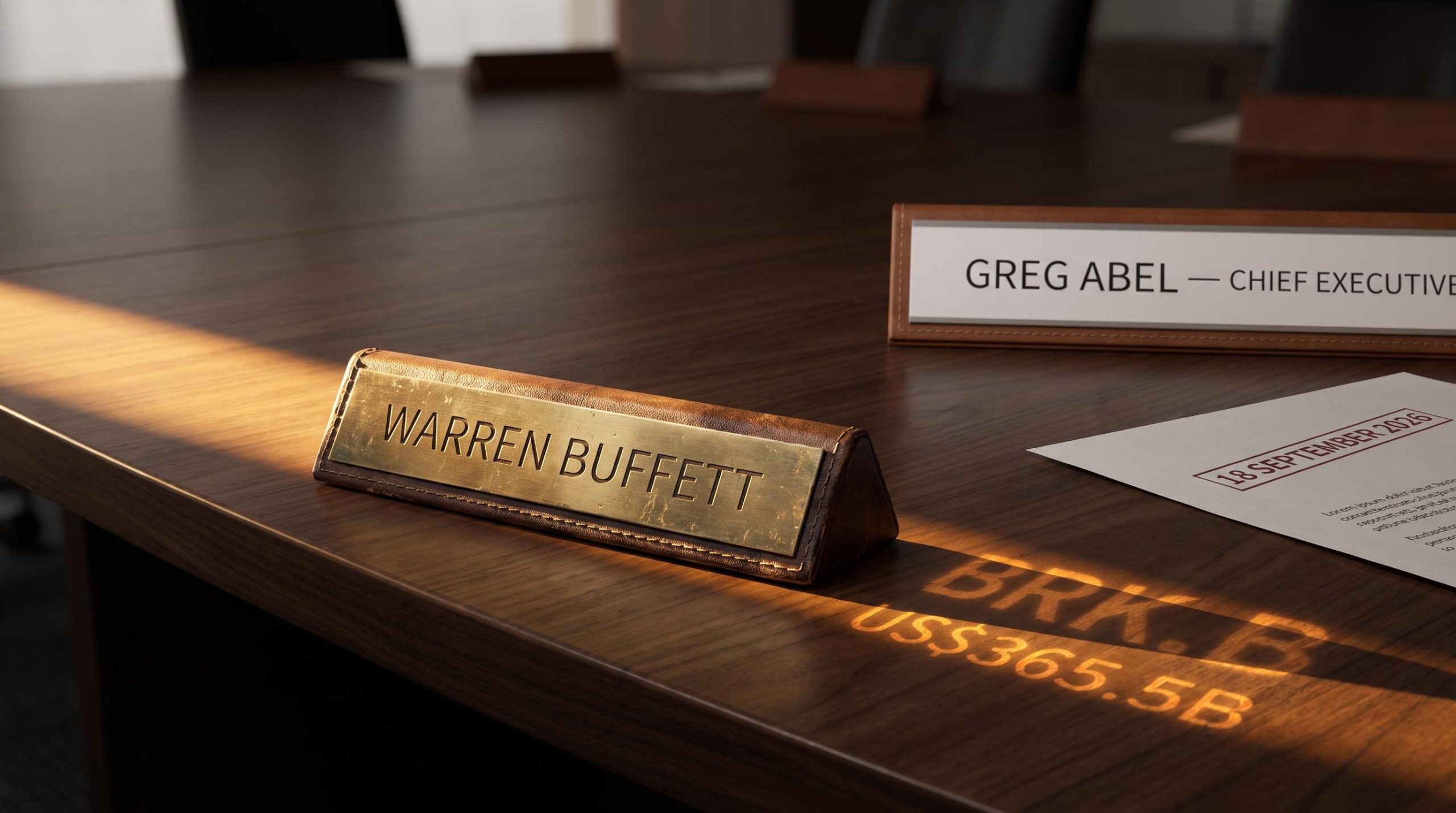
Warren Buffett formally gave up the Berkshire Hathaway chairmanship on 18 September 2026, ending a six-decade grip on one of the most powerful seats in American corporate history and passing the title to his son Howard while Greg Abel continues to run the business day to day.
The move closes a succession process years in the making. It arrives with Berkshire’s stock trailing the S&P 500 by roughly 10-12 percentage points so far this year, and with the company sitting on a US$365.5 billion cash reserve that no single person now controls the way Buffett once did.
For anyone holding BRK.B, or weighing whether to, the transition raises immediate and practical questions: who is making capital decisions now, on what terms, and under whose oversight?
Here is what the handover actually changes about how Berkshire will be run from this point. You will come away knowing who holds what authority, why the stock has lagged, and what the cash pile and Abel’s recent deployment signal about where the company is headed.
Who now runs Berkshire Hathaway, and what each role actually means
Berkshire did not replace one man with another. It split his authority into three.
That distinction matters more than the headlines suggest. Under the new structure, Greg Abel holds the operational and capital-allocation power as chief executive officer. Howard G. Buffett, a Berkshire director since 1993, becomes non-executive chairman with a mandate limited to culture and values. Susan L. Decker continues as lead independent director, representing board-level oversight.
Berkshire’s own news release dated 18 September 2026 confirmed Howard’s election as chairman and Decker’s continuation in her role.
| Role | Person | Primary mandate |
|---|---|---|
| Chief Executive Officer | Greg Abel | Operations, capital allocation, subsidiary oversight, day-to-day decisions |
| Non-executive Chairman | Howard G. Buffett | Guarding Berkshire’s culture and values, no operational or strategic authority |
| Lead Independent Director | Susan L. Decker | Board oversight, shareholder representation, independence check |
The read for you is straightforward. Anyone expecting a clean one-for-one replacement of Buffett needs to adjust: power is now distributed, and that design has consequences for how quickly Berkshire can move on large capital decisions and who answers if strategy drifts.
Howard’s role in Berkshire’s own words
Warren Buffett spelled this out long before the transition happened. In public statements dating back to a 2011 CNNMoney interview and appearances on 60 Minutes, he described Howard’s future job as non-executive chairman and “custodian of the values,” explicitly not involved in strategy, investments, or daily management.
He framed it as an “insurance policy” for the company’s culture, a safeguard shareholders hope never has to be used.
What was announced on 18 September is exactly that blueprint coming into force. This was not a sudden decision. It was the completion of a plan Buffett had publicly sketched years earlier, which tells you the family expects continuity by design, not by luck.
When big ASX news breaks, our subscribers know first
Why Berkshire’s stock has lagged the S&P 500 by more than 10 points this year
The gap is stark, and it deserves emphasis before the explanation.
BRK.B versus the S&P 500, year-to-date +1.39% versus +12.71% as of 20 September 2026
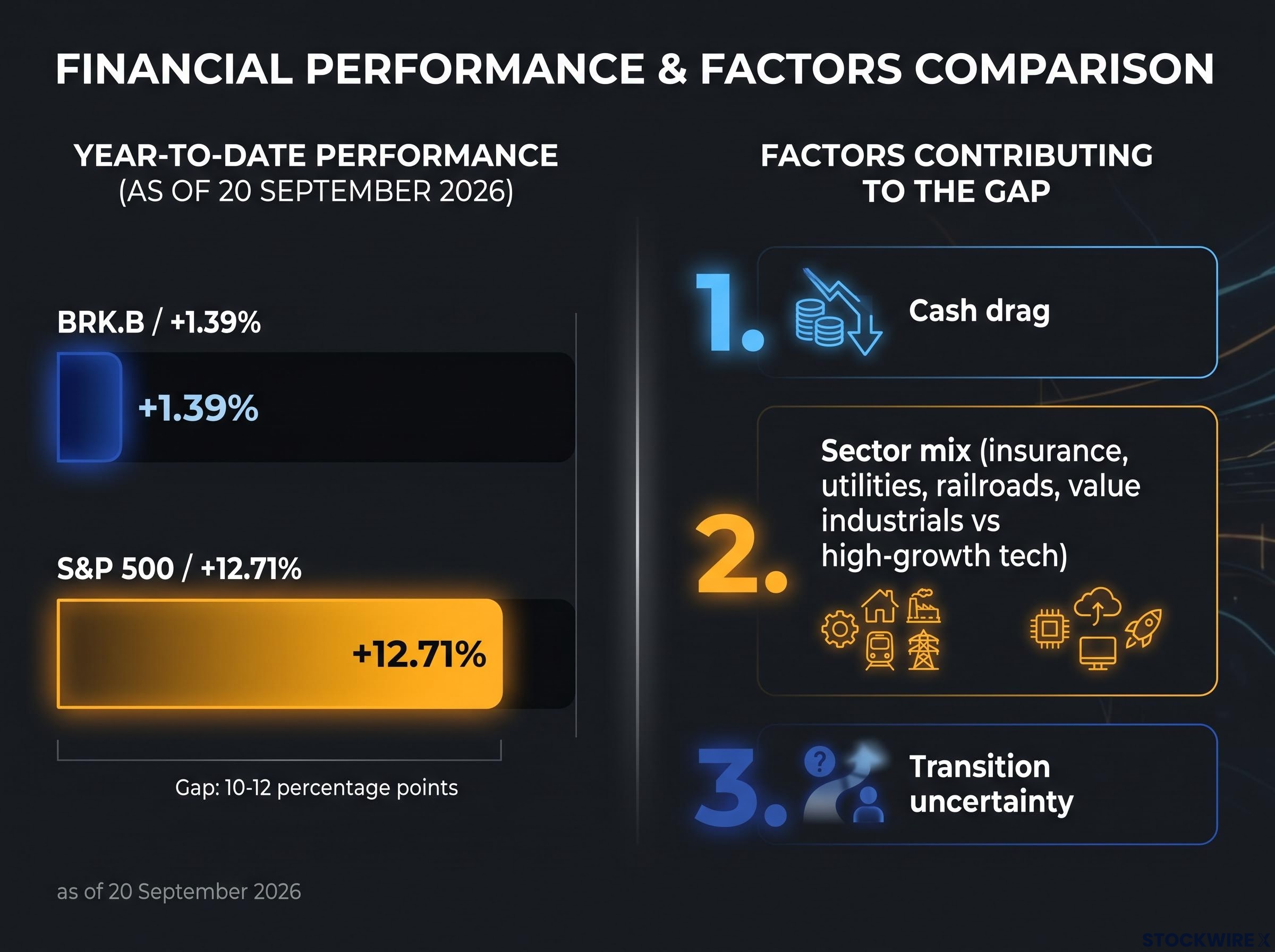
Three factors, in order of weight, explain the shortfall:
- Cash drag: a huge slice of the balance sheet earns modest short-term yields
- Sector mix: heavy exposure to insurance, utilities, railroads and value industrials, light on high-growth technology
- Transition uncertainty: a contested, sentiment-driven factor rather than an established one
Start with the cash. With US$365.5 billion in cash and short-term Treasuries as of 30 June 2026, more than a third of a trillion dollars sat in near-cash instruments earning short-term rates while equity markets rallied. That capital simply did not participate in the gains, and on a business this size the drag is real.
The cash drag on returns is not simply a portfolio construction choice; it reflects three simultaneous market valuation signals that Abel inherited alongside the CEO role, including a Buffett Indicator reading above 226% and a Treasury yield that outpaced the S&P 500 earnings yield through most of Q1 2026.
Then the sector mix. Berkshire’s weighting toward insurance, regulated utilities, railroads and value-oriented industrials left it structurally underexposed to the technology and high-growth names that drove S&P 500 records this year. Even where individual portfolio holdings performed well, the cash and operating businesses were the anchor.
The third factor is softer. Technical analysts at 22V Research flagged weakening relative momentum, with Berkshire’s edge over the index reverting toward levels last seen around 2007. A Yahoo Finance piece citing Michael Burry argued that Berkshire has “lost its ‘attractive’ tag.” Treat this as commentary on sentiment, not settled fact.
Here is what the gap tells you. The lag says more about the mechanics of carrying US$365 billion in cash during a growth rally than about management failure. The open question is whether the sentiment discount narrows now that the formal handover is done.
What Greg Abel has done with Berkshire’s cash pile, and what it signals
Something has already shifted under Abel, and the numbers show it.
Berkshire’s cash and Treasuries peaked at roughly US$397.4 billion in the first quarter of 2026, a record. By 30 June 2026 the figure had fallen to US$365.5 billion, a drawdown that reflects Abel putting capital to work after a long stretch of restraint.
The Q2 buyback surge to $4.53 billion, nearly 20 times the $234 million repurchased in Q1, was accompanied by Berkshire becoming a net buyer of public equities for the first time in 11 quarters, running all three deployment channels simultaneously.
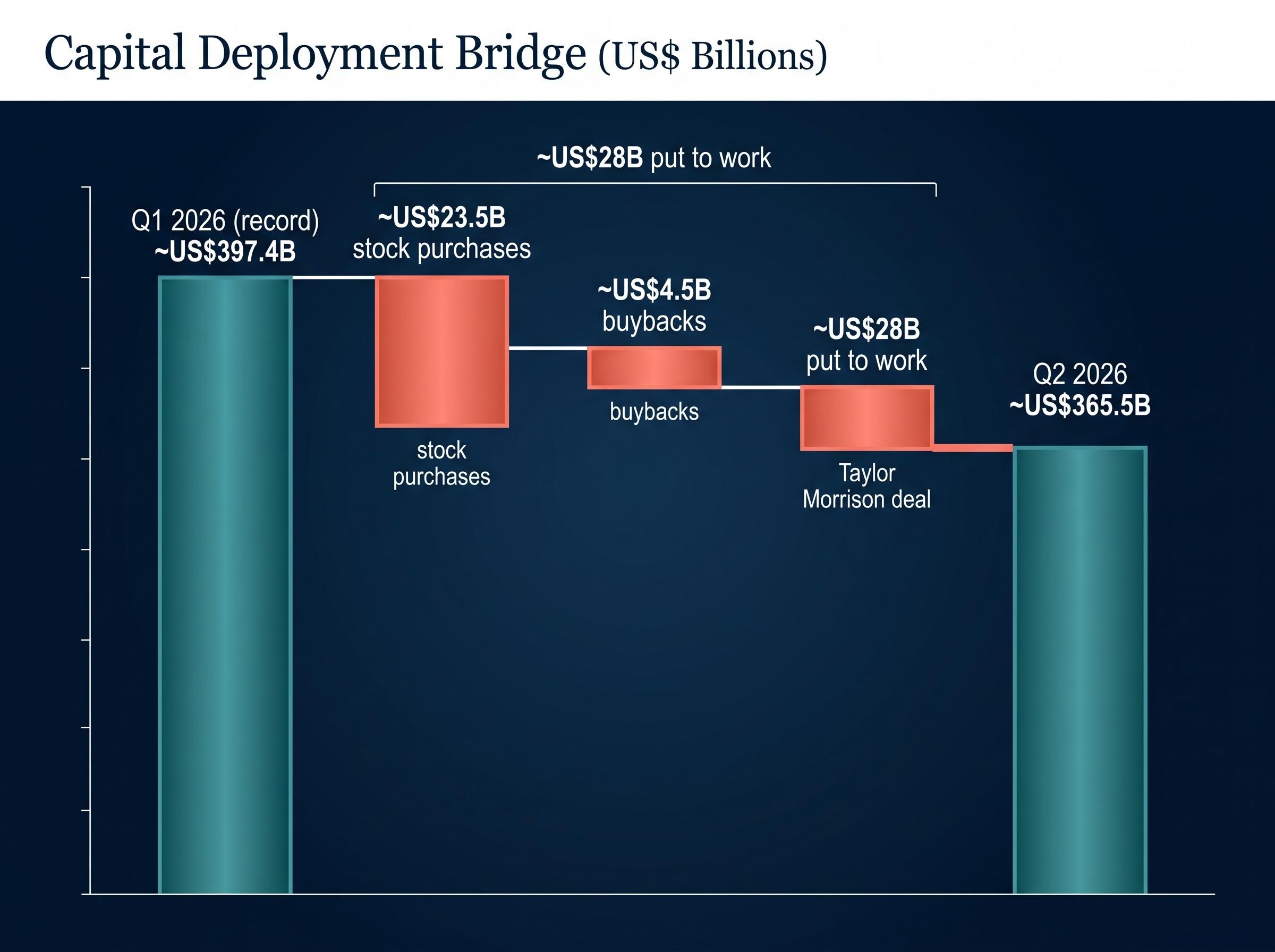
| Period | Cash and Treasuries | Key activity |
|---|---|---|
| Q1 2026 (record) | ~US$397.4B | High-water mark, minimal deployment |
| Q2 2026 | ~US$365.5B | Post-deployment, stock purchases and buybacks |
| Q2 2026 deployment | ~US$28B put to work | ~US$23.5B stock purchases, ~US$4.5B buybacks, Taylor Morrison deal |
Abel’s stated philosophy tracks Buffett’s closely. He has reaffirmed that buybacks happen only when shares trade below a conservatively estimated intrinsic value, that no dividend will be paid while each retained dollar is expected to create at least a dollar of market value, and that the conglomerate stays intact.
On the last point, he was blunt.
On breaking up Berkshire “Absolutely not,” Abel said when asked whether he would split the company, defending the decentralised, autonomous subsidiary model.
The reactions are mixed but broadly supportive. Robert Hagstrom, chief investment officer at EquityCompass and author of The Warren Buffett Way, called Abel “not only the right guy” but “the right guy at the right time.” Andrew Bary of Barron’s graded him a “B-plus,” flagging the limited scale of early buybacks as an area needing improvement.
What this deployment pattern tells you is that Abel is not sitting still. But the US$365.5 billion still on the balance sheet means the market has not yet seen the defining capital decision of his era. His early moves point to discipline rather than urgency, and that cash remains both the biggest drag on near-term returns and the largest source of upside if a big deployment lands well.
What the historical record on founder succession says about what comes next
Move from today’s facts to the odds, and the succession literature is reassuring on one point and demanding on another.
McKinsey’s February 2026 analysis of family-business CEO succession identifies a “family to nonfamily executive” archetype, with examples including Acciona, Gerdau and Dabur. Effective transitions in this model typically unfold over eight to fifteen years of gradual responsibility transfer. Berkshire has already completed that phase; Abel was identified and groomed over more than a decade.
Governance scholars have described Berkshire’s split of capital allocation, portfolio management and the board chairmanship across distinct people as a deliberate multi-role architecture, built to reduce single-point-of-failure risk. One analysis frames Howard’s chairmanship as an “insurance policy” shareholders hope never needs to be exercised.
The market itself treated the news calmly. Berkshire shares were marginally lower in the immediate aftermath, consistent with an orderly event rather than a shock.
What the precedent tells you is that Berkshire did the preparation correctly. The variable that decides success is not the governance chart. It is whether Abel can sustain Buffett-style capital-allocation discipline over a five-to-ten-year window, measured in results rather than weeks.
What investors should actually watch from here
Keep the checklist tight and concrete:
- The size and quality of capital deployments under Abel, especially the first large-scale move that draws on the remaining US$365.5 billion
- Operating improvement at underperforming subsidiaries, with BNSF the one Morningstar singled out for room to improve
- Whether the BRK.B underperformance gap narrows as transition uncertainty resolves
Morningstar’s read on Abel so far is that he “stayed conservative,” describing the approach as continuity rather than disruption. For long-term and value-oriented investors, this is not a binary call today. It is a patience question.
What changes at Berkshire from here, and what almost certainly does not
The honest picture separates what is settled from what remains open.
| What stays the same | What is genuinely different |
|---|---|
| Governance: decentralised subsidiary model intact | Single-person accountability replaced by a three-role split |
| Capital philosophy: buyback discipline, no dividend, conglomerate preserved | No individual holds Buffett’s unilateral authority on very large deals |
| Decision framework: intrinsic-value tests unchanged | Distributed power could slow large-scale decisions |
| Long-term ownership ethos confirmed by Abel’s actions | Buffett’s singular communication style is gone |
The structural pieces are confirmed. Abel’s “absolutely not” on breaking up the roughly US$1 trillion conglomerate, his early deployment, and Morningstar’s “stayed conservative” verdict all point to continuity as the base case, not merely the hope.
Abel’s discipline on buybacks and the remaining $365.5 billion in reserves reflects the same patient capital philosophy Buffett applied across six decades, one in which exceptional opportunities arrive roughly once every 10-12 years and the quality of the deployment matters more than its timing.
The underperformance gap is not a verdict. Cash drag is structural and resolves when deployment happens; the sentiment discount may linger longer than the fundamentals justify.
If you stayed the course through the announcement, there is no immediate structural reason to change your thesis. If you are weighing Berkshire now, the question is simpler than it looks: do you believe Abel’s capital-allocation discipline will match Buffett’s over a ten-year horizon?
This article is for informational purposes only and should not be considered financial advice. Investors should conduct their own research and consult with financial professionals before making investment decisions. Past performance does not guarantee future results. Financial projections are subject to market conditions and various risk factors.