Jacob Coxon walked away from four months of unvested Anthropic equity when he resigned in September 2026, publicly warning that frontier AI labs are “racing straight to self-improving superintelligence and gambling with our lives.” When a researcher gives up meaningful personal wealth to sound a safety alarm, the stakes of the regulatory debate now circling AI investment come into sharper focus.
The question of how, or whether, to govern artificial intelligence has stopped being a policy abstraction. It is a live variable in how investors price AI stocks, size infrastructure bets, and model tail risk. The US federal picture remains fragmented: one narrow deepfake law enacted, a broad executive order still operative, voluntary frameworks with no teeth, and dozens of bills stuck in committee.
Into that vacuum, two coherent camps have formed. One holds that market competition and reputational accountability are governors enough. The other argues that voluntary frameworks produce a veneer of responsibility without the liability structures needed to restrain a race dynamic. Here is a working map of both positions, the evidence behind each, and a framework for thinking about what different regulatory outcomes would actually mean for your AI-related holdings and capital allocation.
The market self-regulation argument and what it gets right
Start with the strongest version of the case, because it is more serious than its critics allow. The argument runs that competitive pressure and reputational accountability create natural incentives for firms to avoid catastrophic failures, without any need for prescriptive federal rules. A company that ships an unsafe product loses trust, loses customers, and loses market share. That discipline, proponents say, arrives faster and more precisely than any regulator could.
The Cato Institute put a sharp point on this in a briefing paper dated 16 July 2024, arguing that the real danger to AI is not the technology but the state’s response to it.
The Cato Institute’s framing Government mandates, not artificial intelligence itself, pose the most significant threat to the expressive and innovative potential of AI.
The camp’s favourite cautionary tale is cryptocurrency. In congressional testimony from September 2024, the US Securities and Exchange Commission’s approach to digital assets was described as a “whack-a-mole” enforcement style that stifled innovation and pushed firms offshore. The fear, stated plainly by self-regulation advocates, is that AI becomes the next crypto: capital flight, brain drain, and legal uncertainty without any improvement in actual outcomes.
Why the crypto comparison breaks down
The analogy is intuitive, but it does not hold up cleanly. Wharton researchers Brian Feinstein and Kevin Werbach found no systemic empirical evidence that regulatory measures cause traders or innovators to flee a jurisdiction. Their conclusion cut the other way: tighter regulation can purge bad actors and build market trust.
That finding matters because it directly challenges the empirical foundation of the brain-drain argument. If you are using the crypto analogy to predict how AI regulation plays out, you should know its core premise has been contested by academic research, not merely asserted.
The risk profiles also differ. Crypto poses contained financial risk. Generative AI is threaded into critical infrastructure, productivity systems, and automated decision-making, which means its failures spill far wider. A Nasdaq regulatory roundup dated 24 February 2026 noted that generative AI governance has already moved faster and more clearly toward enforceable expectations than crypto ever did, precisely because those externalities are larger.
When big ASX news breaks, our subscribers know first
What Jacob Coxon’s resignation actually tells investors about insider risk perception
Coxon spent three years doing pretraining research, the foundational work of building large AI models, first at OpenAI and then at Anthropic. He lasted four months at Anthropic before resigning. According to reporting from 9-10 September 2026, he chose to leave before any of his equity vested, judging that his safety concerns outweighed the money on the table.
That sequence is the part worth sitting with. Vesting is the mechanism that keeps talented researchers in place; walking before it triggers is a deliberate forfeiture. He is also reportedly leaving the AI field entirely rather than moving to a rival lab.
In his public statement on X, Coxon did not spare either former employer.
“Neither company is acting responsibly.”
He accused OpenAI staff of failing to internalise the civilisational stakes of their work, and Anthropic staff of being locked in a race to reach advanced AI first. His warning, that frontier labs are “racing straight to self-improving superintelligence and gambling with our lives,” went further, attaching a number to the fear: he estimated a greater than 10% probability that advanced AI could cause catastrophic harm to humanity.
Context matters here. The original commentary framing this debate, from former Congressman Ron Paul, characterised doomsday AI scenarios as fear-based messaging. Coxon’s estimate is a different kind of claim: a specific probability from someone who did the work, not a rhetorical flourish.
An insider choosing financial sacrifice over continuation is a qualitatively different signal from an external critic. For investors assessing governance quality at frontier AI companies, that distinction is the point. Voluntary safety commitments need to be weighed against the possibility that internal race dynamics are already overriding them. Governance quality is becoming a valuation input, and insider departures with explicit safety rationales are a data point due diligence should account for, not dismiss as noise.
Governance quality as a valuation input is particularly acute for OpenAI, where a $1.2 trillion private valuation sits alongside a -122% operating margin, a House Oversight Committee probe, and a delayed IPO, each of which creates a different lens through which safety commitments read as either principled constraint or strategic positioning.
The actual US regulatory landscape, and why its ambiguity is the risk
Advocates on both sides describe a landscape that does not quite exist. The reality is narrower and messier than either camp lets on.
The central federal instrument remains Executive Order 14110, issued on 30 October 2023. It directs agencies to develop safety standards, requires safety test reporting for frontier models under the Defense Production Act, and tasks the National Institute of Standards and Technology (NIST) and the Department of Homeland Security with building security boards.
Below that sits voluntary guidance. NIST released its AI Risk Management Framework 1.0 in January 2023, followed by a Generative AI Profile on 26 July 2024. As of June 2026, NIST confirms this guidance is voluntary, non-certifiable, and non-regulatory. There is no compliance stamp to earn and no penalty for ignoring it.
Only one AI-era federal law has actually been enacted: the TAKE IT DOWN Act, signed in May 2025. It criminalises non-consensual intimate images, explicitly including AI-generated deepfakes, and requires platforms to remove them within 48 hours. Beyond it, dozens of broader cross-sector bills remain stalled in the proposal stage, with no comprehensive statute in sight.
| Instrument | Type | Status | Key obligation |
|---|---|---|---|
| Executive Order 14110 | Executive order | Operative | Frontier model safety test reporting |
| NIST AI RMF 1.0 | Voluntary framework | Non-certifiable | Risk management guidance only |
| NIST Generative AI Profile | Voluntary framework | Non-certifiable | Guidance on generative-specific risks |
| TAKE IT DOWN Act | Enacted law | In force | 48-hour deepfake removal |
The Electronic Privacy Information Center (EPIC) argues this arrangement fails on its own terms. Without measurable compliance and potential liability, voluntary guidelines give AI actors little financial reason to spend on conformity. The frameworks exist; the incentive to follow them does not.
Where regulatory exposure is already live
The practical takeaway for investors is that near-term regulatory risk will not arrive as a single new statute. It will arrive as enforcement actions under laws already on the books.
FTC Chair Lina Khan put it directly on 25 January 2024: “there is no AI exemption from the laws on the books.” The Federal Trade Commission is scrutinising the AI stack, from chips to apps, for monopolistic bottlenecks and fraud risk.
FTC artificial intelligence oversight covers consumer protection, competition, and fraud risk across the AI stack, positioning the Commission as the most active federal enforcer of existing law against AI products in the absence of comprehensive new legislation.
Bloomberg Intelligence, in analysis dated 12 June 2024, expects regulators to enforce existing fair-lending and consumer-protection rules on AI products as the near-term mechanism. For your positioning, that means the exposure is diffuse and unpredictable rather than a single legislative event you can price and prepare for.
How investors are pricing regulatory risk across the two scenarios
Two scenario frameworks are worth holding side by side, because each carries a distinct risk shape.
A heavy-oversight scenario implies higher compliance costs, slower deployment in regulated sectors like finance and healthcare, and constraints on monopolistic business models. The trade-off, per Morgan Stanley reporting through 2026, is potentially lower tail risk and more durable long-term adoption. A light-touch or self-regulation scenario delivers the reverse: near-term valuation uplift from rapid adoption, but under-priced governance risk and exposure to enforcement surprises.
| Dimension | Heavy oversight | Light-touch / self-regulation |
|---|---|---|
| Near-term valuations | Compressed by cost | Uplifted by fast adoption |
| Compliance costs | Higher | Lower |
| Deployment pace (regulated sectors) | Slower | Faster |
| Tail risk | Potentially lower | Under-priced |
| Long-term adoption durability | More durable | Less certain |
Morgan Stanley frames AI policy evolution as a rising macro overlay capable of driving significant technology-stock volatility. A separate Morgan Stanley credit analysis dated 17 September 2026 flags a multi-year AI capex cycle across technology, utilities, and energy that has fuelled a surge in bond issuance and rising leverage.
But the risks that may matter most are not regulatory at all. Analysts increasingly flag execution risks as the primary threat to AI revenue realisation, not a shortfall in demand.
- Local political resistance: A 3 September 2026 analysis warns that community pushback against data centres, over electricity use, water consumption, and quality-of-life disruption, has triggered audits, stricter permitting, and demands that tech firms self-finance infrastructure.
- Elevated capex leverage: The bond-issuance surge tied to the capex cycle raises the sensitivity of AI balance sheets to any deployment delay.
- Geopolitical supply-chain fragmentation: US-China competition over chips, compute, and energy introduces export-control risk that could fracture supply chains and lift operational costs.
Then there is the productivity question. Goldman Sachs chief economist Jan Hatzius stated in February 2026 that AI contributed “basically zero” to US GDP in the prior year, with no measurable boost forecast before 2027. The IMF’s April 2026 World Economic Outlook estimated that AI-related investment added roughly 0.5 percentage points to US GDP growth in 2025.
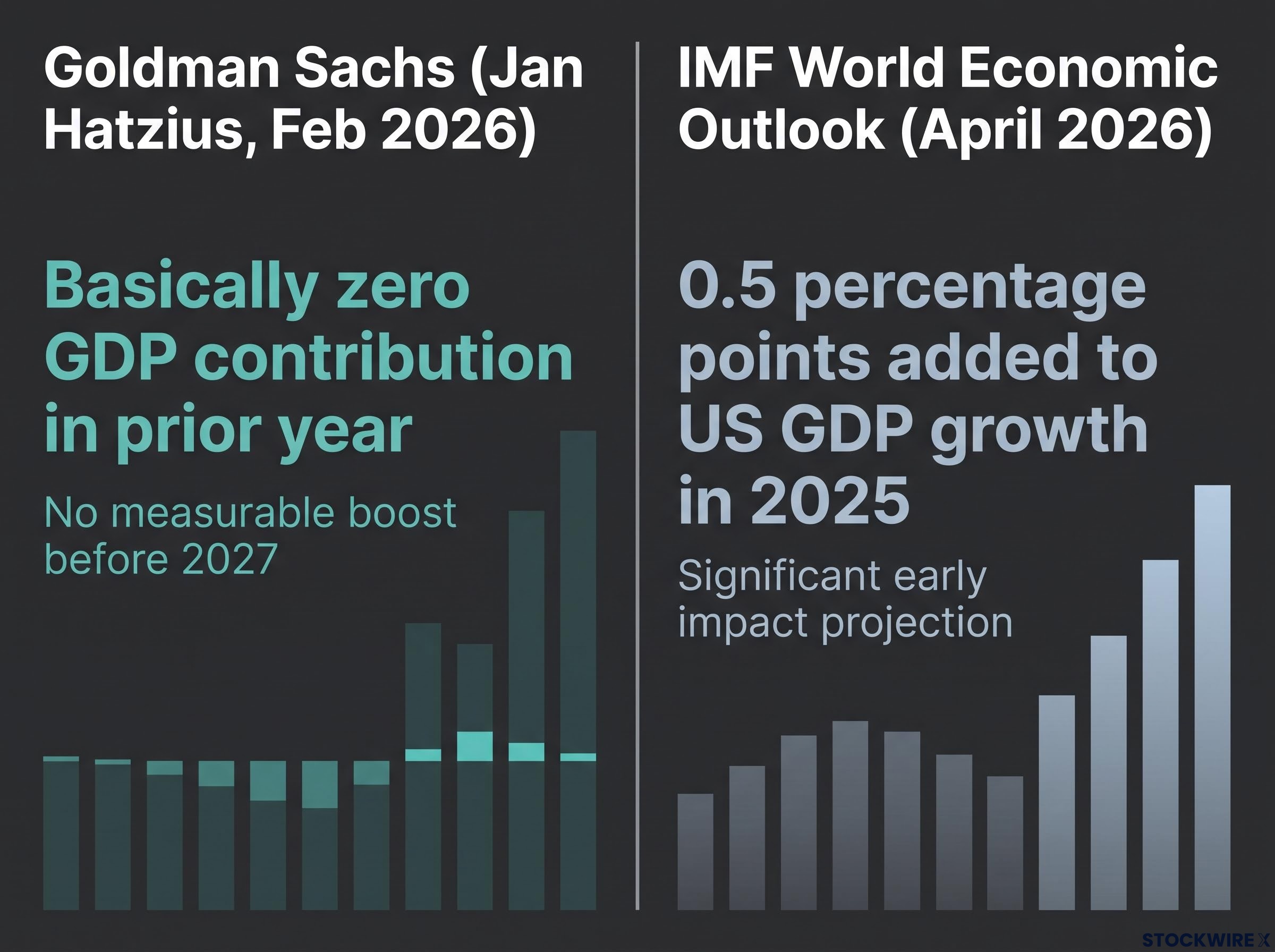
Read together, those figures suggest the productivity payoff investors are pricing into AI valuations has not yet shown up in the GDP data. Valuations are forward-loaded on assumptions that regulatory or execution disruption could push further out. The debate dominating headlines is legislative; the risks quietly building may be operational.
AI stock valuation risk is compounding at the index level: Goldman Sachs’ May 2026 analysis found that AI-related technology spending as a share of US GDP has now surpassed the late-1990s dot-com peak, while the top ten S&P 500 constituents account for roughly 40% of index weight, concentrating forward-loaded regulatory and execution assumptions into positions investors may believe they have diversified away.
Making an informed call in a structurally ambiguous regulatory environment
The market-forces position has real theoretical grounding, but it leans on an empirically contested analogy and assumes voluntary frameworks carry more weight than EPIC’s critique allows. The oversight camp is right that incentive-free guidance rarely changes behaviour under competitive pressure. Neither camp has resolved the actual condition investors face: sustained structural ambiguity.
The practical implication is that AI regulatory risk today is enforcement-action shaped, not statute-shaped. That makes the exposure sector-specific, concentrated in finance, healthcare, and consumer products, rather than a single legislative event you can hedge in one move.
Three variables will determine which scenario materialises:
- Whether Congress passes broad AI legislation before the next election cycle.
- Whether FTC enforcement actions against AI products succeed or are challenged in court.
- Whether frontier-lab voluntary commitments hold as competition intensifies.
For investors wanting to assess whether the latest voluntary pledges represent a structural shift or a reputational manoeuvre, our full explainer on the Altman and Amodei commitments details the specific incident triggers, training halt mechanisms, and IPO timing considerations that shaped each CEO’s public position.
Which brings the picture back to Coxon. Insider departures with explicit safety rationales are a governance-quality indicator that institutional due diligence has not yet standardised. That gap is itself a risk for anyone relying on disclosed commitments to price safety.
This article is for informational purposes only and should not be considered financial advice. Investors should conduct their own research and consult with financial professionals before making investment decisions. Past performance does not guarantee future results, and forward-looking scenarios are speculative and subject to change based on market and policy developments.