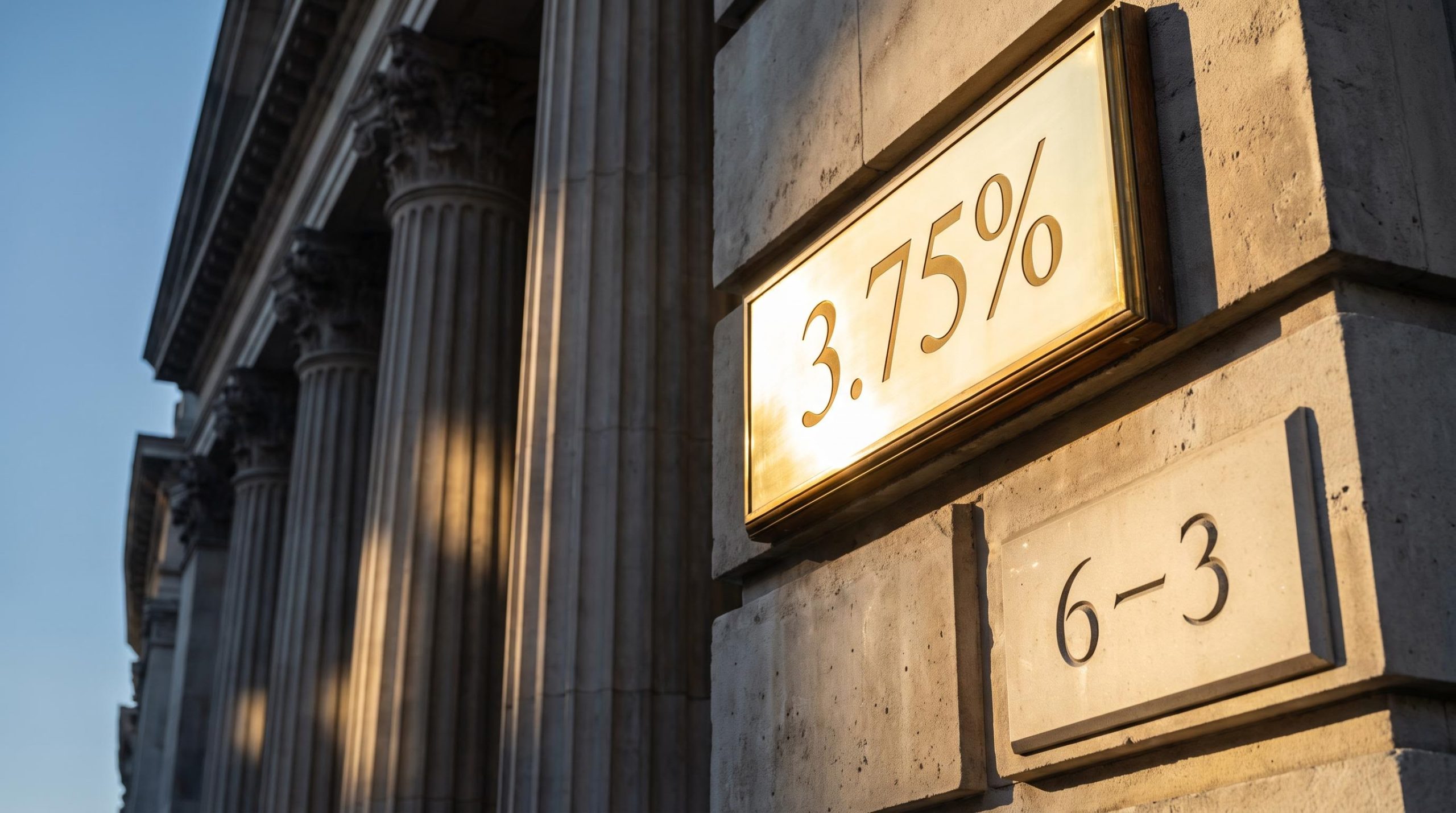
The Bank of England held Bank Rate at 3.75% at its July 2026 meeting on a 6-3 vote, with three members pushing for an immediate hike. Markets had priced a 7-2 split. That single vote off the consensus is the story: holding at 3.75% is not the same as being settled at 3.75%, and the committee is drifting in a direction rather than standing still.
The July decision marked the sixth consecutive meeting without a rate change, which is precisely why the widening dissent carries weight now. UK inflation had eased from 3.3% in March 2026 to 2.9% in July, then ticked back up to 3.1% in August 2026, and that oscillation sits at the centre of the Monetary Policy Committee’s disagreement.
This is a Bank of England question, a UK CPI question, and a sterling question all at once. What follows maps the signals the MPC is actually sending, from the vote arithmetic through the inflation transmission chain to the currency mechanics, and what they mean for the Pound’s near-term direction.
A hold that reads as a warning: what the 6-3 split actually signals
Look at the vote sequence rather than the July headline in isolation, and a trend appears that no single meeting reveals.
In March 2026 the MPC held unanimously, 9-0. By April one member had broken ranks, 8-1. In June the dissent widened to 7-2. In July it reached 6-3. Four meetings, and the hawkish minority has grown every time.
| Meeting | Vote (hold vs hike) | Characterisation |
|---|---|---|
| March 2026 | 9-0 | Unanimous hold |
| April 2026 | 8-1 | Broad majority |
| June 2026 | 7-2 | Narrow majority |
| July 2026 | 6-3 | Slim majority |
The market had expected the July split to hold at 7-2. The actual 6-3 made the decision materially more hawkish than priced, because the arithmetic had moved one vote closer to a live hike to 4.00%.
The three dissenters were Megan Greene, Catherine Mann, and Huw Pill. Greene and Pill had already broken away in June over energy-driven inflation persistence. Mann’s switch to the hawkish camp by July was the marginal shift that turned an expected outcome into a genuine surprise.
The Bank of England July 2026 MPC minutes confirm the 6-3 vote composition and the formal rationale each dissenting member provided, giving the precise language the committee used to frame inflation persistence and second-round effect risk.
Then the messaging split. Pill warned about the risk building underneath the data.
“Insidious” build-up of inflation pressures, warned Huw Pill (Reuters, 31 July 2026), framing the hawkish case around second-round effects and the Bank’s credibility.
Governor Andrew Bailey, meanwhile, insisted publicly that the Bank was “not edging towards a rate rise,” describing the hold as appropriate given uncertain global conditions.
These two signals are not contradictory. The escalating vote pattern tells you the committee’s internal centre of gravity is shifting toward tightening, while the governor manages external expectations downward. They operate on different time horizons: the vote is the leading indicator of where the MPC is heading, and Bailey’s guidance is the near-term brake. For anyone watching sterling or UK rate markets, the takeaway is that this hold is not a steady state. The committee composition is evolving in a direction that reprices risk over the coming meetings.
When big ASX news breaks, our subscribers know first
How the Middle East conflict feeds UK inflation, and why Bailey is not yet convinced
Start at the petrol pump. When the Iran and Middle East conflict disrupted energy supply in early 2026, UK drivers saw the largest jump in petrol and diesel prices in over three years, according to BBC reporting from 22 April 2026. That fuel spike pushed headline inflation up to 3.3% in March 2026.
From there, the pressure moves inward. Higher wholesale oil and gas costs feed household energy bills, and both filter through into broader consumer prices. The transmission runs in four stages:
- Geopolitical disruption drives a wholesale oil and gas price spike.
- Wholesale energy costs pass through to petrol, diesel, and household energy bills.
- Higher energy costs lift consumer price inflation directly.
- Persistent energy inflation feeds wage bargaining and firms’ pricing behaviour, embedding above-target inflation.
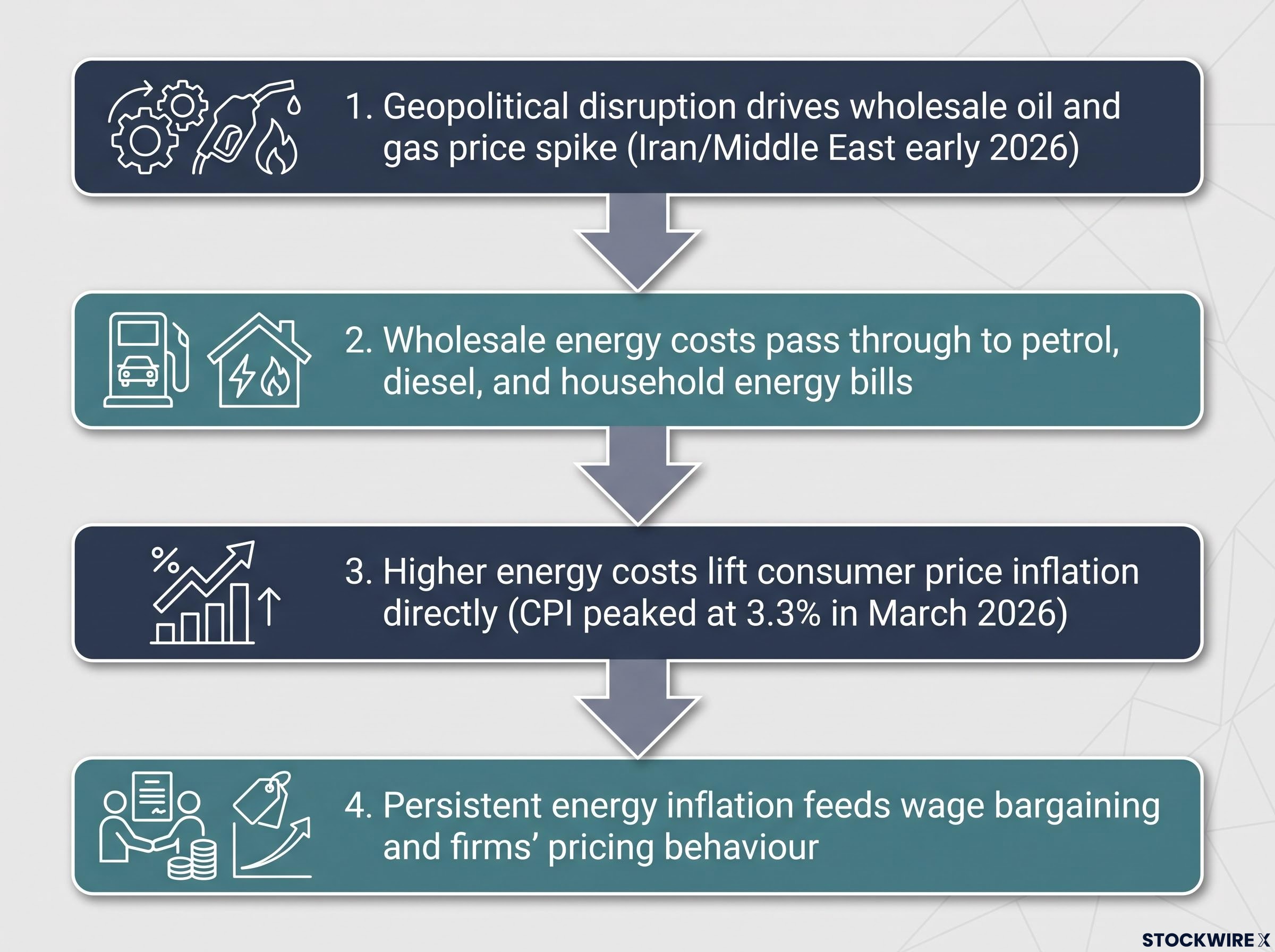
The first two stages are already visible in the CPI data. The fourth stage, the second-round effect, is the one the MPC is watching and has not yet seen materialise in a meaningful way.
That is why the inflation path matters more than any single reading. CPI peaked at 3.3% in March 2026, eased to 2.9% in July, then bounced back to 3.1% in August 2026, per the ONS and BBC News (16 September 2026). The reference point throughout is the Bank’s 2% target, and the data has not returned to it cleanly.
The divergence between headline and core readings is central to the MPC’s split: the energy-driven CPI spike that pushed headline to 2.9% in July was accompanied by falling core and services measures, which is precisely why the majority characterised the move as not representing a deterioration in the medium-term outlook.
Bailey’s language has been carefully conditional throughout.
The Bank “stands ready to act” if the Iran war price shock persists, said Governor Andrew Bailey (BBC, 19 March 2026), noting the war had pushed up energy prices visible at the pump and likely to raise household bills later in the year.
By 30 April 2026, the Guardian reported the Bank judged “higher inflation unavoidable” from the Middle East war, warning that persistently high energy costs could require a more forceful response to stop inflation becoming entrenched. The conditionality in that framing is doing significant work: the Bank could tighten if hostilities persist and second-round effects arrive, but it has explicitly said little evidence of those effects exists so far.
The August bounce back to 3.1% after the July dip tells you the inflation path is not cleanly downward. A second energy spike, or a wage bargaining round that embeds higher expectations, is the trigger that could turn the hawkish minority into a majority. For monitoring purposes, that narrows what you need to watch: not every headline, but specifically whether oil price spikes persist long enough to enter the wage and price-setting round.
What the BoE’s policy toolkit means for sterling, and how GBP actually moved
Before reading the price action, it helps to know why rate decisions move a currency at all. Higher interest rates attract global capital chasing yield, which supports sterling. Quantitative easing, the emergency tool of buying assets to inject money into the system, tends to weaken the Pound. Quantitative tightening, the reversal currently in progress, is generally associated with GBP strength.
The three BoE monetary policy tools, base rate adjustments, quantitative easing, and quantitative tightening, do not transmit equally to sterling; QE research from the Bank itself estimated early programme announcements caused the sterling exchange rate index to fall approximately 4%, an asymmetry that matters when interpreting the muted GBP reaction to the July vote.
So a more hawkish-than-expected vote should, in theory, lift sterling. The actual reaction is where the theory breaks down.
Why a hawkish vote did not produce a hawkish pound
On 30 July 2026, GBP/USD initially traded around 1.337-1.339. IG UK described the move as a hawkish hold that briefly took the pair to roughly 1.3376 before it eased back, leaving sterling little changed on the day. Against the New Zealand Dollar, the Pound was the weakest major performer, down about 0.55%.
An XTB research note explains the mechanism. When forward guidance is balanced or dovish, investors scale back tightening expectations regardless of the vote composition, and a sell-the-fact dynamic can take hold. Bailey’s explicit statement that the Bank was “not edging towards a rate rise” effectively capped the rally the 6-3 split might otherwise have generated.
TD Securities, cited by FXStreet on 30 July 2026, recommended fading the knee-jerk GBP rally against both EUR and USD. That is the more instructive read: forward guidance, not the vote split, drove the actual FX outcome.
| Source | GBP/USD | Date |
|---|---|---|
| Reuters | ~1.337-1.339 | 30 July 2026 |
| IG UK (intraday) | ~1.3376 | 30 July 2026 |
| Bloomberg | 1.3375 | 17 September 2026 |
| MarketScreener | ~1.3370-1.3373 | 17 September 2026 |
As of 17 September 2026, cable remained in the mid-1.33s: Bloomberg showed 1.3375 and MarketScreener roughly 1.3370-1.3373, with technical resistance identified around 1.3460-1.3473 as the near-term ceiling.
The GBP/USD technical outlook heading into the 17 September meeting showed the pair pinned below short-term moving average resistance in the 1.3479-1.3524 band with RSI fading into the low-40s, a configuration consistent with the capped rally thesis and giving the resistance at 1.3460-1.3473 greater analytical weight than a single level in isolation.
The muted reaction tells you FX markets are reading Bailey’s dovish guidance at face value rather than pricing the dissent as a leading indicator. That sets up a binary rather than a trend. A further hold with dovish guidance keeps GBP capped near resistance; any pivot in Bailey’s language or a September hike would likely produce a sharper move.
The case against hiking, and why the hold is not simply caution
The hold is not hesitation. It rests on structurally grounded arguments that over-tightening is a real risk, not a set of soft dovish opinions.
Start with the growth backdrop. The EY Item Club has assessed that the UK is flirting with recession in 2026, with growth expected to stall completely across the second and third quarters. That is a fragile foundation on which to raise rates further.
The most articulate internal counter-position comes from external MPC member Swati Dhingra. In her speech “Money’s Too Tight (To Mention),” she argued that the case for erring toward over-tightening does not hold up.
UK GDP growth data published in September complicated the hold calculus further: the 0.4% month-on-month July beat, with all four major sectors expanding simultaneously, prompted Deutsche Bank to quadruple its Q3 forecast and removed the straightforward recession-risk argument that had anchored the dovish majority’s position.
The evidence to err on the side of overtightening is “not compelling,” argued Swati Dhingra, warning that it often leads to hard landings and scarring of supply capacity that weigh on living standards.
External institutions reinforce the point. The bear case lines up as follows:
- Growth stalling: the EY Item Club sees the economy stalling through Q2 and Q3 2026.
- Over-tightening risk: Dhingra’s argument that the evidence to tighten further is not compelling.
- Deflation undershoot risk: the IEA Shadow Monetary Policy Committee warns rates held high too long risk undershooting the 2% target and sliding toward deflation.
- Contraction signal: S&P Global’s Chris Williamson notes PMI surveys point to renewed contraction risk, with the fight against inflation carrying a heavy cost.
- Rate drag on growth: Capital Economics’ Paul Dales highlights that higher rates are flattening growth.
This is the structural reason the six-meeting hold exists. The majority is not waiting for inflation to vanish. It is weighing the cost of a recession against the cost of embedded above-target inflation, with CPI having travelled from 3.3% in March to 2.9% in July before the 3.1% August uptick.
For anyone positioned in UK rate or currency markets, this reframes the vote count. Even if the hawkish minority reaches a majority, the MPC will not hike mechanically. The growth backdrop and the genuine risk of over-tightening set a higher bar for action than the 6-3 split alone implies. Readers who see that vote and assume a hike is imminent are missing the constraint.
What shifts the calculus, and where sterling goes from here
The useful question now is not what the MPC will do, but what would move it. Three variables would tilt the balance toward a hike, and three toward a hold or a cut discussion.
| Hike triggers | Hold or cut triggers |
|---|---|
| Persistent Middle East energy prices feeding second-round wage effects | GDP data confirming Q2-Q3 stall or contraction |
| CPI rising above 3.3%, showing re-acceleration rather than oscillation | A clear downward CPI trend from the 3.1% August level |
| Hawkish dissent widening from three to four or five members | De-escalation in Middle East energy disruption |
Market pricing for the 17 September 2026 meeting has not resolved the dilemma either. As of 27 August 2026, Reuters reported fewer than 4 basis points of tightening priced, implying roughly a 15% hike probability. By mid-September, CentralBank.watch showed no-change odds above 70%, while InvestingLive put no-change near 57% (a roughly 43% implied hike chance). All sources agreed the modal outcome was a hold.
Market-implied hike probability ranged from roughly 15% to 43% depending on source and date, a spread that tells you the market itself has not resolved the Bank’s dilemma.
That wide range means the September decision carries genuine surprise risk that is not fully priced. For sterling, the setup is binary. Another hold with dovish guidance keeps GBP capped near resistance at 1.3460-1.3473, currently the anchor with Bank Rate at 3.75%. A shift in Bailey’s language or a surprise hike would likely produce a more decisive move. Rather than a forecast, that gives you the specific data points to watch and turns passive observation into an active monitoring framework for your positioning.
This article is for informational purposes only and should not be considered financial advice. Investors should conduct their own research and consult with financial professionals before making investment decisions. Past performance does not guarantee future results. Financial projections are subject to market conditions and various risk factors, and forward-looking statements are speculative and subject to change.
Three variables to watch before the BoE’s next move reshapes sterling
The tension at the heart of all this is simple to state. The Bank holds because the majority sees genuine over-tightening risk, while a growing minority sees embedded inflation as the greater threat. Everything else is a question of which view the data confirms.
Three forward variables are the analytical tripwire worth watching:
- CPI trajectory beyond 3.1%. A rise back above 3.3% signals re-acceleration; a clear decline points the other way.
- Middle East energy price persistence. The question is whether oil spikes last long enough to reach the wage and price-setting round.
- MPC dissent count at the next meeting. The 6-3 July split is the baseline for reading whatever comes next.
The 17 September 2026 meeting is the immediate event horizon, and even another hold carries information. A 6-3 repeat confirms the stalemate. A 5-4 or wider split would materially change the FX and rates picture.
Sterling at 1.3375 on the morning of the meeting is a market that has placed its bet on a hold but left room for a surprise. That residual uncertainty is itself the signal, and the reader who tracks these three variables is far better positioned than one watching only the headline rate.