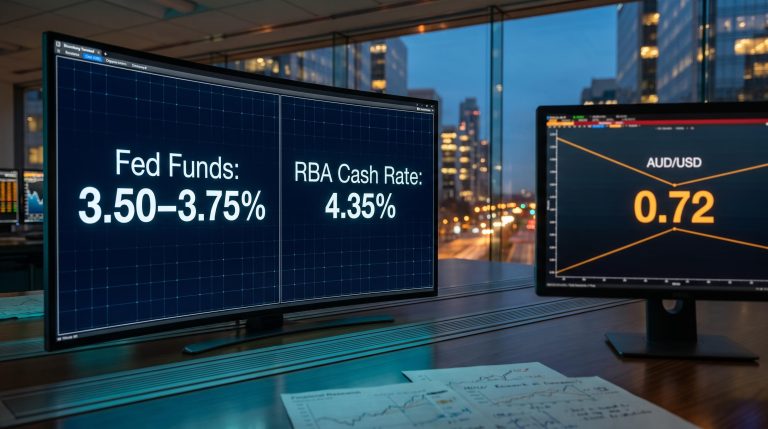
The Federal Reserve has now held the federal funds rate at the same range for five consecutive meetings. Yet at its most recent decision, three of its own policymakers broke ranks and voted to hike further.
That internal fracture is the real story, and it should unsettle any investor who has been treating “hold” as a neutral, stable signal.
The September 16, 2026 meeting lands inside a specific controversy. At the time BNY strategists published their latest analysis, roughly 100 basis points of cumulative hikes were priced into markets. But the last concluded FOMC decision, on 28-29 July 2026, held rates at 3.50-3.75%, already 25 basis points below the 3.75%-4.00% range that the original market consensus had built into its expectations. That gap between what markets priced and where the Fed actually sits is the thread worth pulling.
What follows here gives you a clear framework for reading the Fed’s next move, understanding what BNY strategists think the bond market has priced incorrectly, and deciding where the real risk in your fixed income positioning sits right now.
Five holds, three dissenters, and a rate path that still has not settled
To understand why the current hold is not the calm it appears, you have to watch the sequence build.
The Fed cut in December 2025, trimming the range by 25 basis points from 3.75%-4.00% down to 3.50-3.75%. Since then, it has held at that level through five straight meetings. On the surface, that reads as stability.
Look closer, and the pattern tells a different story.
The earlier FOMC fracture in April 2026, an 8-4 split with dissenters pulling in opposite directions simultaneously, established the pattern of internal division that the July nine-to-three hawkish result extended and concentrated into a single directional camp.
- December 2025: A 25 bps cut to 3.50-3.75%, moving toward a gradual easing base case.
- April 2026: A hold, but with at least one governor dissenting in favour of a cut, and others objecting to adding an easing bias.
- July 2026: A hold, but with three members dissenting in favour of a 25 bps hike.
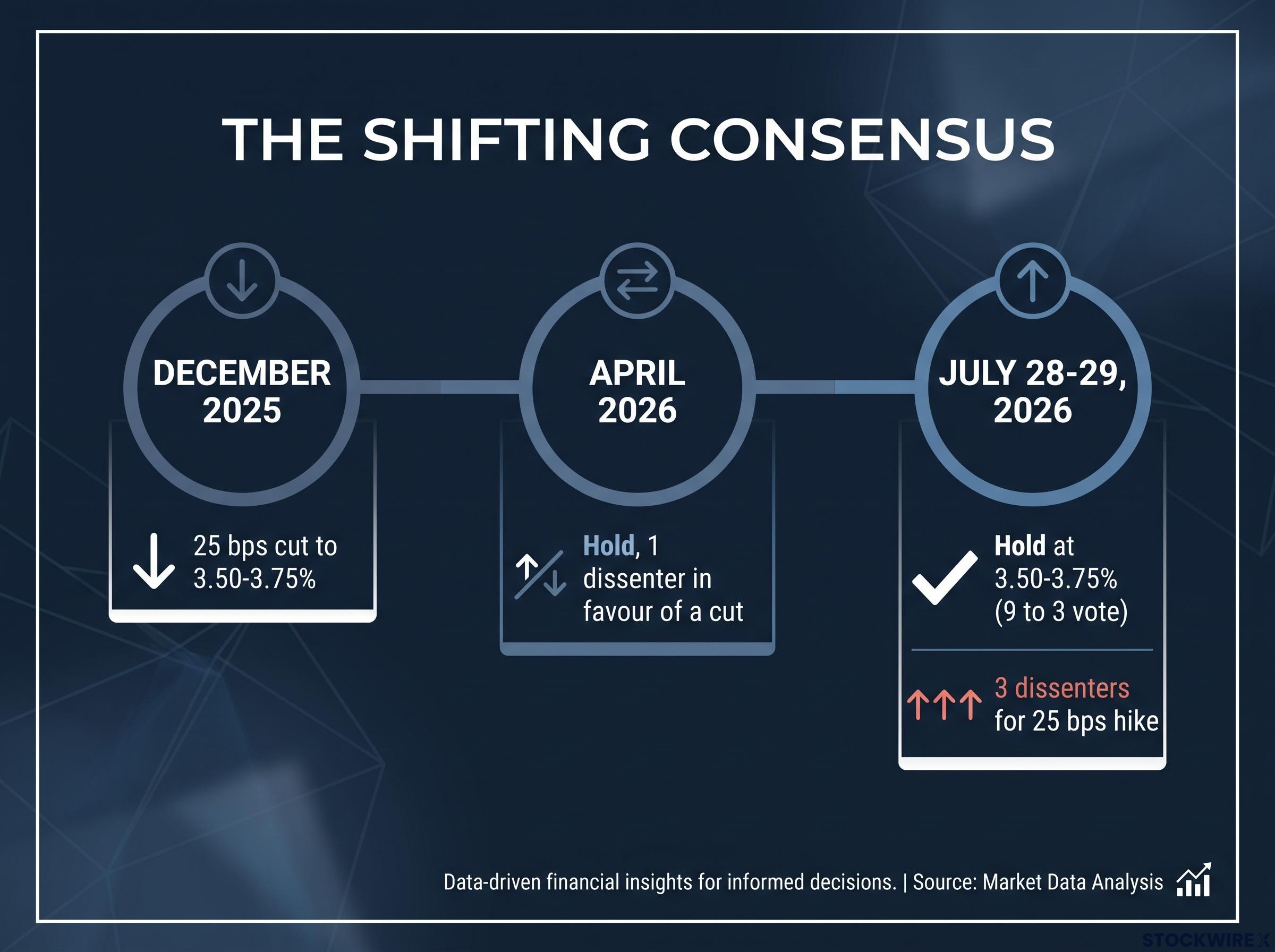
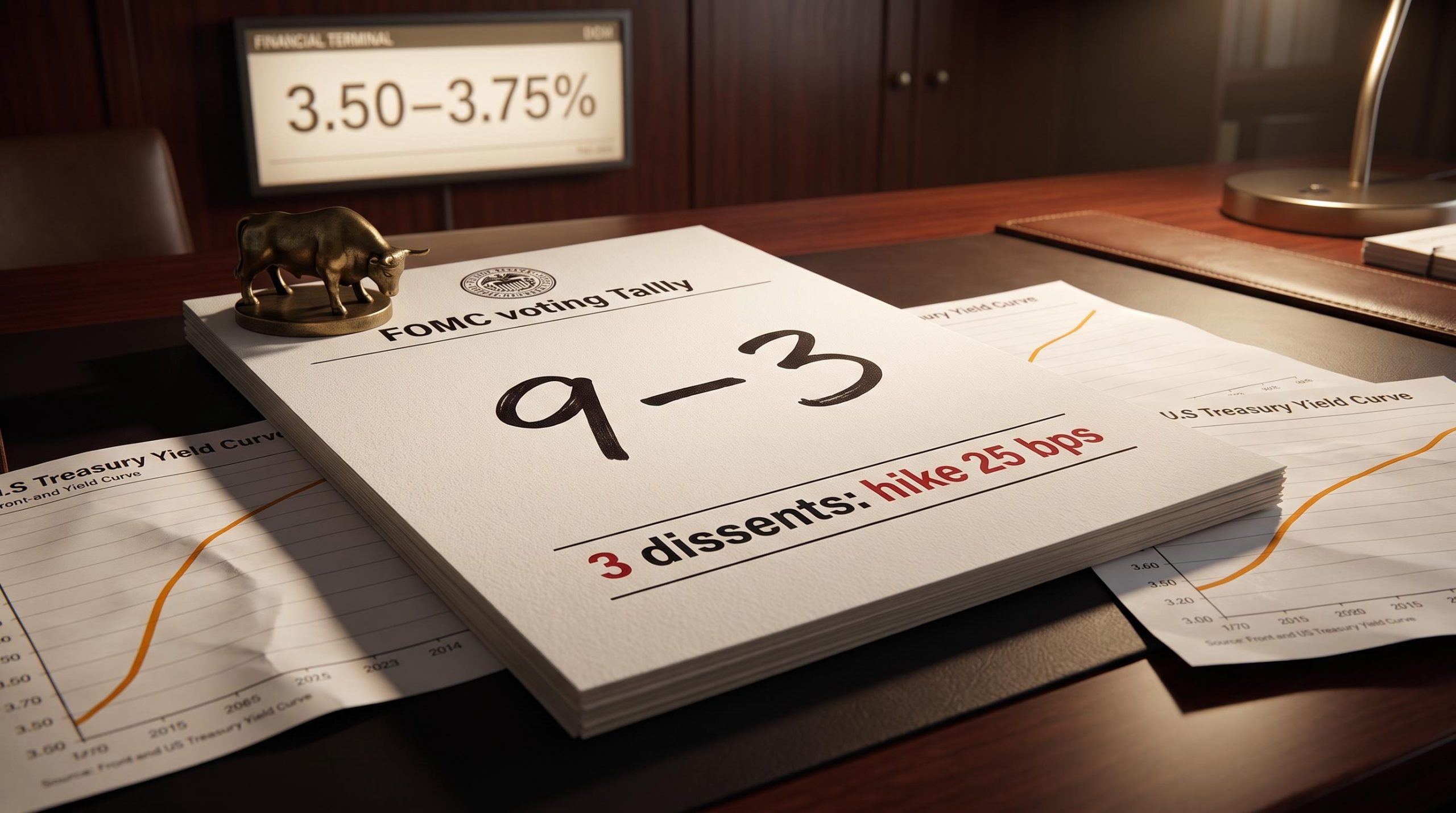
The 28-29 July 2026 vote broke down nine to three. Nine members voted to maintain the range. Three dissented, all wanting a 25 basis point increase, according to the Federal Reserve’s official statement and TD Economics’ summary of the meeting.
Three dissents at a fifth consecutive hold is an unusually large count.
The FOMC vote split is historically associated with cyclical turning points in the rate cycle, and the July 2026 nine-to-three hawkish result carries more forward-looking information than the unchanged headline rate.
TD Economics flagged the number precisely because it signals policymakers who believe the rate may still sit below what is needed to fully contain inflation. This is not a rubber-stamp majority. It is a governing coalition under active pressure.
The statement itself kept its data-dependent framing intact.
“In considering the extent and timing of additional adjustments to the target range for the federal funds rate, the Committee will carefully assess incoming data, the evolving outlook and the balance of risks.”
The effective federal funds rate sat at roughly 3.63% in the days before the September meeting, consistent with trading inside the target band, though that daily figure remains unverified against a second source.
Here is what the vote structure means for you. The three-way hawkish dissent tells you the internal consensus is fragile, and a single data shock could tip the majority in either direction. A Fed with three hawkish dissenters at a fifth hold is materially different from a unanimous one, and treating this hold as a stable equilibrium underprices the tail risk on both sides.
When big ASX news breaks, our subscribers know first
What BNY strategists see that the market may be missing on short-maturity yields
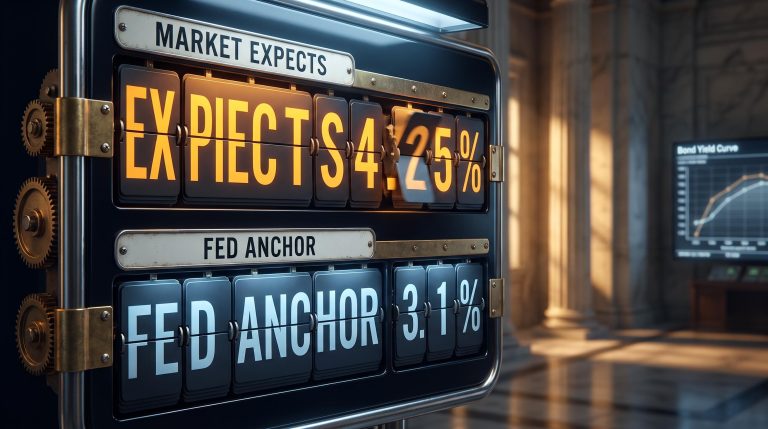
The gap between market pricing and Fed reality is where BNY’s analysis gets interesting. Markets priced in roughly 100 basis points of cumulative hikes, equivalent to four standard 25 bps moves. The Fed, meanwhile, sits at 3.50-3.75% and has held there for months.
BNY strategists argue that shorter-maturity yields may have moved ahead of fundamentals, though they were not yet expecting those yields to fall.
What does “running ahead” actually mean here? Front-end yields, on maturities out to a few years, are anchored to the expected path of the federal funds rate over the next several meetings. They are not driven by long-run growth or inflation fundamentals. When market conviction about the rate path diverges sharply from the Fed’s own data-dependent messaging, the front end can overshoot.
BNY frames this in its report “Vantage Point: Rates, Rules, and Reality (Q1 2026).” The framing juxtaposes rules-based rate prescriptions, the kind a Taylor-rule setting would generate, against the Fed’s actual assessment of risks and constraints. The point is that market pricing anchored in simple rules can drift from what the Fed’s broader judgment ultimately delivers.
BNY’s own house view projects one additional 25 bps hike beyond the September meeting for the rest of 2026. That is a meaningfully shallower path than the roughly 100 bps the market had embedded.
There is one unresolved factual wrinkle worth flagging. The original BNY-era source referenced an expected hold at 3.75%-4.00%, while the actual concluded July rate is 3.50-3.75%. Whether that reflects a September hike back up or a framing discrepancy in the original reporting remains unclear.
| Source | Rate Path View | Target Outcome | Implication for Duration |
|---|---|---|---|
| Market pricing (per BNY) | ~100 bps cumulative hikes priced | Aggressive tightening scenario | High front-end repricing risk if Fed under-delivers |
| BNY house view | One additional 25 bps hike | Modest further tightening | Front-end yields may have overshot |
| Major bank consensus (Dec 2025) | Two to three 25 bps cuts | ~3.00-3.25% via gradual easing | Longer duration rewarded if easing arrives |
The major bank consensus figures (Morgan Stanley, Bank of America Global Research, Goldman Sachs Research) remain unverified against a second source.
What the gap between market pricing and BNY’s view means for duration
If BNY is right that front-end yields have run ahead, the implication for you is specific: positions in 2- to 5-year maturities carry more repricing risk than current yield levels suggest, because the market’s embedded rate path may not survive contact with the Fed’s actual decisions.
Adding front-end duration is effectively a bet that the Fed under-delivers on the market’s aggressive scenario. That pays off if reality lands closer to fundamentals than to market extremes.
The reverse holds too. If the three hawkish July dissenters gradually shape the majority, investors sitting underweight short duration face greater risk than those positioned defensively.
How to read the September FOMC statement before the market does
The statement itself is where the next move gets telegraphed, and you can read it before consensus forms around it. Practitioners parse FOMC language through three frameworks, and applying them in order gives you a repeatable method.
The Federal Reserve FOMC meeting calendar publishes the scheduled decision dates and corresponding statement releases, giving investors the precise windows around which front-end yield moves and positioning adjustments tend to cluster.
- Descriptors for growth, employment, and inflation. Watch how the Fed characterises each. The April 2026 statement described growth as “solid,” job growth as having “remained low,” and inflation as “elevated, in part reflecting the recent increase in global energy prices,” per JPMorgan Asset Management’s commentary. An upgrade or downgrade in any of these signals which way the majority leans.
- Forward-guidance phrasing. The recurring formulation covers the “extent and timing of additional adjustments” based on “incoming data, the evolving outlook and the balance of risks.” When this stays free of an explicit easing bias, as it did in April and July, the Fed is signalling it remains open to moving in either direction.
- Balance of risks and global-risk language. The Fed flagged “developments in the Middle East” as a live source of uncertainty. Increased emphasis on downside risks would typically read as a green light to extend duration.
The value of the September statement lies not in confirming the hold, which markets already expect, but in how the Fed describes growth, jobs, and inflation relative to April and July. Those word choices reveal the majority’s lean before the next meeting arrives.
| Framework Variable | July 2026 Baseline Language | Hawkish Shift Signal | Dovish Shift Signal |
|---|---|---|---|
| Growth descriptor | “Solid” | Upgrade to “strong” or “robust growth” | Downgrade to “moderate” or “slowing” |
| Inflation descriptor | “Elevated,” tied to energy prices | Sharper emphasis on persistence | “Moving toward 2%” or easing pressure |
| Forward guidance | “Extent and timing of additional adjustments” | Explicit reference to further tightening | Introduction of an easing bias |
The April and July 2026 language references from JPMorgan Asset Management are unverified against a second source. Note that both statements retained no explicit easing bias, which tells you the Fed has deliberately kept its options open in both directions.
Hawkish tail, dovish tail, and what each scenario costs a bond portfolio
Neither tail is negligible here. Five consecutive holds, dissent running both ways, and data-dependent language retained mean the distribution around the next move is wide. The practical question is not which scenario is more likely, but which one your current maturity profile is least protected against.
BNY forward projection: One additional 25 bps hike beyond September 2026, per BNY’s “Vantage Point: Rates, Rules, and Reality” analysis.
If the hawks win the majority
The trigger is straightforward. The three July dissenters need only one or two more members to shift, and BNY already projects one more hike.
- Trigger: Persistent inflation or global shocks push the majority toward the dissenters. BNY’s one-hike view materialises or extends.
- Consequences: Front-end yields rise sharply. Investors holding intermediate maturities (2- to 5-year Treasuries) with limited hedging take mark-to-market losses, since those maturities are most sensitive to shifts in the expected funds rate path. The curve could steepen if long-term inflation expectations stay anchored, hurting barbell strategies that relied on front-end stability.
Leverage or one-sided bets on the easing narrative are the most exposed positions of all under this outcome.
Duration sensitivity is what converts the rate-path uncertainty described here into actual dollar losses: a position in 5-year Treasuries with a duration of roughly 4.5 loses approximately 4.5% in market value for every 1 percentage point the funds rate moves against the holder’s positioning.
If the doves accelerate
The dovish trigger runs through the major bank consensus and the labour market.
- Trigger: Labour conditions deteriorate faster than the current “low” job growth reading suggests. The Fed accelerates beyond the gradual two-to-three-cut path that Morgan Stanley, Bank of America, and Goldman Sachs envisaged toward 3.00-3.25%.
- Consequences: The front end rallies aggressively, rewarding extended duration but compressing term premiums and flattening or inverting the curve further.
The risk here is policy whiplash. If easing arrives while inflation stays elevated, the Fed could be forced into a later reversal, reintroducing volatility and forcing markets to recalibrate to a fresh tightening narrative.
Abrupt divergences between the Fed’s path and market expectations have historically produced outsized front-end yield moves and elevated volatility in risk assets. For you, the cost of being wrong on the tail the market is ignoring is asymmetric, which is exactly why one-sided bets carry more danger than they appear to.
What the data and the dissenters tell you about positioning before the next move
Pull the threads together and a coherent position emerges. BNY sees short-maturity yields ahead of fundamentals and projects one more hike. The Fed carries three hawkish dissenters against a recent history of a dovish one. That combination points to genuine two-sided risk concentrated at the front end, not a settled path in either direction.
The September statement is the decision point that will confirm or challenge the prevailing narrative, the roughly 100 bps priced and the major bank easing consensus. Use the three language frameworks to form your own read rather than waiting for market consensus to tell you what the statement said.
Here is the structured way to update your view as data arrives. Watch these variables after September:
- The inflation descriptor language in the statement, and whether it hardens or softens.
- Whether the dissent count grows, holds, or reverses.
- Incoming labour market data against the “low” job growth baseline.
- The energy price trajectory the Fed has tied its inflation language to.
The gap between BNY’s one-hike projection and the major bank two-to-three-cut consensus is real analytical uncertainty, not noise. Where you position on that spectrum should reflect your own assessment of inflation persistence and Fed credibility, not a default to the consensus view.
For investors wanting to translate the two-sided risk identified here into specific positioning adjustments, our dedicated guide to bond portfolio management details how major asset managers are calibrating duration within the 1-5 year curve segment given current rate uncertainty.
This article is for informational purposes only and should not be considered financial advice. Investors should conduct their own research and consult with financial professionals before making investment decisions. Past performance does not guarantee future results. Financial projections are subject to market conditions and various risk factors, and forward-looking statements are speculative and subject to change based on market developments.