
The Bank of England is preparing to stop selling its longest-dated gilts altogether, according to a report from The Telegraph published today. The plan would see the central bank discontinue the offloading of 20- and 30-year government bonds, the endpoint of a retreat that began 18 months ago with a single rescheduled auction and has crept steadily further ever since.
This lands at a fraught moment for UK borrowing. On 10 September 2026, the 30-year gilt yield hit 5.948%, its highest since 1998, with the 20-year close behind at 5.895%. Those levels are eating directly into the chancellor’s fiscal room to manoeuvre.
The Bank’s quantitative tightening programme, the process of shrinking the balance sheet built up during years of bond-buying, has been the one policy lever adding fresh supply to an already strained long end of the market. Any change to how it sells matters for government financing and for anyone holding long-dated bonds.
Here is what the shift actually involves, why the long end of the gilt market is so exposed to central bank selling in the first place, and what investors and fiscal watchers should take from a decision the Bank is careful to call technical.
How the Bank of England arrived at a quiet withdrawal from long-dated gilt sales
Today’s report reads like a reversal only if you missed the previous 18 months. Each step along the way pointed in the same direction.
The first sign came in April 2025. The Bank pulled a planned long-maturity auction and swapped it for short-dated debt, citing “recent market volatility.” According to Bloomberg’s reporting, a £600 million long-dated sale was replaced with £750 million of short-dated bonds as gilt yields surged on global trade and tariff shocks.
Then came the structural move. In September 2025, the Bank slowed the annual pace of gilt disposals and formalised a maturity skew designed to keep supply away from the long end.
The Monetary Policy Committee voted 7-2 to slow gilt disposals to £70 billion between October 2025 and September 2026, down from £100 billion the year before.
That same decision introduced a 40:40:20 split of sales across short-, medium-, and long-dated gilts, measured by initial purchase price, explicitly weighting supply away from the maturities under most pressure.
By June 2026, the drift became a full stop at the long end. The Bank scheduled no long-dated gilt sales at all for the July-September quarter, the first quarter without them since active sales began in January 2023.
Here is the sequence in order:
- April 2025: A £600 million long-dated auction swapped for £750 million short-dated debt, blamed on “recent market volatility.”
- September 2025: Annual QT pace cut from £100 billion to £70 billion; 40:40:20 maturity split formalised on a 7-2 MPC vote.
- June 2026: No long-dated gilt sales scheduled for the coming quarter, a first since January 2023.
- September 2026: The Telegraph reports plans to scrap 20- and 30-year sales entirely, with economists forecasting a cut in the annual QT envelope to as low as £50 billion.
Deutsche Bank expects the total programme trimmed to £50 billion with long-dated sales scrapped, while Oxford Economics forecasts active sales staying near £20 billion, the rest delivered through bonds simply maturing without replacement.
The pattern tells you the Bank concluded some time ago that the long end cannot absorb active selling without consequences. Today’s report is the policy catching up to what its operations already signalled.
When big ASX news breaks, our subscribers know first
Why long-dated gilts are unusually exposed to central bank selling pressure
Start with the observable fact: yields near 6% at the long end, against a historical trading range closer to 4.70-4.80%, according to centralbank.watch commentary. Then work backwards to why the long end reacts so violently to central bank supply.
The inverse relationship between bond prices and yields sits at the centre of why central bank selling matters: gilt yield mechanics mean that additional supply depresses prices and pushes yields higher, amplifying the pressure the Bank is now trying to relieve at the long end.
The duration and convexity problem
Long-dated gilts carry far higher duration and convexity than short-dated bonds. Duration measures how much a bond’s price moves for a given change in yield; convexity captures how that sensitivity itself shifts as yields move.
The practical effect is that a pound of central bank selling at the 30-year point produces a much larger yield move than the same pound sold at the two-year point. The Bank’s sales, even at modest volumes, hit hardest exactly where the market is thinnest.
A weakened demand base and an LDI overhang
The demand side makes it worse. Traditional long-duration buyers, chiefly pension funds, have pulled back their appetite for 20- and 30-year gilts.
Britain’s Debt Management Office has already responded by shifting its own issuance toward shorter and medium-dated bonds, a tacit admission that the natural buyer base at the long end has shrunk. Any supply the Bank adds through QT lands in a market with fewer hands to catch it.
The DMO annual report 2025-2026 documents the official shift toward shorter gilt issuance, attributing the change explicitly to structural changes in demand and market feedback about the maturity profile investors were willing to absorb.
There is a financial-stability dimension too. Yields near 6% put mark-to-market pressure on liability-driven investment (LDI) strategies, the tools pension funds use to match their long-term obligations, and raise the collateral those strategies must post.
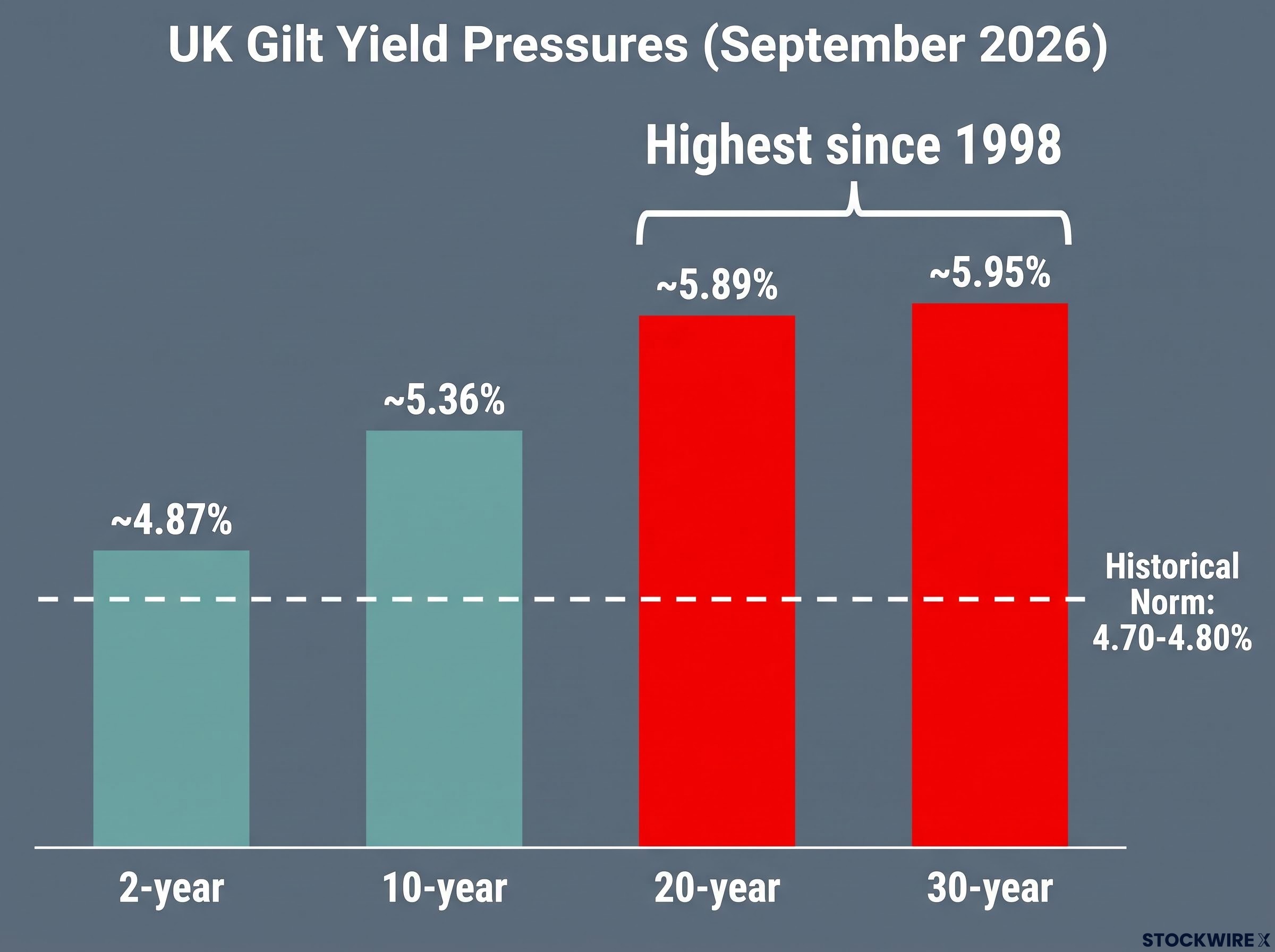
| Maturity | Yield (Sept 2026) | Historical context | Key driver of stress |
|---|---|---|---|
| 2-year | ~4.87% | Tracks policy rate (~3.75%) | Rate expectations |
| 10-year | ~5.36% | Broad-based rise | Global term premium |
| 20-year | ~5.89% | Highest since 1998; vs ~4.70-4.80% norm | Thin demand, QT supply |
| 30-year | ~5.95% | Highest since 1998; vs ~4.70-4.80% norm | Thin demand, QT supply |
For a pension fund running LDI and for the chancellor’s debt-servicing bill, that near-6% level is where long-end stress stops being a bond market problem and becomes a balance-sheet and fiscal one.
What the shift means for UK borrowing costs and fiscal headroom
Move from the Bank’s internal choice to its external bill. Elevated long-dated yields feed straight into the cost of servicing government debt, and the arithmetic is unforgiving.
The Guardian reported that long-term borrowing costs, with the 30-year yield around 5.85%, could halve the chancellor’s budget headroom.
The relationship between fiscal headroom and gilt yields is not mechanical: a 0.3-percentage-point rise in borrowing costs is enough to wipe out a £9.9 billion headroom cushion, as the January 2025 episode demonstrated, making the chancellor’s position acutely sensitive to where long-end yields settle.
That is what turns a monetary decision into a fiscal one. When the yield the government pays to borrow for 30 years sits well above the levels baked into official forecasts, the room for spending or tax choices narrows fast.
The spread tells its own story. With the Bank’s policy rate around 3.75% and 30-year yields near 6%, the pressure is concentrated at the long end even as the two-year yield of roughly 4.87% shows stress across the curve.
That concentration is precisely why the Bank’s decision to stop selling at the long end matters fiscally, and why it is delicate. The language has shifted across each step, but the underlying justification has held steady:
- April 2025: “recent market volatility”
- September 2025: minimising the impact on “volatile gilt markets”
- September 2026: reduced market demand for long-dated debt
The signalling risk is real. Any move that visibly relieves long-end pressure can be read as the central bank bending to fiscal constraints, however firmly it is justified on market-functioning grounds.
The Bank’s defence is that QT continues overall. Oxford Economics’ Alexander Harvey expects active sales to stay near £20 billion, with the balance of the forecast £50 billion annual reduction delivered through passive runoff, letting bonds mature without reinvestment.
Whether that framing holds depends on the market accepting a genuine difference between scrapping long-dated sales while shrinking the balance sheet, and easing. If it fails, the credibility cost could rival the yield move itself.
What happens next, and what experts are watching
The forecasts converge on direction but diverge on scale, and that gap is where the open questions sit.
- Deutsche Bank (Sanjay Raja): annual QT envelope cut to £50 billion, long-dated sales scrapped entirely.
- RSM UK (Thomas Pugh): a reduction or pause of longer-dated sales, framed around market stability.
- Oxford Economics (Alexander Harvey): active sales around £20 billion, with passive runoff doing the heavy lifting.
None of these is a done deal. As of mid-September 2026 they are expectations ahead of an MPC decision, not the decision itself.
City AM reporting on QT forecasts ahead of the MPC decision captures the spread of economist expectations, with projections ranging from a trimmed but active programme to one relying almost entirely on passive runoff to shrink the balance sheet.
There is a conceptual anchor for treating this as legitimate QT rather than retreat. In July 2025, former MPC member Michael Saunders, now at Oxford Economics, argued the Bank could hold most of its long-dated gilts to maturity.
Saunders pointed to the Bank of Canada’s approach, holding long-dated bonds to maturity rather than actively selling, as a model for implementing QT through passive runoff.
The scale of the overall reduction gives that framing weight. The Bank’s gilt portfolio peaked near £875 billion before QT, fell to roughly £738 billion by January 2024, and stood at about £522 billion as of June 2026. The balance sheet has shrunk substantively regardless of which maturities are sold.
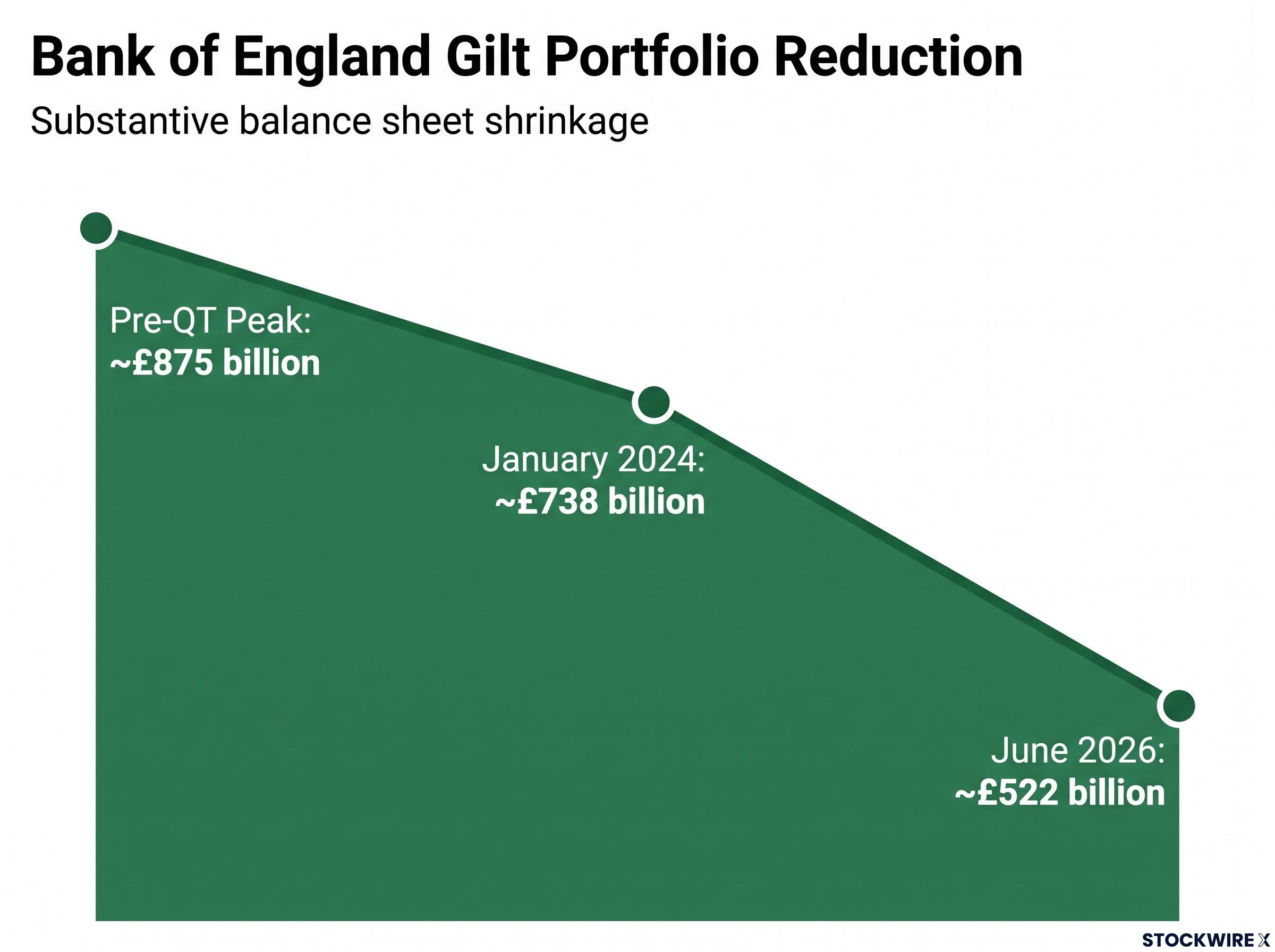
The risk scenario is clear enough. If the restructuring fails to steady long-end yields, or if markets read it as fiscal accommodation dressed up as technical calibration, the credibility of the whole QT programme comes into question.
For fixed income investors, the read is this: continued passive-runoff QT is a very different backdrop from active selling across every maturity. The technical framing is load-bearing, and it holds only while the total portfolio keeps falling. Any future decision to pause the overall reduction would be a materially different signal.
For investors wanting to trace how a lower QT envelope interacts with sterling, our full explainer on the GBP repricing risk examines why BBH and ING see the swaps curve as mispricing the Bank’s actual rate path and what a dovish repricing means for pound holders.
A recalibration, not a retreat, but the distinction carries weight
The central tension runs through every step. The Bank has consistently called each move a market-functioning decision, yet the cumulative effect is that active long-dated sales, which started in January 2023, are ending, and the annual QT target is likely to fall further toward £50 billion.
What the Bank must now demonstrate is straightforward to state and harder to deliver: that passive runoff shrinks the balance sheet meaningfully, that total gilt holdings keep declining from the current £522 billion, and that long-end yields stabilise without further operational retreats. The Bank of Canada precedent is the model it appears to be moving toward.
Post-QE yield normalisation is part of the analytical backdrop: the decade of suppressed yields created a distorted baseline, and bid-to-cover ratios at or above ten-year averages across major sovereign markets in mid-2026 suggest institutional demand has not collapsed even as yields approach 6%.
For you, the variable that matters is not the label. It is whether the long-end yield response in the weeks after this announcement confirms the technical reading or reveals a market that sees a deeper shift in the Bank’s tolerance for fiscal pressure.
That distinction is not semantic. It shapes how the Bank’s next move on rates, QT, or fiscal communication gets interpreted, and reading the framing carefully is what will separate investors who understand the signal from those who react to the headline.
This article is for informational purposes only and should not be considered financial advice. Investors should conduct their own research and consult with financial professionals before making investment decisions.
Financial projections and analyst forecasts referenced here are speculative and subject to change based on market developments and central bank decisions. Past performance does not guarantee future results.