

Xaranetide concussion data earns oral presentation spot at international neurotrauma congress
Preclinical concussion data from Argenica Therapeutics (ASX: AGN) has been selected for oral presentation at the 2026 Meeting of the International NeuroTrauma Society (INTS), to be held in Cartagena, Colombia in October 2026. The presentation, titled “A Single Low Dose of R18D is Neuroprotective after Repeated Mild Traumatic Brain Injury,” will be delivered by Dr Chidozie Anyaegbu, Lead of the Preclinical Neurotrauma Research Program and Research Fellow at Curtin University Faculty of Health Sciences, who led the study. The research was conducted by Curtin University and the Perron Institute for Neurological and Translational Science as part of Argenica’s Cooperative Research Centre Project.
Dr Liz Dallimore, Managing Director
“Selection of these data for an oral presentation at the International NeuroTrauma Society meeting is an important recognition of the scientific interest in our concussion program. Importantly, the study demonstrated that a single low dose of xaranetide administered after repeated mild traumatic brain injury produced sustained effects across multiple markers of secondary brain injury. Together with our broader traumatic brain injury and stroke research, these findings continue to build the evidence supporting xaranetide as a potential neuroprotective treatment across acute neurological injuries.”
When big ASX news breaks, our subscribers know first
What the preclinical concussion study showed
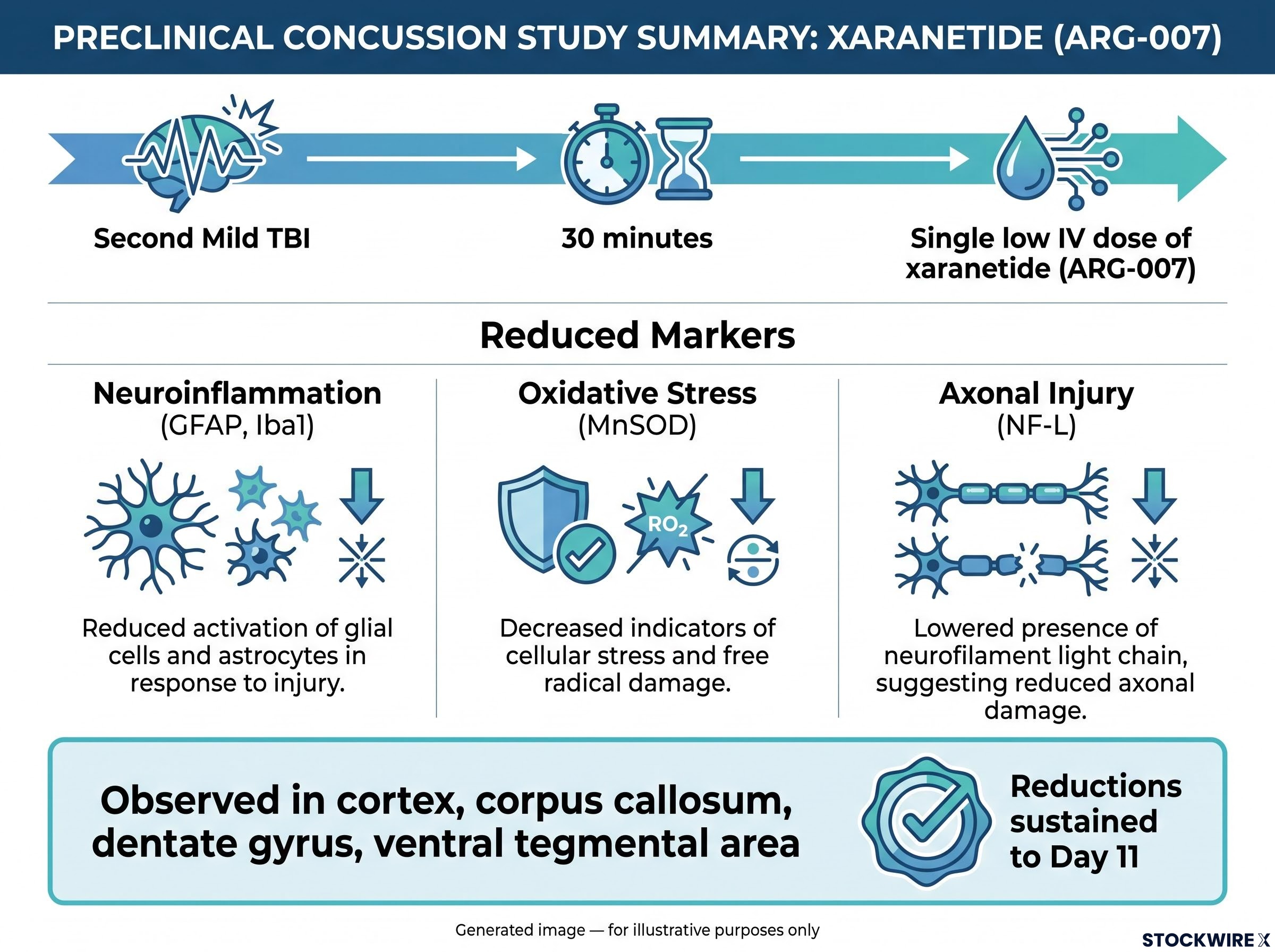
The findings referenced here were previously announced on 16 July 2026. This is a conference selection event, not a new data release. The preclinical study demonstrated that a single low intravenous dose of xaranetide (ARG-007), administered 30 minutes after a second mild traumatic brain injury (TBI), significantly reduced markers across three categories:
- Neuroinflammation markers, including GFAP and Iba1
- Oxidative stress markers, including MnSOD
- Axonal injury markers, including NF-L
These effects were observed across multiple brain regions, including the cortex, corpus callosum, dentate gyrus, and ventral tegmental area. Importantly, the reductions were sustained to Day 11 following injury.
The xaranetide concussion study found that biomarker reductions extended to levels comparable with uninjured sham animals, a result that positions the drug as a potential platform therapy rather than a single-indication candidate, given no approved pharmacological neuroprotective treatment currently exists for repeated mild TBI.
Why a single low dose matters
In acute injury settings such as emergency departments and hospitals, treatment simplicity is a practical consideration. A single low-dose intravenous administration reduces the complexity of the dosing regime, which may be advantageous when speed and ease of delivery are important. The study’s findings suggest xaranetide may be suitable for such acute-care environments, though this remains at the preclinical stage.
Understanding xaranetide and why neuroprotection is a high-stakes space
After a brain injury, damage does not stop at the moment of impact. A cascade of secondary processes, including neuroinflammation, oxidative stress, and axonal injury, continues to destroy brain tissue in the hours and days that follow. This window represents an opportunity for neuroprotective therapies to intervene and limit long-term harm. Reducing markers such as GFAP, Iba1, MnSOD, and NF-L is considered relevant to interrupting these secondary injury processes and improving patient outcomes.
Xaranetide (also referred to as R18D or ARG-007) is Argenica’s clinical-stage drug candidate. Its lead development program targets acute ischaemic stroke, while the TBI and concussion programs remain at the preclinical stage. The drug’s positioning across multiple acute neurological injury types represents a form of commercial optionality, as positive data in one indication can support the broader therapeutic rationale.
Xaranetide INN confirmation by the WHO, finalised in June 2026 with no objections raised during the public consultation period, streamlines engagement with global regulators, clinical investigators, and potential commercial partners as the programme scales across indications.
Building the case across acute neurological injuries
The INTS selection fits into an expanding body of preclinical and clinical evidence supporting the xaranetide program. The company’s development work now spans three areas:
- Lead clinical program: Acute ischaemic stroke
- Preclinical TBI program: Existing research base in traumatic brain injury
- Preclinical concussion study: Now recognised for oral presentation at an international neurotrauma congress
Selection for an oral presentation at a specialist international congress signals peer-level scientific interest in the data. This type of recognition can support future conversations around partnerships, grant applications, and clinical expansion, though a conference presentation does not in itself represent a commercial milestone. Argenica’s stated goal remains advancing xaranetide across a range of acute neurological injuries, with the INTS presentation adding to the body of external scientific engagement with the program.
Don’t Miss the Next Healthcare Breakthrough
Big News Blast delivers FREE breaking ASX healthcare and biotech news directly to your inbox within minutes of release, complete with in-depth analysis. Join 20,000+ subscribers already staying ahead of the market. Click the “Free Alerts” button at StockWire X to get the next market-moving announcement the moment it drops.