
It is Sunday evening, and you are scrolling X. The same stock appears in three separate posts on your feed, the CEO turns up in a podcast clip someone has shared, and a comment chain is busy linking the company to a famous artificial intelligence (AI) partner. Everything feels aligned, exciting, almost inevitable.
Here is the uncomfortable question: at what point does that much enthusiasm become a reason to be more careful, not less?
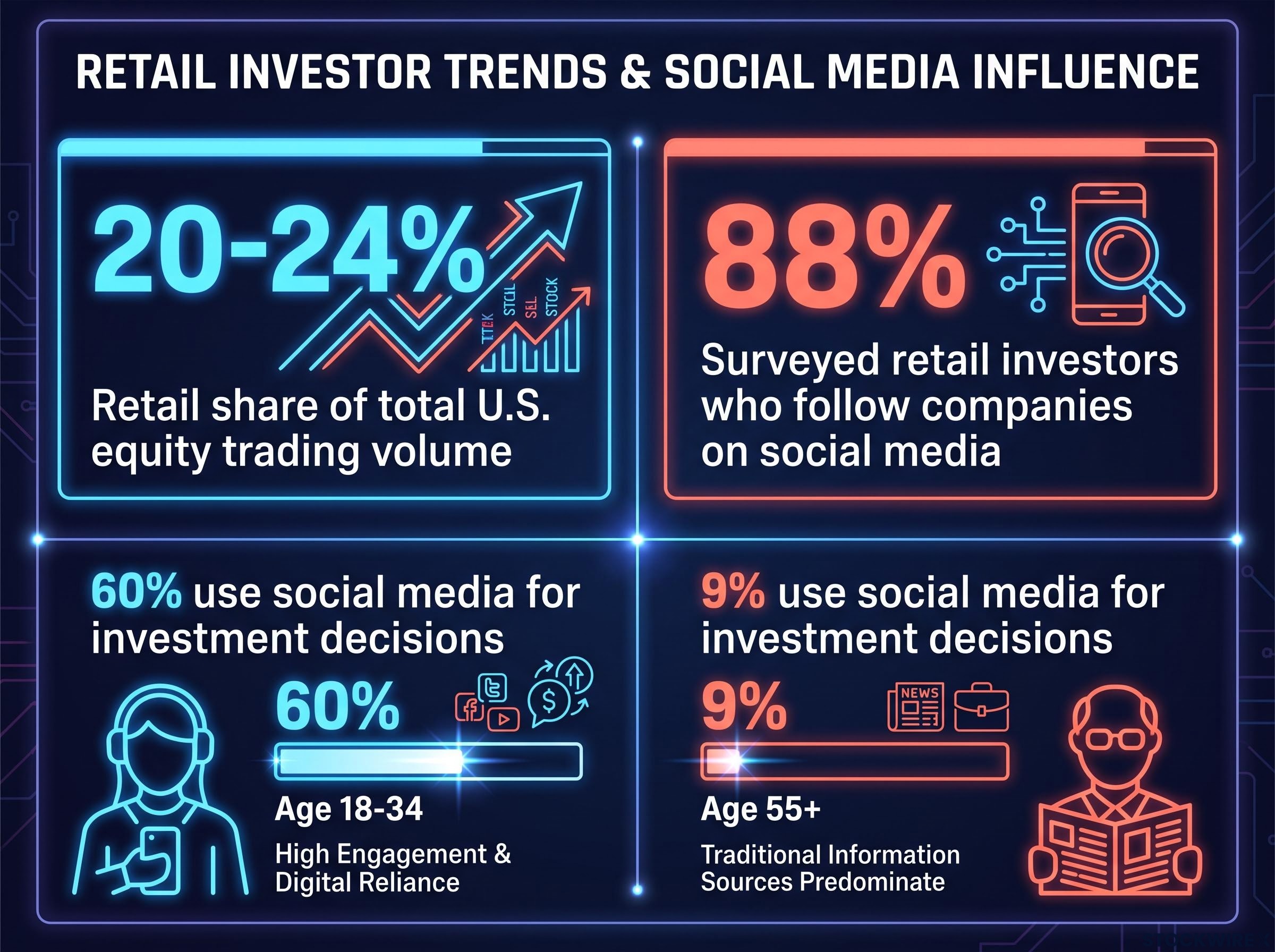
This matters because the audience most exposed to coordinated promotion is also the least prepared for it. FINRA research shows that social-media-informed investors skew younger, hold smaller portfolios, and have limited foundational investment knowledge. Retail investors now account for roughly 20-24% of total U.S. equity trading volume, which makes this group both influential in the market and a prime target for orchestrated hype.
The documented price pattern behind social media stock promotions is consistent across three independent studies: a short-term spike of up to 11.94% followed by full reversion within 30 days, and a collapse of nearly 33% when undisclosed paid relationships are later exposed.
After reading this, you will be able to identify the specific tactics promoters use, understand why even polished executive outreach can be a warning sign, and apply a concrete framework before you commit a dollar to any heavily promoted stock.
What stock promotion actually looks like in the social media era
The surface of stock promotion is comfortable. A confident CEO on a popular podcast. A stock trending in your feed because plenty of people seem to be talking about it. A tidy narrative connecting a small company to one of the biggest names in tech. None of that feels like a warning.
That comfort is exactly the problem.
Coordinated stock promotion is a pattern of activity designed to generate retail buying interest through non-fundamental means. It is distinct from normal investor relations, where a company communicates results and strategy to all shareholders on equal terms. Promotion is engineered to move the crowd, not to inform it.
Three tactics show up repeatedly in promoted disruptive technology stocks:
- Executive social media tours: CEOs and CFOs appearing across podcasts and content-creator channels rather than through formal disclosure channels.
- Narrative attachment: Tying a company’s story to a high-profile, fashionable name to borrow its credibility.
- Dedicated promotion accounts: Social accounts on platforms like X that exist largely to keep a single stock in constant discussion.
Here is what makes these hard to catch: none of them is automatically illegal. A CEO is allowed to do interviews. A company can announce a partnership. That legality is precisely why you need a framework rather than a gut feeling to tell promotion apart from communication.
Why these tactics work on otherwise rational investors
The tactics work because they target emotion before analysis. Fear of missing out (FOMO) is the sensation that everyone else is profiting while you hesitate. Herd behaviour is the pull to do what the crowd is doing. Emotional contagion is how a bullish mood spreads through a community until the narrative feels like consensus fact.
Academic research using the r/wallstreetbets community found that consensus-driven, emotion-based trading tends to produce negative medium-term returns for the people chasing the hype rather than the fundamentals. The language of promotion is engineered around this: urgency framing such as “buy before you miss out” and claims of inside information are deliberate psychological levers, not casual word choices.
The demographic concentration is the tell you should not ignore. FINRA data shows 60% of investors aged 18-34 use social media for investment decisions, against just 9% of those aged 55 and over. NASAA reports that 29% of retail investors overall use social media or message boards to make investment decisions. FTI Strategic Communications found 88% of surveyed retail investors follow companies on social media and 82% actively search or receive alerts. Promoters are not reaching this audience by accident. They are reaching the investors least equipped to question the pitch.
The FINRA Foundation research on social media investors draws on the 2024 National Financial Capability Study to show that finfluencer followers skew younger, carry smaller portfolios, and score lower on foundational investment knowledge tests, making them the demographic most exposed to coordinated promotion campaigns.
When big ASX news breaks, our subscribers know first
The Zeta Global playbook: a real-world case study in promotion recognition
Now apply that framework to a real company. Zeta Global is useful precisely because it is not an obvious fraud. It is a marketing technology firm with genuine, fast-growing revenue, and that is what makes it the hardest kind of case to read.
Start with the fundamentals, because they are real. Zeta reported 2025 revenue of $1.305 billion, up roughly 30% from $1.01 billion in 2024, while narrowing its net loss to $31.51 million. It beat revenue expectations across all four quarters of the year.
| Quarter | Revenue | YoY Growth | Stock Reaction |
|---|---|---|---|
| Q1 2025 | $264M | 36% | Strong beat |
| Q2 2025 | $308M | 35% | Beat, free cash flow up 69% YoY |
| Q3 2025 | $337M | 26% | Fell 5.22% after-hours to $17.22 despite beat |
| Q4 2025 | $395M | 25% | Positive GAAP net income of $6.5M |
Look at the Q3 line. Revenue rose 26% year-on-year, a clear beat, and the stock still dropped 5.22% in after-hours trading to $17.22, sitting well below its 52-week high of $38.20. The share price rose roughly 45.4% between September 2025 and September 2026, but with volatility that had little to do with the steady growth on the income statement.
That is the signal. Real growth and hype-driven price action are not opposites, and treating them as the same thing is the mistake that costs money.
Earnings report analysis reveals a layer of information that promotional narratives consistently obscure: non-GAAP adjustments that recur quarter after quarter, operating cash flow that diverges from net income, and management language in the analyst Q&A that signals business confidence far more reliably than headline revenue figures.
Analysts examining Zeta flagged three specific red flags. First, the company reportedly hired a B2B-focused marketing firm to steer executive attention toward retail investors. Second, the CEO and CFO appeared in multiple interviews with social media content creators. Third, accounts on X exist largely to promote the stock, keeping it among the platform’s most-discussed names.
Then there is the narrative attachment. Zeta’s promotional coverage leaned heavily on a partnership announcement with Palantir, one of the most fashionable names in the AI trade.
Attaching a company’s story to a famous name lets promoters borrow that name’s credibility and generate FOMO, even when there is no direct financial relationship that justifies the association.
The scale of narrative-driven concentration is worth sitting with. eToro found 27% of global retail investors hold AI-related stocks, and 62% either hold or plan to hold AI names. Palantir itself shows where this leads: retail traders account for roughly 42% of its average trading volume, nearly double the S&P 500 average, with projected net retail purchases approaching $8 billion by the end of 2025, accepting forward price-to-earnings multiples as high as 144x. Zeta is not an outlier. It is a well-run company with a professional promotion campaign attached, which is the most common and most difficult situation you will face.
What regulators see that most retail investors miss
Now shift the question. Instead of asking “is this company legitimate?”, ask “are the disclosure rules being followed?” That is the question regulators are asking, and it changes what you look for.
The legal line runs between legitimate investor relations and undisclosed paid promotion. Under SEC Regulation Fair Disclosure (Reg FD), a company must release material information to all investors at the same time, not selectively to a favoured few. FINRA broker-dealer rules require communications to be fair, balanced, and not misleading. When a CEO’s social media account becomes a private channel to a specific retail community, both principles come under strain.
Enforcement is active, not theoretical.
| Entity | Date | Violation Type | Penalty |
|---|---|---|---|
| Van Eck Associates | February 2024 | Failure to disclose influencer role and licensing arrangement in an ETF launch | $1.75M civil penalty |
| DraftKings | September 2024 | Reg FD violation, selective disclosure via CEO social accounts | SEC charges |
| Broker-dealer (FINRA) | March 2024 | Paid influencer program producing misleading communications | $850,000 fine |
The pattern here tells you something specific. Regulators now treat executive social media accounts as regulated disclosure channels. That means any executive tour featuring forward-looking language or market-moving information, without simultaneous broad disclosure, is a legal exposure rather than a clever public relations move.
The concept doing the work is selective disclosure: sharing material non-public information with some investors before others. It does not require outright fraud to cause damage. The AMC Entertainment case shows how contested this can be, where the CEO’s direct engagement with retail “Apes” on Twitter was framed by communications professionals as democratised investor relations and by critics as narrative-driven volatility amplification. Both readings can be argued in good faith, which is exactly why the disclosure standard, not the vibe, is what matters.
At the disclosure level, watch for these warning signs:
- No disclosed compensation behind finfluencer content that promotes a stock.
- Selective sharing of results or previews through executive social accounts rather than formal filings.
- Promotional content without a clear “paid partnership” label.
Understanding this line helps you tell the difference between a company communicating aggressively, which is legal if properly disclosed, and one toeing or crossing the boundary, which is a material risk to both the share price and to investor confidence.
A disciplined entry and exit framework for heavily promoted stocks
Recognition is only half the job. You also need a decision rule you can apply before the next promoted stock lands in your feed. Treat the following three parts as a sequence, because each one fixes a different failure that promotion creates.
- Stage your entry with dollar-cost averaging (DCA). DCA means spreading your buying across time rather than committing everything at one price. It reduces the risk of buying at a single bad moment. The trap is applying it to one heavily promoted stock: DCA does not protect you from a fundamentally weakening position, and buying repeatedly into a name that a community tells you to hold can turn a trading mistake into permanent capital loss. Use it alongside diversification, never as a tool to blindly average down on hype.
- Cap your position size. Financial practitioners recommend treating promoted or meme stocks as speculative satellites, with no single position exceeding 2-5% of total portfolio value. This is the rule most investors know and most often break under social media pressure. The 2-5% cap is not timid caution. It is the specific structural defence against “diamond hands” community pressure that pushes retail investors to hold long past any fundamental justification. Brokers already price this risk in, having imposed margin requirements as high as 100%, meaning zero leverage, on idiosyncratic stocks during meme rallies.
Beta-weighted position sizing makes the 2-5% cap on speculative positions more precise than a dollar rule alone: a promoted technology stock with a beta of 2.0 contributes twice its dollar weight to overall portfolio risk, meaning a 3% allocation in dollar terms produces a 6% risk contribution that sits well outside the structural defence the cap is intended to create.
- Set exit triggers before you buy. SEC investor alerts implicitly endorse pre-defined decision rules rather than reacting emotionally mid-volatility. For disruptive technology stocks, three triggers matter:
- A slowdown in revenue growth.
- A change in the original reason you bought.
- The position growing disproportionately large in your portfolio.
You can also add a valuation check at entry. The Simple Valuation Ratio (SVR) compares a stock’s current valuation against its own historical four-quarter average, a structured way to test whether you are buying into hype-inflated pricing rather than a reasonable entry point.
No single promoted or speculative position should exceed 2-5% of your total portfolio value.
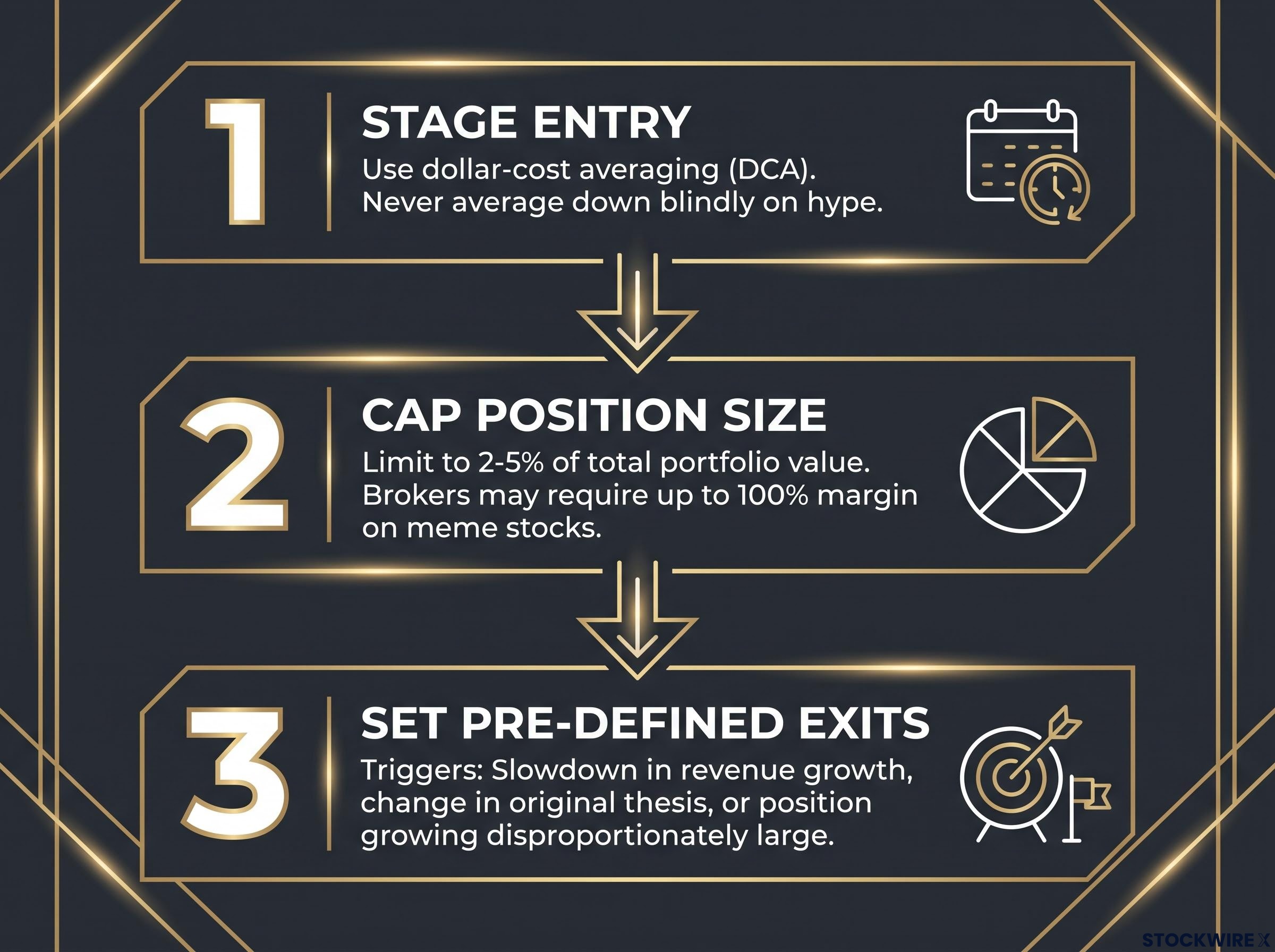
The point of this sequence is conversion. It turns a vague intention to “be disciplined” into three concrete decisions you make before the emotion arrives, not after you have already bought and the community is telling you to hold.
Spotting hype before it costs you: building your personal promotion checklist
Everything so far collapses into one usable tool. Before you commit capital to any heavily promoted stock, run it through these five questions:
- Is the executive’s social media presence disclosed and aligned with formal SEC filings, or does it look like it is targeting retail communities separately?
- Is the company’s narrative being attached to a high-profile name, an AI partner or a famous company, without a direct financial relationship that justifies the association?
- Are dedicated promotion accounts amplifying the stock, and can you identify who runs them and whether they disclose compensation?
- Does the price action diverge sharply from the fundamental trajectory in revenue growth and margins?
- Have you set a position size limit and pre-defined exit triggers before establishing the position?
Run Zeta through this checklist and the red flags surface fast. The executive appearances with content creators and the reported B2B firm steering attention toward retail hit question one. The Palantir narrative attachment hits question two. The dedicated X accounts hit question three. The 45.4% price swing against steady 25-36% revenue growth hits question four. None of that makes Zeta a fraud. It simply means you would enter, if at all, with your eyes open and a defined exit, not on momentum.
FINRA’s research is blunt on who gets hurt: investors motivated mainly by community and entertainment rather than fundamental analysis are the most vulnerable to promotion campaigns. The checklist is not a tool for avoiding every volatile stock. It is a tool for ensuring that when you own a promoted name, you own it for a deliberate reason with a defined exit, not because a community told you to hold.
For readers wanting to understand how the same psychological trap operates across broader market themes, our full explainer on recency bias and performance chasing examines how billions flowed into ARKK after its 150% return year, just before an 81% drawdown.
This article is for informational purposes only and should not be considered financial advice. Investors should conduct their own research and consult with financial professionals before making investment decisions. Past performance does not guarantee future results.
Discipline is the edge promotion campaigns cannot replicate
The disruptive technology sector will keep producing genuine opportunities and coordinated promotion campaigns at the same time, often around the very same companies. The investor who can tell them apart holds a structural advantage over most social-media-driven participation.
Your checklist, your position limit, and your exit trigger are the parts of the process a hype campaign cannot manufacture for you. Apply them to the next stock that appears in your feed, and you opt out of the behavioural loop that makes promotion profitable for promoters and expensive for everyone chasing it.