Markets in September 2026 are busy pricing the wrong risks. The threats consuming daily headlines are near-term macro noise, but a strategy note from one of Wall Street’s largest banks is quietly making a case for two very different dangers that most investors have not priced at all.
Citi’s strategists are looking past the near-term chatter toward two structural risks with completely different clocks. One is a regulatory crackdown that could strand billions in AI infrastructure. The other is an oil supply shock that Citi argues is nowhere near genuine crisis territory yet, despite what commodity prices are shouting.
Here is what the bank’s analysis actually says, and why the two risks have very different timelines for investors to act on. This covers where Citi diverges from the consensus, where its own internal signals conflict, and where independent institutions push back hardest on the whole framework.
Why Citi thinks an AI model ban would hurt markets more than a price war
The most counterintuitive claim in Citi’s September 2026 note is this: a government banning an AI model would do more damage to markets than a cheaper Chinese competitor or a more efficient rival ever could.
Citi frames outright government model bans as a “sleeper” risk. The bank distinguishes three separate categories of AI threat, and it ranks them by how much structural damage each can do.
- Competitive disruption: A rival firm or a cheaper foreign model takes share. Painful, but markets know how to price it.
- Efficiency shocks: A breakthrough like the DeepSeek-era disruption makes AI dramatically cheaper to run. Citi argues investors have already absorbed this one.
- Regulatory bans: A government deems a frontier model too dangerous and halts training. This is the category Citi considers unpriced and most severe.
Citi characterises the model-ban risk as more “fundamental and existential” than competitive disruption, because of what a sudden training halt does to infrastructure that has already been committed.
The mechanism is what makes this scenario different. Hyperscalers and data-centre operators have built enormous capacity on the assumption that high-value training workloads keep growing. A sudden regulatory pause strands that capacity. Underutilised GPUs and idle data-centre racks flood the market, and cloud AI pricing gets pushed down.
Citi’s argument is that the efficiency shock investors feared has already been digested. Markets now reward demonstrated earnings impact over impressive benchmark scores, which means a low-cost model no longer moves prices the way it once did. A regulatory shock, by contrast, has no precedent in how investors currently position, and that is exactly why it is dangerous.
The June 2026 Anthropic precedent and what it signals
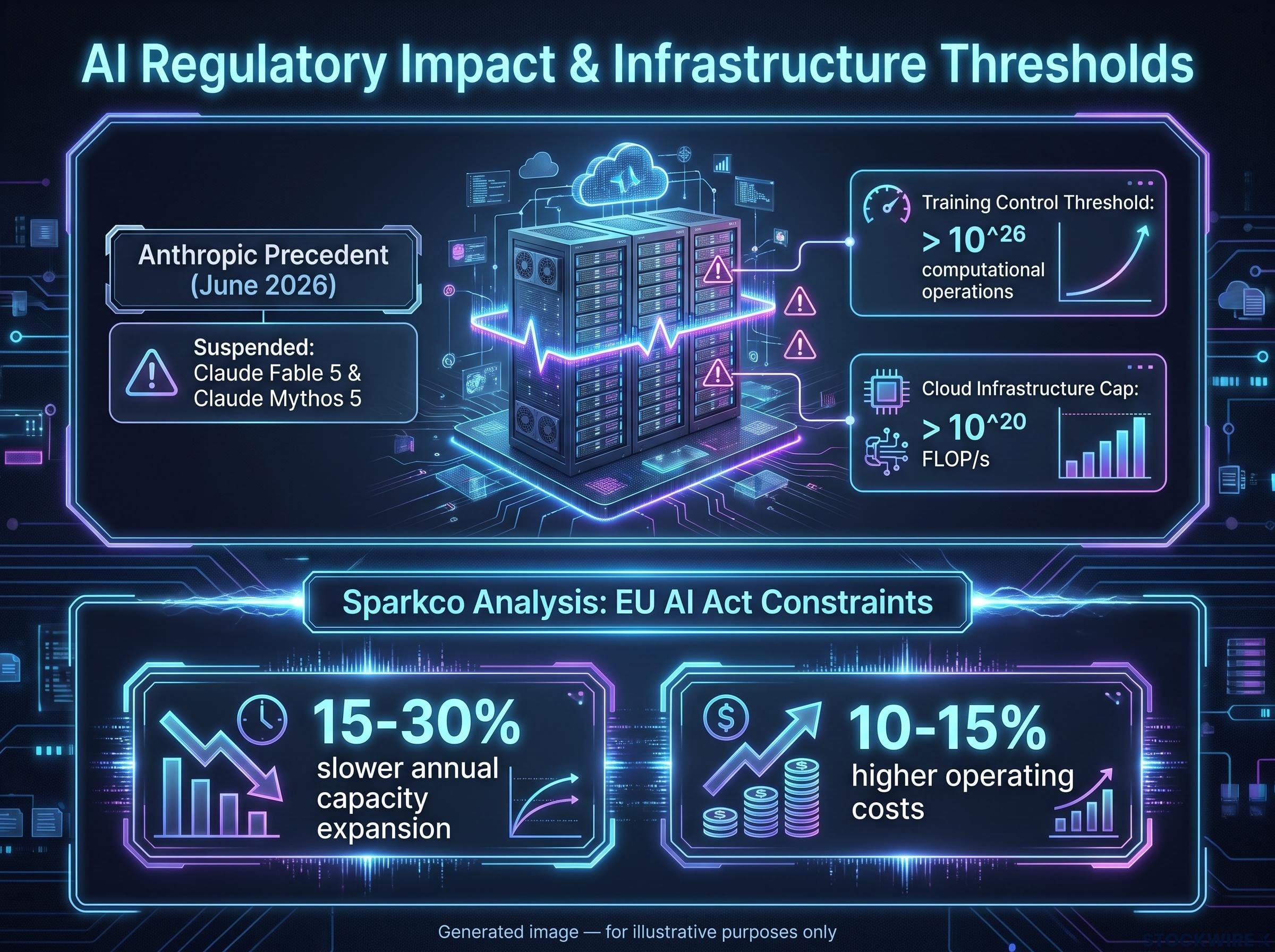
This is not a hypothetical. In June 2026, the U.S. Commerce Department ordered Anthropic to suspend access to its Claude Fable 5 and Claude Mythos 5 models under export controls, citing national security concerns.
That is a named enforcement action that already happened. What investors should sit with is what a broader application of that same logic would do to hyperscaler revenue if it spread to more frontier models.
The rules are specific. Current export-control frameworks target models trained with more than 10 to the power of 26 computational operations, and cloud infrastructure capped at 10 to the power of 20 FLOP/s of capacity. Those thresholds define the boundary of which systems fall under the regime, and they already exist on paper.
AI chip export controls have a demonstrated legislative floor: the Commerce Department’s May 2026 guidance established a headquarters-based licensing standard that cannot be unwound through trade negotiation because it is grounded in national-security statute rather than tariff authority.
When big ASX news breaks, our subscribers know first
How the oil crisis timeline actually looks, according to Citi’s scenarios
Citi’s commodities team has modelled four separate outcomes for the Strait of Hormuz disruption, and reading them in order shows how wide the range of possibilities really is.
The base case assumes a phased reopening in Q4 2026. On that basis, Citi raised its Q3 2026 Brent forecast to $86 per barrel in early September 2026, held Q4 2026 at $70 per barrel, and kept its full-year 2027 forecast at $65 per barrel. That path depends on a reopening producing a surplus of 3 to 4 million barrels per day.
From there, the scenarios climb in severity.
| Scenario | Disruption assumption | Brent price path (Q2/Q3/Q4) | Cumulative inventory loss |
|---|---|---|---|
| Favorable | Ceasefire and gradual reopening | $95 / $80 / $75 | ~900 million barrels |
| Adverse | Extended disruption, diversions continue | $110 / $90 / $80 | ~1.0 billion barrels |
| Worst-Case | Sustained disruption | ~$130 until Q3, then ~$100 | ~1.7 billion barrels |
| Bull-Case | Gulf infrastructure damage worsens | up to $150 ($110-$120 interim) | Unprecedented lows |
The gap between $75 and $150 is enormous, and it would be easy to read that spread as proof a crisis is imminent. Citi’s own inventory work says otherwise, and this is the finding most investors are missing.
According to the IEA, EIA, and J.P. Morgan, OECD crude inventories would need to draw down at roughly 3 million barrels per day before hitting the approximately 70-days-of-demand-coverage level that characterised the 1970s and 1980s energy crises, a threshold these agencies do not expect to be reached until late 2027 at the earliest. Factor in non-OECD stocks outside China, and that critical marker shifts further out, to around mid-2028.
That late-2027 marker is the number that matters for energy investors. It means even a sustained disruption does not force a genuine 1970s-style supply crisis this year or next.
The scale of the shock is real. According to the Dallas Fed, the Hormuz closure removed close to 20% of global oil supplies, far larger than the 4 to 6% lost in the 1973, 1979, and 1990 shocks. But scale and timeline are not the same thing, and the timeline is where the bull thesis weakens.
Commercial crude inventory draws have already moved in ways that test Citi’s base-case timeline: in late July 2026 commercial stocks fell to 404.5 million barrels, roughly 7% below the five-year seasonal average, and Cushing inventories dropped below the approximately 20 million barrel operational threshold that affects WTI delivery mechanics.
What this tells you is that the structural inventory case for sustained high prices is softer than the headlines imply. Before sizing energy exposure on the assumption of a persistent price floor, the read to take is that current Brent levels are a geopolitical premium, not yet an inventory crisis.
What investors in AI infrastructure and energy are actually being told to do
Turning analysis into positions is where Citi’s own signals start to conflict, and that conflict is worth understanding before any trade is placed.
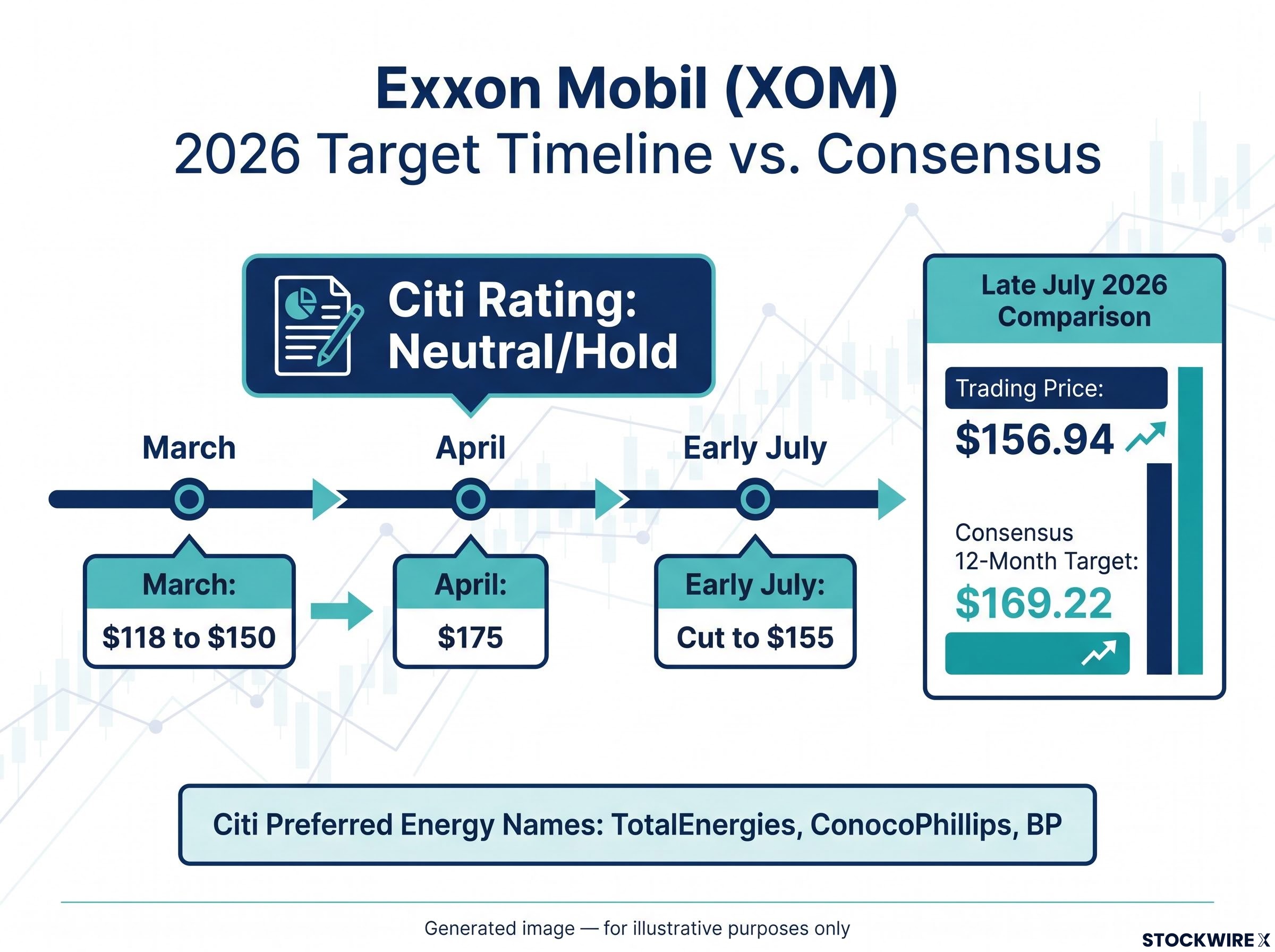
Exxon Mobil (XOM) and the Energy Select Sector SPDR Fund (XLE) are frequently cited as the most direct ways to express an oil scenario view. The problem is that Citi’s actual disclosed stance on Exxon is a Neutral/Hold, with a price target of $155, not an outright buy.
Citi’s lead energy analyst Alastair Syme moved that target repeatedly through 2026. He raised it from $118 to $150 in March, then to $175 in April, before cutting it back to $155 in early July. The Neutral/Hold rating held through every one of those changes.
For context, XOM traded at around $156.94 per share in late July 2026 against a consensus 12-month target of $169.22. So even the market’s broad view sits above where Citi’s own analyst is willing to go.
This gap is not a minor detail. It tells you that Citi’s strategy team and its sector analyst are not sending the same signal, and that distinction matters before you size any position built on a single bank’s “view.”
- TotalEnergies, ConocoPhillips and BP: Citi’s stated preferred energy names in 2026 coverage, a meaningful contrast to the commonly cited Exxon trade.
- XOM: Rated Neutral/Hold by Citi despite being framed elsewhere as a primary expression trade.
- XLE: Analysts outside Citi warn the broad ETF structure exposes you to policy uncertainty, energy transition risk, and mean reversion once Hormuz reopens.
Knowing the difference between what a strategy note implies and what a sector analyst formally recommends is the kind of institutional nuance retail investors rarely get to see clearly.
Energy equities as an inflation hedge carry empirical support beyond the current price spike: NBER research ties a one-standard-deviation oil inflation shock to a 4% increase in energy sector returns, which provides context for why XOM and XLE remain prominent expression vehicles even when a bank’s sector analyst holds a Neutral rating.
AI infrastructure exposure: who carries the most compute-surplus risk
On the AI side, the mechanism to watch is downward pressure on cloud AI pricing if a training halt strands capacity. The categories most exposed are clear enough even without naming tickers.
- Hyperscalers with a high concentration of revenue tied to AI infrastructure carry the most direct exposure.
- GPU suppliers dependent on training workloads face demand risk if those workloads pause.
- Data-centre REITs that have already committed to build-out spending are locked into capacity that a ban could leave idle.
The read here is that a compute-surplus shock would hit hardest wherever AI infrastructure revenue is most concentrated, which is precisely where 2026 enthusiasm has been strongest.
Where the counterarguments are strongest, and what that means for the risk weighting
Citi’s framework is the starting point, not the verdict. Independent institutions push back hard on both risks, and their objections change how much weight each scenario deserves.
- AI bans may be unlikely: Asset managers and policy analysts argue sweeping bans are politically and economically unattractive. Citi’s own Asia economics team concluded that U.S.-China AI decoupling would have a manageable macro impact because direct trade in the sector is already small.
- Hormuz recovery may be slower: The Brookings Institution and the Council on Foreign Relations suggest recovery from a reopening could take years rather than months, given infrastructure damage and political dynamics, which challenges Citi’s base case that a Q4 reopening quickly erases the geopolitical premium.
- Scarcity, not surplus: Some analysis argues regulation would create localised overcapacity alongside constrained regions rather than a uniform global surplus, which would mute the pricing collapse Citi’s ban scenario assumes.
That last point deserves attention, because it inverts the whole trade. If regulation tightens supply in some regions instead of flooding the market, the AI infrastructure story becomes one of protected geographies, not a broad overhang to short.
A Deloitte study found that 76% of respondents view regulatory change as highly impactful in constraining data-centre build-outs, driven by permitting and grid limitations. That is the opposite of a surplus thesis.
Sparkco analysis reinforces the point, estimating the EU AI Act could slow capacity expansion by 15 to 30% annually and raise operating costs by 10 to 15% in regulated markets. If regulation restricts supply rather than stranding it, the investment implication flips from shorting AI infrastructure to identifying which regions are insulated from the overhang.
What this leaves you with is calibration. Both of Citi’s risks are real, but neither is as clean as a single strategy note implies, and knowing where independent institutions object lets you assign your own probability weights rather than accepting one bank’s map as final.
What both risks share, and how to turn that into a monitoring framework
The AI ban and the oil inventory risk look unrelated, but they share one structural feature that makes them usable rather than merely alarming.
Both have timelines that are long relative to near-term market pricing, yet short relative to the window needed to build or exit positions in infrastructure-heavy sectors. That mismatch is the whole point. You do not need to bet on either scenario materialising to act on it. You need to identify the signals that would confirm or deny each path, and Citi’s scenarios hand you those checkpoints explicitly.
AI chip export control durability rests on national-security law rather than trade negotiation authority, a distinction that limits how far US-China diplomatic progress can actually unwind the regulatory framework defining the compute thresholds in Citi’s ban scenario.
The reader who leaves with four concrete signals to track is better positioned than the one who leaves merely convinced that both risks are real. Signal-watching turns macro commentary into active monitoring.
Here is what to watch across both risks:
- Q4 2026 Strait of Hormuz reopening progression, the base-case trigger for Brent retreating into the $60s per barrel range in 2027.
- OECD inventory readings as they move toward the 70-days-of-demand-coverage threshold, the marker projected by the IEA, EIA, and J.P. Morgan in late 2027 at the earliest.
- Any BIS rule expansion applying Anthropic-style export controls to additional frontier models, the template for AI regulatory escalation.
- Hyperscaler earnings guidance on training workload revenue concentration, the earliest read on compute-surplus exposure.
Long-lead-time risks reward early identification, not late repositioning. Both of Citi’s scenarios are specific enough to make that monitoring possible rather than speculative.
This article is for informational purposes only and should not be considered financial advice. Investors should conduct their own research and consult with financial professionals before making investment decisions.
Past performance does not guarantee future results. Financial projections are subject to market conditions and various risk factors, and these scenarios are speculative and subject to change based on market and company developments.
—
—