The commercial fitout operators best positioned to serve Sydney and Melbourne today were not shaped by those cities. They were forged in Perth, inside the pressure system of a resources boom that gave operators no room for slow delivery or budget slippage.
That distinction matters more than it might first appear. Western Australia’s non-residential construction surge did more than lift building activity; it functioned as a capability-generating event, drilling speed and cost discipline into the operators who survived it. National non-residential building approvals rose 26.1% to $7.92 billion in August 2025, so this expansion is unfolding inside an unusually active national construction environment.
If you are a business owner, landlord, or developer weighing whether a WA-originated operator belongs on your Sydney or Melbourne shortlist, this piece gives you a concrete answer. It examines what that operating background actually produces, and what separates it from the local field.
Why Perth became the proving ground for fast, cost-disciplined fitout work
Perth’s commercial property sector has run hot on the back of the resources cycle, and that heat translated directly into pressure on fitout operators. Tightening vacancy, compressed delivery windows, and unrelenting budget expectations became the operating baseline rather than the exception.
The numbers confirm the intensity. WA non-residential building activity rose 13.0% to $6.8 billion, according to the WA Economic Profile update for July 2025 (derived from ABS data). Perth CBD headline office vacancy sat at 17.1% in JLL’s Q2 2025 reporting, with prime-grade vacancy at 15.6%, after 39,732 m² of new and refurbished prime space entered the market in 2024.
Three forces are tightening the Perth office market and driving future rent growth:
- Resources-sector expansion, with mining demand anchoring CBD office absorption
- Record population growth, sustained by strong inflows into the WA economy
- A constrained future supply pipeline, with few new developments committed beyond 2025
JLL forecasts average annual prime net effective rent growth of roughly 6% from 2025-2029, with all-grade vacancy expected to fall toward the low teens (around 11.9%). Meanwhile, ABS data shows building construction business prices rose 31.1% between Q3 2020 and Q2 2024, with materials price growth averaging 4.3% in 2024.
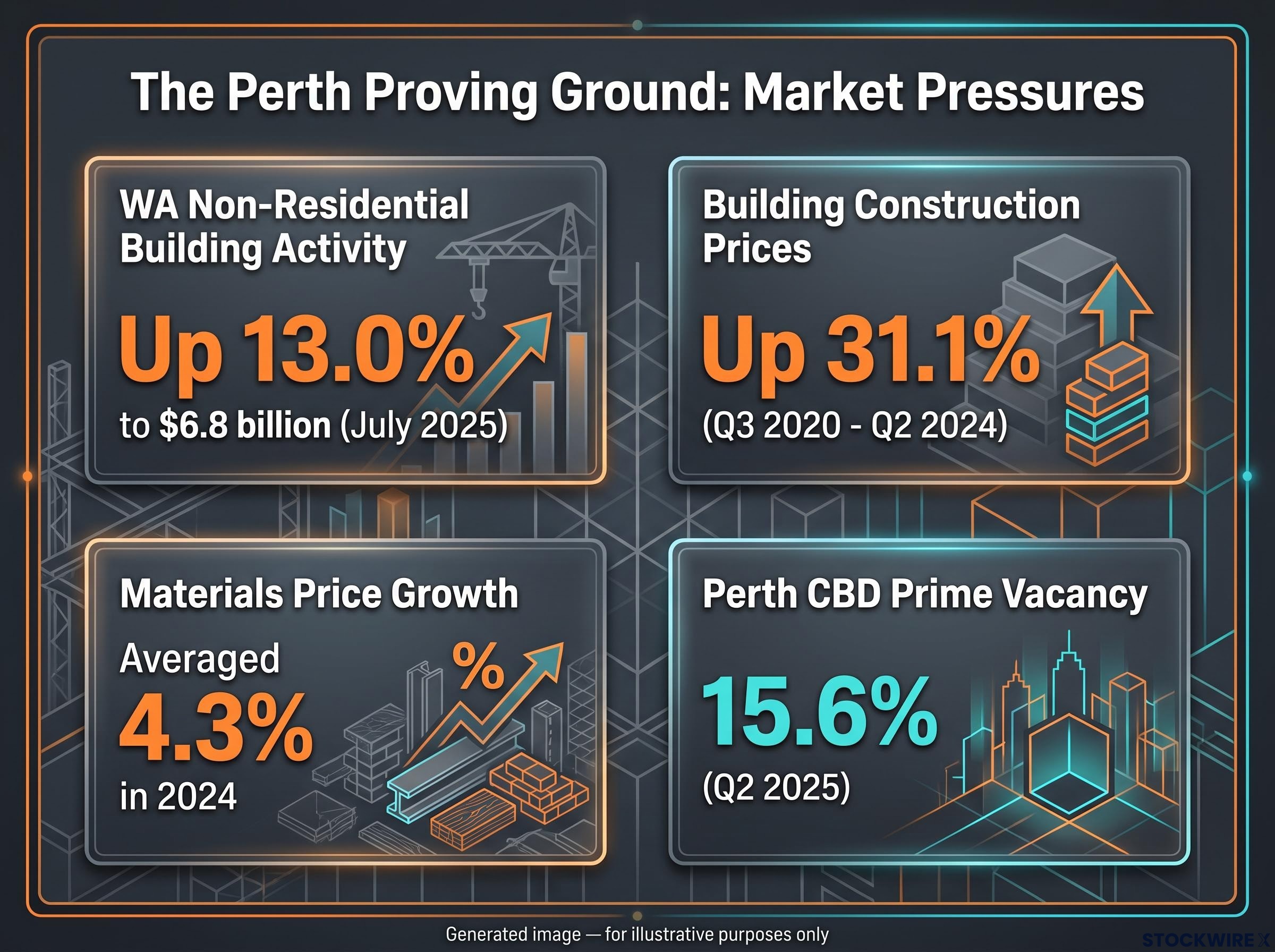
Read together, these figures tell you Perth was not a gentle upcycle. It was a structurally demanding environment where cost escalation and tight supply forced operational discipline into operators, or eliminated the ones who could not adapt.
The Perth trade labour shortage adds another layer to this dynamic: average build times have lengthened from 3.02 quarters in 2019-20 to 5.15 quarters currently, which means fitout operators who can source and coordinate tradespeople reliably hold a structural advantage over those who cannot.
The market conditions that forged a different kind of operator
Operating under those conditions produced a specific competency set: fast-turnaround execution, material sourcing under supply pressure, and subcontractor coordination on schedules that left no slack. These were not aspirations. They were survival requirements.
Hub Interiors is the case study here. It scaled through this environment as a high-volume, fast-turnaround, cost-disciplined operator, building a demonstrable project track record and client profile in WA that now underpins its move east.
When big ASX news breaks, our subscribers know first
What the east coast market actually needs right now
The Sydney and Melbourne opportunity is not the obvious growth story it looks like from a distance. The demand profile is specific, and it favours a particular kind of operator.
East coast fitout demand is being driven by three converging forces: return-to-office retrofit projects, new commercial builds, and hospitality and retail crossover work. Together they create simultaneous timeline pressure across very different project types.
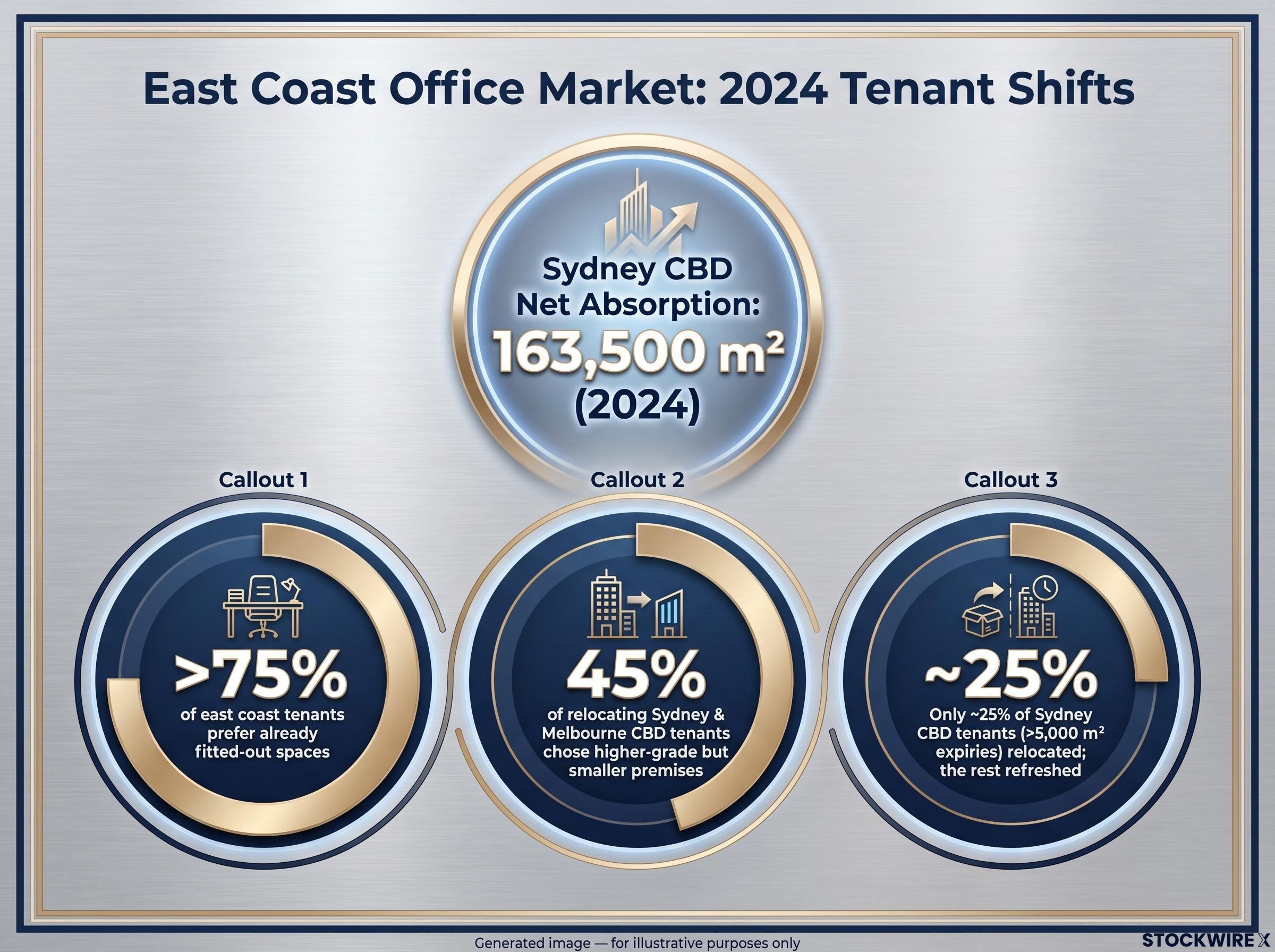
Sydney CBD was the dominant contributor to national CBD net absorption of 163,500 m² in 2024, the highest figure since 2018. Sydney CBD vacancy moved from 12.2% in January 2024 to 13.7% in 2025, rising alongside strong absorption, which points to active churn and steady fitout demand rather than a stalling market.
The flight-to-quality dynamic sharpens the picture. Among relocating Sydney and Melbourne CBD tenants in 2024, 45% chose higher-grade but smaller premises. Only around 25% of Sydney CBD tenants with lease expiries over 5,000 m² in 2024 chose to relocate; the rest refreshed existing fitouts.
The eastern seaboard office portfolio composition that landlords are managing has direct implications for fitout demand: Abacus Group’s $1.9 billion FY26 book shows 96% Eastern Seaboard exposure with prime Sydney CBD assets at 100% occupancy alongside a Melbourne asset sitting at just 8.0%, confirming the divergent lease-up conditions that drive different fitout urgency across the two markets.
That retrofit preference tells you the east coast market is not simply growing. It is changing shape in a way that rewards operators built for speed and constraint, because tenants refreshing in place have far less tolerance for project overruns than tenants moving into new space.
Cost benchmarks frame why. Here is the national anchor before the city-level detail:
National mid-range fitout benchmark: A moderate, medium-quality office fitout in Australia averages $3,011/m², according to JLL Q1 2026.
| City | Specification Level | Cost per m² Range | Source |
|---|---|---|---|
| Sydney | Low-specification | $3,357/m² | Turner & Townsend (Aug 2026) |
| Sydney | Mid-range corporate | $1,400-$2,400/m² | Turner & Townsend (Aug 2026) |
| Sydney | High-specification | $7,221/m² | Turner & Townsend (Aug 2026) |
| Perth | Refresh / mid / high-spec | $600-$2,200/m² | Cadre Build (2026) |
For a Sydney or Melbourne business or landlord, the read is straightforward: the dominant demand trend rewards operators who move quickly and hold a budget. Where that discipline came from matters less than whether the operator demonstrably has it.
Hub Interiors’ east coast proposition, and who it is built for
The east coast demand profile you have just seen has a shape. The WA capability set fits into it almost exactly, which is what makes this expansion more than an ambition play.
Hub Interiors is extending operations into NSW and Victoria around the operational differentiators built in WA: speed, cost discipline, materials sourcing, and stakeholder coordination on compressed schedules. Its target clients are specific: commercial landlords, growing businesses, and property developers managing fitout timelines under cost pressure who cannot absorb overruns.
- Commercial landlords: turnkey and spec fitouts delivered fast enough to shorten vacancy windows
- Growing businesses: cost-controlled corporate fitouts that hold to budget under a fixed timeline
- Property developers: coordinated delivery across multiple trades on tight programme schedules
This is not an experimental model. It follows an established interstate pattern that has already worked for other operators.
Why the interstate model works at scale
Successful out-of-market delivery rests on a few structural enablers: centralised design and project governance, in-house manufacturing or sourcing capacity, and local site teams paired with state-specific compliance knowledge. Those enablers are what separate operators who expand cleanly from those who stall.
The precedents are live. Shopfit Co announced a Sydney expansion in September 2023, setting up a local base to remove travel costs and hold competitive pricing. South Australian contractor Ahrens acquired Victorian firm Vaughan Constructions in 2025 specifically to build east coast scale, and firms such as Axiom Workplaces, INTREC Management, and MBM (delivering PwC national fitouts) already coordinate design centrally while sourcing local trades across capitals.
Vertical integration in fitout delivery has become a competitive differentiator at scale: SHAPE Australia’s acquisition of Australian Professional Shopfitters in July 2026 added in-house manufacturing and procurement control, illustrating how leading national operators are locking in supply-chain certainty rather than relying on external sourcing under constrained market conditions.
Read against that backdrop, Hub Interiors’ move is an execution of a proven model, not a gamble, which should raise your confidence when weighing it against local incumbents.
Where this expansion is heading, and what it means for the national fitout market
The eastward movement of WA-forged operators is bigger than any single company. It represents a structural shift in how Australian commercial fitout capability is distributed, and you are encountering it at an early stage.
Hub Interiors’ own trajectory tracks that shift: from Perth-established operator to nationally active player, with NSW and Victoria as the current expansion fronts. The broader implication is that east coast clients now have access to a different kind of operator, one whose cost discipline and delivery speed were shaped by a more demanding environment than the eastern states typically produce.
Perth’s development pipeline continues to expand despite constrained supply conditions: Finbar Group’s settlement of a $402 million South Perth site lifts its five-year pipeline to approximately $1.95 billion, a signal that institutional-scale capital is still committing to WA delivery capacity well into the 2030s.
National demand backdrop: Non-residential building approvals reached $7.92 billion in August 2025, confirming there is national appetite for capable delivery.
The demand signal reinforces the fit. With more than 75% of east coast tenants reported to prefer spaces that are already fitted out, and fitout costs still rising, the market is tilting toward operators who can deliver complete, cost-controlled outcomes faster than the incumbent field. That is precisely the capability profile the WA boom produced.
If you are shortlisting fitout companies in Sydney or Melbourne, the criteria worth applying include evidence of delivery under constraint, not just east-coast tenure.
What separates the operators worth shortlisting from those who just arrived
Pull the analytical thread to its practical end and one selection question surfaces. When evaluating commercial fitout companies in Sydney or Melbourne, the question is not where the operator is based. It is whether their delivery record was forged under cost pressure and compressed timelines.
JLL reports prime office demand rose by 272,700 m² over 2024 while secondary space shrank by 136,200 m². East coast clients are already applying quality and performance criteria when choosing buildings. The same discriminating instinct should govern how you choose the operator who fits them out.
Here is a short framework to apply when shortlisting:
- Project volume evidence: a demonstrable track record of high-turnover delivery
- Timeline track record: proof of completing on compressed schedules
- Cost discipline demonstration: evidence of holding budgets under escalation
- Constrained-market delivery: performance in genuinely demanding conditions
Hub Interiors fits this profile because its WA background makes each of these criteria demonstrable rather than aspirational. The origin is the credential.
This article is for informational purposes only and should not be considered financial advice. Investors should conduct their own research and consult with financial professionals before making investment decisions.
Past performance does not guarantee future results. Financial projections and forward-looking market statements are subject to market conditions and various risk factors.