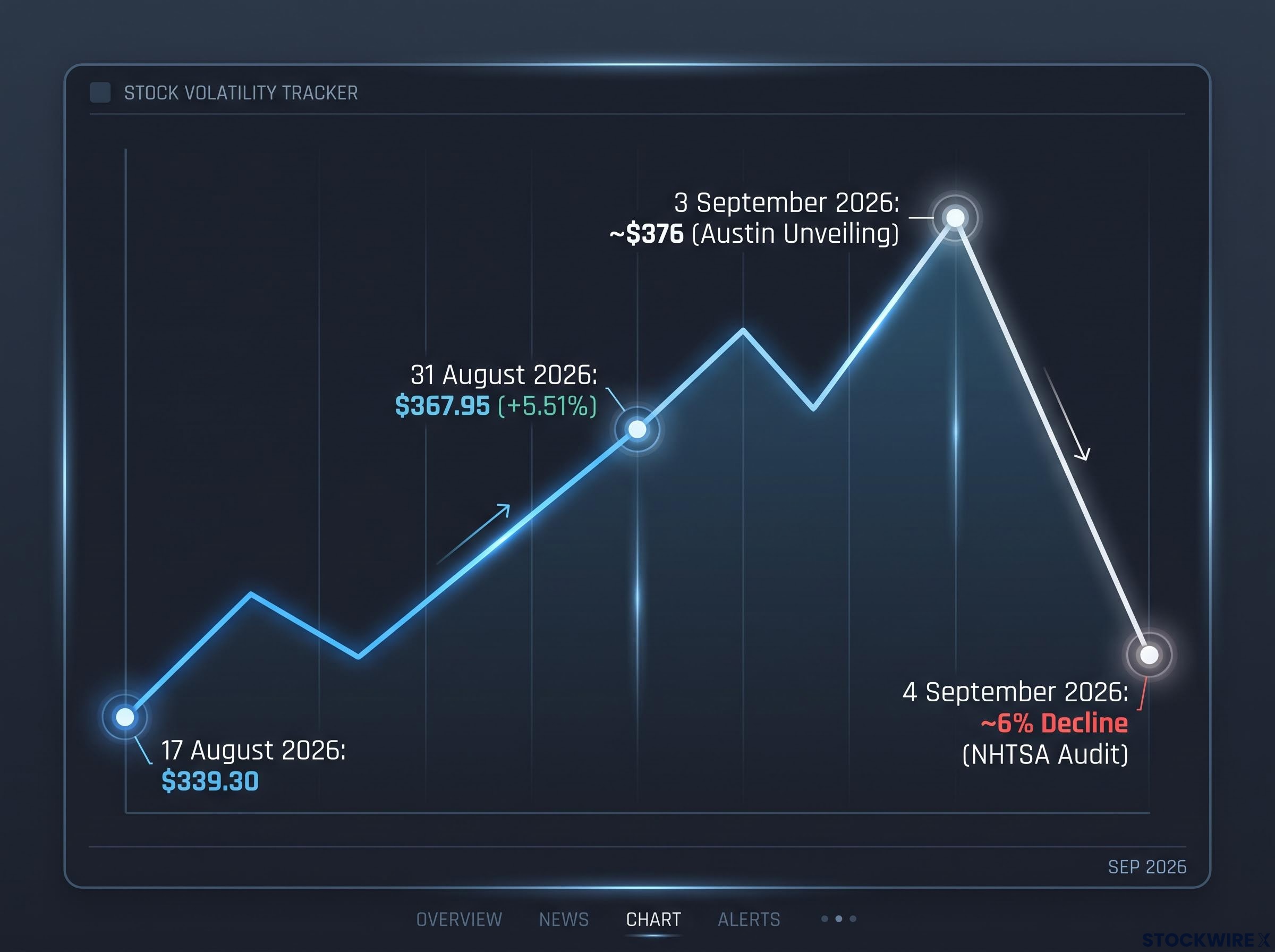
Tesla closed near $376 on 3 September 2026, the day it wheeled a steering-wheel-free robotaxi into downtown Austin and told the world the future had arrived. The next morning, the stock fell roughly 6%.
The reason for the reversal was not a change of heart about the product. It was a federal safety audit landing on the same day the first public Cybercab rides began.
That two-day whipsaw, a celebration and an investigation stacked on top of each other, is the entire Tesla autonomous story compressed into 48 hours. It is also a pattern investors have seen before.
Tesla shares do a specific thing around major product launches: they rally on anticipation, then correct when hard details or regulatory reality arrive. Understanding that structure changes how you should read what happened this week, and whether it should change your position at all.
Here is what the price action actually tells you about the Cybercab stock impact, and what it does not. The signal is real. So is the noise, and the two are easy to confuse.
The two-day Cybercab whipsaw: what the price action actually showed
The rally started well before the unveiling. Tesla shares climbed more than 18% through August 2026, outpacing rival electric-vehicle makers, as reports of an imminent Austin robotaxi launch built momentum.
The buying accelerated into the event. By 31 August 2026, the stock closed at $367.95, up 5.51% on the day, driven by anticipation of the 3 September Cybercab reveal and renewed interest in Full Self-Driving.
Here is the sequence that matters:
- 17 August 2026 close: $339.30, following reports of the imminent Austin launch
- 31 August 2026 close: $367.95, up 5.51% on the day
- 3 September 2026 close: approximately $376, after the downtown Austin unveiling
- 4 September 2026: roughly 6% decline as the NHTSA audit news landed
The reveal itself delivered. Tesla hosted a formal product event in downtown Austin on 3 September, and by 4 September at 5 p.m. Central Time, the two-seat Cybercabs officially entered the wider public Austin fleet. Public rides were no longer a promise; they were happening.
Then the second signal arrived, and it pointed the other way.
NHTSA audit scope On 4 September 2026, the National Highway Traffic Safety Administration opened a safety audit covering roughly 1,000 Tesla Cybercab vehicles nationwide. The agency is scrutinising Tesla’s self-certification given the absence of traditional driver controls, no steering wheel, pedals, or mirrors, and evaluating whether Tesla improperly deemed certain safety standards “not applicable.”
The 4 September selloff was two signals colliding in real time. Public excitement over Cybercab rides beginning, and federal scrutiny over how Tesla certified a vehicle with no driver controls, hit the tape on the same afternoon.
This was not irrational panic. It was a rational repricing of near-term execution risk, the market absorbing that the commercial reality and the regulatory reality are advancing in parallel.
Near-term execution risk is not a peripheral concern for Tesla: with over $25 billion in planned 2026 capital expenditure and negative free cash flow projected, the company is spending heavily at precisely the moment it needs to demonstrate that Cybercab operations can scale beyond a limited Austin geofence.
That parallel is the point. If you saw only the product launch, you missed the risk. If you saw only the audit headline, you missed the milestone. Both timelines will move the stock from here, and neither cancels the other out.
When big ASX news breaks, our subscribers know first
Tesla’s launch-day pattern: hype cycles have a documented shape
Start with the Model 3 in 2016. Shares jumped roughly 8-10% after the unveiling, a clean anticipation-and-relief move for a product the market wanted.
Then the Cybertruck reveal in 2019. A botched on-stage window demonstration became the story, and the stock fell more than 6% the following trading day. The reaction was immediate and visceral, tied to a single specific failure.
The 2023 Cybertruck chapter operated differently. As deliveries began and production-scaling realities emerged, the stock declined more than 20% over roughly 10 weeks. That was not a one-day flinch; it was a multi-week recalibration as the gap between promise and manufacturing reality widened.
More recent announcements tell you something about how the market has evolved. Reporting indicates Tesla stock dipped around 4% after an October 2025 “budget Tesla” announcement, erasing earlier teaser-video gains, though that exact figure is not independently confirmed. An affordable Cybertruck trim announced in February 2026 reportedly moved the share price only 0.03%, again a figure not independently verified.
Put the sequence side by side and the shape becomes hard to miss.
| Launch event | Year | Pre-event move | Post-event move | Driver of correction |
|---|---|---|---|---|
| Model 3 unveil | 2016 | Anticipation rally | Up ~8-10% | No correction; expectations met |
| Cybertruck reveal | 2019 | Rally into event | Down >6% next day | Window demo failure (immediate) |
| Cybertruck deliveries | 2023 | Elevated expectations | Down >20% over ~10 weeks | Production scaling reality (gradual) |
| “Budget Tesla” (reported) | 2025 | Teaser-video gains | Down ~4% | Announcement without execution detail |
| Affordable Cybertruck trim (reported) | 2026 | Muted interest | ~0.03% move | Market fatigue with announcement-only news |
Now name it. Anticipation rallies precede the event, corrections follow when hard details or regulatory reality arrive, and the size of the correction scales to the distance between what the market expected and what it actually got.
The shrinking reaction to successive announcements tells you the market has grown more sophisticated about separating announcement value from execution value. A press release no longer moves the stock the way it once did.
For you, the practical read is this: the anticipation rally is the part you should be most cautious about buying, because it prices hope. The sustained moves have historically come from execution milestones, and Cybercab will be judged by that same standard.
What Cybercab actually is and why the deployment timeline is longer than headlines suggest
The Cybercab is not a modified consumer Tesla. It is a purpose-built, two-seat autonomous vehicle with no steering wheel, no pedals, and no mirrors, and that single design choice is why its regulatory path is more complicated than anything Tesla has launched before.
What makes Cybercab legally and technically distinct from prior Tesla vehicles
Under US law, the NHTSA does not pre-approve new vehicle technology. Manufacturers self-certify that they meet Federal Motor Vehicle Safety Standards, and the agency investigates after deployment.
That system was built around vehicles with human drivers. A car with no driver controls does not fit neatly into standards that assume a steering wheel exists, which is exactly why the current audit is examining whether Tesla improperly deemed certain safety standards “not applicable.”
NHTSA’s automated vehicles report to Congress documents exactly this tension, identifying how existing Federal Motor Vehicle Safety Standards were written around the assumption that a human driver is present and how removing the steering wheel and pedals forces manufacturers into certification grey zones that the agency is still working to resolve.
“Not applicable” is the phrase carrying the risk. If Tesla decided a given standard does not apply because there is no steering wheel, and the NHTSA disagrees, the vehicle’s certification basis comes into question. That is a live near-term risk, not a hypothetical one.
Reading the deployment clock: phases, dependencies, and realistic ranges
The Austin operation did not start with Cybercab. In June 2025, Tesla launched a paid service using roughly 10 driverless Model Y vehicles at a flat $4.20 fare, inside a limited South Austin geofence, running 6 a.m. to midnight with employees monitoring.
By 3 June 2026, that footprint expanded to a 245-square-mile Austin Metro geofence, with human safety drivers removed from many rides. The Cybercab was added to the Texas robotaxi roster on 31 August 2026, with the formal unveiling and first public rides following on 3 September.
Here is the realistic deployment sequence:
- Austin pilot (now): Limited public Cybercab fleet, building on the existing Model Y robotaxi service and the expanded metro geofence.
- Initial city expansion (2027): Tesla’s 28 January 2026 SEC filing targeted the first half of 2026 for unsupervised operations in Dallas, Houston, Phoenix, Miami, Orlando, Tampa, and Las Vegas, though independent coverage places meaningful scale closer to 2027.
- Sun Belt scale-up (2027-2029): Larger rollout across warm-weather markets, dependent on FSD v15 performance and state approvals.
- National reach (2029-2031): Widespread coverage, dependent on regulatory clearance and fleet manufacturing scale.
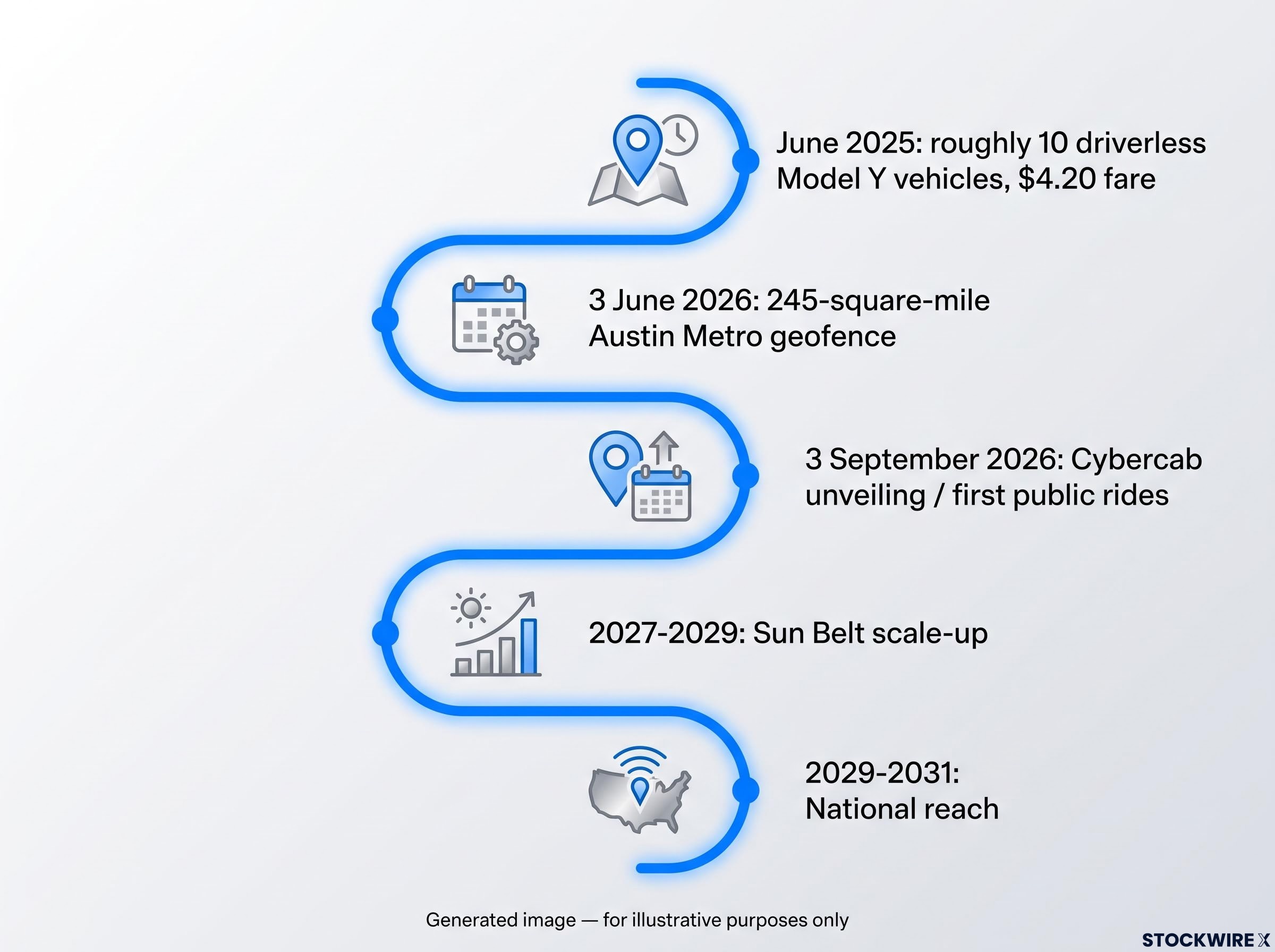
Each phase hangs on the same three dependencies: FSD v15 performance, regulatory approval, and manufacturing scale. None of these is a marketing decision Tesla can accelerate by announcement.
The gap between Tesla’s SEC filing ambition for the first half of 2026 and today’s limited Austin pilot is the tell. Timelines in autonomous vehicle deployment are structural, not strategic, and underestimating that gap is where most AV investment theses go wrong.
For context on the bar Tesla must clear, Waymo has run commercial operations in Phoenix since 2023, carries an implied valuation of roughly $126 billion, and according to a Stifel estimate, more than 1,500 robotaxis already operate commercially in the US today, a figure projected to reach 35,000 by 2030. Longer-term projections from the McKinsey Center for Future Mobility and The Economist place mass Level 4 robotaxi rollout closer to 2030. Tesla is entering a contested market, not building an empty one.
Bull case, bear case, and what to actually watch: how analysts are pricing long-term autonomous vehicle value
The bull case is structural, and Morgan Stanley states it most directly: robotaxis are the “single biggest driver” of Tesla shares in 2026. The logic is a flywheel, where every additional autonomous mile improves the model, which lifts FSD attach rates, which drives cash flow, which funds more miles.
Wolfe Research projection Tesla’s robotaxi business could generate up to $250 billion in revenue by 2035, assuming 30% autonomous-vehicle penetration, 50% Tesla market share, and $1 per mile pricing, implying roughly $900 billion in discounted equity value.
Morningstar also treats robotaxis as a major component of its long-term fair-value estimate for Tesla. The bull case is not fringe; it sits inside mainstream valuation models.
Tesla’s robotaxi valuation premium sits inside mainstream analyst models, not fringe projections, with Morgan Stanley naming autonomous vehicles the single biggest driver of shares and Wolfe Research embedding a $900 billion discounted equity value in its bull scenario, conditional on specific market-share and pricing assumptions holding through 2035.
The bear case is equally specific. After the October 2024 Cybercab reveal, analysts at Barclays, Piper Sandler, and Morgan Stanley criticised the lack of actionable fundamentals, with some calling it a “publicity stunt.”
Forrester analysts have argued it would be extremely difficult for Tesla to deliver a Cybercab under $30,000 in the 2026-2027 window given cost and regulatory hurdles, though that specific figure is not independently confirmed. And the open NHTSA audit is the bear case made concrete: a live regulatory risk to near-term scaling.
| Claim | Bull case | Bear case |
|---|---|---|
| Revenue potential | Up to $250B by 2035 (Wolfe) | Requires unproven market-share and pricing assumptions |
| Strategic weight | “Single biggest driver” of shares (Morgan Stanley) | Narrative thesis lacking actionable fundamentals |
| Product economics | Low-cost purpose-built robotaxi | Sub-$30,000 unit called extremely difficult (Forrester) |
| Regulatory path | Self-certification enables speed | Open NHTSA audit questions certification basis |
The more useful move is to stop asking who is right and start asking what would have to be true. Four empirical metrics will resolve this debate by 2029-2031:
- Fleet scale and geography: How many fully driverless Cybercabs operate across how many metros, benchmarked against the projected 35,000 US robotaxis by 2030.
- R&D-to-mile efficiency: How much research spending it takes to generate disengagement-free miles.
- Unit economics: Per-trip profitability, revenue per mile, and operating margins, moving from pilot to sustained cash flow.
- Regulatory standing: The transition from audited pilot, like the current NHTSA review, to standard commercial operations.
Treat the $900 billion Wolfe figure as a scenario, not a forecast. It only holds if Tesla hits specific share and pricing assumptions by 2035, so the honest question for you is which of those four metrics you are most confident, or least confident, Tesla will achieve. You do not need to join a camp. You need to know what evidence would move you.
What the Cybercab era actually changes for investors who hold or are watching Tesla
The launch does not hand you a buy-or-sell trigger. What it changes is the weighting, how you balance Tesla’s near-term revenue against its long-term autonomous optionality now that both timelines are confirmed to be running at once with very different risk profiles.
If you searched for how the Cybercab affects the stock, you are making a positioning decision, so here is a direct framework. Three variables should drive it:
- Time horizon: Meaningful Cybercab scale is more likely in 2027 at the earliest, with a national network closer to 2029-2031. A short horizon and a multi-year thesis do not mix well here.
- Regulatory risk tolerance: The NHTSA audit remains open as of 4 September 2026, with self-certification questions unresolved. If open regulatory risk keeps you up at night, that is a real input.
- The metric you most trust Tesla to hit first: Fleet scale, unit economics, R&D efficiency, or regulatory standing. Whichever of the four you have the most conviction in should anchor your view.
There is also a competitive reality to hold in mind. Waymo is already operational and more than 1,500 robotaxis are commercially active in the US today, so Tesla is entering a contested market, not creating a monopoly.
The contested robotaxi market that Cybercab is entering already has structural incumbents: in the three US cities with active Waymo operations, Uber’s trip growth accelerated rather than declined quarter-over-quarter, suggesting that platform aggregation and AV supply fragmentation may actually reinforce existing ride-hail networks rather than displace them.
The August-into-September volatility is very likely a preview. Each city expansion will carry the same anticipation-rally, execution-reality structure the historical record shows, and FSD v15 performance sits underneath both the regulatory case and the commercial case.
An investor with a long horizon and a high tolerance for regulatory event risk is positioned very differently from one hunting near-term catalysts. Locate yourself in that framework, and the correct action for your circumstances becomes a lot clearer than any blanket recommendation could make it.
This article is for informational purposes only and should not be considered financial advice. Investors should conduct their own research and consult with financial professionals before making investment decisions. Past performance does not guarantee future results, and financial projections are subject to market conditions and various risk factors.
The Cybercab story is just beginning, and so is the uncertainty
The 3-4 September 2026 event settled one question and opened many. Cybercab is operationally real; it is carrying public riders in limited Austin areas right now.
The distance between “operationally real in limited Austin areas” and “commercially scaled national network” is where nearly all of the valuation debate lives. That distance is measured in years and regulatory outcomes, not press releases.
The next twelve months will be the most informative stretch investors have had on this thesis. FSD v15 regulatory results, the resolution of the NHTSA audit, and whether Tesla actually adds the cities named in its January SEC filing, Dallas, Houston, Phoenix, Miami, Orlando, Tampa, and Las Vegas, will together show whether Cybercab is tracking toward a 2027 expansion or slipping toward the 2029-2031 outer boundary.
The correct posture right now is not conviction in either direction. It is systematic attention to the four tracking metrics as each expansion and each regulatory development lands. Watch the evidence arrive, and let it, rather than the launch-day excitement, decide your thesis.