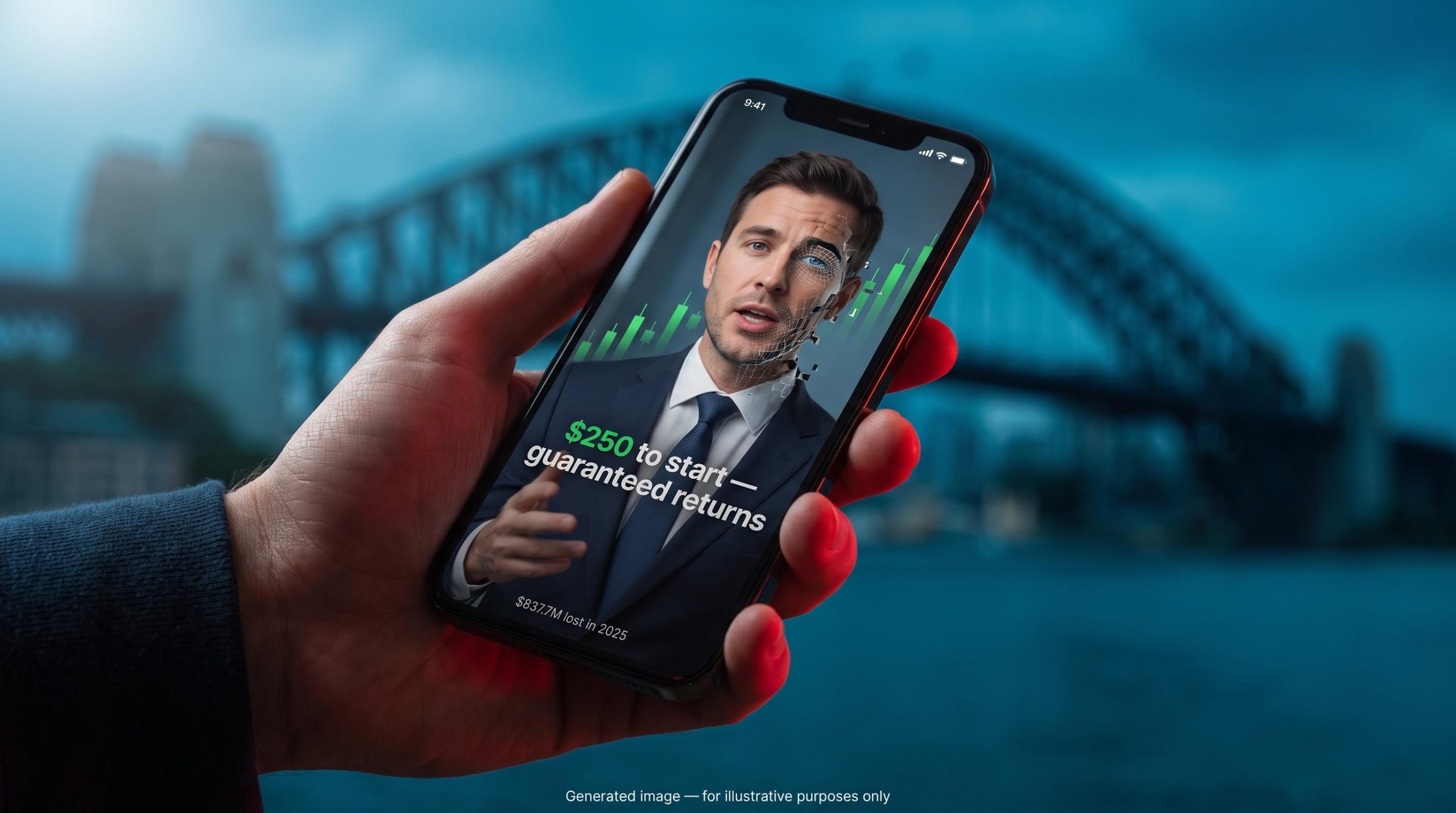
A video of a familiar face appears in your social media feed. It is the Prime Minister, or an ABC finance journalist, or a well-known business figure, speaking directly to camera about an investment opportunity that sounds almost too good to walk away from. The face is real. The voice is right. The endorsement is a complete fabrication.
This is the tactic behind the current wave of pump and dump scam activity in Australia, and it is working with alarming efficiency. In the first half of 2026, scam-related submissions made up nearly one in five of all misconduct reports received by the Australian Securities and Investments Commission (ASIC). Investment scams as a whole cost Australians $837.7 million in reported losses in 2025.
ASIC has issued escalating warnings throughout 2025 and 2026 and has directed enforcement resources specifically at these schemes. That should tell you how seriously the regulator now treats them.
Here is what you will take away from this: exactly how these scams are built stage by stage, the specific signals that expose a scheme before you part with any money, and the precise steps Australian authorities recommend the moment you suspect you have been targeted.
Why fake celebrity investment ads are everywhere right now
The volume is the first thing to understand. According to ABC reporting, ASIC removed a record 19,400 online scams in one recent year, an increase of 182% on the year before. That is not a slow creep in fraudulent activity. That is a fraud environment industrialising in real time.
The financial toll matches the scale of the infrastructure.
Australians reported $837.7 million in investment scam losses in 2025, making it the single largest scam category by dollars lost. Source: Targeting Scams Report 2025, published by the National Anti-Scam Centre (NASC) and Scamwatch on 30 March 2026.
Total scam losses across all categories reached $2.18 billion in the same year. ASIC’s own recent releases confirm the trend is sharpening: a July 2026 media release (26-157MR) flagged a spike in pump-and-dump scams using fake celebrity endorsements across social media and WhatsApp, and an August 2026 warning (26-195MR) singled out deepfake videos of celebrities and politicians promoting fake schemes.
The scale of investment scam losses in Australia reflects a paradox: ASIC removed nearly 12,000 scam websites in 2025, a 90% increase on the prior year, yet aggregate losses still reached $2.18 billion across all scam categories, with fewer incidents producing higher losses per victim.
The people being impersonated are chosen precisely because you trust them:
- Politicians, including the Prime Minister
- ABC finance journalists and other media figures
- Prominent Australian business leaders
That trust is now a liability rather than an asset. In one Western Australian case, a single victim lost more than $10 million after being drawn in by a fake celebrity endorsement video.
How deepfakes changed the scam calculus
A deepfake is a video or audio recording generated by artificial intelligence to make a real person appear to say or do something they never did. The technology has become good enough, and cheap enough, that scammers can now produce convincing endorsements at industrial scale.
This is why the old rule of thumb no longer protects you. “If it looks fake, it probably is” assumes fakes look fake. These do not.
ASIC states that generative AI has allowed scammers to build vast networks of deepfake websites and endorsements. The regulator is explicit that “a quick online search is not enough,” because scammers construct inter-linked networks of fake review sites designed to intercept your verification attempt and reassure you at exactly the moment you go looking for reassurance.
AI investment scams have expanded well beyond deepfake video: fraudsters now produce synthetic ASIC licensing documents and cloaked advertisements capable of passing platform moderation, meaning the deception can begin before a target ever sees a celebrity endorsement.
When big ASX news breaks, our subscribers know first
How a pump-and-dump scheme actually works, step by step
Understanding the sequence is the most reliable early-warning tool you have. If you can name the stage you are in, you can leave before the expensive part arrives. Here is the anatomy these schemes follow, drawn from ASIC’s July 2026 release (26-157MR):
- The hook. A social media ad or clickbait post featuring a deepfaked celebrity promotes an investment promising outsized returns.
- Redirection. Clicking sends you to an imposter website or a fake news article mimicking a reputable outlet, often misusing trusted brands or even the ASIC logo.
- Sign-up. The page collects your contact details, and a scammer posing as an “account manager” gets in touch.
- Initial payment. You are asked for an access fee or minimum investment, typically around $250, a figure calibrated to feel low enough to risk.
- The illusion of profit. You are given a fake dashboard showing small early gains, building your confidence before the real ask.
- Escalation. You are pushed to invest more, or moved into WhatsApp or Telegram groups where planted accomplices post fake profit screenshots to manufacture momentum.
- The dump or lock-out. Organisers sell their holdings and the price collapses, or withdrawal requests get blocked behind demands for extra “taxes” and “fees.”
There is an eighth stage most people never hear about: secondary exploitation. Victims are frequently retargeted by “recovery scams,” where a new fraudster demands a fee for the false promise of clawing back the money already lost.
The design here matters. By the time you are asked for a large sum, the fake dashboard has already done its work. Falling for this is a designed outcome, not a personal failing.
The two main variants share this DNA but differ in the mechanics of the loss:
| Scheme type | Primary lure | Typical platform | How money is lost | Secondary trap |
|---|---|---|---|---|
| Pump-and-dump share scheme | Insider stock tips and boasts of profit | WhatsApp or Telegram groups | Coordinated buying inflates a thinly traded stock, then organisers sell and the price collapses | Recovery scam fees |
| Fake investment platform | Deepfake celebrity endorsement | Imposter website with fake dashboard | Withdrawals blocked behind “tax” and “fee” demands | Recovery scam fees |
The regulatory response reflects the seriousness of the harm.
In July 2024 (24-161MR), ASIC charged four individuals over an alleged Telegram pump-and-dump conspiracy. The charges carry potential penalties of up to 15 years imprisonment.
The human cost is just as concrete. One Australian man lost $80,000 in cryptocurrency after registering through a fraudulent site promoted by a deepfake interview with Elon Musk.
The red flags that separate a real investment from a scam
You do not need to become a fraud analyst to protect yourself. You need a short list of testable signals you can run through in the moment, before money moves.
Visual and structural signals
- A celebrity endorsement for an investment appearing in a social media ad or feed
- A $250 initial deposit or “access fee” to get started
- “Taxes” or “fees” demanded before you can withdraw your own money
- A provider that cannot be found on ASIC’s Australian Financial Services Licence (AFSL) register
- A slick dashboard showing early profits you cannot actually withdraw
These are the hallmark warning signs NASC identifies, and the Australian Federal Police (AFP) advice is blunt: treat all celebrity endorsements with deep scepticism and avoid clicking investment links circulating on social media.
Scams that pass the usual checks represent a harder category: the Capital Guard case showed that a firm can hold a genuine, current ASIC-issued AFS licence and still operate a fraudulent bond scheme, collecting $17.4 million from 80 Australian investors before regulators intervened.
How to verify before you invest
The tools you need are free, authoritative, and government-maintained. Most Australians who get caught never use them. Run these checks in order:
- Search the provider on ASIC’s professional registers to confirm it holds a current AFSL.
- Check the entity name against ASIC’s Investor Alert List, which names businesses the regulator has flagged.
- Run any URL that prompted the offer through ASIC’s website-verification tool, launched in April 2026 (26-063MR) specifically to catch imposter investment sites.
You can also confirm membership of the Australian Financial Complaints Authority (AFCA) for additional assurance. These checks take under two minutes combined.
Do not rely on a Google search of the company name.
ASIC warns that “a quick online search is not enough,” because scammers build inter-linked networks of fake review sites designed to reassure you.
Communication signals that mark a scam
The way you are contacted is often the clearest tell. Watch for unsolicited approaches through WhatsApp or Telegram, pressure to act quickly before you have time to think, and group chats where multiple participants conveniently claim to be profiting. Any request to move the conversation off a regulated platform and into a private messaging app is a signal to stop, not to continue.
What to do immediately if you think you have been targeted
Speed changes outcomes. Australians who act within hours of spotting a scam have a meaningfully better chance of stopping a transaction than those who wait. NASC frames the response around a simple structure.
Pause. Verify. Report. Pause before transferring money or sharing details. Verify the counterparty independently. Report the scam to your bank, the Australian Cyber Security Centre (ACSC), and Scamwatch. Source: National Anti-Scam Centre consumer guidance.
Here is the sequence to follow:
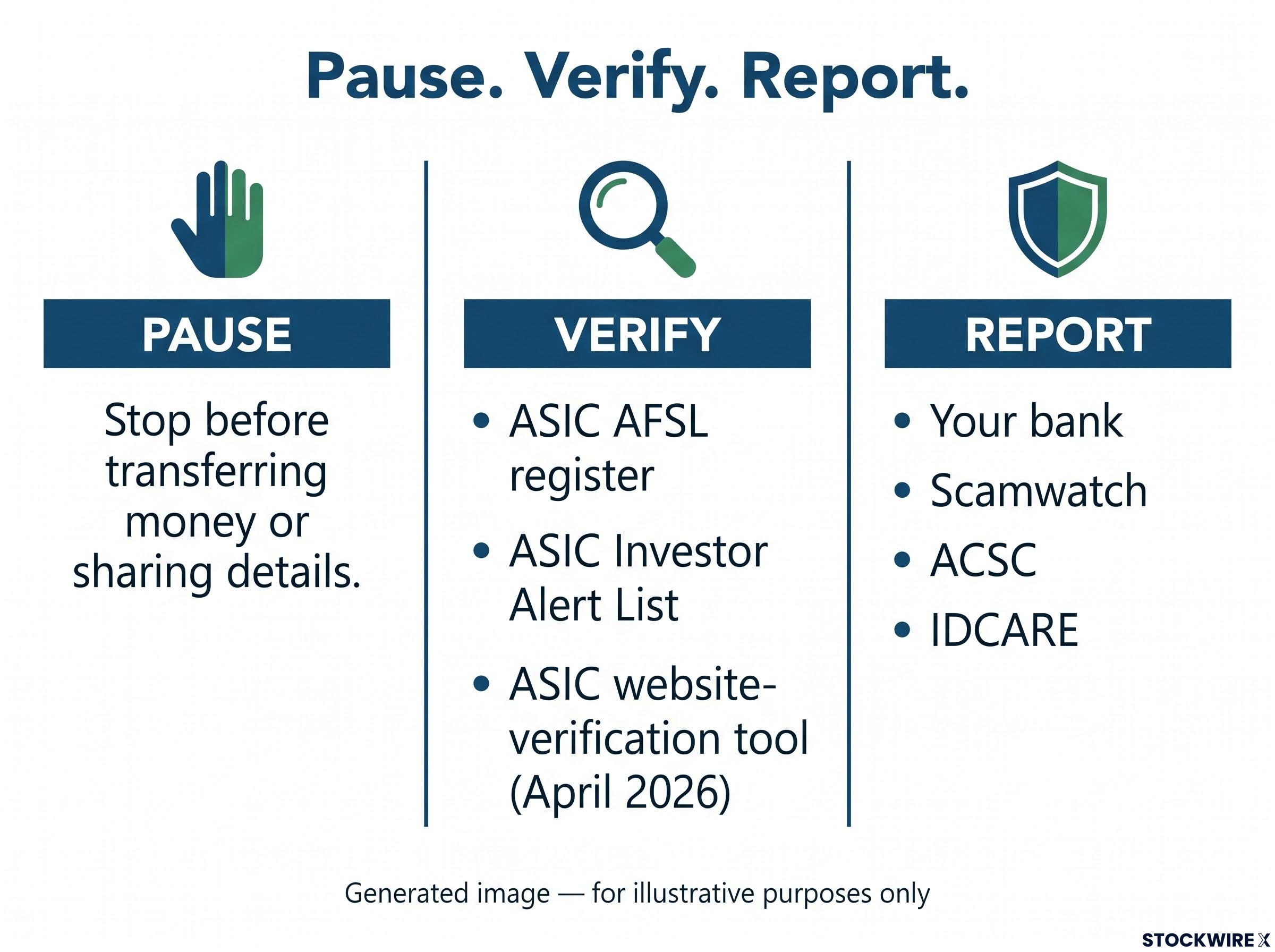
- Contact your bank or financial institution immediately to stop or reverse the transaction. This is the single most time-sensitive step.
- Report the scam to Scamwatch, which is operated by NASC.
- Report cyber elements to the ACSC through ReportCyber.
- Contact IDCARE for free identity and cyber support.
- Change your passwords and secure any accounts the scammers may have accessed.
Knowing which body does what helps you route your report to the right place:
| Organisation | What they handle | How to contact |
|---|---|---|
| Scamwatch (NASC) | Scam reports that feed takedown and disruption operations | Scamwatch website |
| ACSC | Cybercrime and online fraud reports | ReportCyber |
| IDCARE | Free identity and cyber support for individuals | IDCARE service |
| Your bank | Stopping or reversing transactions | Direct, immediately |
Reporting does more than help you. In 2024, NASC referred over 8,000 URLs for takedown, including more than 2,000 investment-related scams, and these operations rely directly on public reports. When you report a scam, even one that never cost you a cent, you help dismantle the infrastructure targeting the next person.
That systemic value matters because under-reporting is a genuine problem. Shame and embarrassment, particularly among older Australians, keep many losses hidden, which distorts the official picture and lets scammers keep working the same demographics undisturbed. ASIC prioritises scam reports for assessment ahead of other categories, so a report you file is acted on quickly.
What you can check today to protect yourself going forward
The most useful thing you can do right now is turn this into three standing habits, not a one-off act of caution:
- Verify AFSL status on ASIC’s professional registers before engaging with any investment offer.
- Treat a celebrity endorsement as a scam signal, not a trust signal.
- Report any suspicious contact to Scamwatch, whether or not you lost money.
Why does personal vigilance still carry so much weight? Because the regulatory backstop is not fully in place yet. The planned Scam Prevention Framework is expected to introduce mandated controls for banks, telcos, and digital platforms, but full implementation is not anticipated until around 2027. Until then, the checks you run yourself are the primary line of defence.
Two standing resources deserve a permanent bookmark: ASIC’s Moneysmart website for consumer financial education, and ASIC’s professional registers for verifying any provider on demand. Between them, they give you a free way to check almost any investment offer before you commit.
For readers wanting to run every available check before committing funds, our dedicated guide to verifying any Australian broker walks through the exact AFSL, ASIC, AFCA, and ABN sequence in under 15 minutes, including how to search the Banned and Disqualified Registers by individual name.
The stakes justify the habit. Investment scams remain the single largest category of scam loss in Australia, at $837.7 million in 2025. A reader who leaves knowing which tools to check is materially safer than one who leaves with only a vague sense of unease.
This article is for informational purposes only and should not be considered financial advice. Investors should conduct their own research and consult with financial professionals before making investment decisions.