
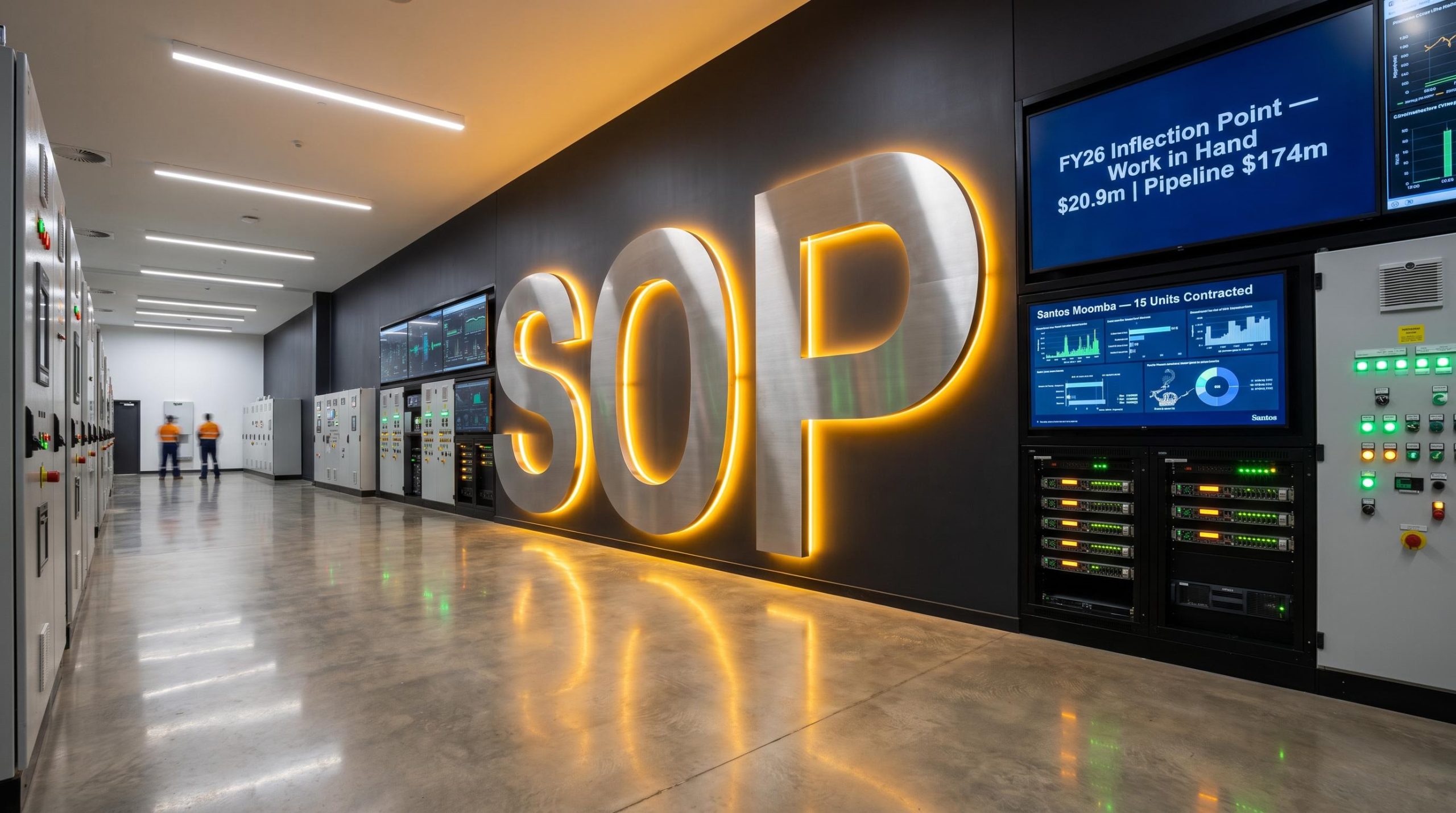
Synertec’s FY26 turnaround: $4.6m operating cash swing and 188% jump in work in hand
In its FY26 full-year results presentation dated 2 September 2026, Synertec Corporation framed the year as an inflection point built on three structural changes: base restored, technical excellence continued, and growth contracted.
Management detailed a $4.6m operating cash turnaround, delivering net operating cash inflow of +$0.5m. This marked the company’s first full-year inflow since FY19, a return to positive operating cash flow rather than a first-ever result.
Group revenue rose 19% against the prior corresponding period. Work in hand reached $20.9m, up 188%, representing approximately 68% of FY27 revenue guidance.
Taken together, the presentation positioned FY26 as the pivot from restructuring toward contracted growth.
When big ASX news breaks, our subscribers know first
FY26 financial performance: cash and EBITDA both inflect
The results presentation outlined a twin turnaround narrative across operating cash flow and earnings before interest, tax, depreciation and amortisation (EBITDA).
Operating cash flow moved from an outflow of ($4.1m) in FY25 to an inflow of +$0.5m in FY26, a swing of $4.6m. The company also recorded a sequential improvement in normalised EBITDA across four consecutive halves.
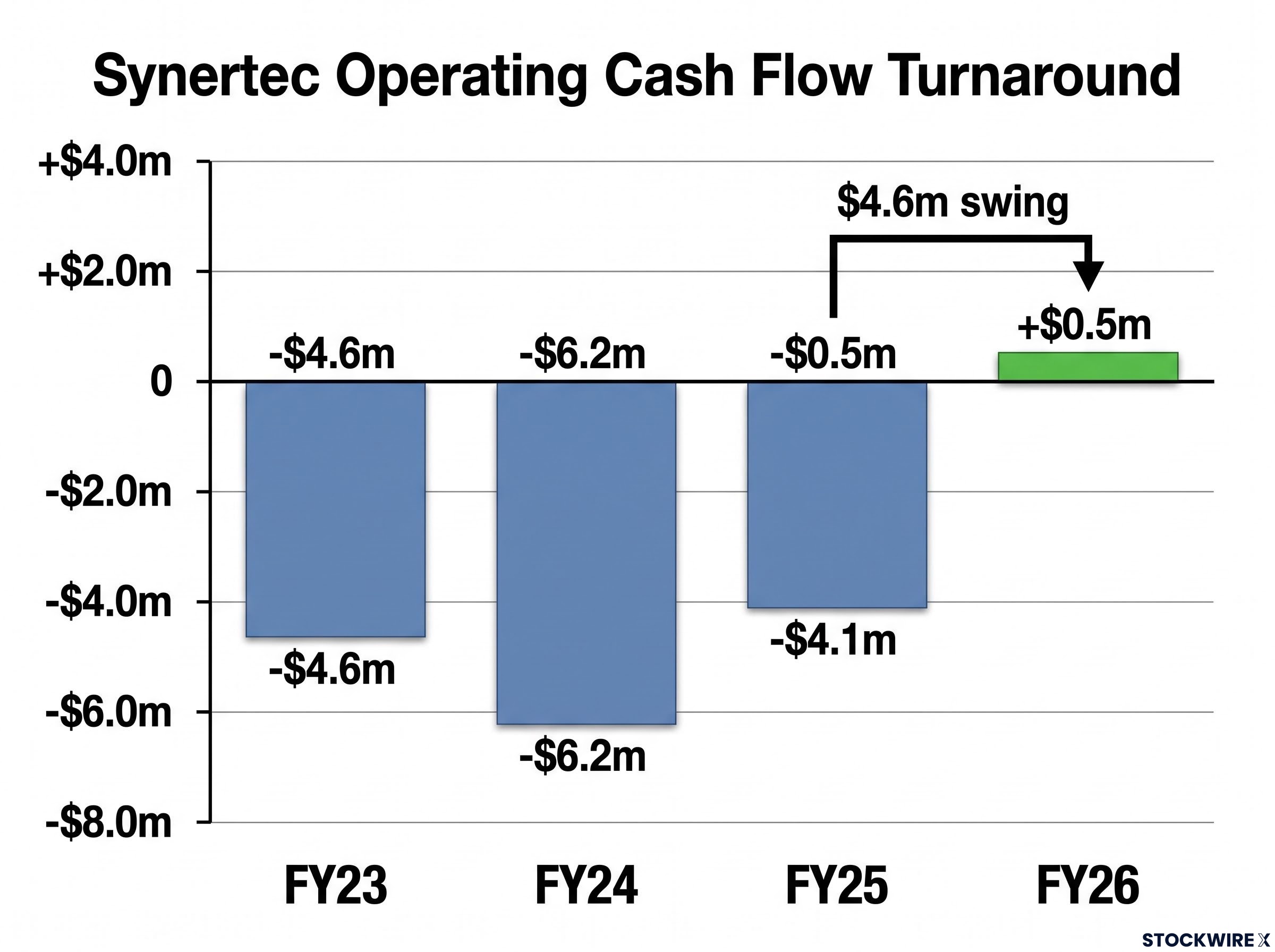
| Metric | FY23 | FY24 | FY25 | FY26 |
|---|---|---|---|---|
| Operating cash flow | ($4.6m) | ($6.2m) | ($4.1m) | +$0.5m |
Supporting metrics from the presentation included:
-
Normalised EBITDA 2H26: breakeven (2H26 at ($0.4m), improved from ($1.5m) in 1H26)
-
Engineering contribution margin: +35% versus the prior corresponding period
-
Corporate cost-out: $1.5m
The sequential EBITDA improvement across four halves, from ($3.4m) in 1H25 to ($0.4m) in 2H26, suggests operating leverage taking hold as the cost base was reduced.
Why engineering panels and recurring technology revenue matter
Two structural features of Synertec’s model underpin its revenue visibility: pre-qualified engineering infrastructure panels and recurring technology revenue from its Powerhouse platform.
Pre-qualified engineering infrastructure panels are approved supplier lists that major asset owners use for capital projects. Synertec is pre-qualified on nine such panels, with agreements typically running 5 to 7 years and specialist works reserved to panel members.
The presentation framed four investor benefits from this position:
-
Barrier to entry through pre-qualification for major capital projects
-
Exclusivity, with specialist works reserved to panel members
-
Revenue visibility via multi-year streams with extension options
-
Long-term nature, with agreements typically running 5 to 7 years
On the technology side, Powerhouse generated $2.5m in recurring technology revenue, up 23%. The presentation detailed two commercial models: the BOOM model, described with economics of >90% EBITDA and >27% IRR, and the Sale model, described at >20% gross margin at scale.
The combination is designed so panels de-risk engineering revenue while recurring technology revenue compounds over time.
Engineering pipeline leveraged to water and critical infrastructure spending
Management highlighted that the engineering business is positioned to benefit from structural infrastructure investment. The engineering pipeline reached $174m, up 60% on the prior corresponding period.
Client capital programmes are expanding. The presentation referenced the Melbourne Water FY27–FY31 Water Plan at $7.3bn, up 51% on the prior five-year period, and the Sydney Water long-term plan at approximately $32bn, an increase of around $20bn over the comparative period.
The company also flagged the Sydney Water SCADA and Electrical Services Panel, representing approximately $245m of potential project work over the next five years. Management identified population growth, data centres, climate resilience, and asset renewal as the underlying growth drivers.
The Sydney Water panel appointment, secured within nine months and delivering $1 million in initial contracts, provides early evidence of Synertec’s ability to convert multi-year panel positions into active revenue, a conversion dynamic that underpins the $64 million NSW pipeline figure.
The state breakdown, distinguishing FY26 revenue from pipeline, was outlined as:
-
NSW: FY26 revenue $2.0m; pipeline $64m
-
WA: FY26 revenue $1.7m (a later slide references $1.3m WA revenue); pipeline $30m
-
Victoria & Other: FY26 revenue $17.2m; pipeline $80m
Powerhouse scales: Santos contract and 15 units contracted
The presentation positioned Powerhouse as the growth-technology headline, supported by a multi-year reliability track record.
Management reported >99.95% uptime across six years of continuous, fossil-fuel-free operation in remote Queensland, with zero unplanned callouts. The Gen 2 unit was cited at 99.98% over 2.5 years, and the platform delivered a 2,400 tCO₂e reduction in FY26. Contracted units reached 15, up from 3 in FY25.
The marquee win was the Santos Moomba Central Optimisation Project, where Powerhouse was selected by Santos after a competitive tender process. Two Powerhouse units are to operate within the Moomba Power Station alongside five 12MW gas-fired generators.
| Metric | Detail |
|---|---|
| Contract value (approximate) | A$6m |
| Battery energy capacity | 12MW / 12MWh |
| Scheduled delivery | H1 FY28 |
| Milestone | Largest single Powerhouse order to date |
The presentation set out four Santos benefits:
-
Spinning reserve, held in the battery, improving operational flexibility across the station
-
Power system stability, improving power quality and overall system performance
-
Lower fuel use and emissions, by optimising how gas-fired generation is dispatched
-
Reliability for a remotely operated hub, where power availability becomes production availability
The 15 contracted units comprise Santos (7), TasNetworks (6), Shell (1), and Amplitude Energy (1). Management, led by Managing Director and CEO Michael Carroll, framed FY26 as an inflection point for the business, with the base restored, technical excellence continued, and growth contracted.
FY27 outlook: three measures and revenue guidance
The presentation outlined management’s roadmap for FY27, structured around three measures:
-
Powerhouse pipeline conversion and deployment, to convert and expand the pipeline
-
Engineering conversion, to convert the panel pipeline, expand the geographic footprint, and deliver with improved margins
-
Maintain cost discipline, to manage costs as the business delivers operating leverage
Management provided forecast FY27 revenue guidance of $29.5m to $31.7m with an improved EBITDA position. The $20.9m in work in hand already covers approximately 68% of that guidance, providing early visibility on the forecast range.
The company also reported $400m in Powerhouse expressions of interest and tenders submitted, alongside the $174m engineering pipeline.
The Hitachi Energy BESS partnership, a 36-month MoU targeting 5MW to 30MW integrated storage solutions across energy, data centres, mining, and critical infrastructure, extends the Powerhouse addressable market well beyond the remote industrial segment and into projects at a scale the company has not previously tendered alone.
With the base restored, technology revenue contracted, and a growth pipeline building, the FY26 results presentation positioned Synertec at the pivot from turnaround to scaling.
Don’t Miss the Next ASX Industrials Breakout
Big News Blast delivers FREE breaking ASX news straight to your inbox within minutes of release, complete with in-depth analysis. Join 20,000+ investors already staying ahead of the market. Click the “Free Alerts” button at StockWire X to get the next market-moving industrial sector announcement the moment it drops.